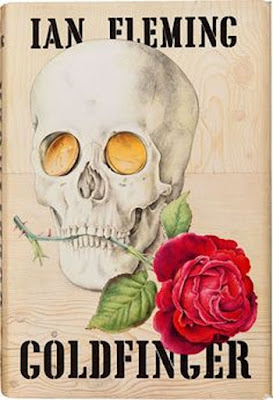
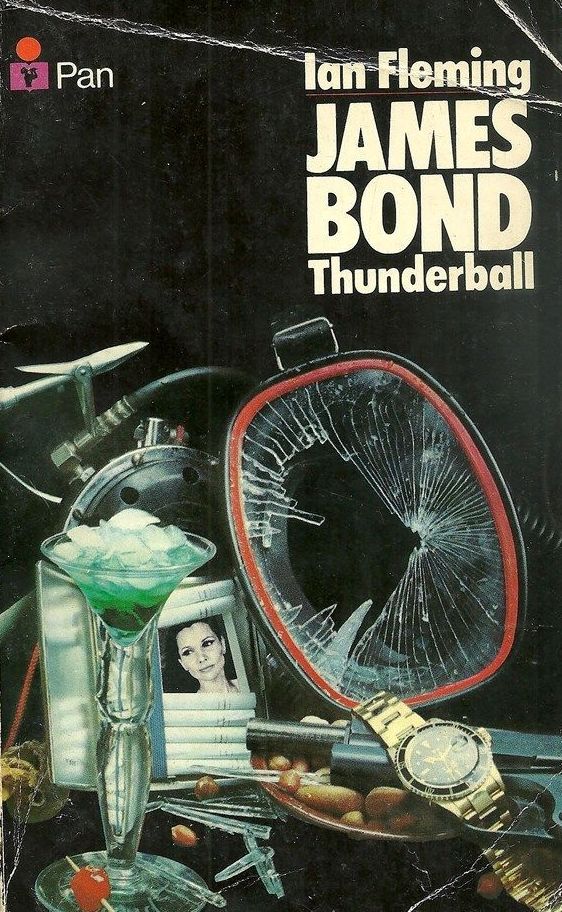
As today is International James Bond day, I’d
like to offer again my 2019 Crime Beat column on one of the best James
Bond films, Goldfinger.
You can read the column below:
A Look Back at the Classic James Bond Film Goldfinger
By Paul Davis
“Mr. Bond, they have a saying in Chicago: 'Once
is happenstance. Twice is coincidence. The third time it's enemy action',” said
Auric Goldfinger, a gold-worshiping, gold smuggling, megalomaniac millionaire
criminal who cheats at cards and golf, in Ian Fleming's 1959 novel Goldfinger.
I don’t know why the writers and producers of
the film Goldfinger, which was based on Ian Fleming’s seventh
James Bond novel, didn’t use this. But they should have.
The first two James Bond films, Dr. No and From
Russia With Love, were successful films, but the third Bond
film, Goldfinger, released in 1964, was the one that made
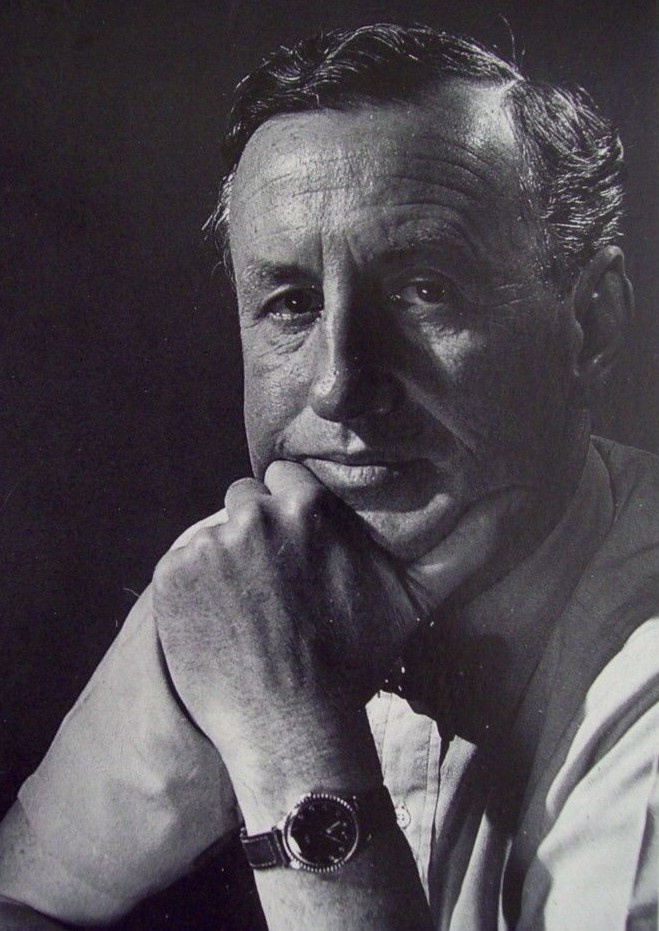
James Bond and Ian Fleming (seen in the bottom photo) household names and helped launch the spy mania of
the 1960s.
Directed by Guy Hamilton with a screenplay by
Richard Maibaum and Paul Dehen, and starring Sean Connery in his third outing
as Bond, the film is often rated as the best Bond film.
The film opens cleverly with Bond coming up from
the water in a diver's dry suit. He climbs over a wall, knocks out a guard
and plants explosives inside a converted oil tank that holds a heroin shipment.
Climbing back over the wall, Bond casually unzips his dry suit and underneath
he is wearing a neatly pressed white dinner jacket. He then places a red
carnation in the lapel.
Walking into a cantina, he glances at his watch
- with a closeup of the face of his Rolex Submariner - and nonchalantly lights
a cigarette as a huge explosion rocks the cantina. The crowd flees and a
beautiful dancer gives Bond a dirty look as she heads off to her dressing room.
Bond walks slowly to the bar and stands next to
a man. The man congratulates Bond and notes that a certain Mr. Ramerizes will
now be out of business.
“Well, at least they won’t be using heroin to
flavor bananas to finance revolution,” Bond says.
“Don’t go back to your hotel, Mr. Bond,” the man
advises. “There is a plane leaving for Miami in an hour.”
“I’ll be on it, Bond says. “But first I have
some unfinished business.”
That unfinished business is the beautiful
dancer.
Bond goes to her dressing room and wraps a towel
around her as she gets out of a tub of water.
He kisses her and she winches and complains
about the Walther PPK in his shoulder holster rubbing against her. He takes off
the shoulder holster and hangs it on a hook.
“Why do you wear that thing?” she asks.
“I have a slight inferior complex,” he responds
with some irony.
He kisses her again and sees in the reflection
of her eye a man coming up to him with a club. Bond twirls the girl around and
she takes the hit from the club. Bond and the man fight until Bond tosses him
into the girl’s bathtub. Bond sees the man reaching for his gun hanging on the
hook, so he tosses an electric fan into the tub, which electrocutes the man.
He puts on his shoulder holster and coat calmly,
and says, “Shocking.” He glances at the girl on the floor and walking out the
door, he says, “Positively shocking.”
I recall the audience in December of 1964
roaring with delight. Was there ever a cooler and tougher man in the
movies?
Goldfinger is a great movie.

I was already an Ian Fleming aficionado in 1964,
having seen the two previous Bonds films, and having read all of Ian Flemings
novels and short stories. Having read Goldfinger, I knew this
opening scene was expanded from the scene in Ian Fleming’s novel, with a bit of
humor added, and I too laughed loudly while the great John Barry Goldfinger theme
song played over the opening credits.
I read many years later in the British
newspaper The Telegraph that the dry suit to dinner jacket
scene was not as unrealistic and fantastic as viewers believed.
Paul Dehn, one the Goldfinger screenwriters,
was a former World War II intelligence officer like Ian Fleming, and he based
the opening sequence on a true espionage case in World War II.
Jeremy Duns, a British author researching his new book, discovered that a Dutch
spy used an almost identical technique to get into Nazi-occupied Netherlands.
Duns believes that Paul Dehn, a British scriptwriter and former senior
intelligence officer during the Second World War who was called in to polish
the screenplay, knew about the Dutch operation and wrote in the scene to give
the film a powerful, dramatic opening.
The late film critic Roger Ebert wrote, “Of all
the Bonds, Goldfinger is the best, and can stand as a
surrogate for the others. If it is not a great film, it is a great
entertainment and contains all the elements of the Bond formula that would
work again and again. It's also interesting as the link between the more modest
first two Bonds and the later big-budget extravaganzas; after this one,
producers Albert "Cubby" Broccoli and Harry Saltzman could be certain
that 007 was good for the long run.”
Ebert went on to write that “Goldfinger contains
more durable images than any other title in the series, such as the young woman
killed by being coated with gold paint; the steel-rimmed bowler of the mute
Korean assassin Oddjob (Harold Sakata), the Aston-Martin tricked out with
deadly gimmicks and an ejector seat; Bond's sexy karate match with Pussy Galore
(Honor Blackman), the villain Goldfinger (Gert Frobe) with his gold-plated
Rolls-Royce, and of course the laser beam pointed at that portion of Bond's
lower anatomy that he most required if he were to continue as hero of the
series.”
(For the record, it was a judo match, not
karate).

Goldfinger offers many other indelible images and unforgettable
characters.
Like the other classic Bond films from the
1960s, I’ve watched Goldfinger again and again over the
years.
In the film, holding Bond as his hostage,
Goldfinger briefed a collection of American organized crime leaders on his bold
plan to rob Fort Knox, the gold suppository of the United States.
Some gangsters scoffed at the idea of robbing
Fort Knox, and one mob guy, Mr., Solo, wanted to take his money and leave.
Oddjob later killed him.
Goldfinger explained to the gangsters that Fort
Knox was only a bank, better protected, but still only a bank.
“Man has climbed Mount Everest, gone to the
bottom of the ocean, fired rockets to the moon, split the atom, achieved
miracles in every field of human endeavor – except crime!”
Goldfinger then used Delta Nine, the aerial
spray he planned to use to kill the soldiers and others around Fort Knox on the
gangsters.
(So, why bother to brief them if you planned to
kill them all along?)
Bond, who spied on the “Hoods’ Congress”
briefing, corrected Goldfinger by saying that the nerve agent Delta 9 was fatal
and not a sleeping agent as Goldfinger told the gangsters.
“You’ll kill 60,000 people uselessly," Bond
said.
"Hah, American motorists kill that many
every two years," Goldfinger replied coldly.
In Ian Fleming’s novel Goldfinger the
criminal mastermind planned to poison the water at Fort Knox, noting that only
drunks and babies will go a full day with drinking some water. He planned to
use the gangsters to help him cart away the gold on a train disguised as a
medical rescue train. Pussy Galore in the novel was the head of a lesbian gang
of cat burglars. Her girls would dress as Red Cross nurses on the train.
In the film she was a pilot and her team of female pilots were to spray the
aerial poison around Fort Knox, while Goldfinger planned to activate s “dirty’
nuclear device to contaminate the Fort Knox gold, thus making his personal
collection gold much more valuable.

In Ian Fleming’s novel, Goldfinger explained
"Operation Grand Slam," his grand criminal enterprise, to his
prisoner, James Bond.
"Man has climbed Everest and he has scraped
the depths of the ocean. He has fired rockets into outer space and split the
atom. He has invented, devised, created in every realm of human endeavor, and
everywhere he has triumphed, broken records, achieved miracles. I said in every
realm, but there is one that has been neglected, Mr. Bond. That one is the
human activity loosely known as crime. The so-called criminal exploits
committed by individual humans - I do not of course refer to their idiotic wars,
their clumsy destruction of each other -are of miserable dimensions: little
bank robberies, tiny swindles, picayune forgeries. And yet, ready to hand, a
few hundred miles from here, opportunity for the greatest crime in history
stands waiting. The stage is set, the gigantic prize is offered. Only the
actors are missing. But the producer is at last here, Mr. Bond" -
Goldfinger raised a finger and tapped his chest - "and he has chosen his
cast. This very afternoon the script will be read to the leading actors. Then
rehearsals will begin and, in one week, the curtain will go up for the single,
the unique performance. And then will come applause, the applause for the
greatest extra-legal coup of all time. And, Mr. Bond, the world will rock with
that applause for centuries."
Bond asked Goldfinger if he planned to rob the
end of the rainbow.
"Yes," Goldfinger nodded. "That is exactly what we are going to
do. We are going to burgle fifteen billion dollars' worth of gold bullion,
approximately half the supply of mined gold in the world.
“We are going, Mr. Bond, to take Fort
Knox."
In my interview with Ben Macintyre, the author
of Operation Mincemeat and For Your Eyes Only: Ian
Fleming and James Bond, he told me that Fleming was fascinated by the
interplay between truth and fiction. Many of his ideas for his James Bond
thrillers were taken from the real world of crime and espionage.
As a journalist before and after World War II, and as a naval intelligence
officer during World War II, Fleming picked up facts, ideas, and stories that
he would later use in his series of thrillers.
"Everything I write has a precedent in truth," Fleming had said.
Macintyre noted that in World War II a Nazi agent planned to rob the Bank of
England, and perhaps this gave Fleming the idea of Goldfinger’s plans to rob
Fort Knox.
Goldfinger is a near perfect film thriller. Unfortunately, the Bond film
makers felt that every subsequent film had to top Goldfinger, and this led to a
series of over-the-top and often silly films, far removed from Ian Fleming’s
novels.
If you have not seen Goldfinger, I
recommend that you do so. If you’ve not seen Goldfinger in some time, I suggest
that you watch it again.
And one should also read, or reread, Ian
Fleming’s great thriller Goldfinger.