Showing posts with label China. Show all posts

Wednesday, February 2, 2022

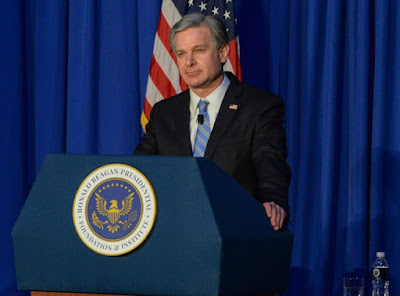
FBI Director Wray: China’s Quest For Economic, Political Domination Threatens America’s Security

 The FBI released the below:

The Chinese government’s disregard for global leadership norms, ruthless hunger for economic superiority, and desire to influence American politics make it a threat to U.S. national security, FBI Director Christopher Wray said on January 31.

“There is so much good we could do with a responsible Chinese government: crack down on cybercriminals, stop money launderers, reduce opioid overdose deaths. But at the FBI, we’re focused on the reality of the Chinese government today,” Wray said during a keynote address at the Ronald Reagan Presidential Library and Museum in Simi Valley, California.

The threat’s complexity is rooted in the intrinsic entanglement of the American and Chinese economies, which is fueled by a high U.S. demand for Chinese-made products and a steady exchange of students between American and Chinese borders. Wray stressed that China has pulled no punches about capitalizing on this interconnectedness to chase economic superiority.

“When we tally up what we see in our investigations—over 2,000 of which are focused on the Chinese government trying to steal our information or technology—there is just no country that presents a broader threat to our ideas, our innovation, and our economic security than China,” Wray said, adding that the Bureau opens a new counterintelligence case against China about twice a day.

China’s strategy is especially dangerous because it pursues economic espionage on multiple fronts—some so subtle that they don’t set off alarms. But once China sets its sights on a technology, Wray explained, it uses every available resource to try to steal it. He pointed to a foiled Chinese plot to use a combination of industrial espionage and hacking to steal trade secrets from GE Aviation to illustrate this approach.

This theft not only gives China an unfair advantage in the global marketplace but also directly harms American companies and workers.

Yet the Chinese government’s thirst for power can’t be quenched by economic dominance alone, Wray noted. China also ultimately seeks to undermine and infiltrate the U.S. government and silence dissent whenever possible.

The Chinese Communist Party (CCP) aims to win American leaders’ loyalty through money or intimidation and “to undermine our democratic process by influencing our elected officials.” Wray said. The CCP is patient in this pursuit, aiming to recruit early-career politicians—often at the state and local level—who can then be called on to do Beijing’s bidding when their power and influence grow.

The Chinese government is also increasingly using a program it calls Fox Hunt to target, threaten, intimidate, and ultimately repatriate former Chinese citizens living overseas whom it sees as a political or financial threat. Many of them are green card holders and naturalized citizens here in the United States.

Through Fox Hunt, the Chinese government has sought to intimidate and silence Chinese and Chinese American students who are studying at U.S. universities. If a student voices or posts an opinion critical of the Chinese government, their family members back in China may receive threats.

“China may be the first government to combine authoritarian ambitions with cutting-edge technical capability,” Wray said. “It’s like the surveillance nightmare of East Germany combined with the tech of Silicon Valley.”

Fortunately, as China’s thirst for power has grown, the FBI’s strategy and capabilities have evolved to deter it.

One such advance has been the FBI’s use of intelligence to identify and disrupt threats early, as it did in response to China’s recent compromise of Microsoft Exchange email servers.

The FBI also now shares information with domestic and international partners to help them defend against future plots and has boosted private-sector engagement.

Additionally, the Bureau has repurposed lessons learned from the counterterrorism arena to deter China. This included standing up Cyber Task Forces and Counterintelligence Task Forces in every FBI field office and forming a National Counterintelligence Task Force.

America’s democratic and legal processes also play a role, Wray explained, since our ability to make substantiated allegations can move allies to act, and indictments can inspire increased public scrutiny of bad actors.

“So, we’re confronting this threat and winning important battles, not just while adhering to our values, but by adhering to our values,” Wray said. “I believe that in the course of doing so, we’re showing why the Chinese government needs to change course—for all our sakes.”

Wray’s appearance marked the opening of the Reagan Library’s “FBI: From Al Capone to al Qaeda” exhibition. He is the first sitting Bureau director to visit the library.


Sunday, December 12, 2021

General Keane: Russia, China, Iran View Biden's America As 'Appeasement' Nation That Can Be Taken Advantage Of

General Jack Keane (retired), one of our best minds on military and foreign affairs, (I wish he were president) appeared on Fox News. 

Fox News senior strategic analyst Gen. Jack Keane argued on "The Faulkner Focus" Thursday that the collapse of Afghanistan was an "accelerant" for America's adversaries to try to take advantage of President Biden's "accommodation" administration as Russian President Vladimir Putin gathers forces on the Ukraine border.


GEN. JACK KEANE: I do believe that this administration is being challenged by Russia, Iran and also China. They're looking at it as an appeasement and accommodation administration that can be taken advantage of. And certainly after the collapse of Afghanistan, that has become an accelerant to our adversaries moving even more earnestly to take advantage of it. Witness what's happening here with 110,000 troops on the [Ukraine] border.


You can watch the full interview via the below link:


Keane: Russia, China, Iran view Biden's America as 'appeasement' nation that can be taken advantage of | Fox News 

Thursday, August 19, 2021

Bill Gertz: China Set To Join ‘Graveyard Of Empires’ In Afghanistan

Veteran national security reporter and author Bill Gertz (seen in the below photo) offers a piece in the Washington Times on China’s involvement in Afghanistan. 

China has reaped the benefits of costly American military and security efforts in Afghanistan but now faces a hostile Islamic regime near its western border, according to David Stilwell, former assistant secretary of state for East Asia and Pacific affairs, who adds that the Biden administration should not help Beijing deal with its problems there. 

Mr. Stilwell, a former military attache in China, said the large and growing presence of Chinese officials and businesses in Afghanistan will become more prominent once more than 10,000 Americans depart the country. Then al Qaeda and other groups will begin conducting terrorist attacks against the Chinese in Afghanistan. 

Beijing has been quietly developing economic relations with Afghanistan for the past decade or more under its Belt and Road Initiative infrastructure program. Beijing also has signaled its support for the new Taliban regime in Kabul. 

Mr. Stilwell, who worked in the State Department during the Trump administration, recalled an encounter in China with a People’s Liberation Army (PLA) officer who criticized him for what the officer said were “imperialist” U.S. policies that had turned Afghanistan into an American colony. 

Mr. Stilwell responded that he agreed it was long past time for the United States to depart the country. “I wished him and his PLA buddies luck in the graveyard of empires,” he told Inside the Ring. “Publicly, he pounded his chest and said that suited him fine. Afterward, he pulled me aside and said he hoped we wouldn’t leave anytime soon.” 

You can read the rest of the piece via the below link:

https://www.washingtontimes.com/news/2021/aug/18/china-set-join-graveyard-empires-afghanistan/ 


 You can also read my Counterterrorism magazine Q&A with Bill Gertz via the below link:

Paul Davis On Crime: Communist China's Drive For Global Supremacy: My Q&A With National Security Reporter Bill Gertz


Saturday, May 2, 2020

Leaked Western Intel Dossier Reveals How China Deceived The World About Coronavirus


FoxNews.com offers a piece on a leaked intelligence report that states China hid or destroyed evidence of the coronavirus.

 A research dossier compiled by the so-called "Five Eyes" intelligence alliance states that China intentionally hid or destroyed evidence of the coronavirus outbreak, leading to the loss of tens of thousands of lives around the world.

The 15-page document from the intelligence agencies of the U.S., Canada, the U.K., Australia and New Zealand, was obtained by Australia's Saturday Telegraph newspaper and states that China's secrecy amounted to an “assault on international transparency."

The dossier touches on themes that have been discussed in media reports about the outbreak of the virus, including an initial denial by China that the virus could be transmitted between humans, the silencing or "disappearing" of doctors who tried to speak up, the destruction of evidence in laboratories and refusal to provide live samples to international scientists working on a vaccine. 

You can read the rest of the piece via the below link:

https://www.foxnews.com/world/new-dossier-condemns-china-for-destroying-evidence-of-covid-19-outbreak 

Tuesday, July 30, 2019

Texas Man Convicted Of Conspiracy To Commit Theft Of Trade Secrets


The U. S. Justice Department released the below information:
A Texas man was convicted today by a federal jury in Washington D.C. of conspiracy to commit theft of trade secrets.
Following a nine-day trial, Shan Shi, 54, of Houston, Texas, was convicted of one count of conspiracy to commit theft of trade secrets.  Shi was originally indicted in June 2017 for conspiracy to commit theft of trade secrets, and a superseding indictment containing one count of conspiracy to commit economic espionage and one count of conspiracy to commit money laundering charges issued in April 2018.  Shi was acquitted on the other charges. 
“Shan Shi and his coconspirators went to great lengths to cash in on the Chinese government’s desire to obtain syntactic foam technology,” said Assistant Attorney General Brian A. Benczkowski of the Justice Department’s Criminal Division.  “As this case demonstrates, the Department of Justice is and will remain on the front lines of defending U.S. companies against the theft of their trade secrets.”
“The jury’s verdict makes clear that Shan Shi conspired to steal trade secrets by poaching employees from a U.S. company and enticing them to bring technical data to his company,” said Assistant Attorney General for National Security John C. Demers.  “He did this against the backdrop of China’s strategic plan to close the gap between China and United States in buoyancy technology and with the benefit of millions of dollars of funding from China.  Like our many other prosecutions implicating China’s economic aggression, this case exemplifies both the threat to American companies and our commitment to confront it.”  
“We take very seriously the theft of intellectual property that was developed in the United States through long years of research, development, and innovation,” said U.S. Attorney Jessie K. Liu for the District of Columbia.  “Shi chose to steal the secrets of a U.S. company rather than do the hard work necessary to succeed honestly in the free market.  He is now being held accountable for that choice.”
“Shan Shi attempted to obtain sophisticated U.S. technology with both military and civilian uses for the ultimate benefit of China,” said Assistant Director John Brown of the FBI’s Counterintelligence Division.  “It is no secret that China is determined to achieve superiority in virtually all high-tech areas, and the FBI is equally determined to stop individuals who commit illegal acts to help China achieve its goals.  The stakes are high both for U.S. national security and for American companies who invest so much money and time on research and development.”
“FBI Houston’s elite counterintelligence investigators worked for years to dismantle Mr. Shi’s prolific network and bring him to justice,” said Special Agent in Charge Perrye K. Turner of the FBI’s Houston Field Office.  “Our highly trained agents and intelligence analysts work every day to protect American businesses from unscrupulous foreign adversaries.  We are pleased by today’s verdict, and we will continue to aggressively protect America's economic security and intellectual property from those who would do us harm.”
Evidence introduced at trial established that Shi conspired with others to steal trade secrets from a Houston-based company, Trelleborg Offshore, relating to syntactic foam, a strong, lightweight material with commercial and military uses that is essential for deep-sea oil and gas drilling.  In public statements of its national priorities, China has made clear its desire to develop this technology.  Shi sought to obtain information about syntactic foam for the benefit of CBM-Future New Material Science and Technology Co. Ltd. (CBMF), a Chinese company based in Taizhou, and for the ultimate benefit of the People’s Republic of China.  Four of Shi’s codefendants—some of whom worked at Trelleborg—had pleaded guilty to conspiring to steal trade secrets, and two testified as cooperating witnesses at trial.  From 2014 to 2017, CBMF sent Shi’s company in Houston approximately $3.1 million from China in order to promote Shi’s activity in the United States. 
Sentencing has been set for Oct. 25, 2019. 
The FBI’s Houston Field Office conducted the investigation.  Senior Counsel Joss Nichols of the Criminal Division’s Computer Crime and Intellectual Property Section and Assistant U.S. Attorneys Jeffrey Pearlman and Luke Jones for the District of Columbia are prosecuting the case. 

Friday, June 7, 2019

Stolen Secrets Saved: FBI Thwarted Transfer Of Trade Secrets To China


The FBI released the below information:

Wenfeng Lu was seemingly living the American dream—a comfortable life in Irvine, California, with his family and a career in medical device research and development.
Yet Lu’s secret goal was to use trade secrets stolen from his employer to strike it rich in his native China. However, thanks to an FBI investigation, his plan was thwarted, and Lu is now serving a 27-month prison sentence.
Lu worked for several different U.S. companies, all of which developed high-tech medical equipment, such as clot retrieval tools and balloon-guide catheters. In each job, Lu signed a non-disclosure agreement for his research and development work.
Despite signing the confidentiality agreement, Lu routinely did “data dumps” from his various medical research employers for about three years until his arrest in 2012. Lu transferred all of the data he could get his hands on to a personal laptop. Many of the hundreds of documents Lu stole had nothing to do with his own research; he took as much information as he could access, including proprietary information.
“He had access to so many files, not just for his own projects, and he downloaded files for a variety of different projects and took them home and to China,” said Special Agent Gina Kwon, who investigated this case out of the FBI’s Los Angeles Field Office.
One of Lu’s former employers noticed the unusual activity on their systems and reported the results of their internal investigation to the FBI. Investigators quickly proceeded to build their case and arrested Lu, just before he boarded a plane to China with the files.
The investigative team learned that Lu had planned to create and run his own medical device manufacturing company in China using the stolen technology and Chinese government funding. He had even applied for Chinese patents using technology stolen from the American companies. (China’s government creates policies that disadvantage American businesses, and hacking against American companies and interests is a common tactic.)
“Lu wanted his own business, and he thought there was a great market in China for this technology,” Kwon said.
Kwon said the American company’s quick response to the unusual activity on their systems was key to the successful investigation. That’s why the FBI works closely with private sector companies to build relationships and promote information sharing. Kwon encouraged the victim companies in this case—and all companies who have trade secrets—to compartmentalize access to files so each employee only has access to what is needed for his or her job.
“These cases are important for the economic prosperity of our country,” Kwon said. “China and others are doing what they can to cut corners by stealing technology from American companies. It’s detrimental to U.S companies because they’ve spent years and money to develop the technology, and it undercuts their ability to sell it competitively.”
Note: Shown in the above photo are the laptop, thumb drives, cell phones, and other items confiscated from Wengfeng Lu during his 2012 arrest as he tried to board a plane to China with stolen trade secrets.

Monday, December 18, 2017

President Trump Announces New Whole-of-Government National Security Strategy


Jim Garamone at DoD News offers the below piece.

WASHINGTON, Dec. 18, 2017 — President Donald J. Trump today announced a new national security strategy rooted in a whole-of-government approach that stresses the economic might of the United States.

In a written statement, Defense Secretary James N. Mattis called the strategy "clear and comprehensive."

"As the world's most lethal armed force, the men and women of the United States military ensure our diplomats always speak from a position of strength," he said. "Supported by our allies and partners, we will continue to defend our common security interests as we protect America from those seeking to threaten the freedoms we enjoy."

Trump announced the new strategy during a speech at the Reagan Building near the White House. The national security strategy sets the stage for the national defense strategy and the national military strategy.

“With every decision and every action, we are now putting America first,” the president said. “We are rebuilding our nation, our confidence and our standing in the world.”

In addition to the military aspect of national security, the new strategy includes homeland defense, border security, trade policy and economic strength. Still, military power does play a part, and the president noted the $700 billion National Defense Authorization Act he signed last week.

“We are demanding extraordinary strength, which will hopefully lead to long and extraordinary peace,” he said. “We are giving our courageous military men and women the support they need and so dearly deserve.”

ISIS and Other Threats

Trump also spoke about specific threats such as Iran, North Korea, Russia and China, and he touted efforts against the Islamic State of Iraq and Syria.

“Following my trip to the Middle East, the Gulf States and other Muslim-majority nations joined together to fight radical Islamist ideology and terrorist financing,” he said. “We have dealt ISIS one devastating defeat after another. The coalition to defeat ISIS has now recaptured almost 100 percent of the land once held by these terrorists in Iraq and in Syria. Great job.”

To keep this momentum moving, the United States must integrate every dimension of national strength, “and we must compete with every instrument of our national power,” the president said. “With the strategy I'm announcing today, we are declaring that America is in the game, and America is going win.”

Vital Interests

The strategy advances four vital national interests. The first is to protect the American people, the homeland and the American way of life. “We cannot secure a nation if we do not secure our borders,” Trump said. “So for the first time ever, an American strategy now includes a serious plan to defend our homeland.”

In addition, the strategy also calls on America to confront, discredit and defeat radical Islamic terrorism and ideology, and to prevent it from spreading into the United States. “We will develop new ways to counter those who use new domains, such as cyber and social media, to attack our nation or threaten our society,” he said.

The second pillar is economic. “For the first time, American strategy recognizes that economic security is national security,” the president said. “Economic vitality, growth and prosperity at home is absolutely necessary for American power and influence abroad. Any nation that trades away its prosperity for security will end up losing both.”

Preserving Peace Through Strength

Preserving peace through strength is the third pillar of the new strategy. “We recognize that weakness is the surest path to conflict, and unrivaled power is the most certain means of defense,” Trump said. “For this reason, our strategy breaks from the damaging defense sequester. We're going to get rid of that.”

Trump said the strategy calls for a total military modernization, and reversing previous decisions to shrink the force. “It calls for streamlining acquisition, eliminating bloated bureaucracy, and massively building up our military, which has the fundamental side benefit of creating millions and millions of jobs,” he added.

New military domains of space and cyberspace have key roles in the strategy, the president said. “This strategy outlines important steps to address new forms of conflict, such as economic and political aggression, and our strategy emphasizes strengthening alliances to cope with these threats,” he said. “It recognizes that our strength is magnified by allies who share principles and our principles, and shoulder their fair share of responsibility for our common security.”

Advancing American Influence

Finally, the strategy seeks to advance American influence, which begins with building wealth and power at home. “America will lead again,” Trump said. “We do not seek to impose our way of life on anyone, but we will champion the values without apology.”

The United States values strong alliances and partnerships, based on cooperation and reciprocity, the president said. “We will make new partnerships with those who share our goals and make common interests into a common cause,” he added.

“We will pursue the vision we have carried around the world over this past year, a vision of strong, sovereign and independent nations that respect their citizens and respect their neighbors, nations that thrive in commerce and cooperation, rooted in their histories and branching out toward their destinies.”

Wednesday, May 24, 2017

Defense Intelligence Agency Director Testifies On Top Five Global Military Threats


Cheryl Pellerin at the DoD News offers the below report:

WASHINGTON, May 23, 2017 — North Korea, Russia, China, Iran and extremist organizations are the top five military threats facing the nation, the director of the Defense Intelligence Agency said here this morning.

Marine Corps Lt. Gen. Vincent R. Stewart (seen in the below photo) testified before the Senate Armed Services Committee to discuss worldwide threats. Also testifying today was Daniel R. Coats, director of National Intelligence.

Expanding on the nature of the threats, Stewart said they include a nuclear-capable and increasingly provocative North Korea, a resurgent Russia, a modernizing China, an ambitious regional power in Iran and violent extremist organizations.

The last category encompasses ongoing operations in Afghanistan, Iraq, Syria and elsewhere, the general noted.

“We in DIA call these our no-fail missions because the risk is too high for us to fail in pursuing these missions,” Stewart added.


North Korea’s Trajectory

The world is focused on events in Pyongyang and for good reasons, Stewart told the panel.

“Since assuming power, Kim Jong Un has conducted three nuclear tests and the regime has tested an unprecedented number of ballistic missiles of varying ranges over the past year,” he said.

Despite technical shortfalls, the regime has achieved key milestones in specific systems and engineers get valuable data and insights from each test, Stewart observed.

“If left on its current trajectory, the regime will ultimately succeed in fielding a nuclear-armed missile capable of threatening the United States homeland,” the general said, adding that it’s impossible to say when the capability will be operational but the regime is committed and on a sure path to the capability.

Russia’s Key Objective

Stewart said Russia sees military power as critical to achieving key strategic objective and the nation devotes significant resources to its military modernization program.

“The Russian government seeks to be the center of influence in what it describes as a multi-polar, post-West world order,” he explained.

To support this worldview, he said, Moscow pursues aggressive foreign and defense policies by using a full spectrum of influence and coercion aimed at challenging U.S. interests around the globe.

Out-of-area operations remain a priority as demonstrated by its ongoing deployment to Syria and long-range aviation approaching U.S. airspace.

China’s Military Modernization

China is in the third decade of an unprecedented military modernization program involving weapon systems, doctrine, tactics and training, and space and cyber operations, Stewart said.

The nation now stands firmly as a near-peer U.S. competitor, the general added.

New bases are being built in the South China Sea and Stewart said that evidence suggests the outposts will be used for military purposes.

“A key component of China's strategy for a regional contingency is planning for potential U.S. intervention in a conflict in the region,” he added. “Its navy remains on a course for 350 ships by the year 2020 and anti-access, area-denial capabilities continue to improve.”

Iran’s Regional Security Threat

In Iran, despite sanctions Tehran is putting considerable resources into conventional military priorities such as ballistic and cruise missiles, naval systems, unmanned aerial vehicles and air defense systems that could threaten the U.S. and its interests in the region, Stewart said.

“Iran's conventional military doctrine is designed to protect Iran from the consequences of its assertive regional policy,” he added, noting that policy is spearheaded by the Iranian Revolutionary Guard's Kuds Force and its regional proxy Lebanese Hezbollah, and in concert with certain Iraqi Shia militias and the Houthis, a Shia-led movement.

“We should expect Iran to continue to undermine the current regional security architecture,” the general said, “using terrorist organizations and proxies to complicate U.S. efforts throughout the region.”

Transregional Terrorism

Steady progress is being made against transregional terrorism but there is still a long way to go, Stewart said.

The Islamic State in Iraq and Syria has been diminished in Libya, he added. Soon it will lose control of Mosul and of its capital in Raqqa, which is now nearly isolated by counter-ISIS local fighters.

“We've killed many ISIS and al-Qaida leaders, and numerous terrorist plots have been averted,” Stewart said.

Trend lines are moving in the right direction but the fight will not end soon, he noted, adding that the enemy is highly adaptable and capable, and instability and under-governed territory may give them opportunities to resurge.

“I'm particularly concerned about the long-term impact of returning foreign fighters and the potential for these groups to capitalize on the proliferation of armed unmanned aerial vehicles to do harm to U.S. and our allied interests,” the general said.

Note: In the top Air Force photo taken by Senior Airman Jordan Castelan airmen secure a load of cargo in a C-130H Hercules at Qayyarah Airfield West, Iraq on Feb. 3, 2017. Airmen assigned to the 737th Expeditionary Airlift Squadron delivered 30,000 pounds of cargo to aid in the fight against Islamic State of Iraq and the Levant. 

Saturday, May 9, 2015

Former PPG Employee Charged with Theft of Trade Secrets


The U.S. Justice Department released the below information:

A former PPG Industries, Inc. employee has been arrested and charged in federal court in Pittsburgh with theft of trade secrets, U.S. Attorney David J. Hickton for the Western District of Pennsylvania announced today.

The criminal complaint names Thomas Rukavina, 62, of Plum Borough, Pennsylvania.

“Theft, whether hands-on or through cyber intrusions, diminishes our competitive edge in technology and product development and deprives our citizens of economic opportunities,” stated U.S. Attorney Hickton.  “We will aggressively pursue intellectual property theft regardless of who commits the crime.”

The criminal complaint alleges that Rukavina retired from PPG in July of 2012.  As early as June 2014, Rukavina passed proprietary and confidential information to J.T.M.G. Co., a glass company based in Jiangsu, China, that specializes in automotive and other specialty glass.  The trade secret information he passed included PPG’s manufacturing specifications for windows, which are made of synthetic plastics and used for high-speed transportation, including airplanes.

The defendant was arrested yesterday and made an initial appearance today before federal magistrate Judge Cynthia Reed Eddy.   He was ordered detained pending a formal detention hearing scheduled for Monday, May 11, 2015.

The law provides for a maximum total sentence of up to ten years in prison, a fine of $250,000, or both. Under the federal sentencing guidelines, the actual sentence imposed would be based upon the seriousness of the offense and the prior criminal history, if any, of the defendant.      

A criminal complaint is only a charge and is not evidence of guilt.  A defendant may not be prosecuted unless, within 30 days, a grand jury has found probable cause to believe that he is guilty of an offense.

Assistant U.S. Attorney James T. Kitchen is prosecuting this case. The Federal Bureau of Investigation conducted the investigation that led to the complaint charging Rukavina.

Friday, February 27, 2015

U.S. Intelligence Chief Describes 'Pervasive Uncertainty' Of Worldwide Threats


Jim Garamone at the DoD News offers the below piece:

WASHINGTON, Feb. 27, 2015 - "Unpredictable instability" is the new normal, the director of National Intelligence told the Senate Armed Services Committee here yesterday.

James R. Clapper (seen above in his official photo) testified on worldwide threats facing the United States and gave his best advice on what he considers to be the dangers Americans need to be aware of.

He said 2014 had the highest rate of political instability since 1992, when the Soviet Union collapsed. Last year also saw the most deaths as a result of state-sponsored mass killing and the highest number of refugees and internally displaced persons since World War II.

"This pervasive uncertainty makes it all the harder to predict the future," he said.

The North Korean cyberattack on Sony, the Ebola epidemic, and dramatic terrorist attacks in Australia, Belgium, Canada, Denmark, France and the United States mean 2015 promises to be as unstable as 2014, Clapper said.

Cyber, Terror Concerns

Cyberattacks are increasing in frequency, scale, sophistication and severity of impact, he said. The U.S. government must be prepared for a massive cyberattack, he added, but the truth is the nation is already living with a constant and expanding barrage of cyberattacks.

Nations, criminal networks, terror groups and even individuals can launch these attacks, Clapper said. He highlighted the actions of North Korea, Iran, Russia and China in the cyber realm.

The terrorist threat grew last year, also, the director said.

"In 2013, just over 11,500 terrorist attacks worldwide killed approximately 22,000 people," he said. "Preliminary data for the first nine months of 2014 reflects nearly 13,000 attacks, which killed 31,000 people."

About half of all attacks, as well as fatalities occurred in just three countries: Iraq, Pakistan and Afghanistan, Clapper said. The Islamic State of Iraq and the Levant conducted more terror attacks than any other entity in the first nine months of 2014.

A new terror threat comes from "radicalized" individuals who travel to fight with ISIL in Syria or Iraq and then return to their home countries and launch attacks there, Clapper said. He estimates more than 20,000 Sunni foreign fighters have traveled to Syria from more than 90 countries to fight the Assad regime. Of that number, at least 13,600 have extremist ties, he said.

"About 180 Americans or so have been involved in various stages of travel to Syria," Clapper said.

Rise of ISIL

ISIL is increasing its influence outside of Iraq and Syria, seeking to expand its self-declared caliphate into the Arabian Peninsula, North Africa and South Asia and planning terrorist attacks against Western and Shia interests, Clapper said.

"ISIL's rise represents the greatest shift in the Sunni violent extremist landscape since al-Qaida affiliates first began forming, and it is the first to assume at least some characteristics of a nation state," the director said.

Iran is exerting its influence in Syria, Iraq and Yemen, he said. Iranian leaders have provided robust military support to Syrian leader Bashir al-Assad and to the Iraqi government. This includes arms, advisers, funding, intelligence collection, electronic warfare and cyber support and combat support, Clapper explained.

"More broadly, Iran will face many of the same decision points in 2015 as it did in 2014," Clapper said. "Foremost is whether the supreme leader will agree to a nuclear deal. He wants sanctions relief but, at the same time, to preserve his options on nuclear capabilities."

Yemen's political future and stability are, at best, uncertain. Iran has provided support to the Houthis -- a group that now controls the government -- for years," Clapper said. "Their ascendancy is increasing Iran's influence."

Russia's Intentions in Eastern Europe

Clapper discussed problematic relations with Russia, as the country seems intent on a revanchist strategy with Ukraine squarely in the cross hairs.

"Moscow sees itself in direct confrontation with the West over Ukraine and will be very prone to overreact to U.S. actions," he said. "[Russian President Vladimir] Putin's goals are to keep Ukraine out of NATO and to ensure separatist control of an autonomous entity within Ukraine. He wants Moscow to retain leverage over Kiev, and Crimea, in his view, is simply not negotiable."

China Modernizes its Military

China is an emerging power and China's leaders are primarily concerned with domestic issues, the Communist Party's hold on power, internal stability and economic growth, Clapper said.

"Although China is looking for stable ties with the United States," he said, "it is more willing to accept bilateral and regional tensions in pursuit of its interest, especially on maritime-sovereignty issues."

The Chinese government continues a robust military modernization program directly aimed at what they consider to be U.S. strengths, Clapper said.

"Their military training program last year included exercises unprecedented in scope, scale and complexity to both test modernization progress and to improve their theater warfare capabilities," he said.

Friday, February 20, 2015

General Dempsey: Russia, China, Iran, North Korea, Terrorists, Cyber Among Top Threats


Lisa Ferdinando at DoD News offers a piece on General Dempsey speaking about national security threats.

COLLEGE STATION, Texas, Feb. 19, 2015 - The global security environment contains a host of threats, including Russian aggression that threatens NATO allies, and the violent extremists network from western Pakistan to north Africa, said the chairman of the Joint Chiefs of Staff.

Army Gen. Martin E. Dempsey spoke today at a student conference on national affairs at Texas A&M University, rounding out a two-day visit to the campus.

He outlined his "two, two, two and one" view on national security, which is comprised of two heavyweights, two middleweights, two networks and one domain.

Russia is included as a heavyweight, along with China.

Russia 'Lit a Fire'

Russia "lit a fire of ethnicity and nationalism that actually threatens to burn out of control," he said. "And in so doing, they are threatening our NATO allies."

Dempsey said it is hard to imagine that in 2015 there would be that kind of conflict and "those kind of instincts" that are coming to the front again in Europe.

The human suffering in Ukraine is "atrocious," he said.

"It's almost unimaginable," the chairman told the audience, which included members of the Texas A&M University Corps of Cadets, other university students and members of the military.

The United States is working with its NATO allies, he said, to reassure the alliance and also try to assist Eastern Europe, including non-NATO countries, in "suppressing this effort to rekindle fires that haven't burned in Europe" in 70 years.

China Reemerging

On the other heavyweight, China, he said that nation is reemerging on the global scene. It is a very strong economic country that is becoming militarily strong, the chairman said.

The United States will continue to work with China in managing any differences, he said.

"We'll be competitors but it doesn't mean, I think, we'll have to be enemies," he said. "We're working hard to do that."

Middleweight Powers: Iran, North Korea

The two middleweights are Iran and North Korea.

The United States is working with its partners to try to convince Iran to seek a diplomatic resolution to the Iranian nuclear issue, he said. Western nations contend that Iran is seeking nuclear weapons, while Tehran says its nuclear ambitions are for peaceful purposes.

"We are working hard to reach a negotiated settlement on their nuclear program, but we shouldn't forget there are other issues which cause us concern about Iran," the chairman said, noting those concerns include Iran being a state sponsor of terrorism.

Networks and Cyber Domain

The two networks Dempsey talked about in his speech are the violent extremist network from western Pakistan to northern Africa, and the transnational criminal network that runs north and south in the Western Hemisphere. The domain is cyber.

The transregional network of al-Qaida, Islamic State of Iraq and the Levant, and other terrorists are competing for a radical, anti-Western ideology that is fomenting the internal challenges of Islam's Sunni and Shia, he said.

"That network is transregional," he said. "It will take a generation or more to be defeated and it will take persistence on our part and working closely and most often through partners and hardening our allies in order to deal with it."

To combat both the extremist and transnational criminal networks, they need to be "pressed" across their entire length, not just "pinched" in a spot, the chairman said.

"You have to interdict the financing; you have to interdict the flow of foreign fighters or criminals. It takes a really broad effort with partners to deal with that," he said.

Finally, on the domain of cyber, he said, "we've got a lot of work to do. We've made some strides, some pretty significant strides, militarily in particular in terms of defending ourselves."

But the general said despite the security in military networks, 90 percent of his administration and logistics functions ride on commercial Internet providers.

"So if they're vulnerable, I'm vulnerable and I don't like being vulnerable," he said.

Action in securing this domain, he said, includes legislation that establishes a common set of standards on Internet security, and allows information sharing between the government and the private sector.

From College Station, Dempsey travels on to Kwajalein Atoll and Australia.  

Thursday, November 27, 2014

Russia, China, Iran, Islamists Waging Unconventional Warfare, Says U.S. Army Special Operations Command Report


Veteran national security reporter Bill Gertz at the Washington Free Beacon offers a piece on a U.S. Army Special Operations Command report on our adversaries waging political warfare.

Russia, China, Iran, and Islamists are waging unconventional warfare around the world, and the United States currently lacks a clear strategy to counter the threat, according to a recent report by the Army Special Operations Command.

“This challenge is hybrid warfare combining conventional, irregular, and asymmetric means, to include the persistent manipulation of political and ideological conflict,” states the Army white paper, “Countering Unconventional Warfare.”

“Foreshadowed by Iranian actions throughout the Middle East, and by Chinese ‘unrestricted warfare’ strategists in the 1990s, hybrid warfare has now reached its most brazen form in Russia’s support for separatist insurgents in Ukraine.”

The 48-page white paper, published Sept. 26 by the Fort Bragg, North Carolina command, urges building new, non-kinetic warfare tools into a comprehensive U.S. and allied strategy.

You can read the rest of the piece, and link to the white paper, via the below link:

http://freebeacon.com/national-security/russia-china-iran-waging-unconventional-warfare-report-says/

Wednesday, February 12, 2014

U.S. Intelligence Leaders Detail Global Threats To Senate Panel


Cheryl Pellerin at the American Forces Press Service offers the below piece:

WASHINGTON, Feb. 11, 2014 - Global threats most critical to U.S. national security include Syria's civil war and its spillover, terrorism, weapons of mass destruction and deep cuts to America's defense budget, two top intelligence leaders told a Senate panel here this morning.

Director of National Intelligence James Clapper Jr. and Defense Intelligence Agency Director Army Lt. Gen. Michael Flynn (seen in the above DIA photo) testified before the Senate Armed Services Committee about the contents of the Worldwide Threat Assessment of the U.S. Intelligence Community, released Jan. 29 and based on information available as of Jan. 15.

"Looking back over my more than half a century in intelligence," Clapper said, "I've not experienced a time when we've been beset by more crises and threats around the globe."

Clapper's list of threats included "the scourge and diversification of terrorism, loosely connected and globally dispersed, ... as exemplified by the Boston Marathon bombing and by the sectarian war in Syria [and] its attraction as a growing center of radical extremism and the potential threat this poses to the homeland."

Despite different missions and audiences, Clapper and Flynn described similar priorities, among them widespread dangers inherent in Syria's sectarian war, harm to the intelligence community and the nation of Edward Snowden's unauthorized release last year of classified National Security Agency documents, and the effect on the intelligence community and military services of deep budget cuts.

In Syria, Clapper said, the insurgency's strength is an estimated 75,000 to 115,000, organized into more than 1,500 groups of widely varied political leanings.

"Three of the most effective are the Al-Nusrah Front, Ahrar al-Sham and the Islamic State of Iraq in the Levant, or ISIL as it's known, whose numbers total more than 20,000," the director of national intelligence added.

At least 7,500 foreign fighters from 50 countries have gravitated to Syria, he said, among them a small group of Afghanistan-Pakistan al-Qaida veterans "who have aspirations for external attack in Europe if not the homeland itself," Clapper said.

Other related threats include the spillover of the Syrian conflict into neighboring Lebanon and Iraq, he added, and the destabilizing flood of nearly 2.5 million refugees into Jordan, Turkey and Lebanon.

For DIA, the situation in Syria ties into one of three global threats that are of special concern to the agency, Flynn said:

-- The threat of weapons of mass destruction falling into the hands of nonstate actors and proliferation of the weapons to other state actors;

-- The emergence of foreign militaries with capabilities approaching those of the United States and its allies; and

-- Increasing tensions in the Pacific.

"The current instability in Syria presents a perfect opportunity for al-Qaida and associated groups to acquire these weapons or their components," he added.

While the Bashar al-Assad regime controls Syria's stockpiles of chemical weapon materials, moving the materials for disposal or other reasons drastically increases the risk of such components falling into the wrong hands, Flynn explained.

"There is also the very real possibility that extremists in the Syrian opposition could overrun and exploit chemical and biological weapons storage facilities before all the materials are removed," the general said.

Outside Syria, Flynn added, proliferation of weapons of mass destruction and associated technologies is an ongoing challenge.

On DIA's other priorities, Flynn said the armed forces of China and Russia are fielding new weapon systems that challenge the United States' conventional military superiority, and both are restructuring their militaries and improving command and control to better operate in an information-dominated combat environment.

These efforts are a marked departure for both countries, the general added, "and although it will take time for each to integrate these new capabilities and force structures into their militaries, we cannot afford to ignore these developments."

On the issue of increasing tensions in the Pacific region, Flynn called Kim Jong Un's regime in North Korea highly unpredictable and possibly the region's most destabilizing force.

"The disputed areas in the East and South China Seas also remain important flash points [and] the announcement in November that the Chinese are establishing an air identification zone over portions of the East China Sea raised regional tensions, particularly with Japan," Flynn said.

Such tensions, he added, "raise the prospect for further incidents that could lead to an escalation involving military force."

On the topic of last year's theft and release of National Security Agency intelligence documents by former contractor Edward Snowden, Clapper called the crime potentially the most damaging in U.S. history.

Clapper, as the nation's senior intelligence officer, noted the profound damage the disclosures have caused and continue to cause.

"The nation is less safe and its people less secure. What Snowden has stolen and exposed has gone way beyond his professed concerns with so-called domestic surveillance programs," Clapper said, noting that the nation has lost critical intelligence sources.

Clapper said terrorists and other adversaries are going to school on U.S. intelligence sources, methods and tradecraft.

"The insights they're gaining are making our job in the intelligence community much harder, and this includes putting the lives of members or assets of the intelligence community at risk as well as those of our armed forces, diplomats and citizens."

"We're beginning to see changes in the communications behavior of adversaries, particularly terrorists," he said.

Clapper and Flynn called on Snowden and his accomplices to return the rest of the stolen documents to prevent even more damage to U.S. security.

"In my professional military judgment, Mr. Snowden's disclosures have done grave damage to the Department of Defense and go far beyond the act of a so-called whistleblower," Flynn said.

"I have no doubt that he has placed the men and women of our armed services at risk," the general added, "and that his disclosures will cost lives on our future battlefields."

Clapper told the Senate panel that substantial U.S. budget reductions will amplify the impact of losses caused by Snowden's disclosures. "The intelligence community is going to have less capacity to protect our nation and its allies than we've had in the past," he said, adding, "We're thus faced collectively ... with the inescapable imperative to accept more risk."

Clapper called it "a plain hard fact and a circumstance that the community must and will manage, together with [Congress] and those whom we support in the executive branch."

Flynn said that though there is increasing pressure to reduce defense spending, "I would note that the demands on the United States intelligence system have skyrocketed in recent years, and these demands are only expected to increase in the years to come."

Such reductions must occur, he added, "and we will have to accept greater risk ... [but] defense intelligence must continue to be able to provide timely and actionable intelligence across the entire threat spectrum.

The general said that together, his agency and Congress must "address the very delicate balance between critical defense needs and our nation's long-term fiscal health."

Thursday, June 27, 2013

U.S. Loses Secrets, Prestige As Russia, China Protect NSA Leaker


Dave Boyer at the Washington Times reports on the Obama administration's problems with Russia and China over the NSA leaker.

It doesn’t look good when the most powerful man in the world can’t get his hands on one of the most wanted men in the world.

Edward Snowden, the confessed National Security Agency leaker, has eluded U.S. authorities since early June, even as President Obama administration pleaded with officials in China and Russia to send the fugitive back to America.

The traditional rivals of the U.S. have even seemed to enjoy the Obama administration's distress. Russian President Vladimir Putin declared Mr. Snowden “a free man” Tuesday, confirming that Mr. Snowden had been at Moscow's Sheremetyevo International Airport since Sunday. He explicitly refused to comply with the U.S. request to turn over Mr. Snowden, noting that the two countries don’t have an extradition treaty.

The episode is making the U.S. look weak in the eyes of Russia and China, said Leon Aron, a foreign policy analyst at the conservative-leaning American Enterprise Institute.

“From the point of view of the Russians and the Chinese, definitely,” Mr. Aron said. “In their systems, legitimacy comes from being treated with fear and respect. And clearly, they’re choosing not to treat the United States that way.”

You can read the rest of the story via the below link:

http://www.washingtontimes.com/news/2013/jun/25/china-russia-defy-obama-handing-over-snowden/