Showing posts with label Olivia Rutigliano. Show all posts

Sunday, December 5, 2021

A Look Back At Mel Brooks and Buck Henry's Groundbreaking Spy Comedy TV Series, 'Get Smart'

When I was a teenager back in the 1960s, I was a huge fan of the James Bond films, TV’s Secret Agent and other spy thrillers.  

I also loved Get Smart, the Mel Brooks and Buck Henry TV spy comedy series. 

Olivia Rutigliano at Crimereads.com offers a look back at the funny and clever series.       

In the first few moments of the black-and-white pilot episode of Get Smart, the camera hangs over an audience in a concert hall—Symphony Hall, the narrator tells us, in Washington D.C. Somewhere in the city is the headquarters for a secret counter-espionage organization known as “CONTROL.” And as the camera moves around the audience, capturing the group in evening dress watching in rapt silence as the orchestra plays, the narrator informs us, that somewhere in the audience “is one of CONTROL’s top employees, a man who lives a life of danger and intrigue, a man who has been carefully trained never to disclose the fact that he is a secret agent.” 

At that very moment, in the middle of the concert hall, a phone rings. It’s a loud, jangly telephone ring, the kind from a mid-century rotary phone, and it echoes throughout the venue. 

Watching this scene in the twenty-first century, it might not seem so jarring; how often have we sat inside crowded theaters and had our viewing experiences disturbed by the loud ringing of a phone? But this episode is from 1965, and so when the phone goes off in the middle of the theater, the patrons look around incredulously. A man stands up and hastily exists the theater and when he does, the ringing travels with him, out into the hall. 

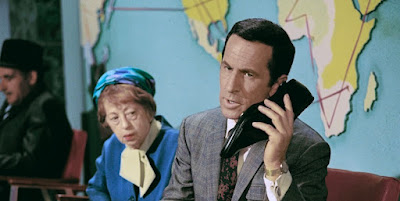
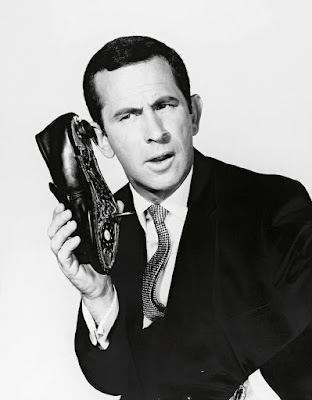
Ducking into a supply closet, he takes off his right shoe and removes the bottom, revealing a tiny, compact phone receiver with built-in rotary dial along the sole. “This is Smart,” he says into the shoe (which it is, but then he elaborates): “Maxwell Smart… Agent 86.” He learns from his boss that the evil organization KAOS is up to a nefarious plan, and so promises to get right down to headquarters. 

Of course, this will take a moment, because in the course of answering his shoe-phone, he has unwittingly locked himself in the closet. 

You can read the rest of the piece via the below link:

Get Wise to Get Smart ‹ CrimeReads
You can also watch a Get Smart clip about “the Cone of silence” from the first episode via the below link:

Get Smart - Cone of Silence (from episode 1) - YouTube

Tuesday, January 19, 2021

When Edgar Allan Poe Invented The Detective Story, He Changed The Literary World Forever

Today, on Edgar Allan Poe's birthday, Olivia Rutigliano offers a piece on Poe and the first detective story at CrimeReads.com. 

Even though literature had, for centuries, brimmed with clever problem-solvers, from tricksters to reformed thieves to wise men to police prefects, Edgar Allan Poe’s detective story, “The Murders in the Rue Morgue,” still awed the literary world when it appeared in 1841. 

A gruesome double-murder has taken place in a home along the Rue Morgue (a fictional street in Paris). Several witnesses heard several voices, but no one can agree on what language one of the speakers may have been using. Several clues linger about, each more baffling than the next. The police are stumped. But C. Auguste Dupin, a chevalier and rare book aficionado, solves the mystery at home after reading the details in the paper, becoming literature’s first bona fide detective character and starting a genre revolution. He would appear again in two more stories, “The Mystery of Marie RogĂȘt,” published from 1842-1943, and “The Purloined Letter” in 1844. 

As literary critic A. E. Murch writes, the detective story is one where its “primary interest lies in the methodical discovery, by rational means, of the exact circumstances of a mysterious event or series of events.” Critic Peter Thoms elaborates on this, defining the detective story as “chronicling a search for explanation and solution, such fiction typically unfolds as a kind of puzzle or game, a place of play and pleasure for both detective and reader.” 

The well-heeled Dupin in an armchair detective, who solves puzzles because he can, using a process called “ratiocination,” in which Dupin basically thinks outside of the box. (And it’s a good thing he does, or no one will solve these crimes; the murderer in “The Murders in the Rue Morgue” turns out to be an orangutan. It might be safe to say no one else would conclude that.) He narrates his discoveries to his good, book-collector friend (who is an anonymous and often awed first-person narrator). 

You can read the rest of the piece via the below link:

 When Poe Invented the Detective Story, he Changed the Literary World Forever ‹ CrimeReads 


Thursday, April 2, 2020

Raymond Chandler Wanted Cary Grant to Play Philip Marlowe


Olivia Rutigliano offers a piece at CrimeReads.com on the late, great crime novelist Raymond Chandler wanting actor Cary Grant to portray his iconic private eye character Philip Marlowe.
Humphrey Bogart will go down in history as the actor most associated with the detective character Phillip Marlowe, but he wasn’t the first actor to play him, and he wasn’t author Raymond Chandler’s first preference.
In 1944, the washed-up musical star Dick Powell played the sleuth in the first film adaptation of a Chandler novel Farewell, My Lovely (retitled to Murder, My Sweet, lest it seem like another musical). The movie relaunched Powell’s career, and Chandler was not disappointed with the casting decision. Powell bought an air of refinement that Chandler had initially envisioned for his P.I. But actually, he said later, the actor he most wanted to play his detective was Cary Grant.

What a movie that would have been. But anyway.
“I like people with manners, grace, some social intuition, an education slightly above the Reader’s Digest fan,” he mentioned in a letter to his colleague, the writer George Harmon Coxe. When writing to movie producer John Houseman, he stressed that Marlowe was an “honorable man” above all, and this quality needed to shine through.

You can read the rest of the piece via the below link: 


Note: Think of Cary Grant portraying Marlowe as he portrayed a tough guy gambler in Mr. Lucky (seen in the top and above photos), as I noted in my Crime Beat column on Raymond Chandler.

You can read my Crime Beat column on Raymond Chandler via the below link: