Showing posts with label crime novel. Show all posts

Sunday, June 8, 2025

My Crime Fiction: 'Butterfly'

The story below is Butterfly, chapter one of Olongapo, a crime novel I hope to soon publish. 

Butterfly originally appeared in American Crime Magazine. 

Butterfly 

By Paul Davis 

I lived in what we considered a tough neighborhood in South Philadelphia when I was a teenager in the 1960s. I ran with a tough crowd on the mean streets of South Philly, but I would later discover that Olongapo in the early 1970s was a truly tough town. 

I recall an old Navy chief telling me and other young sailors on the USS Kitty Hawk about the notorious port city as the aircraft carrier sailed towards the Philippines in November of 1970. The chief, who had been around the world while serving many years in the U.S. Navy, told us that Olongapo was the wildest place he had ever seen.

 “Once you walk across the bridge over Shit River into Olongapo, you’ll be corrupted quickly by sexy bar girls, cheap booze, available drugs, and all sorts of crime,” the old chief said with a mischievous grin.

During the Vietnam War, Olongapo, the city located next to the massive U.S. Navy Base at Subic Bay in the Philippines, was like Dodge City, Las Vegas, and Sodom and Gomorrah all rolled into one. The U.S. Navy’s Seventh Fleet ships that operated off the coast of Vietnam during the war were frequent visitors to Subic Bay, as the naval base provided repairs and replenishment to the warships.

As the pent-up American sailors left the ships and swarmed into Olongapo, the city’s shadier elements were waiting. Sailors walked out of the naval base’s gate and crossed over the small bridge above the Olongapo River, called “Shit River” by the Americans due to its muddy brown color and pungent smell. Despite the filth and pollution, several small children on boats were willing to slip into the river and dive for the coins the sailors tossed from the bridge into the water. 

On the other side of the bridge was Olongapo’s main street, Magsaysay Drive. Known as the “Strip,” there was a seemingly endless line of bars, restaurants and hotels all lit up in colorful neon lights. The street was noisy and crowded with passing American sailors and Marines, street vendors, drug dealers, pickpockets, thieves, con artists, armed robbers and innocent-looking young shoeshine boys who were known to hold a razor against a sailor’s heel until he handed over his wallet.

Also on the crowded street were scores of young, attractive Filipinas enticing sailors to come into their bar with blown kisses, swaying hips, pushed out breasts, and shaking derrieres. Occasionally a girl would use strong-arm tactics, such as grabbing a young sailor by the arm and yanking him into the bar and announcing loudly that she had a “Cherry Boy” virgin. 

Crossing Magsaysay Drive was often a case of bravery or foolhardiness, as one could be hit by one of the ubiquitous “jeepneys,” Olongapo’s colorfully decorated minibuses that were converted from American jeeps abandoned after World War II.

The American dollar was like gold in the early 1970s, and one could spend a wild night in Olongapo drinking, eating, dancing, and staying in a hotel room with a local beauty for only about $20.

I was 18 years old when I first visited Olongapo in 1970. I was a cocky, street-smart South Philly kid, as well as a lean and muscular amateur middleweight boxer, so I was not intimidated by the barrage of sights, sounds and smells of this strange town like so many other young sailors who first experience it. I was also not fazed when a bar girl grabbed my arm outside of a bar and yanked me towards the bar’s entrance.

“You so young and handsome,” the pretty Filipina said as she tugged my arm.  “You Cherry Boy?” I pulled my arm loose from her grip and replied, “Not hardly.”

Thankfully, I had good friends on the aircraft carrier who had visited Olongapo during the Kitty Hawk’s previous combat cruise, and they warned me about the dangers and pitfalls, as well as the delights, of the notorious city. As an aspiring crime writer, Olongapo sounded like just the place for me.

All American servicemen were duly warned of the dangers when visiting Olongapo’s bars and other establishments. One rule pounded into the sailors by the older sailors was not to “Butterfly” in individual bars. To butterfly was to associate with two bar girls, called “Hostesses,” in any one bar. The bar girls were protective of their claimed sailors and the money they earned from the sailors buying them whisky (actually Coke) and champagne (actually 7-Up). The price of a drink for the girls was only about a buck, so the sailors didn’t mind paying this apparent scam. But the bar girls resented another bar girl poaching on their moneymakers.

When a sailor would butterfly, whether on his own initiative or by the encouragement of another bar girl, the aggrieved bar girl would often fly into a rage and attack the other bar girl, and sometimes the offending sailor. 

Even before I set foot in Olongapo, I heard the much-repeated cautionary tale about an American sailor who committed the offense and paid a dear price. The bar girl he had been seeing was so mad when he flirted with another bar girl that she attacked the girl on the dance floor. To the consternation of the bar’s manager and the utter delight of the American sailors, the two girls pulled hair, and kicked and punched each other. 

 The Filipino manager and his waiters pulled the two girls apart. The offended girl then went to her purse and pulled out her Batangas knife, a weapon more commonly known as a “Butterfly” knife. The knife had two handles with the sharp blade concealed in the groves of the handles. When flashed, flipped and fanned by someone who knew what they are doing, the butterfly knife was a most scary and deadly thing. 

 This bar girl knew how to use the butterfly knife and she charged the butterflying sailor and slit his throat as he sat in a chair. He died on the way to the base hospital.


On my first visit to Olongapo in early December of 1970, I went into one of the bars with some shipmates and met a pretty girl who sat with me as I bought her drinks. I had fun drinking and dancing with her, and we ended up in a hotel room for the night. I returned to the ship the following morning and we soon shoved off for our first “Yankee Station” line period in the Gulf of Tonkin in the South China Sea off the coast of Vietnam.   

We spent Christmas on Yankee Station, but we pulled back into Subic Bay on December 31st, New Year's Eve. Not everyone was glad to see us. The American sailors stationed on the base and on smaller ships hated when an aircraft carrier pulled into port. With the carrier’s 4, 700 men going ashore with money in their pockets and eager for action, the city’s inhabitants went all out to receive them. 

In a case of reverse butterflying, two sailors stationed on the base at Subic Bay resented the Kitty Hawk’s sailors taking over the city on that first night in port. One base sailor was truly angry, as his regular girl at the bar ignored him and cuddled up to a young Kitty Hawk sailor. The base sailor got drunk along with his pal and when the girl went to the restroom, the two base sailors pounced on the Kitty Hawk sailor. They beat him to the floor and one of the two assailants broke a bottle of beer over his head. 

The Kitty Hawk sailor was beaten unconscious before other sailors and the Filipino waiters could break it up. The Philippine police and the U.S. Navy Shore Patrol rushed into the bar and took hold of the two base sailors. The Kitty Hawk sailor was gravely injured, and he was taken by two Shore Patrol petty officers to the base hospital. The two base sailors were released by the Philippine police into the custody of two other Shore Patrol petty officers and a junior officer. The Shore Patrol petty officers handcuffed the pair and escorted them to the base, where they were charged with aggravated assault and attempted murder by civilian Naval Investigative Service (NIS) special agents.


The story of the assault on the Kitty Hawk sailor spread quickly all over Olongapo. I heard the story from another sailor as I sat in the Starlight bar with two of my shipmates from the Kitty Hawk’s Communications Radio (CR) Division. Dino Ingemi was a solid six-footer with thinning dark hair. He was an outgoing and funny guy from the Bronx, and everyone in the division liked him. Mike Hunt was also a popular guy. He was a brawny, laid-back Californian whose light brown hair, ski nose and easygoing manner belied his background as an outlaw biker prior to enlisting in the Navy to avoid being drafted into the Army. Both Ingemi and Hunt were Olongapo veterans, having visited the wild city the year before during Kitty Hawk’s previous combat cruise. 

 As I was half-Italian on my mother’s side and I grew up in a predominantly Italian American South Philadelphia neighborhood, I called Dino Ingemi my paisan. 

"Just another fun night in Olongapo, Paul," my paison said. "That kind of shit won't happen here at the Starlight."

The Filipino band at the Starlight had everyone jumping and dancing to their renditions of popular American songs of the time. The Filipino musicians were incredible mimics, sounding like Sly and the Family Stone with one song, the Four Tops with another, and then went on to sound eerily like the Beatles in yet another number. 

We were all dressed in “civies,” as sailors called civilian clothes, and I was wearing a short-sleeved tan and black Italian knit shirt and black slacks. I was something of a clotheshorse, and I differed from most of the other sailors, who were usually clad simply in tie-dyed t-shirts and jeans. Thankfully, the then-chief of naval operations, Admiral Elmo Zumwalt, the enlisted man’s hero, allowed sailors to go ashore in civies rather than in uniform.

We sat at a table drinking bottles of San Miguel, the local beer, when I was approached by Linda Divita, a slim, pretty girl who swayed around me to the music and then pulled me up from my chair to dance with her.  Linda had long dark hair and long lovely legs beneath her short black dress. The low cut of her dress afforded one the view of her mostly exposed small breasts.

 Dino Ingemi approved.  

“She’s got a great ass and cute little tits,” Ingemi said to me when we finally sat back down. I nodded in agreement as Ingemi was smacked on the arm by Marlena Abadiano, the pretty girl he had been seeing since he first visited Olongapo the year before. 

Dino Ingemi was very social and made friends easily. He had become close with the Starlight manager, Samuel Rosalita, during the previous cruise. Rosalita joined us at our table and laughed and drank with us. He gave me his business card and another card that read “Welcome to the Starlight: Charming A-Go-Go dancers, Beautiful Ladies and Outstanding Combos.”

I mentioned to Ingemi that Rosalita looked like the entertainer Sammy Davis Jr, and Ingemi began to call him “Sammy,” much to the manager’s delight. Rosalita chuckled and shook his head at everything Ingemi said.  


I had a fun night drinking and dancing with Linda that New Year's Eve at the Starlight, and when the bar closed, I took her to a nearby hotel. I was drunk and worried that the girl would steal my money when I fell asleep, so when she was in the bathroom, I looked for a place to hide my slim black leather wallet that held my Navy ID and my cash. I looked up at the light fixture mounted on the ceiling six feet above me. Thinking I was clever, I tossed my wallet up onto the glass fixture underneath the light bulb.

Linda came out of the bathroom and threw her arms around me and laughed crazily. She was loopy drunk, but she was wild, sexy and fun in bed with me right up until the moment she passed out in my arms. In the morning, I could not wake her. I knew she was alive, as she moaned and muttered, but she would not move from her face down position on the bed. I found a handful of “Red Devils,” a barbiturate, on the bedside table next to her purse. I didn’t know how many of the pills she took, but I was concerned.

I dressed her and left the room. Rosalita’s business card did not have a telephone number on it, so I went to the front desk and I slipped five dollars to one of the clerks and asked him to go and get the Starlight manager.  

I went back to the room and saw that Linda was still out. About a half hour later, there was a knock on the door. Rosalita came in, accompanied by one of his waiters and an older woman who was the Mama-San for the bar. Rosalita thanked me for contacting him and then looked at Linda on the bed. He cursed her in Tagalog. The two men lifted Linda and took her out of the room. After they left, I looked up at the ceiling light and tried to retrieve my wallet, but it was beyond my reach. I went down to the front desk and asked the clerks for a ladder. They looked puzzled. I returned to my room with two Filipinos and a ladder in tow. They stood in the doorway in amazement as I climbed the ladder and retrieved my wallet.

I gave each of the hotel clerks a five-dollar bill for their trouble as I was leaving the hotel room. The two Filipinos took the money as they laughed uncontrollably.

“Fuck you,” I said to them, although I had to laugh along with them.

Back at the carrier, I took a shower, ate lunch in the galley and then I took a nap in my rack. When I awoke, I took another shower and changed into a black dress shirt and light gray slacks. I met up with Hunt and Ingemi and we all headed out to Olongapo and the Starlight. We took a table and Marlena came over with Hunt’s girl Carmelina and sat with us. I was thankful that I didn’t see Linda. Rosalita came over to the table with a waiter armed with a tray of San Miguel beers. 

Marlena whispered into Ingemi’s ear, and he nodded. Marlena got up and left the table. She returned to our table with a beautiful girl that she introduced to us as her sister, Zeny Abadiano.

Zeny had long, raven hair with bangs cut just above her dark, sultry eyes. She had a pretty face and an alluring figure. At 5’ 11,’ I towered over her five-foot stature when we danced. In addition to her being an exotic beauty, Zeny was sexy, smart and funny. I was drawn to her immediately.

And I forgot all about Linda. 


After the bar closed, Ingemi, Hunt and I took the girls to a nearby hotel. In my hotel room, I took Zeny in my arms, unzipped her dress and let it fall to the floor. I told her she was beautiful as I kissed her madly, and we fell across the bed. 

A couple of hours later, I heard a pounding on the door. I jumped up and retrieved my pocketknife from under the pillow. I heard Linda on the other side of the door. 

“Paul! Paul! Open up!” I heard her holler. “I want to talk to you!” 

Zeny pulled the sheet over her head and giggled. “Oh, you think this is funny?”  I told Linda to go away.

“Paul, open up. I want to talk to you!” Linda said in a screeching and blood-curdling voice. Of course, I didn’t open the door. I then heard what I presumed were hotel employees arguing with Linda in Tagalog, and thankfully the voices outside the door finally ceased. 

“So, you think a crazy, drugged girl coming to the room was funny,” I said to Zeny as I took her once again in my arms.  


I was awakened in the morning by a pounding on the door. Not again, I thought. But then I heard Ingemi’s voice. I hollered out to Ingemi that I would be ready in a half hour. I took a shower with Zeny and afterwards I sat in a chair, and she stood in front of me nude and dried my hair with a towel. She took my pocket comb and    combed my short, dark brown hair, carefully parting it on the left side. I pulled her wonderfully luscious body towards me and hugged her.

I met Ingemi and Hunt outside of the hotel and we grabbed a jeepney and headed back to the ship.

Later that evening, Ingemi and I returned to the Starlight.

Zeny and Marlena were waiting for us and the four of us took a table. Rosalita waved to us and motioned to a waiter, who quickly came over with San Miguel beers. While we were drinking at the table, Linda suddenly appeared by my side. Zeny grabbed my arm and snuggled up close to me. Linda was clearly angry and deranged. 

“You butterfly, you motherfucker!” 

“Get the fuck out of here,” I replied calmly, tilting my head slightly to the right while trying to sound like a South Philly half-a-hoodlum.

“I get you good, motherfucker,” Linda said with a snarl.  

Rosalita rushed over to the table and spoke harshly in Tagalog to Linda. She spat on the table and walked away. Rosalita apologized and left us. Zeny and Marlena were unfazed, and Ingemi was laughing uncontrollably. Linda sat at a nearby table with some poor sailor and began cursing me loudly in English and Tagalog.  

“She crazy,” Zeny said, kissing me to further anger Linda. 

Linda then began to fling lit cigarettes at us. Then she threw a beer bottle that hit our table. Ingemi, who was no longer laughing, got up and walked over to Rosalita. Rosalita listened briefly to Ingemi and then marched over to Linda, and he must have told her in no uncertain terms to cut it out. 

We resumed drinking, dancing, and having fun and I tried to ignore Linda. A while later I got up to go to the men’s room, which was on the other side of a wall that separated the bar from the rest rooms, the kitchen, and storerooms. When I came out of the men’s room, I encountered Linda in my path. 

“You butterfly me, you son a bitch,” Linda hissed. “I kill you.” 

From behind her back, Linda produced a Butterfly knife and began to twirl it in front of me. As she flashed and fanned the knife in a menacing fashion, I threw a short right punch that hit her square in the face. She went down, her nose and teeth bloody, and she lay motionless on the floor. 

Rosalita and two waiters rushed in, and my immediate thought was that I would have to fight them all. But Rosalita cursed Linda, who lay unconscious. The two waiters picked up Linda and took her away. 

Rosalita apologized profusely to me, and I walked back to the table and told everyone what happened. 


From then on, whenever the carrier visited Subic Bay, I went to the Starlight and stayed with Zeny. 

I never again saw Linda, and no one ever said what had become of her.

And I never asked.  

© 2022 Paul Davis 


Note: You can read other chapters via the below links: 

Paul Davis On Crime: My Crime Fiction: 'Salvatore Lorino'

Paul Davis On Crime: My Crime Fiction: The Old Huk

Paul Davis On Crime: My Crime Fiction: Join The Navy And See Olongapo

Paul Davis On Crime: My Crime Fiction: 'Boots On The Ground'

Paul Davis On Crime: My Crime Fiction: 'The 30-Day Detail'

Paul Davis On Crime: My Crime Fiction: 'Cat Street'

Paul Davis On Crime: Chapter 12: On Yankee Station 

Paul Davis On Crime: My Crime Fiction: 'The Cherry Boy'

Paul Davis On Crime: My Crime Fiction: 'The Hit'

Paul Davis On Crime: My Crime Fiction: Welcome To Japan, Davis-San

Paul Davis On Crime: A Look Back At Life Aboard An Aircraft Carrier During The Vietnam War: 'The Compartment Cleaner'

Paul Davis On Crime: My Crime Fiction: 'Murder By Fire'

Paul Davis On Crime: My Crime Fiction: 'Admiral McCain'

Paul Davis On Crime: My Crime Fiction: 'Hit The Head' 

Paul Davis On Crime: My Crime Fiction: 'A Night At The Americano'  

Paul Davis On Crime: My Crime Fiction: 'Missing Muster'

Paul Davis On Crime: My Crime Fiction: 'The Barracks Thief'

Paul Davis On Crime: My Crime Fiction: 'The City of Bizarre Happenings'

Paul Davis On Crime: My Crime Fiction: 'The Refrigerator Thieves'

Paul Davis On Crime: My Crime Fiction: 'Go Forth, Goforth'


Tuesday, November 28, 2023

Chapter Two: 'Salvatore Lorino'

As I noted in a previous post, a friend and fellow Navy veteran who visited Olongapo in the Philippines while serving in Southeast Asia during the Vietnam War asked to read Olongapo, the crime novel I’ve written and hope to soon publish.

I told him that I had posted five of the chapters on my website, and he asked that I repost the chapters.     

Below is chapter two, Salvatore Lorino.

The below story originally appeared in American Crime Magazine. 

Salvatore Lorino

 By Paul Davis

I was standing at the bar in a South Philadelphia bar & grill drinking a glass of Sambuca and thinking about my time in Olongapo so long ago. I was waiting for an old Kitty Hawk shipmate to join me. 

I knew Salvatore Lorino slightly before we served together in the U.S. Navy, as we were both raised in the same South Philadelphia neighborhood. Our row home neighborhood was clean and well-maintained back in the 1960s, as it remains today, but back in the 1960s there were a dozen or so troublesome teenage street corner gangs that kept the police busy. I ran with one of the teenage street corner gangs and Lorino ran with another corner gang a few blocks away. 

Although the gangs rarely bothered the neighbors, other than with late night noise, the gangs were often in conflict – mostly over girls and perceived insults - and they fought one another in schoolyards, playgrounds and parks. The worst of these teenage gangs served as breeding grounds for future adult criminals. This was especially true of the street corner gang at Dalton Street and Oregon Avenue. 

Called the “D&O,” the South Philly teenage gang spawned drug dealers, burglars, car thieves, gamblers, armed robbers, and an enterprising hoodlum named Salvatore Lorino.  

As South Philadelphia was the hub of the Philadelphia-South Jersey Cosa Nostra organized crime family, the more criminally ambitious South Philly teenage gang members, like Lorino, graduated from the street corners to the bars and nightclubs owned and operated by the local mobsters. 

I remember Lorino as being about six feet tall, lean, with black hair and rugged features. I recall that he had a long face and a perpetual lopsided grin that served to alternate charm and menace. 

Although Lorino was more than five years older than I, we both coincidentally entered the Navy in 1970. I enlisted at age 17 in a patriotic fever, coupled with a strong desire to see the world. Lorino had a strong desire to avoid a term in the state penitentiary. So when a judge gave him a choice between prison and the military, he chose the Navy. 

In February of 1970, Lorino and I reported to the Naval Recruit Training Center, informally called “Boot Camp,” in Great Lakes, Illinois. We were assigned to different recruit companies, but I saw him during our training from time to time and we exchanged greetings. After graduating from Boot Camp, Lorino and I received orders to report to the aircraft carrier USS Kitty Hawk, CVA-63. 

In November of 1970, we shoved off from San Diego and sailed to Southeast Asia for the Kitty Hawk’s fifth WESTPAC (Western Pacific) combat cruise.

Although I was assigned to the Communications Radio Division and Lorino was assigned to the Deck Department, he often stopped by our berthing compartment and visited me. My friends in the division got a kick out of Lorino’s engaging personality and roguish demeanor. 

Lorino gained quite a reputation aboard the carrier. He was an aggressive predator. He conned naive and gullible sailors out of their pay. He gambled, cheated and hustled. A large ship like the Kitty Hawk allowed Lorino to be constantly on the move, like a shark. 

Despite his criminal proclivities, he was a popular guy throughout the ship. Even the chiefs who failed to get much work out of him could not help but like him. He was gregarious and amusing, and most of the sailors on the ship reluctantly accepted his larcenous bent. 

Salvatore Lorino’s short military career ended in 1971 when he left the USS Kitty Hawk in handcuffs, escorted by special agents from the Naval Investigative Service. 


So, when after all these years, I heard his rapid-fire, raspy voice on my voice mail, I was taken aback. His message said he happened to see my crime column in the local newspaper and called the telephone number listed. He suggested we meet somewhere for a drink, and he left his telephone number. I was curious, so I called him back and agreed to meet him. 

I told Lorino to meet me at the Bomb Bomb bar and grill in South Philly. The bar was so named because after the corner taproom opened in 1936, local racketeers were not happy with a competing bar in the Italian American neighborhood. So they planted a bomb that exploded on a Sunday morning when the bar was closed. Despite the bombing, the owner was not scared off. A second bomb was later planted and exploded in the bar. But the bar remained open, and it is still operating today. 

The Bomb Bomb was typical of a South Philly eatery; friendly and unpretentious, with relatively inexpensive and good Italian food.

As I was sipping my Sambuca and thinking of my time with my old shipmate, Lorino walked into the bar with his old swagger and oversize personality. He had not changed all that much, it seemed to me. His once dark hair was now gray, but he appeared to be the same old Lorino. Lorino hugged me and we took a table in the back of the bar. Like all predators, Lorino was keenly observant. He took noticed of my attire, a light gray sport jacket, an open collar black dress shirt, black slacks and black leather Italian loafers.

“I see you’re still a sharp dresser,” Lorino said. “For an old guy.”

Lorino was clad in what appeared to be an expensive sport shirt, jeans and white sneakers, and I replied that he looked good as well – for an old guy. 

Lorino also noticed my Rolex Submariner watch held by a black leather band on my left wrist. He lightly tapped the crystal above the watch’s black dial and white dot hour markers with his finger.

“Nice watch.” 

“It’s my prized possession. A beautiful woman bought the watch for me on my 30th birthday,” I explained. “I married her a month later.” 

He laughed. 

We ordered a bottle of red wine and quickly dispensed with what we’ve done with our lives since our Navy days. After the Navy, I went to Penn State for a year; he did two at the state pen. I went to work for the Defense Department, doing security work as a federal civilian employee; he went to work for Federal Prison Industries as a federal inmate. I was happily married with grown children; he was happily divorced without children. I covered crime as a reporter and columnist for the local newspaper; he committed crime for the local mob. 

We drank several glasses of wine and I ate a generous serving of Chicken Parmigiana with Ziti. Lorino had a large bowl of mussels with Linguini. 

At the table next to us was a young couple who looked like tourists or newcomers to South Philadelphia. As our tables were close together, we overheard the young man say, “That was great Italian sauce.” 

Lorino titled his head towards the couple, frowned, leaned over and poked the young man’s arm hard with his index finger. “You’re in South Philly, cuz,” Lorino informed him. “And in South Philly it’s called “gravy,” not sauce.” 

“Sal,” I said in a low voice. “Leave them alone.” 

The couple reared back in fright. They got up quickly, paid the waitress and hurried out. 

“Fucking Medigans.” Lorino said, using the crude insult that some Italian Americans call non-Italians. 

“You haven’t changed,” I said. “You’re still a fucking nut.” Lorino shrugged and sipped his wine. 

After our fine and filling meal, we drank coffee and launched into swapping sea stories and reminiscing about our time in the Navy with boyish enthusiasm. We spoke mostly about Olongapo.

While most young American sailors saw Olongapo as a wide-open city to have fun in, Lorino saw Olongapo as the land of opportunity.

Lorino spoke fondly of his adventures in Olongapo. He told me he was introduced to Olongapo by Douglas Winston, a 2nd class Boatswain Mate that he worked for in the Kitty Hawk’s Deck Department.

“Winston was a miserable and annoying prick,” Lorino explained. “But you know me, I get along with everyone.”

Winston was thin but sported a pot belly that dropped over his belt. He was about 30 but looked much older with a craggy face and a bulbous nose. Lorino was one of the few sailors who would associate with Winston off duty.

As the Kitty Hawk sailed from Hawaii to Subic Bay, Winston regaled Lorino with tales of Olongapo. He told Lorino about the great bars where one could meet great girls. Winston also told Lorino that one could acquire anything that one could possibly want. Olongapo knew no limitations.

“If you can’t get your nut in Olongapo, you’re a real fucking pervert,” Winston told Lorino.


On Lorino’s first night in Olongapo, he and Winston were drinking beers with a couple of hostesses in the Ritz, which American sailors called the Ritz Cracker. As Lorino was searching for a connection to buy methamphetamine in bulk, he leaned over to one of the girls and flat out asked her where he could score some meth.

She got up from the table and walked away from Lorino without a word. Winston laughed. After a few minutes, a portly Filipino with shaggy black hair came over, sat down and said his name was Reeinald Bulan.

“Hey, Joe, you want to buy shabu?”

“Shabu? Ain’t that a killer whale in a zoo? I want to buy meth,” Lorino replied.

Bulan and Wilson laughed. “The famous whale is Shamu,” Winston said, chuckling. Lorino shrugged.

“Shabu is crystal meth,” Bulan informed Lorino. "How much you want?”

Lorino pulled out his wad of U.S. dollars. “This much.”

Bulan counted the cash in Lorino’s hand. “That’s a lot of shabu. You wait here.”

Ten minutes later, Bulan came back to the table and beckoned Lorino to follow him to the men’s room. As Lorino walked behind Bulan, he slipped his knife out of his back pocket and held it by his side. In the men’s room, Bulan handed Lorino a small U.S. Navy Exchange paper bag. Lorino dipped his finger in, placed a bit of the meth on his finger and snorted the meth. It was very good. Lorino handed over the money.

Bulan smiled and told Lorino to have a beer on him. “You want girl for the night?”

“No thanks, but I’ll take a beer.”

Lorino felt the stimulating effects of the meth, even though he had snorted only a small portion. Lorino drank the beer down, thanked Bulan, and said he’ll be back to do more business. Bulan shook his shaggy hair and grinned like a mad fool.

Lorino left Winston at the bar and walked happily down Magsaysay Drive. A Filipino in a short-sleeved shirt and jeans suddenly appeared before Lorino, blocking his path. The Filipino held up a badge in his left hand and a revolver in his right. Lorino stopped and looked the Filipino cop in the eye. A second officer came up behind Lorino and placed his firearm in the small of Lorino’s back.

“Hand over the shabu, sailor boy.”

Lorino frowned and then handed the Navy Exchange paper bag to the police officer in front of him. 

“You cops are the same all over the world,” Lorino said disdainfully. “Bigger crooks than us.”

“You want to go to prison, sailor boy?”

“Fuck no.”

“Then go back to ship and don’t come back here.”

The two police officers laughed, pocketed the paper bag, and walked into the Ritz. Fuck, Lorino muttered to himself. Bulan and these crooked cops didn’t even try to hide the rip-off. Lorino walked across Magsaysay Drive, dodging jeepneys, and went into another bar. He brushed off the girls who approached him and went directly to the bar. He beckoned the bartender to come over.

“Where can I buy a baseball bat?”


Lorino had a beer as the bartender produced a baseball bat from under the bar. Lorino paid him. He weighed the bat in his hands and smiled. Lorino planned to go all “South Philly” on the two crooked cops and Reeinald Bulan.

After he downed his drink, Lorino walked back across the street to the Ritz with the baseball bat in his hand. He didn’t see Winston or Bulan anywhere when he walked in, but he saw the two cops drinking at the bar with their backs to him.

Lorino walked up to them and struck the two officers repeatedly across their heads and shoulders with the baseball bat. The Filipino police officers dropped to the floor in blood puddles. They never had the chance to draw their weapons.

As the bar girls screamed and the American sailors backed away, Lorino leaned over and dug into the cops’ pockets, looking for his meth. He did not hear Bulan come up behind him, but he felt the sharp pain in his back from a knife.

The pain was sheering, but Lorino was able to turn around quickly, and he swung the bat at Bulan’s knees. The Filipino drug dealer fell to the floor. Lorino struck Bulan’s knees again and again as the drug dealer wiggled and screamed in pain on the floor. Lorino reached down and pulled the Navy Exchange bag from the Filipino’s pants pocket.

Lorino got up, dropped the baseball bat, and despite his knife wound, he walked calmly out of the bar and walked two blocks down to the Starlight, another bar that Winston told him about. He found Winston there and Lorino sat down, leaned over and told Winston that he would cut him in on his new drug trafficking enterprise on the carrier if the petty officer would store the shabu on the ship until he returned. Winston agreed happily.

Lorino passed the paper bag to Winston. He then asked Winston to hail a jeepney and take him to the base hospital.


Lorino missed the Kitty Hawk’s next Yankee Station line period, as he was recuperating from his knife wound in the Subic Bay base hospital. He told the investigating NIS special agent who visited him that he was drunk and no idea who stabbed him. Raised in South Philly’s Cosa Nostra organized crime culture, Lorino would never speak to cop, so he didn’t tell the special agent about Bulan.  

After Lorino’s release from the hospital, he was temporarily assigned to the base until the Kitty Hawk returned to Subic Bay. In time, Lorino felt fit enough to go back into Olongapo. He ventured to the Americano bar and sat down with a hostess. 

The waiter brought over a beer for Lorino and a whiskey for the girl. The Americano had an American Wild West motif and a band that played country & western music. Lorino didn’t care for country & western music – he was a Motown R&B fan – but he was in the Americano looking for a connection, not entertainment.  

He asked the girl about the “Chief,” and she pointed to a nearly bald, hefty American in his 50s who stood behind the bar. Winston had assured Lorino that the Chief, an American expatriate and retired Navy chief petty officer, was a good guy to know in Olongapo.

Maxwell Walker, originally from Arizona, told everyone to call him “Chief” as he said he was a retired U.S. Navy chief petty officer. He also told people that he was the owner of the Americano. Neither was true.

Although he did in fact retired from the U.S. Navy after 20 years of service, he never achieved the rank of chief petty officer. He retired at the next lower grade, a 1st Class Boatswain Mate, but he liked being called chief, so he promoted himself in retirement. And he was not the owner of the Americano. He was an employee, hired to lure in American sailors. His Filipina wife, a former hostess, was the Americano’s mama-san.    

Lorino went up to the bar and introduced himself to Walker. He told the chief that Winston told him that the chief could hook him up.

“So, you’re friend of Winston’s?”

“Yeah, we work in the Kitty Hawk’s Deck Department. He told me I could get a gun here.”

“Why do you want a gun?”

“My business.”

“If I sell you a gun, it becomes my business.”

Lorino told Walker the story of the rip-off and how he was stabbed by Bulan. He told Walker how he beat the cops and Bulan with a bat, but he now wanted payback for the stabbing. 

“Yeah, I heard about that,” Walker said laughing. “Reeinald is a piece of shit. If you want good shabu, I can fix you up with some people here. Look, ya still looking to score good shabu?”

“Yeah. I got plans to go into business on the Kitty Hawk.”

“Tell ya what, I’ll give you a gun. Do what you have to do with it and then toss it in Shit River. Come back here and we can do shabu business.”

Lorino took the gun, a .38 Smith and Wesson revolver with a two-inch barrel. He hefted the firearm in his hand. Lorino thanked Walker and left the Americano. He walked down Magsaysay Drive to the Ritz. He brushed aside the girls who rushed up to him and looked around for Bulan. 

He spotted Bulan sitting at a table with a pair of crutches leaning against his chair. Without a word, Lorino walked up to Bulan briskly, pulled out the .38 revolver from his waistband and shot the Filipino drug dealer once in the left foot and once in the right knee. As Bulan lay screaming in pain on the floor. the bar patrons and employees all backed away from the shots.

Lorino walked calmly out of the bar and onto Magsaysay Drive.

“Gotta love Olongapo,” Lorino said loudly and happily to two passing sailors.

© 2022 By Paul Davis 


Note: You can read the other posted chapters via the below links:

Paul Davis On Crime: My Crime Fiction: 'Butterfly'

Paul Davis On Crime: My Crime Fiction: The Old Huk

Paul Davis On Crime: My Crime Fiction: Join The Navy And See Olongapo

Paul Davis On Crime: My Crime Fiction: 'Boots On The Ground'

Paul Davis On Crime: My Crime Fiction: 'The 30-Day Detail"

Paul Davis On Crime: My Crime Fiction: 'Cat Street'

Paul Davis On Crime: Chapter 12: On Yankee Station

Paul Davis On Crime: My Crime Fiction: 'The Cherry Boy'

Paul Davis On Crime: My Crime Fiction: 'The Hit'

Paul Davis On Crime: My Crime Fiction: Welcome To Japan, Davis-San

Paul Davis On Crime: A Look Back At Life Aboard An Aircraft Carrier During The Vietnam War: 'The Compartment Cleaner'

Paul Davis On Crime: My Crime Fiction: 'Murder By Fire'

Paul Davis On Crime: My Crime Fiction: 'Admiral McCain'

Paul Davis On Crime: My Crime Fiction: 'Hit The Head'

Paul Davis On Crime: My Crime Fiction: 'A Night At The Americano'

Paul Davis On Crime: My Crime Fiction: 'Missing Muster'

Paul Davis On Crime: My Crime Fiction: 'The Barracks Thief'

Paul Davis On Crime: My Crime Fiction: 'The City of Bizarre Happenings'

Thursday, April 27, 2023

A Private Eye Witness To History: My Washington Times On Crime Column On Max Allen Collins 'The Big Bundle'


The Washington Times ran my On Crime column on Max Allen Collins’ The Big Bundle.


This interesting and insightful crime novel is about a fictional private eye traversing through a begone era and a true and once famous child kidnapping.  

You can read the column via the below link or the text below:


BOOK REVIEW: 'The Big Bundle' - Washington Times 


In “The Big Bundle,” Max Allan Collins’ 18th novel featuring Nathan Heller, the private detective appears alongside Robert F. Kennedy and Jimmy Hoffa, as well as historical crime and law enforcement figures involved in the real-life kidnapping of a millionaire’s son in 1953.


I contacted Mr. Collins and asked him to describe “The Big Bundle.”


“In many respects, it’s a private eye thriller in the tradition of Dashiell Hammett, Raymond Chandler and Mickey Spillane,” Mr. Collins replied. “I was moving to a new publisher, Hard Case Crime, and knew their audience was steeped in hardboiled fiction and might be put off by the famous crimes I usually look at in a Nathan Heller novel. The real-life case in ‘The Big Bundle,’ quite well known in the 1950s but forgotten now, allowed me to put the emphasis on the noir aspect of the Heller novels and not be accused of teaching a “history lesson.”


How would you describe Nathan Heller?


“Heller is a businessman who starts out in a small office where he sleeps on a Murphy bed and winds up with a coast-to-coast detective agency. He is not the typical Phillip Marlowe-style modern-day knight who would never take a bribe or seduce a virgin — Heller has done both and often indulges in situational ethics. Unlike most fictional private eyes, he marries (more than once) and is a father and had a father and mother and even grandparents. He ages with the years. At any age, Heller recoils at injustice in society and serves up rough justice when he feels it necessary. He not only knows where the bodies are buried, he has buried more than his share.”


Why have you written a series of crime novels based on historical events with a fictional character interacting with historical figures?


“Rereading ‘The Maltese Falcon’ for a college class I was teaching in the early 1970s, I noticed the 1929 copyright. I had a light-bulb moment: The St. Valentine’s Day Massacre was 1929 — Sam Spade and Al Capone were contemporaries! Instead of Mike Hammer meeting a Capone type, I could have Capone meeting a Mike Hammer type. It was a fresh way into a form that had gone stale,” Mr. Collins (seen in the bottom photo) explained. “What evolved, from the initial novel about Frank Nitti’s Chicago (“True Detective,” 1983), was Heller solving famous unsolved or controversially solved crimes, like the Lindbergh kidnapping, the Black Dahila murder, the assassinations of Huey Long and JFK. Often, I substitute him for a real detective involved in a case. Heller becomes a sort of ‘private eye witness’ to history.”


How did you research the history that you use in “The Big Bundle”?


“Less was available about the Greenlease case than with most mysteries Heller has tackled — both Amelia Earhart’s disappearance, the Roswell incident, required dealing with a staggering number of books and voluminous newspaper and magazine material. Only a handful of books about the Greenlease kidnapping existed to draw upon in “The Big Bundle.” But the political aspect — Bobby Kennedy and Jimmy Hoffa’s involvement in the aftermath of the ransom’s disappearance — meant referring to several dozen nonfiction works, as well as the usual newspaper and magazine articles, which the kidnapping itself also generated. The idea is that I prepare to write the definitive nonfiction book on a real crime or mystery. Then I write a private eye novel instead.


Did you discover anything in your research that surprised you about the kidnapping and other elements you use in your novel?


“Automobiles were everywhere in the narrative, befitting the postwar boom in car buying and interstate travel. Key events took place at a famous no-tell motel, the Coral Court, outside St. Louis. A crooked taxicab company was caught up in the probable theft of half the ransom, and every criminal in the case seemed either to drive a Caddy or want to — purchased inevitably at one of the many Midwestern Cadillac dealerships owned by the kidnap victim’s father.”


Do you plan to continue the Nathan Heller series?


“Too Many Bullets” has been completed, with Heller present in the pantry at the Ambassador Hotel when Robert Kennedy was shot. It’s an open-and-shut case, supposedly, yet the research indicates otherwise. In many respects, the real story is like something out of Raymond Chandler: hit men, crooked cops, a crazy hypnotist, a duplicitous showgirl. That comes out in October, again from Hard Case Crime. There may be one more after that. The degree of difficulty here is high, however, and I just turned 75, so it depends on how well Heller and I hold up.”


• Paul Davis’ On Crime column covers true crime, crime fiction and thrillers.

• • •

The Big Bundle
Max Allan Collins
Hard Case Crime, $22.99, 304 pages


Tuesday, October 19, 2021

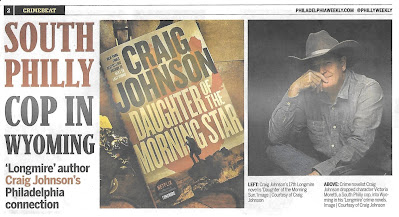
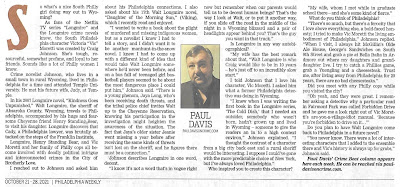
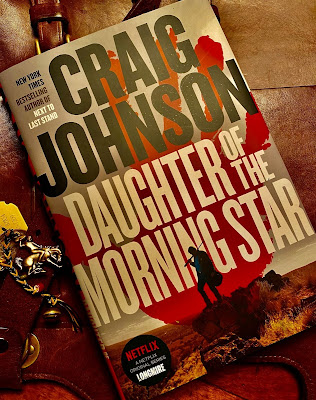
A South Philly Cop In Wyoming: My Philadelphia Weekly Crime Beat Column On ‘Longmire’ Author Craig Johnson’s Philadelphia Connection

Philadelphia Weekly published my Crime Beat column on Longmire author Craig Johnson's Philadelphia connection:

So what’s a nice South Philly girl doing way out in Wyoming?

As fans of the Netflix TV series “Longmire” and the Longmire crime novels know, the South Philadelphia character Victoria “Vic’ Moretti was created by Craig Johnson. She’s tough, resourceful, somewhat profane, and loyal to her friends. Sounds like a lot of Philly women I know. 

You can read the rest of the column via the below link or the below pages:

South Philly cop in Wyoming - Philadelphia Weekly 


You can click on the above and below to enlarge.


Saturday, May 9, 2020

Craig Johnson On His Upcoming Walt Longmire Crime Novel, 'Next To Last Stand'


Viking Books, the publisher of Craig Johnson’s upcoming Walt Longmire mystery, offers a conversation with Craig Johnson about the novel, called Next to Last Stand:

What inspired you to write Next to Last Stand?

You know, I’ve seen that poster of Custer’s Last Fight in every bar and saloon in the west, and one day I just decided to do a little research on it and found it really fascinating. I knew from looking at the painting that there were a number of historical inaccuracies, and when I found out about the connection to Budweiser and the destruction of the painting, I was intrigued to the point of thinking about incorporating it as a case for Walt. 

Do you have a personal connection to the story?

Other than staring at the thing hanging above numerous bars across the country, no. I think the key element of any novel that relies on an historic incident or relic would be the point of access, and I had one right here in my Wyoming county. About twenty miles away is the Veteran’s Home of Wyoming, or as it used to be known, the Soldier and Sailor’s Home. There were always guys sitting in their wheelchairs who would wave at passing traffic, and I had gotten in the habit of stopping every once in a while for a little conversation. They were amazing guys with some surprising histories who had been forgotten—this book gave me an opportunity to get them back in action.

How did you become interested in Custer’s Last Stand?

Oh Gosh, I never was . . . The battlefield is only about an hour from my ranch—western history of the United States can be divided in categories, and one of those huge categories would have to be Custer-ana. It’s one of those black holes of research that you can lose a year of your life researching. I guess I knew it was a mountain I was going to have to climb sometime, but I just wasn’t sure when.

What kind of special research did you have to do for the book?

After an entire year of research and reading every book on the subject I could get my hands on, I can tell you one thing—there are a lot of really crappy books about Custer out there . . . There are some really marvelous ones that have come out more recently, but that’s one of the things that was particularly interesting to me—the fluctuating image of the battle and the man himself and the way it mirrored the social and political leanings of the different periods. The other opportunity for gathering information was provided by my neighbors up on the Cheyenne and Crow Reservations who had family member that fought in the battle and their oral histories which were quite a bit different from the mainstream, published works.

What made you decide to feature the painting—and its history in American bars—in this novel?

Pretty simple—It may be the most-viewed piece of artwork in American history. An iconoclastic image that would link Walt and the area into a type of book I hadn’t written—an art heist. The last couple of books have been rather serious in nature, and I thought it was time to send Walt off on a lark in the art world, and possibly distract him with something inherent to his nature . . . research. I’m on the board of the Buffalo Bill Center of the West, which gave me an inordinate advantage in doing the research for the project and an insider’s look at how something like this investigation might unravel. I’m not the most knowledgeable source on art history, so for me it was a new world, too.

What is the connection between Budweiser/Anheiser-Busch and Custer’s Last Fight?

When the St. Louis artist Cassilly Adam’s painting had finished its nationwide tour and it hadn’t realized the profits the owners imagined, it was brought back to St. Louis where the owners were at a loss as to what to do with it. So, they sold it to a local saloon owner, and it was plastered up on the wall behind the bar and became a conversation piece for thirsty art critics. Decades later the bar went bankrupt and their greatest creditor was a then small, local brewery by the name of Anheiser-Busch. Well, Augie Busch marches into the place and demands payment for the thirty thousand dollars’ worth of beer that they owed and they tell him they can’t pay him. He looks up on the wall and says, “I’ll take the painting.” Hauling it back to the brewery, he unrolls it and tells his marketing department that they’re going to make posters of the painting and send them out to every restaurant, bar, saloon, and rumpus room in America and when they’re done they’re going to be a much bigger brewery—and boy were they ever. After utilizing the painting for a number of years Augie had a fit of philanthropy and gives the painting to the 7th Cavalry in Fort Bliss, Texas in 1946, where it goes up in flames… Or did it?   

Next to Last Stand is the sixteenth novel in your Walt Longmire series and you write one a year. That’s amazing! What keeps you writing them and where do you get your ideas?

Does it really seem like a lot? I feel like I should’ve written more. I keep my ear to the ground and whatever piques my curiosity is something that might interest Walt. For me it’s not a segmented train of novels, but rather a continuous storyline of the sheriff’s life that I hope still has a long future ahead of it.

How much of Walt Longmire is based on Craig Johnson?

My wife Judy has the best quote about that, “Walt Longmire is who Craig Johnson would like to be in ten years, he’s just off to an inordinately slow start . . .”

Your books are so informed by the scenery and the landscape of Wyoming. What makes it such a great backdrop for your novels and how does it inspire you? 

My ranch lies at the foot of the Bighorn Mountains near the border of Wyoming and Montana, and the nearest town has a population of 25. I think there’s a solitude that allows me the focus I need to write my novels. It’s hard to not be inspired by the world that surrounds me. I always enjoy going on the tours, but I also appreciate coming home.

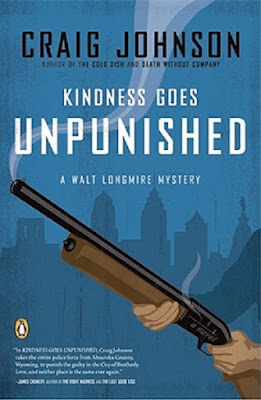
Note: You can read my Washington Times On Crime column about Craig Johnson and Walt Longmire via the below link: