Showing posts with label Navy Admiral William H. McRaven. Show all posts

Friday, August 29, 2014

Army General Votel Takes Charge of Special Operations Command

Claudette Roulo at the DoD News offers the below piece:

WASHINGTON, Aug. 28, 2014 - Defense Secretary Chuck Hagel today presided over the U.S. Special Operations Command change of command ceremony in Tampa, Florida, where Army Gen. Joseph L. Votel III (seen in his offical DoD photo above) assumed command from Navy Adm. William H. McRaven.

McRaven, who's served as the command's chief since Aug. 8, 2011, has been named as the next chancellor of the University of Texas. Votel most recently served as commander of Joint Special Operations Command. A full account of McRaven's career has yet to be written, Hagel said in his prepared remarks. "When it is, it will have to be heavily redacted," he joked. "But his legacy in the special operations community is already secure. He is a warrior-leader that generations of special operators from across the branches of service will strive to emulate," Hagel said.
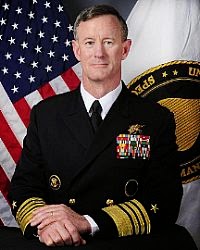
 Career milestones McRaven (seen in his official DoD photo above) has been deeply intertwined with the history of special operations in this country, the defense secretary said. "He helped establish and was in the first graduating class of the Special Operations/Low Intensity Conflict curriculum at the Naval Postgraduate School," Hagel said of McRaven.

"He literally wrote the book on special operations -- I'm told that his graduate school thesis at one point outranked even Clausewitz on Amazon's list of military strategy bestsellers. "As the commander for special operations in Europe, he was the driving force behind the creation of the NATO Special Operations Forces Coordination Centre," the defense secretary continued, "and under his leadership, the Joint Special Operations Command carried out perhaps the most important mission in their history -- hunting down and killing Osama bin Laden."

Socom's transition

McRaven led the special operations community as it transitioned from the era of post-9/11 conflicts and into confronting the next generation of dynamic, dispersed, and networked challenges, Hagel said. "Special operators have long been the vanguard of our military's global engagement, epitomizing the kind of far-reaching work that our military will be called upon to do in the future," the defense secretary said. "What special operators do every day not only helps make America safer, it also directly contradicts the uninformed and false narrative that the United States is pulling back from the world,"

Hagel said. Special operations forces deployed into more than 150 countries under McRaven's command, he noted. "In fact, Socom and the entire U.S. military are more engaged internationally than ever before -- in more places and with a wider variety of missions," the defense secretary added.

Special operations missions under McRaven included delivering life-saving relief after Typhoon Haiyan struck the Philippines in 2013, Hagel said. "They helped Peruvian forces successfully target two senior members of the Shining Path rebel group. They're working with African partners to help counter the terrorist activities of Boko Haram," he said.

In Iraq, special operations forces are helping strengthen Iraqi security forces in their fight against terrorist forces from the Islamic State of Iraq and the Levant, the defense secretary noted. "And in Eastern Europe, they are reinforcing NATO allies in light of Russian aggression in Ukraine," he said.

A more agile force

During his time in command, McRaven organized Socom's forces to be more agile, flexible and responsive, Hagel said. "He has better integrated Socom with the geographic combatant commands, and issued the first-ever Global Campaign Plan for Special Operations," he said. "He has deepened our relationships abroad, working more closely with allies and partners to better anticipate and counter threats. "

As a testament to the growing demand for special operators," the defense secretary continued, "Socom has grown by almost 8,000 people over the past three years -- and its growth will continue even as other parts of our military draw down.". Repeated deployments have dealt the special operations community a heavy burden, Hagel said, but McRaven and his wife Georgeann have worked tirelessly to help alleviate some of the strain. "[McRaven] established initiatives to address the physical and mental well-being of his force, offer support to family members, and provide more predictability on deployments.

He modified Socom's definition of readiness to include families as a vital part of the equation, something the entire Department of Defense can learn from," he said. And Georgeann has been a consistent advocate for special operations families, personally supporting many of these important initiatives, the defense secretary said. "The McRavens live by the [special operations] community's saying ... 'Our people are more important than our hardware,'" Hagel added.

Incoming commander

Votel is a worthy successor to McRaven, the defense secretary said. "[His] quiet, decisive leadership -- combining both operational and strategic expertise -- is precisely what this command will need as we confront the next generation of threats to our national security," Hagel said.

Both men know that an institution is only as strong as its people, Hagel said before thanking the special operations community for their sacrifices, particularly over the past 13 years. "Your skill, your agility and your dedication are what make you so often the force of choice for our highest priority missions," the defense secretary said. "And a special thank-you to your families, who make untold sacrifices and never get the amount of recognition and appreciation they deserve."

"In a complicated and combustible world, this community is a precious national asset," Hagel said. "All Americans are inspired by your strength, determination, and devotion to duty."

Tuesday, November 19, 2013

U.S. Special Operations Command Planning For Future Missions, Admiral McRaven Says


Karen Parrish at the American Forces Press Service offers the below piece:

WASHINGTON, Nov. 18, 2013 - U.S. special operations forces are postured to take on the global counterterrorism challenges the nation faces in the years ahead, the commander of U.S. Special Operations Command said Nov. 16.

Navy Adm. William H. McRaven took part in a panel discussion at the first Reagan National Security Forum at the Reagan Library in Simi Valley, Calif., examining what will be required to effectively fight terrorism in 2025.

Numerous senior Defense Department officials, including Defense Secretary Chuck Hagel and Army Gen. Martin E. Dempsey, chairman of the Joint Chiefs of Staff, attended the forum. McRaven's panel included Michael G. Vickers, undersecretary of defense for intelligence, along with U.S. Sen. Carl Levin and U.S. Rep. Mac Thornberry. Washington Post national security reporter Craig Whitlock moderated the panel.

McRaven said the role of U.S. special operations forces in the coming decade-plus is "a very timely topic." Through the 1990s, he said, "the international special operations community had a lot of great [special operations] forces. And frankly, there were many that were as good, if not better, than we were."

Since 9/11 and continuing today, however, "I can tell you, there is nobody in the world who can compare to U.S. special operations forces and U.S. counterterrorism forces," the admiral said.

Thanks to the support of Congress, he reported, Socom has since 2001 doubled its people, tripled its budgets and quadrupled its capability -- not just in the areas of hardware and intelligence, surveillance and reconnaissance assets, but also in noncommissioned officer training, officer education, and language and cultural studies.

The question now, McRaven said, is whether the special operations force that has evolved to fight the wars in Iraq and Afghanistan is also adaptable to today's threats. He said it absolutely is.

The admiral noted that the U.S. special operations forces now postured in Afghanistan will, as the drawdown of troops in 2014 proceeds, be available for new missions.

"A lot of what we will do as we go forward in this force is build partner capacity. ... We will always be the best in the world at rescuing Americans and taking care of threats to the nation, but a large part of what we will do [in future] is build partner capacity," he said.

U.S. forces have worked over the past decade with partners in Colombia, the Philippines, Chad and a dozen other countries around the world to strengthen their special operations programs, he said. U.S. allies and partners including NATO, the Arab states of the Persian Gulf, and Asian and Latin American nations "are absolutely essential to how we're doing business," he added.

Interagency collaboration across the U.S. government is also crucial, McRaven said. "I have special operations support teams, liaison officers, in 38 agencies and departments within Washington, D.C.," he noted.

Socom's relationships with other agencies such as the CIA and FBI are "phenomenal," he reported.

"Lives are important, and the security of the nation is important, and it has brought us together," the admiral said. "My concern is that as we draw down in Afghanistan, and we don't have the opportunity that, unfortunately, war brings you to continue to work together, we've got to be careful about moving apart."

The whole-of-government approach is "absolutely crucial to getting after these threats," he said.

"At the end of the day, it doesn't make any difference to me whether it's a Department of Defense guy, or a law enforcement individual or an intelligence individual that takes care of the threat," McRaven said. "We've got to work together to make sure that those threats don't end up on our shores."

McRaven said his special operators also rely on regular U.S. forces.

"I am the biggest supporter of the conventional forces, because frankly, we can't do our special operations job without support from the big Army, Navy, Air Force and Marine Corps," the admiral said. He added, "If we are going to have a viable force in 2025, it's all about the people."

He pointed out that 12 years of war have exacted a high price from his troops. "We have had more suicides this year than [at] any point ... in the history of special operations forces," McRaven said. While that "single data point" can't capture the overall health of his force, the admiral said, it is important.

"The stress on the force is pretty significant," he said. "We are going out of our way to work with the services to make sure that the individual soldiers, sailors, airmen or Marines are healthy physically, mentally and spiritually."

Resilience within families is equally important, he said, and Socom's "preservation of the force and families" initiative is one approach the command is taking to help families learn adapting and coping skills.

"If you want a strong [special operations] force for 2025, or frankly for 2014 and 2015, we have got to take care of our force," he emphasized.

But McRaven said that overall, he is confident the nation's special operators are ready to take on current and future missions. "I think we're going to be ready to go now and in the future," he said. He noted that Socom is channeling more troops into language and cultural training that will make them effective in Africa, Asia and Latin America.

"Up to 2025, this building partner capacity is going to be important," he explained. "You can't build that partner capacity well unless you speak their language, unless you understand their culture, and unless you have gained their trust."

Such engagement is not effective if it's episodic, the admiral said. Special operations forces bring sustained engagement, backed by language and cultural knowledge, to the task of improving partner forces, he noted. "Episodic engagement with our partners will not get us to the point where they have a competent and capable force that can deal with the threat," he said. "We've got to have persistent engagement."

Vickers addressed a question from Whitlock on how the Pentagon determines who the enemy is as terrorist groups shift membership and affiliation.

"It is a governmentwide issue," he replied. While al-Qaida has many branches and all of them are considered enemies, he said, other groups claim ideological similarities with terrorist organizations while not, themselves, posing a threat to America or its allies.

Vickers said fusion of intelligence and operations, and sustained pressure on terrorist groups, are both vital to addressing counterterrorism missions effectively. During the years when America was fighting in both Iraq and Afghanistan, he said, al-Qaida wasn't pressured and was able to reconstitute, resulting in significantly increased threats to the United States.

"Our government then responded quite effectively, and we've beaten those threats back," Vickers said. "But even when there have been smaller pauses in the pressure on these groups, whether it's in Yemen or Pakistan or elsewhere for, say, just months, you see them reconstituting. It emphasizes the real importance of sustained pressure, but also precision application of power."

McRaven said the best solution the United States can work toward with partners and allies in many parts of the world is to "train them to deal with their own problems." The admiral said U.S. special operations forces are currently in 81 countries. In some cases, that may mean one or two people working in an embassy, he said, while other times it may mean a couple hundred trainers on the ground.

In each case, he said, "we do a very, very thorough review, and we understand those risks ahead of time."

The State Department plays a big role in deciding what forces the U.S. military will train with, he noted. Special operations forces don't train with other nations unless the regional combatant commander, the ambassador and the country team all give the go-ahead, McRaven said.

"We shouldn't lose sight of the fact that there are forces out there that ... have questionable reputations," the admiral pointed out. "I think we need to assume some risk in helping them. Libya would be a prime example. So right now, as we go forward to try and find a good way to build up the Libyan security forces so they are not run by militias, we are going to have to assume some risks."

McRaven said the Libyan training mission, which Pentagon spokesman Army Col. Steve Warren said today will take place in Bulgaria, will involve both conventional and special Libyan forces.

Between 5,000 and 7,000 Libyan conventional forces will take part, he said, while a U.S. special operations component will train "a certain number of their forces to do counterterrorism."

Thursday, November 15, 2012

Admiral William McRaven Discusses Osama Bin Laden And Calls David Petraeus 'An American Hero' At The Hero Summit


Eli Lake at the Daily Beast reports on Admiral William H. McRaven speaking publicly about the bin Laden raid and former CIA Director David Petraeus.

The man who commanded and devised the raid that killed Osama bin Laden said David Petraeus—who resigned Friday as director of the CIA after acknowledging an extramarital affair—was “the finest general” he had ever served under.
 
Speaking at The Hero Summit, presented by Newsweek & The Daily Beast, Admiral William McRaven, the commander of U.S. Special Operations Command, called Petraeus an “American hero” who made thousands of decisions that saved lives as a commander of troops in Iraq and Afghanistan. He added: “I obviously don’t condone what he did because Holly Petraeus is also an American hero.”
McRaven’s remarks were one of the first public comments from an elite U.S. military leader on the biggest scandal to hit the CIA under the Obama administration. His comments suggest Petraeus will maintain influence within the military—where he spent his career before retiring as a four-star general to become director of the CIA. 

You can read the rest of the story via the below link:

http://www.thedailybeast.com/articles/2012/11/14/admiral-william-mcraven-discusses-osama-bin-laden-and-david-petraeus.html 

Wednesday, March 7, 2012

Special Ops Provide Great Return On Investment, Commander Says


By Karen Parrish,
American Forces Press Service

WASHINGTON, March 6, 2012 - U.S. special operations forces remain focused on Afghanistan, but they also are active across the globe, the commander of U.S. Special Operations Command said today.

Navy Adm. William H. McRaven testified with Marine Corps Gen. James N. Mattis, U.S. Central Command commander, before the Senate Armed Services Committee.

About 80 percent of McRaven's troops support Centcom's mission in Afghanistan, and much of the remaining force is spread across nearly 80 other countries, he said.

The Centcom focus "doesn't diminish the effort we are putting into the cultural training or the language training with respect to those other folks that are deployed globally," the admiral said.

Preparing special operations forces for post-Afghanistan operations "will be a function of ... reemphasizing some languages and some cultures as we move from a Centcom-centric environment to a more globally balanced environment over time," he said.

The roughly 66,000 service members who make up Socom support U.S. policy objectives in the Pacific, Africa, Latin America, Europe and other regions, he noted.

Special operations forces have "unique skills, cultural knowledge and the ability to work with partners [that create] effects far above our relatively small numbers," the admiral said.

McRaven said he is committed to strengthening "embedded" special operations forces support to geographical combatant commanders by reinforcing theater special operations commands.

The traditional "hearts and minds" mission of training other nations' special operations forces also continues, he said.

Since service-specific special operations forces were established in the the 1960s, followed by Socom's stand-up in 1987, McRaven said "our relationship with our allied partner force around the world has strengthened each nation's [special operations forces] and each nation's ability to deal with their own security problems. We must continue to build these relationships wherever possible."

McRaven noted that his predecessor at Socom, retired Navy Adm. Eric T. Olson, drew attention last year to the "fraying around the edges" special operations troops experienced during a decade of extremely high demand for their talents.

Olson set up a task force to study the issue, McRaven said, and he has followed through with his own efforts.

"I have put a general officer and my command sergeant major in charge of the preservation of the force and families," he said. "They are empowered to implement innovative solutions across the Socom enterprise to improve the well-being of our warriors and their families."

Recruiting is up from previous years among special operations forces, McRaven noted. He cautioned that retaining those forces requires a considered approach to any change in future benefits.

"I think if you polled a lot of those young men and women coming in, they probably wouldn't cite the health care and retirement benefits as the reason that they are joining," he acknowledged. "However, it could very well be the reason they stay after a certain point in time."

Any changes in future retirement and health care benefits should be "prudent and careful ... so that we keep those experienced noncommissioned officers and officers in and take care of them for the service that they have rendered," McRaven added.

Socom is a force already in line with Defense Secretary Leon E. Panetta's strategy calling for a smaller, leaner and more agile military, the admiral said.

Special operations forces remain relevant, in high demand and offer "an unparalleled return on the nation's investment," he said.