
I
wrote about South Philly's Oregon Avenue for Philadelphia Weekly back in
1994.
You
can read the piece above and below (click on to enlarge).

I
wrote about South Philly's Oregon Avenue for Philadelphia Weekly back in
1994.
You
can read the piece above and below (click on to enlarge).

For a time, I was proud to have my Crime Beat column appear in Philadelphia Weekly alongside the contributions of veteran newspaper columnist Stu Bykofsky.
Previous to this, I was also a proud contributor for 19 years to the Philadelphia Inquirer, where Stu Bykofsky’s popular column ran for many years.
So when I read that Stu Bykofsky had written a novel about newspapers, reporters, crime and politics, called Press Card, I purchased the novel online, and I read and thoroughly enjoyed it.
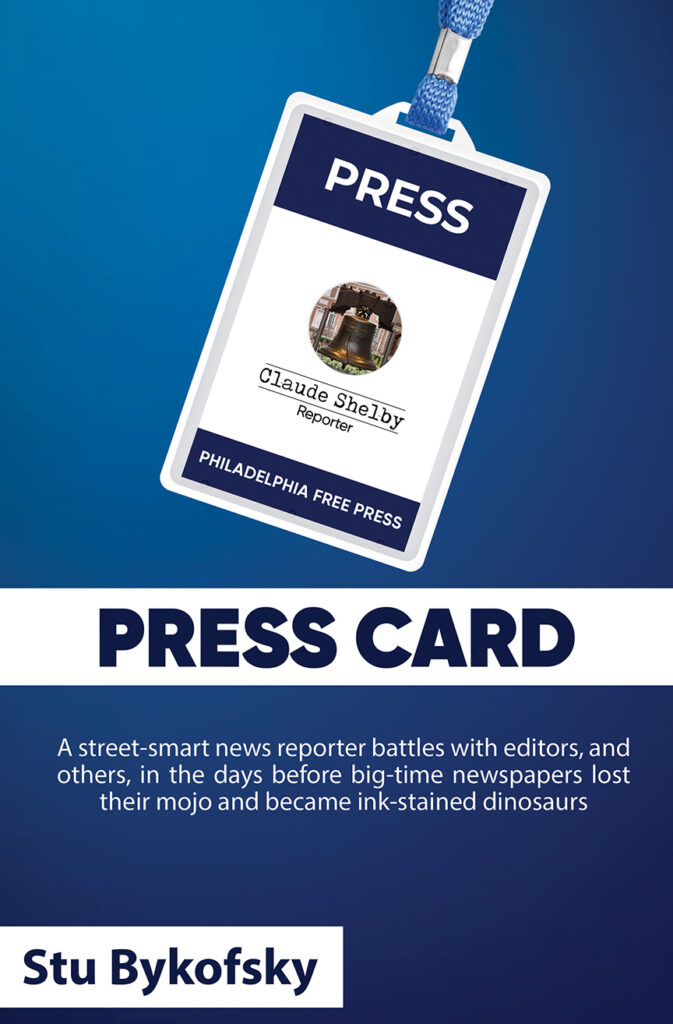
Stu Bykofsky described Press Card on his website, STU BYKOFSKY - Reality determines my political positions, not vice versa :
Did you ever have a bad boss? Sure, you have.
Did you ever do anything about him (or her)?
Probably not.
Claude Shelby does.
He’s a straight-talking, wisecracking, street-savvy reporter who doesn’t like his bosses -- and they don’t like him.
That conflict provides the framework for Press Card, which is funny, sad, poetic, obscene, sexy, and knowing.
Following his demotion for cutting corners to get a political story, Shelby struggles with his bosses, and with what his job sometimes requires him to do.
When he’s at his lowest point and floating aimlessly, he stumbles into clues that could lead him to the biggest story of his life -- finding fugitive Black revolutionary Sister Sojourner.
He chases the leads he digs out all the way to St. Lucia in the Caribbean, where he receives help from an unexpected source in a skintight dress.
In this picaresque novel, Claude Shelby interacts with memorable characters: a rags-to-riches millionaire, a close friend who regrets quitting journalism for the big bucks of P.R., the Philadelphia artist who designs neon tube clothing accessories that double as dildos, and a predatory female reporter.
Press Card takes readers inside the Fourth Estate and reveals how some newspapers make decisions. It unmasks power plays between union and management, and reporters’ tricks.
It is fiction based on fact.
Press Card crackles like a police radio and rolls as fast as the presses that print the fictional Philadelphia Free Press.

I reached out to Stu Bykofsky and asked him about Press Card.
Davis: Why did you write Press Card?
Bykofsky: Two reasons. 1- A personal challenge to myself to see if I could write something that long. “Cats Are Supermodels” was a decade earlier, nonfiction, and about 20% as long as “Press Card.” 2- Wanted revenge on some editors.
Davis: How would you describe the novel?
Bykofsky: I call it “faction” -- fact wrapped in fiction. It pulls back the curtains on how print really works, in a fast-paced, humorous manner.
Davis: Is Claude Shelby in any way autobiographical?
Bykofsky: Claude Shelby is not Stu Bykofsky, but some of
Stu Bykofsky is in Claude Shelby. Claude is somewhat anti-union; Stu is very pro-union.
Shelby chews gum, Stu never had, and Stu was never a political reporter.
Davis: Is the Philadelphia Free Press based on the Daily News or the Inquirer?
Bykofsky: The Free Press is a tabloid, like the News, and, honestly, the novel is a roman a clef, using the News as a template. You know the adage -- write what you know.
Davis: Are the other characters, especially the editors, based on real people?
Bykofsky: Some yes, some no. Some are complete inventions;
other characters are borrowed from people I know. When inventing a character, I
picture someone I know. It helps with the physical descriptions and helps me
keep them separate.
Davis: Did you cover any of the stories that Shelby covered in the novel?
Bykofsky: I was working the desk the night a tanker exploded in the Delaware. That’s the chapter called Fire on the Water. I actually had a lead on Patty Hearst, through a friend, but the trail went cold fast. As to the suicide of a TV anchor, that was loosely based on Bud Dwyer, but I did not cover that. I was a TV critic for five years and will say the TV reporter Howard Scott was based on WPVI’s Marc Howard.
Davis: Why do newspapers cover crime stories so prominently?
Bykofsky: They don’t anymore -- and that is intentional. The “Woke” element in newsrooms have decided coverage of crime is racist. If you give it a moment's thought, you can imagine why.
Davis: What made you want to go into newspaper journalism?
Bykofsky: I started by joining the college newspaper at
Brooklyn College (night school), because I didn’t like fraternities and it was
one club that had girls, where everyone drank and cursed and smoked. It turned
out writing was a gift -- I could do it easily and I figured it would be a good
career. Not a lot of money, but a lot of fun. My intuition was correct. And the
editor of its college paper got me my first professional job at The
World-Telegram & The Sun in NYC in 1959. I retired 60 years later.
Davis: Was anyone in particular a major influence?
Bykofsky: The aforementioned college editor, Gordon
Lattey -- still a friend. Got me the job at the Telegram, and later got me a
freelance job with a travel magazine he edited, which opened the door to world
travel -- with someone else paying the bill. I have been everywhere from
Antigua to Yugoslavia, something that would have been completely impossible for
someone like me who grew up in the projects.
Davis: How are newspapers today different today from the 1970s, the era portrayed in Press Card?
Bykofsky: I hate to generalize, but they seem to be
run by people guided more by their politics than by news values.
Davis: What do you see for the future of newspapers?
Bykofsky: In print -- none, and that is really sad. I see
them each becoming silos, catering to the perceived biases of their readers. I
can’t be specific because I signed a NDA (Non-Disclosure Agreement) with the
Inquirer, which I am suing for defamation.
Davis: Do you have a favorite book, novel or play about newspapers?
Bykofsky: Citizen Hearst, although only indirectly
about newspapers. And The
Front Page, of course, for sheer fun.
Davis: Do you have a favorite film or TV series about newspapers?
Bykofsky: There was an OLD series, maybe the ‘50s, called The Big Story, something like that, that was sort of a documentary recreation. I also strongly like Absence of Malice, although it is slightly off-kilter about libel law. But Paul Newman and Sally Field -- what’s not to like?
Davis: How would you describe your career as a newspaperman and columnist?
Bykofsky: Pleasure.
The bad days were few, and I got to travel the world, and rub elbows with
celebrities and politicians. (I don’t really like celebrities, but they make
good fodder for story telling). Unfortunately, I now have forgotten most of the
stories. Importantly, at stages in my career I was able to help people who
needed it, and kick the asses of politicians, who also needed it.
Davis: Do you plan to write another novel?
Bykofsky: The
first one took almost 40 years. I am 80. And I write a very active blog, so
there’s no time.
Davis: Good luck with the novel.
Note: You can read Stu Bykofsky's bio via the below link:
Stu Bykofsky | Columnist & Author | About (presscardthebook.com)
And you can purchase Press Card via the below link:


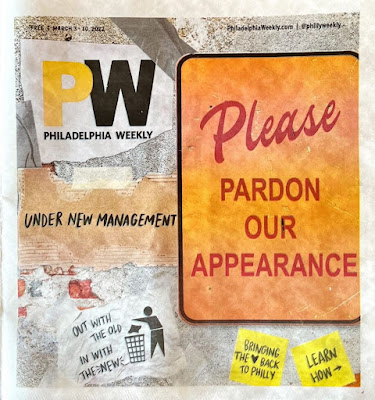
Stu Bykofsky (seen in the below photo), the former Philadelphia Daily News columnist, was until recently, like me, a contributor to Philadelphia Weekly.
My
Crime Beat column ran in Philadelphia Weekly for a year and four
months.
Then a new publisher and new editor decided to take the weekly newspaper in a new direction. And like me, Stu Bykofsky was dropped without so much as an email notification.
Stu Bykofsky addresses this in his blog at:
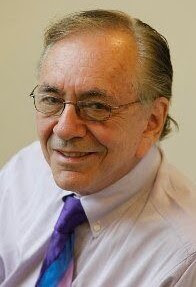
Note: I moved my Crime Beat column over to broadandliberty.com.
Christine Flowers offers her take on progressives and working-class ethnics in a piece at Philadelphia Weekly.
You
can read the rest of the piece via the below link:
No respect - Philadelphia Weekly

The man who wants to be your district attorney is willing to take
a break from his 42-year career as one of Philadelphia’s best known and most
successful defense attorneys.
His father, A. Charles Peruto, was a Philadelphia legal legend up
until his death in 2013, a defense attorney famed for using folksy warmth to
seduce juries into seeing things his way. Chuck’s tactic is to entertain. “A
laughing jury never convicts,” he says seriously. In court, he is The
Entertainer.
In one memorable case, he defended a county detective charged with
beating his girlfriend, who happened to be a judge.
She claimed he had beaten her, but instead of calling 911, she
first called a police captain friend of hers who rushed over to her apartment,
to stage the scene, Peruto told the jury.
The judge then called 911, claimed to be in death throes and
slipped unconscious to the floor at the conclusion of the call.
Peruto acted out her testimony, winding up on the floor, in mock
unconsciousness, splitting his pants. The jury roared with laughter – and did
not convict.
Behind closed doors, many of his colleagues say that Peruto is a
hot dog, a term he would relish.
You can read the rest of the piece via the below link:
‘A laughing jury never convicts’ - Philadelphia Weekly

You can also read my Philadelphia Weekly Crime Beat columns on Chuck Peruto via the below links:

Philadelphia Weekly notes that since Carlos Vega was defeated in the Democratic primary, it is up to Chuck Peruto, the Republican candidate for Philadelphia DA, to defeat incumbent DA Larry Krasner in the general election.
Note: You can click on the above to enlarge.

The Wall Street Journal offers an editorial noting that the Democratic City Committee voted not to endorse Philly DA Larry Krasner for reelection. The editorial also mentions Philadelphia Weekly and quotes challenger Carlos Vega from my Crime Beat column.
Prosecutors promising easier bail and fewer criminal
prosecutions have swept to power in several big cities in recent years, but a
backlash may be underway as crime spikes. Witness last week’s developments in
Philadelphia.
On March 31 the Democratic City Committee voted not to
endorse incumbent District Attorney Larry Krasner for May’s primary election.
He won in 2017 after denouncing the city’s police and prosecutors as “both
systemically racist” and has spent his time in office touting his efforts “to end
mass incarceration” by bringing fewer charges and urging lighter sentences.
But Mr. Krasner now faces a primary challenge from Carlos
Vega, a former homicide prosecutor whom he fired.
In December 2020, Mr. Krasner
filed 525 charges for violent crimes, compared to 757 in December 2017, the
month before he took office. The decrease doesn’t reflect a safer city; nearly
500 people were murdered in Philadelphia last year, compared to 315 in 2017.
Last year saw more than 2,200
shootings, and the vast majority of victims were black. Auto thefts have risen
sharply, with some 9,295 vehicles stolen last year compared to 5,694 in 2017.
“Victims are an inconvenient truth that Larry ignores,” Mr. Vega told Philadelphia Weekly in December. “He never talks about the victims.” Mr. Vega says he’s running “to make our city safer.”
You can read the rest of the piece via the below
link:

You can also read my Philadelphia Weekly Crime Beat column on Carlos Vega via the below link:

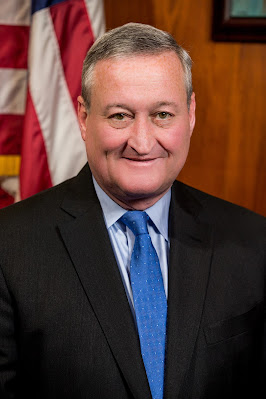
Philadelphia Weekly, where my Crime Beat column runs each week, offers a cover story that states it is time for Philadelphia Mayor Jim Keeney to resign for the good of the city.
You can read the piece via the below link:

Jenny DeHuff (seen in the below photo), the new editor of Philadelphia Weekly - where I write the Crime Beat column - offered an introductory piece:
I assumed the new role
as editor-in-chief of Philadelphia Weekly. When the publication launched
AltPhilly, Philadelphians made it apparent they wanted a more contrarian
viewpoint to be part of the conversation, and Philly Weekly surpassed its fundraising
goal.
So, I’m excited to lead
this new charge as editor because I think we need a fair voice of reason in
this city. The Philadelphia Inquirer axed all their conservative columnists,
from Stu Bykofsky (for whose last day of work I was present) to Christine
Flowers. Most columnists in the city are screaming so loudly into the liberal
echo chamber that there is hardly anyone hearing anything from the other
side.
That’s why I think PW’s
decision to switch makes sense. Right now, content coming from our local news
outlets is largely redundant and people are being led by the nose. We want to
change that. The paper can now offer readers a platform where conservative
perspectives can challenge liberal ones. Here, there is room to share ideas,
debate and learn.
You can read the rest of
the piece via the below link:
https://philadelphiaweekly.com/phillys-brand-new-pw/


Veteran reporter and author Ralph Cipriano (seen in the below photo) at BigTrial.net offers a piece on the scandal at the DA office, which has not received much news coverage here, with the notable exception of Ralph Cipriano’s blog.
(Which is why Philadelphia Weekly changing
editorial direction to a conservative newspaper and offering an alternative
voice in the city is so important. On a personal note, my Crime Beat column
will appear next week in Philadelphia Weekly).
Ralph Cipriano’s post offers the U.S. Attorney’s comments on the DA scandal.
It's day two of the local news media blackout over the latest scandal in the Philly D.A.'s office, involving a gun violence counselor who shot and killed a male prostitute.
And who's trying to expose the ongoing cover up?
U.S. Attorney Bill McSwain went on Twitter today to rip D.A. Larry Krasner:
"Your Philly DA's office: where Krasner hires an employee who allegedly ends up shooting and killing a man. You can't even make this stuff up. The destruction that Krasner has wrought on that office is a tragedy."
McSwain subsequently went on Twitter again to rip The Philadelphia Inquirer, which, as usual, was sleeping through another news cycle involving possible bad publicity for their favorite progressive D.A.:
"So where's the @PhillyInquirer article on this? Everybody knows that the Inquirer bends over backwards to protect Krasner, but this is a little too obvious -- even for them."
You can read the rest of the piece via the below link:
https://www.bigtrial.net/2020/10/us-attorney-rips-krasner-inky-over-da.html


