Showing posts with label journalism. Show all posts

Sunday, March 29, 2026

Dorthy Parker On Ernest Hemingway


Dorthy Parker (August 22, 1893 – June 7, 1967), seen in the above photo, was a brilliant and quite clever writer.

Her 1929 New Yorker profile of a young Ernest Hemingway is a classic piece of journalism.

You can read the piece via the link below:

People Want to Hear Things about Ernest Hemingway | The New Yorker 

Monday, December 29, 2025

From the Editors: Looking Back At A Landmark Year For Broad + Liberty


I’m proud to be a contributor to Broad + Liberty. 

My Crime Beat column appears on the Broad + Liberty and Philly Daily websites each week.

As the editors noted, it’s been a remarkable year at Broad +Liberty. 

You can read the year-end piece by the editors via the below link or the following text:

 From the Editors: Looking back at a landmark year for Broad + Liberty

It’s been a remarkable year at Broad +Liberty. 

We published over 900 original pieces covering wide-ranging topics from scandals in the Shapiro administration, county politics, education, culture and healthcare.

Our investigative reporting by Todd Shepherd garnered state and national attention. The Pennsylvania News Media Association awarded Shepherd the “Best in Investigative Journalism” for his work exposing incompetence and poor management at the Delaware County prison. 

Nationally, the Atlantic cited Shepherd’s work in its lengthy piece on Governor Josh Shapiro. Broad + Liberty broke the news about a sexual harassment scandal involving one of Shapiro’s top aides back in 2023. Shepherd continues to uncover more concerning facts around the incident including deleted email accounts that run contrary to the state’s own policy.

Whether reporting on excessive county tax increases, questionable spending by school districts or political endorsements and campaign donations, Shepherd’s investigative journalism is making a significant impact at the local, state, and national level. Shepherd's work is complemented by additional reporting and informed opinion pieces from our staff, including Kyle Sammin, Brad Vasoli, and Beth Ann Rosica.

We are also proud to publish regular contributions from Guy Ciarrocchi, Thom Nickels, Ben Mannes, Christine Flowers, Paul Davis, and Seth Higgins, in addition to submissions from private citizens and elected officials that the mainstream media would likely ignore. Broad + Liberty fulfills its mission every week by giving voice to issues and ideas that have been shut out of our public discourse for too long.

This year, Broad + Liberty founded The Bucks County Independence in May and The Lancaster County Independence in August. These new sites deliver thoughtful and rigorous journalism on the local level and have each broken numerous hard-hitting stories. Bucks Independence readers were the first to read about recently retired Falls Township Supervisor Jeff Boraski’s payment of most of his campaign funds to himself as “reimbursements,” the latest development in an ongoing fundraising scandal with countywide implications. The Lancaster County Independence provided trenchant coverage of county budget deliberations and broke a story about a controversial potential challenger to Republican State Representative Steven Mentzer.

It’s interesting to look back and reflect upon which stories earned the most attention. It is often surprising to us which pieces do well and which ones don’t seem to get many clicks. Perhaps it’s timing or getting picked up by an aggregator, but ultimately we can never predict the popularity — or lack thereof  — of a story.

As we would expect, our regular writers captured the top ten list this year, but the pieces that made it were sometimes not anticipated.

To cap off the year, here, in order, are Broad + Liberty’s top ten stories in 2025.

1.     Federal probe launched into Unionville-Chadds Ford School District after parent complaints by Beth Ann Rosica

2.     Pandemic policies sparked a transgender spike and the reversal has begun by Beth Ann Rosica

3.     Philly school district spent at least $309,000 sending staff to local union conference despite travel policy by Todd Shepherd

4.     Shapiro admin can’t locate key emails in sexual harassment case – “zero emails on the server……. is preposterous” by Todd Shepherd 

5.     How northern Pennsylvania is being left behind by Seth Higgins

6.     Philly DA Krasner receives endorsement from democratic ward leader convicted of sex offenses against a minor by Todd Shepherd

7.     Chesco bureaucrats end hot meals for needy West Chester families by Beth Ann Rosica

8.     Ideology over justice – how Larry Krasner’s policies failed Kada Scott by Ben Mannes

9.     Emails show questionable collusion between Krasner and PAC donors by Ben Mannes

10. $164k for a Chief Experience Officer? Chester County finds new ways to spend your money by Guy Ciarrocchi

The past year underscores Broad + Liberty’s growing role in Pennsylvania’s public conversation.

From the founding of our republic, the health of our civic life has rested upon a simple but profound truth: a free and independent press is not merely a feature of democracy — it is one of its chief guarantors. As the only industry explicitly contemplated in the Constitution, the framers understood that liberty is not self-perpetuating; it must be renewed through informed citizens, accountable institutions, and a shared commitment to truth that transcends partisan preferences.

We at Broad + Liberty are stewards of a tradition that predates us and will outlast us if we tend to it faithfully. The press is, in the words of Alexis de Tocqueville, the “chief democratic instrument of freedom”— a moral instrument for the advancement of the public good.

In other words, strong communities are built when government is accountable, enterprise is encouraged, innovation is dynamic, and individuals embrace their God-given responsibility for themselves and their neighbors. This is a social compact that is strengthened when we are at our best.

As 2025 comes to a close, Broad + Liberty is excited for what 2026 has in store. Our team is ready to break the stories, report the news, and help our readers make sense of what is happening locally, across the state, and in the country.

We are incredibly grateful to our loyal readers who click on our website daily and to those who continue to support our work financially.

As Broad + Liberty expands and grows, our commitment to freedom of thought remains paramount, and we promise to bring more diverse voices to our pages.

Thank you for your support and Happy New Year! 

Sunday, May 15, 2022

My Crime Beat Column: My Q&A With Veteran Newspaper Columnist And Author Stu Bykofsky

For a time, I was proud to have my Crime Beat column appear in Philadelphia Weekly alongside the contributions of veteran newspaper columnist Stu Bykofsky.  

Previous to this, I was also a proud contributor for 19 years to the Philadelphia Inquirer, where Stu Bykofsky’s popular column ran for many years. 

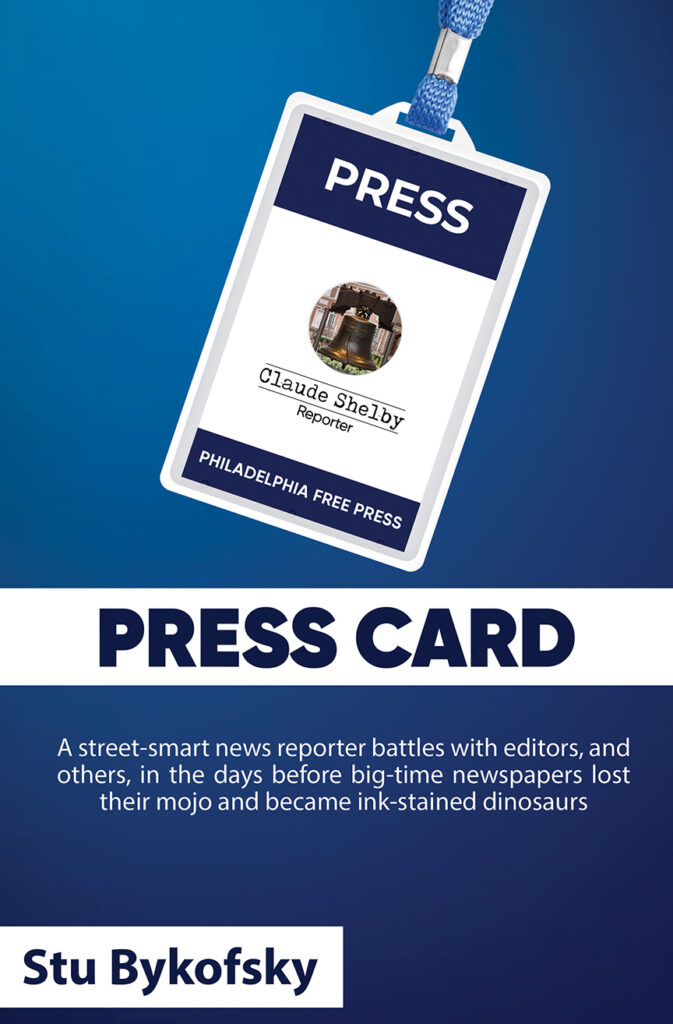
So when I read that Stu Bykofsky had written a novel about newspapers, reporters, crime and politics, called Press Card, I purchased the novel online, and I read and thoroughly enjoyed it. 

Stu Bykofsky described Press Card on his website, STU BYKOFSKY - Reality determines my political positions, not vice versa : 

Did you ever have a bad boss? Sure, you have.​

Did you ever do anything about him (or her)?​

Probably not.​

Claude Shelby does.​

He’s a straight-talking, wisecracking, street-savvy reporter who doesn’t like his bosses -- and they don’t like him.​

That conflict provides the framework for Press Card, which is funny, sad, poetic, obscene, sexy, and knowing.​

Following his demotion for cutting corners to get a political story, Shelby struggles with his bosses, and with what his job sometimes requires him to do. 

When he’s at his lowest point and floating aimlessly, he stumbles into clues that could lead him to the biggest story of his life -- finding fugitive Black revolutionary Sister Sojourner.​

He chases the leads he digs out all the way to St. Lucia in the Caribbean, where he receives help from an unexpected source in a skintight dress.​

In this picaresque novel, Claude Shelby interacts with memorable characters: a rags-to-riches millionaire, a close friend who regrets quitting journalism for the big bucks of P.R., the Philadelphia artist who designs neon tube clothing accessories that double as dildos, and a predatory female reporter.​

Press Card takes readers inside the Fourth Estate and reveals how some newspapers make decisions. It unmasks power plays between union and management, and reporters’ tricks.​

It is fiction based on fact.​

Press Card crackles like a police radio and rolls as fast as the presses that print the fictional Philadelphia Free Press.

I reached out to Stu Bykofsky and asked him about Press Card. 

Davis: Why did you write Press Card? 

Bykofsky: Two reasons. 1- A personal challenge to myself to see if I could write something that long. “Cats Are Supermodels” was a decade earlier, nonfiction, and about 20% as long as “Press Card.” 2- Wanted revenge on some editors.  

Davis: How would you describe the novel? 

Bykofsky: I call it “faction” -- fact wrapped in fiction. It pulls back the curtains on how print really works, in a fast-paced, humorous manner.  

Davis: Is Claude Shelby in any way autobiographical? 

Bykofsky: Claude Shelby is not Stu Bykofsky, but some of Stu Bykofsky is in Claude Shelby. Claude is somewhat anti-union; Stu is very pro-union. Shelby chews gum, Stu never had, and Stu was never a political reporter. 

Davis: Is the Philadelphia Free Press based on the Daily News or the Inquirer? 

Bykofsky: The Free Press is a tabloid, like the News, and, honestly, the novel is a roman a clef, using the News as a template. You know the adage -- write what you know.

Davis: Are the other characters, especially the editors, based on real people? 

Bykofsky: Some yes, some no. Some are complete inventions; other characters are borrowed from people I know. When inventing a character, I picture someone I know. It helps with the physical descriptions and helps me keep them separate. 

Davis: Did you cover any of the stories that Shelby covered in the novel? 

Bykofsky: I was working the desk the night a tanker exploded in the Delaware. That’s the chapter called Fire on the Water. I actually had a lead on Patty Hearst, through a friend, but the trail went cold fast. As to the suicide of a TV anchor, that was loosely based on Bud Dwyer, but I did not cover that. I was a TV critic for five years and will say the TV reporter Howard Scott was based on WPVI’s Marc Howard.  

Davis: Why do newspapers cover crime stories so prominently? 

Bykofsky: They don’t anymore -- and that is intentional. The “Woke” element in newsrooms have decided coverage of crime is racist. If you give it a moment's thought, you can imagine why.  

Davis: What made you want to go into newspaper journalism?  

Bykofsky: I started by joining the college newspaper at Brooklyn College (night school), because I didn’t like fraternities and it was one club that had girls, where everyone drank and cursed and smoked. It turned out writing was a gift -- I could do it easily and I figured it would be a good career. Not a lot of money, but a lot of fun. My intuition was correct. And the editor of its college paper got me my first professional job at The World-Telegram & The Sun in NYC in 1959. I retired 60 years later. 

Davis: Was anyone in particular a major influence? 

Bykofsky: The aforementioned college editor, Gordon Lattey -- still a friend. Got me the job at the Telegram, and later got me a freelance job with a travel magazine he edited, which opened the door to world travel -- with someone else paying the bill. I have been everywhere from Antigua to Yugoslavia, something that would have been completely impossible for someone like me who grew up in the projects. 

Davis: How are newspapers today different today from the 1970s, the era portrayed in Press Card? 

Bykofsky: I hate to generalize, but they seem to be run by people guided more by their politics than by news values. 

Davis: What do you see for the future of newspapers? 

Bykofsky: In print -- none, and that is really sad. I see them each becoming silos, catering to the perceived biases of their readers. I can’t be specific because I signed a NDA (Non-Disclosure Agreement) with the Inquirer, which I am suing for defamation. 

Davis: Do you have a favorite book, novel or play about newspapers? 

Bykofsky: Citizen Hearst, although only indirectly about newspapers. And The Front Page, of course, for sheer fun. 

Davis: Do you have a favorite film or TV series about newspapers? 

Bykofsky: There was an OLD series, maybe the ‘50s, called The Big Story, something like that, that was sort of a documentary recreation. I also strongly like Absence of Malice, although it is slightly off-kilter about libel law. But Paul Newman and Sally Field -- what’s not to like? 

Davis: How would you describe your career as a newspaperman and columnist?  

Bykofsky: Pleasure. The bad days were few, and I got to travel the world, and rub elbows with celebrities and politicians. (I don’t really like celebrities, but they make good fodder for story telling). Unfortunately, I now have forgotten most of the stories. Importantly, at stages in my career I was able to help people who needed it, and kick the asses of politicians, who also needed it. 

Davis: Do you plan to write another novel? 

Bykofsky: The first one took almost 40 years. I am 80. And I write a very active blog, so there’s no time. 

Davis: Good luck with the novel.

Note: You can read Stu Bykofsky's bio via the below link:

Stu Bykofsky | Columnist & Author | About (presscardthebook.com)

And you can purchase Press Card via the below link:  

  Www.PressCardTheBook.com


Wednesday, June 9, 2021

“Writing Is Easy. All You Have To Do Is Cross Out The Wrong Words”: Mark Twain On Writing

I receive a good number of emails and a few phone calls from aspiring writers who ask me for my advice on how to become a writer. 

The first piece of advice I offer is to get a day job and hang on to that day job. 

Good full-time jobs in journalism are hard to find and most freelance writers and fiction writers have a day job that pays most of their bills. 

I became a Defense Department civilian employee after I was discharged from the Navy many years ago and I stayed with DoD until I retired. 

For the last 15 years of my time at DoD, I was a freelance writer, working nights and weekends for newspapers and magazines. I made some money, but it was my DoD job that provided my major income, my health insurance and eventually, my retirement income. 

I attended journalism courses at Penn State and Temple University, and they were helpful, but the second piece of advice I offer aspiring writers is to read. 

If you want to learn how to write, read books, magazines, newspapers, blogs and Internet publications. Read everything, but especially read the great writers, such as Mark Twain, one of my favorite writers.           

Steven Matthew Leonard at news.clearancejobs.com offers a piece on writing advice and quotes Mark Twain: 

“Writing is easy. All you have to do is cross out the wrong words.”—Mark Twain 

More years ago than I care to remember, I first met the man who would come to define my future as a writer and storyteller. It was the first Monday of the spring semester of my junior year at the University of Idaho, where a gaggle of engineering students sat stuffed into uncomfortably small desks for our required technical writing course. Scrawled in white chalk across the blackboard were the words: “The man who does not read has no advantage over the man who cannot read.” 

Standing to one side of the blackboard was our professor, Charles Stratton, wearing quintessential 1980s glasses and a threadbare sweater that could have been a hand-me-down from Ward Cleaver. I would later learn that his friends referred to him as “Skip,” but none of us were his friends and from the look on his face, never would be. In one hand, he held a long piece of chalk. In the other, an eraser—likely positioned for precise delivery if necessary. Skip Stratton didn’t suffer fools well, was blunt to the point of rudeness, and recognized us all as semi-literate STEM majors who, on a good day, would struggle to compile enough coherent words to assemble a readable sentence. But this was his job. And he was good at it. 

He opened that first class with a simple question: “Does anyone know the source of this quote?” He didn’t wait for an answer but continued: “Mark Twain.” He explained that good writing begins with good reading, and the more we read—especially from great writers—the better we would write.

LISTEN TO THE WORDS OF MARK TWAIN: 

… “Write what you know.”  When writing, it’s best to focus on subjects in which you possess some personal knowledge. If you’re going to expand beyond those boundaries, do your research. 

“Writing is easy. All you have to do is cross out the wrong words.” Learn to be your own critic. If that doesn’t work, find someone who will fill that role for you. Brutally. 

 “To get the right word in the right place is a rare achievement.” Take the time to find those words. As Twain also noted, this often comes down to the difference between the almost right word and the right word. If you want your writing to matter, strive for the right word. 

 “Anybody can have ideas–the difficulty is to express them without squandering a quire of paper on an idea that ought to be reduced to one glittering paragraph.” Avoid verbosity. Cut to the chase and tell the story. 

… “If you tell the truth, you don’t have to remember anything.” In life as well as in writing, it’s best to stick to the facts. The more you embellish, the more likely you’re going to be written off. Told well, the truth is every bit as interesting. 

… “Write without pay until someone offers pay.” Too often, new writers constrain their potential by seeking the rewards before proving their worth. If you’re good enough, someone will eventually offer to pay for your work. If not, then, as Twain remarked “sawing wood is what he was intended for.” 

You can read the rest of the piece via the below link:

Tell Your Story: Mark Twain and His Words on Writing - ClearanceJobs


And you can read my Philadelphia Inquirer review of Chasing the Last Laugh: Mark Twain's Raucous and Redemptive Round-The-World Comedy Tour below:


Wednesday, January 6, 2021

Stu Bykofsky: The Truth Behind Reporters’ Sources

Former Philadelphia Inquirer and Daily News columnist Stu Bykofsky explains journalism news sources in a post on stubykofsky.com. 

One thing the Main Stream Media rightfully gets criticized for is the use of anonymous sources. If you want a better understanding of journalism, here’s an explanation of sourcing. 

Sources are those who provide information to reporters for news stories. If you think about it, most news stories are built on platforms of information provided by sources. 

Reporters may initiate stories, but they are dependent on sources to provide data, detail, and fact. 

Sources are frequently the government — information shared by everything from the Census, to the Department of Revenue, to State, Defense, HUD, Education, and so on. 

In addition to the government, reporters receive information from think tanks, industry groups, political organizations, universities, scholars, scientists, unions, various experts, and so on. It’s a long list. 

None of this information should be accepted without question, but it often is. In most cases, organizations like those I mentioned, or their executives or spokespeople, are willing to be quoted by name.  

Why use these sources? Because reporters are trained to get information from authority, which makes sense (although authority sometimes has reason to shade the truth).  

A source willing to be quoted by name, and thereby willing to face any argument or challenge, is more believable than one that refuses to be identified.  

Back in the ‘50s, most people were willing to be quoted by name, and not just because the media was more highly regarded then. Times were different, simpler. 

Starting in the ‘60s, I believe things began to change as a direct result of a loss of trust in government and other institutions.  

… Here’s what these terms generally mean.  

On the record means the information can be directly quoted, and the name and title of the person providing it can be used. 

Off the record means the information can’t be used, it is only for the edification of the person hearing it. Some people — including some journalists — confuse it with 

Not for attribution, which means the information can be used, but the person providing it can’t be named. You see this all the time when you read, “A high government official says that….” or “A Department of Revenue spokesman said…”

… On background provides information on a situation for the journalist, who uses the background details to help him or her construct a deeper story in his or her own words. 

… Journalism is an occupation where practitioners will happily cast out the bad apples.

Real journalists hate “fake news” even more than you do.  

You can read the rest of the piece via the below link:  

https://stubykofsky.com/the-truth-behind-reporters-sources/ 

Thursday, November 12, 2020

Jenny DeHuff: Philly's Brand-New Philadelphia Weekly - 'All The News They Won’t Print’

 Jenny DeHuff (seen in the below photo), the new editor of Philadelphia Weekly - where I write the Crime Beat column - offered an introductory piece: 

I assumed the new role as editor-in-chief of Philadelphia Weekly. When the publication launched AltPhilly, Philadelphians made it apparent they wanted a more contrarian viewpoint to be part of the conversation, and Philly Weekly surpassed its fundraising goal. 

So, I’m excited to lead this new charge as editor because I think we need a fair voice of reason in this city. The Philadelphia Inquirer axed all their conservative columnists, from Stu Bykofsky (for whose last day of work I was present) to Christine Flowers. Most columnists in the city are screaming so loudly into the liberal echo chamber that there is hardly anyone hearing anything from the other side. 

That’s why I think PW’s decision to switch makes sense. Right now, content coming from our local news outlets is largely redundant and people are being led by the nose. We want to change that. The paper can now offer readers a platform where conservative perspectives can challenge liberal ones. Here, there is room to share ideas, debate and learn. 

You can read the rest of the piece via the below link: 

https://philadelphiaweekly.com/phillys-brand-new-pw/ 


Saturday, June 6, 2020

Voyage To Victory: Novelist And War Correspondent Ernest Hemingway On The D-Day Invasion


In honor of the anniversary of D-Day, below is novelist and Collier's famed war correspondent Ernest Hemingway's magazine piece on the D-Day invasion:

No one remembers the date of the Battle of Shiloh. But the day we took Fox Green beach was the sixth of June, and the wind was blowing hard out of the northwest. As we moved in toward land in the gray early light, the 36-foot coffin-shaped steel boats took solid green sheet of water that fell on the helmeted heads of the troops packed shoulder to shoulder in the stiff, awkward, uncomfortable, lonely companionship of men going to a battle. There were cases of TNT, with rubber tube life preservers wrapped around them to float them in the surf, stacked forward in the steel well of the LCV(P), and there were piles of bazookas and boxes of bazooka rockets encased in waterproof coverings that reminded you of the transparent raincoats college girls wear.

All this equipment, too, had the rubber tube life preservers strapped and tied on, and the men wore these same gray rubber tubes strapped under their armpits.

As the boat rose to a sea, the green water turned white and came slamming in over the men, the guns and the cases of explosives. Ahead you could see the coast of France. The gray booms and derrick-forested bulks of the attack transports were behind now, and, over all the sea, boats were crawling forward toward France.

As the LCV(P) rose to the crest of a wave, you saw the line of low, silhouetted cruisers and the two big battlewagons lying broad-side to the shore. You saw the heat-bright flashes of their guns and the brown smoke that pushed out against the wind and then blew away.

"What's your course, coxswain?" Lieutenant (jg) Robert Anderson of Roanoke, Virginia, shouted from the stern.

"Two-twenty, sir." the coxswain, Frank Currier of Saugus, Massachusetts, answered. He was a thin-faced, freckled boy with his eyes fixed on the compass.

"Then steer two-twenty, damn it!" Anderson said. "Don't steer all over the whole damn ocean!"

"I'm steering two-twenty, sir," the coxswain said patiently.

"Well, steer it, then," Andy said. He was nervous, but the boat crew, who were making their first landing under fire, knew this officer had taken LCV(P)s into the African landing, Sicily and Salerno, and they had confidence in him.

"Don't steer into that LCT," Andy shouted, as we roared by the ugly steel hull of a tank landing craft, her vehicles sea-lashed, her troops huddling out of the spray.

"I'm steering two-twenty," the coxswain said.

"That doesn't mean you have to run into everything on the ocean," Andy said. He was a handsome, hollow-cheeked boy with a lot of style and a sort of easy petulance. "Mr. Hemingway, will you please see if you can see what that flag is over there, with your glasses?"

I got my old miniature Zeiss glasses out of an inside pocket, where they were wrapped in a woolen sock with some tissue to clean them, and focused them on the flag. I made the flag out just before a wave drenched the glasses.

"It's green."

"Then we are in the mine-swept channel," Andy said. "That's all right. Coxswain, what's the matter with you? Can't you steer two-twenty?"

I was trying to dry my glasses, but it was hopeless the way the spray was coming in, so I wrapped them up for a try later on and watched the battleship Texas shelling the shore. She was just off on our right now and firing over us as we moved in toward the French coast, which was showing clearer all the time on what was, or was not, a course of 220 degrees, depending on whether you believed Andy or Currier the coxswain.

The low cliffs were broken by valleys. There was a town with a church spire in one of them. There was a wood that came down to the sea. There was a house on the right of one of the beaches. On all the headlands, the gorse was burning, but the northwest wind held the smoke close to the ground.

Those of our troops who were not wax-gray with seasickness, fighting it off, trying to hold onto themselves before they had to grab for the steel side of the boat, were watching the Texas with looks of surprise and happiness. Under the steel helmets they looked like pikemen of the Middle Ages to whose aid in battle had suddenly come some strange and unbelievable monster.

There would be a flash like a blast furnace from the 14-inch guns of the Texas, that would lick far out from the ship. Then the yellow-brown smoke would cloud out and, with the smoke still rolling, the concussion and the report would hit us, jarring the men's helmets. It struck your near ear like a punch with a heavy, dry glove.

Then up on the green rise of a hill that now showed clearly as we moved in would spout two tall black fountains of earth and smoke.

That is the only thing I remember hearing a G.I. say all that morning. They spoke to one another sometimes, but you could not hear them with the roar the 225-horsepower high-speed gray Diesel made. Mostly, though, they stood silent without speaking.

I never saw anyone smile after we left the line of firing ships. They had seen the mysterious monster that was helping them, but now he was gone and they were alone again. I found if I kept my mouth open from the time I saw the guns flash until after the concussion, it took the shock away.

I was glad when we were inside and out of the line of fire of the Texas and the Arkansas. Other ships were firing over us all day and you were never away from the sudden, slapping thud of naval gunfire. But the big guns of the Texas and Arkansas that sounded as though they were throwing whole railway trains across the sky were far away as we moved on in. They were no part of our world as we moved steadily over the gray, whitecapped sea toward where, ahead of us, death was being issued in small, intimate, accurately administered packages. They were like the thunder of a storm that is passing in another county whose rain will never reach you. But they were knocking out the shore batteries, so that later the destroyers could move in almost to the shore when they had to come in to save the landing.

Invasion Coast Dead Ahead

Now ahead of us we could see the coast in complete detail. Andy opened the silhouette map with all the beaches and their distinguishing features reproduced on it, and I got my glasses out and commenced drying and wiping them under the shelter of the skirts of my burberry. As far as you could see, there were landing craft moving in over the gray sea. The sun was under at this time, and smoke was blowing all along the coast.

The map that Andy spread on his knees was in ten folded sheets, held together with staples, and marked Appendix One to Annex A. Five different sheets were stapled together and, as I watched Andy open his map, which spread, open, twice as long as a man could reach with outstretched arms, the wind caught it, and the section of the map showing Dog White, Fox Red, Fox Green, Dog Green, Easy Red and part of Sector Charlie snapped twice gaily in the wind and blew overboard.

I had studied this map and memorized most of it, but it is one thing to have it in your memory and another thing to see it actually on paper and be able to check and be sure.

"Have you got a small chart, Andy?" I shouted. "One of those one-sheet ones with just Fox Green and Easy Red?"

"Never had one," said Andy. All this time we were approaching the coast of France, which looked increasingly hostile.

"That the only chart?" I said, close to his ear.

"Only one," said Andy, "and it disintegrated on me. A wave hit it, and it disintegrated. What beach do you think we are opposite?"

"There's the church tower that looks like Colleville," I said. "That ought to be on Fox Green. Then there is a house like the one marked on Fox Green and the timber that runs down to the water in a straight line, like on Easy Red."

"That's right," said Andy. "But I think we're too far to the left."

"Those are the features, all right," I said. "I've got them in my head but there shouldn't be any cliffs. The cliffs start to the left of Fox Green where Fox Red beach starts. If that's true, then Fox Green has to be on our right."

"There's a control boat here somewhere," Andy said. "We'll find out what beach we're opposite."

"She can't be Fox Green if there are cliffs," I said.

"That's right," Andy said. "We'll find out from a control boat. Steer for that PC, coxswain. No, not there! Don't you see him? Get ahead of him. You'll never catch him that way."

We never did catch him, either. We slammed into the seas instead of topping them, and the boat pulled away from us. The LCV(P) was bow-heavy with the load of TNT and the weight of the three-eighth-inch steel armor, and where she should have lifted easily over the seas she banged into them and the water came in solidly.

"The hell with him!" Andy said. "We'll ask this LCI."

Landing Craft Infantry are the only amphibious operations craft that look as though they were made to go to sea. They very nearly have the lines of a ship, while the LCV(P)s look like iron bathtubs, and the LCTs like floating freight gondolas. Everywhere you could see, the ocean was covered with these craft but very few of them were headed toward shore. They would start toward the beach, then sheer off and circle back. On the beach itself, in from where we were, there were lines of what looked like tanks, but my glasses were still too wet to function.

"Where's Fox Green beach?" Andy cupped his hands and shouted up at the LCI that was surging past us, loaded with troops.

"Can't hear," someone shouted. We had no megaphone.

"What beach are we opposite?" Andy yelled.

The officer on the LCI shook his head. The other officers did not even look toward us. They were looking over their shoulders at the beach.

"Get her close alongside, coxswain," Andy said. "Come on, get in there close."

We roared up alongside the LCI, then cut down the motor as she slipped past us.

"Where's Fox Green beach?" Andy yelled, as the wind blew the words away.

"Straight in to your right," an officer shouted.

"Thanks." Andy looked astern at the other two boats and told Ed Banker, the signalman, "Get them to close up. Get them up."

Ed Banker turned around and jerked his forearm, with index finger raised, up and down. "They're closing up, sir," he said.

Looking back you could see the other heavily loaded boats climbing the waves that were green now the sun was out, and pounding down into the troughs.

"You wet all through, sir?" Ed asked me.

"All the way."

"Me, too," Ed said. "Only thing wasn't wet was my belly button. Now it's wet, too."

"This has got to be Fox Green," I said to Andy. "I recognize where the cliff stops. That's all Fox Green to the right. There is the Colleville church. There's the house on the beach. There's the Ruquet Valley on Easy Red to the right. This is Fox Green absolutely."

"We'll check when we get in closer," Andy said. "You really think it's Fox Green?"

"It has to be."

Ahead of us, the various landing craft were all acting in the same confusing manner—heading in, coming out and circling.

The Tanks Were Stymied

"There's something wrong as hell," I said to Andy. "See the tanks? They're all along the edge of the beach. They haven't gone in at all."

Just then one of the tanks flared up and started to burn with thick black smoke and yellow flame. Farther down the beach, another tank started burning. Along the line of the beach, they were crouched like big yellow toads along the high water line. As I stood up, watching, two more started to barn. The first ones were pouring out gray smoke now, and the wind was blowing it flat along the beach. As I stood up, trying to see if there was anyone in beyond the high water line of tanks, one of the burning tanks blew up with a flash in the streaming gray smoke.

"There's a boat we can check with," Andy said. "Coxswain, steer for that LC over there. Yes, that one. Put her hard over. Come on. Get over there!"

This was a black boat, fast-looking, mounting two machine guns and wallowing slowly out away from the beach, her engine almost idling.

"Can you tell us what beach this is?" Andy shouted.

"Dog White," came the answer.

"Are you sure?"

"Dog White beach," they called from the black boat.

"You checked it?" Andy called.

"It's Dog White beach," they called back from the boat, and their screw churned the water white as they slipped into speed and pulled away from us.

I was discouraged now, because ahead of us, inshore, was every landmark I had memorized on Fox Green and Easy Red beaches. The line of the cliffs that marked the left end of Fox Green beach showed clearly. Every house was where it should be. The steeple of the Colleville church showed exactly as it had in the silhouette. I had studied the charts, the silhouettes, the data on the obstacles in the water and the defenses all one morning, and I remember having asked our captain, Commander W. I. Leahy of the attack transport Dorothea M. Dix, if our attack was to be a diversion in force.

"No," he had said. "Absolutely not. What makes you ask that question?"

"Because these beaches are so highly defensible."

"The Army is going to clear the obstacles and the mines out in the first thirty minutes," Captain Leahy had told me. "They're going to cut lanes in through them for the landing craft."

I wish I could write the full story of what it means to take a transport across through a mine-swept channel; the mathematical precision of maneuver; the infinite detail and chronometrical accuracy and split-second timing of everything from the time the anchor comes up until the boats are lowered and away into the roaring, sea-churning assembly circle from which they break off into the attack wave.

The story of all the teamwork behind that has to be written, but to get all that in would take a book, and this is simply the account of how it was in a LCV(P) on the day we stormed Fox Green beach.

Right at this moment, no one seemed to know where Fox Green beach was. I was sure we were opposite it, but the patrol boat had said this was Dog White beach which should be 4,295 yards to our right, if we were where I knew we were.

"It can't be Dog White, Andy," I said. "Those are the cliffs where Fox Red starts on our left."

"The man says it's Dog White," Andy said.

In the solid-packed troops in the boat, a man with a vertical white bar painted on his helmet was looking at us and shaking his head. He had high cheekbones and a rather flat, puzzled face.

"The lieutenant says he knows it, and we're on Fox Green," Ed Banker shouted back at us. He spoke again to the lieutenant but we could not hear what they said.

Andy shouted at the lieutenant, and he nodded his helmeted head up and down.

"He says it's Fox Green," Andy said.

"Ask him where he wants to go in," I said.

Leading in the Seventh Wave

Just then another small black patrol boat with several officers in it came toward us from the beach, and an officer stood up in it and megaphoned, "Are there any boats here for the seventh wave on Fox Green beach?"

There was one boat for that wave with us, and the officer shouted to them to follow their boat.

"Is this Fox Green?" Andy called to them.

"Yes. Do you see that ruined house? Fox Green beach runs for eleven hundred and thirty-five yards to the right of that ruined house."

"Can you get into the beach?"

"I can't tell you that. You will have to ask a beach control boat."

"Can't we just run in?"

"I have no authority on that. You must ask the beach control boat."

"Where is it?"

"Way out there somewhere."

"We can go in where an LCV(P) has been in or an LCI," I said. "It's bound to be clear where they run in, and we can go in under the lee of one."

"We'll look for the control boat," Andy said, and we went banging out to sea through the swarming traffic of landing craft and lighters.

"I can't find her," Andy said. "She isn't here. She ought to be in closer. We have to get the hell in. We're late now. Let's go in."

"Ask him where he is supposed to land," I said.

Andy went down and talked to the lieutenant. I could see the lieutenant's lips moving as he spoke, but could hear nothing above the engine noise.

"He wants to run straight in for that ruined house," Andy said, when he came back.

We headed in for the beach. As we came in, running fast, the black patrol boat swung over toward us again.

"Did you find the control boat?" they megaphoned.

"No!"

"What are you going to do?"

"We're going in," Andy yelled.

"Well, good luck to you fellows," the megaphone said. It came over, slow and solemn like an elegy. "Good luck to all of you fellows."

That included Thomas E. Nash, engineer, from Seattle with a good grin and two teeth out of it. It included Edward F. Banker, signalman, of Brooklyn, and Lacey T. Shiflet of Orange, Virginia, who would have been the gunner if we had had room for guns. It included Frank Currier, the coxswain, of Saugus, Massachusetts, and it included Andy and me. When we heard the lugubrious tone of that parting benediction we all knew how bad the beach really was.

As we came roaring in on the beach, I sat high on the stern to see what we were up against. I had the glasses dry now and I took a good look at the shore. The shore was coming toward us awfully fast, and in the glasses it was coming even faster.

On the beach on the left where there was no sheltering overhang of shingled bank, the first, second, third, fourth and fifth waves lay where they had fallen, looking like so many heavily laden bundles on the flat pebbly stretch between the sea and the first cover. To the right, there was an open stretch where the beach exit led up a wooded valley from the sea. It was here that the Germans hoped to get something very good, and later we saw them get it.

To the right of this, two tanks were burning on the crest of the beach, the smoke now gray after the first violent black and yellow billows. Coming in I had spotted two machine gun nests. One was firing intermittently from the ruins of the smashed house on the right of the small valley. The other was two hundred yards to the right and possibly four hundred yards in front of the beach.

The officer commanding the troops we were carrying had asked us to head directly for the beach opposite the ruined house.

"Right in there," he said. "That's where."

"Andy," I said, "that whole sector is enfiladed by machine gun fire. I just saw them open twice on that stranded boat."

Target for Machine Guns

An LCV(P) was slanted drunkenly in the stakes like a lost gray steel bathtub. They were firing at the water line, and the fire was kicking up sharp spurts of water.

"That's where he says he wants to go," Andy said. "So that's where we'll take him."

"It isn't any good," I said. "I've seen both those guns open up."

"That's where he wants to go," Andy said. "Put her ahead straight in." He turned astern and signaled to the other boats, jerking his arm, with its upraised finger, up and down.

"Come on, you guys," he said, inaudible in the roar of the motor that sounded like a plane taking off. "Close up! Close up! What's the matter with you? Close up, can't you? Take her straight in, coxswain!"

At this point, we entered the beaten zone from the two machine gun points, and I ducked my head under the sharp cracking that was going overhead. Then I dropped into the well in the stern sheets where the gunner would have been if we had any guns. The machine gun fire was throwing water all around the boat, and an antitank shell tossed up a jet of water over us.

The lieutenant was talking, but I couldn't hear what he said. Andy could hear him. He had his head down close to his lips.

"Get her the hell around and out of here, coxswain!" Andy called. "Get her out of here!"

As we swung round on our stem in a pivot and pulled out, the machine gun fire stopped. But individual sniping shots kept cracking over or spitting into the water around us. I'd got my head up again with some difficulty and was watching the shore.

"It wasn't cleared, either," Andy said. "You could see the mines on all those stakes."

"Let's coast along and find a good place to put them ashore," I said. "If we stay outside of the machine gun fire, I don't think they'll shoot at us with anything big because we're just as LCV(P), and they've got better targets than us."

"We'll look for a place," Andy said.

"What's he want now?" I said to Andy.

The lieutenant's lips were moving again. They moved very slowly and as though they had no connection with him or with his face.

Andy got down to listen to him. He came back into the stern. "He wants to go out to an LCI we passed that has his commanding officer on it."

"We can get him ashore farther up toward Easy Red," I said.

"He wants to see his commanding officer," Andy said. "Those people in that black boat were from his outfit."

Advice from a Wounded Ship

Out a way, rolling in the sea, was a Landing Craft Infantry, and as we came alongside of her I saw a ragged shellhole through the steel plates forward of her pilothouse where an 88-mm. German shell had punched through. Blood was dripping from the shiny edges of the hole into the sea with each roll of the LCI. Her rails and hull had been befouled by seasick men, and her dead were laid forward of her pilothouse. Our lieutenant had some conversation with another officer while we rose and fell in the surge alongside the black iron hull, and then we pulled away.

Andy went forward and talked to him, then came aft again, and we sat up on the stern and watched two destroyers coming along toward us from the eastern beaches, their guns pounding away at targets on the headlands and sloping fields behind the beaches.

"He says they don't want him to go in yet; to wait," Andy said. "Let's get out of the way of this destroyer."

"How long is he going to wait?"

"He says they have no business in there now. People that should have been ahead of them haven't gone in yet. They told him to wait."

"Let's get in where we can keep track of it," I said. "Take the glasses and look at that beach, but don't tell them forward what you see."

Andy looked. He handed the glasses back to me and shook his head.

"Let's cruise along it to the right and see how it is up at that end," I said. "I'm pretty sure we can get in there when he wants to get in. You're sure they told him he shouldn't go in?"

"That's what he says."

"Talk to him again and get it straight."

Andy came back. "He says they shouldn't go in now. They're supposed to clear the mines away, so the tanks can go, and he says nothing is in there to go yet. He says they told him it is all fouled up and to stay out yet a while."

The destroyer was firing point blank at the concrete pillbox that had fired at us on the first trip into the beach, and as the guns fired you heard the bursts and saw the earth jump almost at the same time as the empty brass cases clanged back onto the steel deck. The five-inch guns of the destroyer were smashing at the ruined house at the edge of the little valley where the other machine gun had fired from.

"Let's move in now that the can has gone by and see if we can't find a good place," Andy said.

"That can punched out what was holding them up there, and you can see some infantry working up that draw now," I said to Andy. "Here, take the glasses."

Slowly, laboriously, as though they were Atlas carrying the world on their shoulders, men were working up the valley on our right. They were not firing. They were just moving slowly up the valley like a tired pack train at the end of the day, going the other way from home.

"The infantry has pushed up to the top of the ridge at the end of that valley," I shouted to the lieutenant.

"They don't want us yet,"' he said. "They told me clear they didn't want us in yet."

"Let me take the glasses for Hemingway," Andy said. Then he handed them back. "In there, there's somebody signaling with a yellow flag, and there's a boat in there in trouble, it looks like. Coxswain, take her straight in."

We moved in toward the beach at full speed, and Ed Banker looked around and said, "Mr. Anderson, the other boats are coming, too."

"Get them back!" Andy said. "Get them back!"

Banker turned around and waved the boats away. He had difficulty making them understand, but finally the wide waves they were throwing subsided and they dropped astern.

"Did you get them back?" Andy asked, without looking away from the beach where we could see a half-sunken LCV(P) foundered in the mined stakes.

"Yes, sir," Ed Banker said.

An LCI was headed straight toward us, pulling away from the beach after having circled to go in. As it passed, a man shouted with a megaphone, "There are wounded on that boat and she is sinking."

"Can you get in to her?"

The only words we heard clearly from the megaphone as the wind snatched the voice away were "machine gun nest."

"Did they say there was or there wasn't a machine gun nest?" Andy said.

"I couldn't hear."

"Run alongside of her again, coxswain," he said. "Run close alongside."

"Did you say there was a machine gun nest?" he shouted.

An officer leaned over with the megaphone, "A machine gun nest has been firing on them. They are sinking."

"Take her straight in, coxswain," Andy said.

It was difficult to make our way through the stakes that had been sunk as obstructions, because there were contact mines fastened them, that looked like large double pie plates fastened face to face. They looked as though they had been spiked to the pilings and then assembled. They were the ugly, neutral gray-yellow color that almost everything is in war.

We did not know what other stakes with mines were under us, but the ones that we could see we fended off by hand and worked our way to the sinking boat.

It was not easy to bring on board the man who had been shot through the lower abdomen, because there was no room to let the ramp down the way we were jammed in the stakes with the cross sea.

I do not know why the Germans did not fire on us unless the destroyer had knocked the machine gun pillbox out. Or maybe they were waiting for us to blow up with the mines. Certainly the mines had been a great amount of trouble to lay and the Germans might well have wanted to see them work. We were in the range of the antitank gun that had fired on us before, and all the time we were maneuvering and working in the stakes I was waiting for it to fire.

As we lowered the ramp the first time, while we were crowded in against the other LCV(P), but before she sank, I saw three tanks coming along the beach, barely moving, they were advancing so slowly. The Germans let them cross the open space where the valley opened onto the beach, and it was absolutely flat with a perfect field of fire. Then I saw a little fountain of water jut up, just over and beyond the lead tank. Then smoke broke out of the leading tank on the side away from us, and I saw two men dive out of the turret and land on their hands and knees on the stones of the beach. They were close enough so that I could see their faces, but no more men came out as the tank started to blaze up and burn fiercely.

By then, we had the wounded man and the survivors on board, the ramp back up, and were feeling our way out through the stakes. As we cleared the last of the stakes, and Currier opened up the engine wide as we pulled out to sea, another tank was beginning to burn.

We took the wounded boy out to the destroyer. They hoisted him aboard it in one of those metal baskets and took on the survivors. Meantime, the destroyers had run in almost to the beach and were blowing every pillbox out of the ground with their five-inch guns. I saw a piece of German about three feet long with an arm on it sail high up into the air in the fountaining of one shellburst. It reminded me of a scene in Petroushka.

Landing on the Beach

The infantry had now worked up the valley on our left and had gone on over that ridge. There was no reason for anyone to stay out now. We ran in to a good spot we had picked on the beach and put our troops and their TNT and their bazookas and their lieutenant ashore, and that was that.

The Germans were still shooting with their antitank guns, shifting them around in the valley, holding their fire until they had a target they wanted. Their mortars were still laying a plunging fire along the beaches. They had left people behind to snipe at the beaches, and when we left, finally, all these people who were firing were evidently going to stay until dark at least.

The heavily loaded ducks that had formerly sunk in the waves on their way in were now making the beach steadily. The famous thirty-minute clearing of the channels through the mined obstacles was still a myth, and now, with the high tide, it was a tough trip in with the stakes submerged.

We had six craft missing, finally, out of the twenty-four LVC(P)s that went in from the Dix, but many of the crews could have been picked up and might be on other vessels. It had been a frontal assault in broad daylight, against a mined beach defended by all the obstacles military ingenuity could devise. The beach had been defended as stubbornly and as intelligently as any troops could defend it. But every boat from the Dix had landed her troops and cargo. No boat was lost through bad seamanship. All that were lost were lost by enemy action. And we had taken the beach.

There is much that I have not written. You could write for a week and not give everyone credit for what he did on a front of 1,135 yards. Real war is never like paper war, nor do accounts of it read much the way it looks. But if you want to know how it was in an LCV(P) on D-Day when we took Fox Green beach and Easy Red beach on the sixth of June, 1944, then this is as near as I can come to it. 


You can also read my Washington Times review of Hemingway at War via the below link:

www.pauldavisoncrime.com/2017/01/my-washington-times-review-of-hemingway.html