
Like many TV viewers, I
watched Ken Burns and Lyn Novick’s fine PBS three-part documentary series on
the late, great writer Ernest Hemingway. Another viewer was Kaylee Jones, the
daughter of another late, great writer, James Jones.
As a longtime Hemingway aficionado, I’ve reviewed Mr. Hemingway’s short stories and several books about him at the Philadelphia Inquirer and the Washington Times.
Hemingway was a great novelist and short story writer, but as his many biographies and the PBS series pointed out, he had serious character flaws, most probably enhanced by depression, alcoholism and several serious head injuries.
Hemingway was generally a decent man, father, husband and friend, but he also had a vile competitive nature and was at times a mean drunk, as well as a braggart, a bore and a bully.
Although as a young writer, Hemingway had been helped and supported by several older, more established writers, such as F. Scott Fitzgerald, he was later unkind to talented writers younger than himself, such as James Jones.
Hemingway disliked James Jones, it seems to me, not only because he was a fine new writer, but because he was a genuine WWII combat veteran.
My late father, Edward M. Davis, another genuine WWII combat veteran – he was an Underwater Demolition Team (UDT) frogman who fought the Japanese in the Pacific – scoffed when he saw me reading Ernest Hemingway when I was a teenager.
He was not impressed with Hemingway being an ambulance driver in WWI, even though, as I pointed out to my father, he was rejected by the army due to poor eyesight, and as a Red Cross volunteer, he had been seriously wounded on the front lines in Italy.
I also noted that Ernest Hemingway had been a war correspondent in the Spanish Civil War and WWII. My father still thought he was a phony, even if he was a good writer.
For Hemingway, I believe, being a world-famous writer was not enough. He also wanted to be respected as a true combat soldier. He thought he was an expert on the military and war, and he was to a point.
In 1942, Hemingway edited and wrote the introduction to Men at War: The Best War Stories of All Time, an anthology of war stories from biblical time to WWII.
“The Germans are not successful because they are supermen. They are simply practical professionals in war who have abandoned all the old theories . . . and who have developed the best practical use of weapons and tactics… It is at that point that we can take over if no dead hand of last-war thinking lies on the high command," Hemingway wrote in the introduction.
As the documentary series points out, he went beyond his role as a correspondent in WWII and engaged in active combat against the Nazis alongside the American soldiers that he was supposed to be covering as a writer. He nearly lost his accreditation as a correspondent due to charges he participated in combat, but he won his case.
But as Terry Mort’s Hemingway at War: Ernest Hemingway’s Adventures as a WWII Correspondent points out, Hemingway did in fact pick up weapons and fight.
And according to Mort's book, both Colonel David Bruce of the OSS and Colonel Buck Lanham, the commander of the 4th Division’s 22nd Infantry Regiment, spoke of Hemingway’s combat skill and bravery under fire.
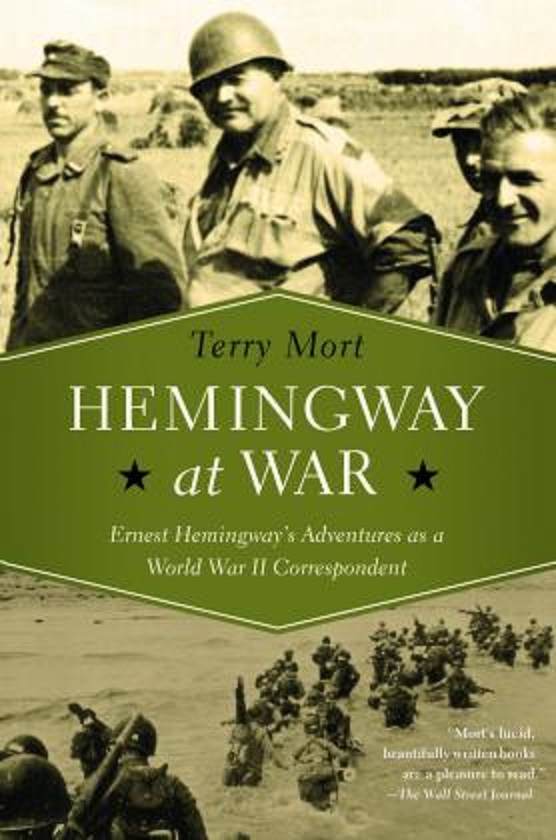
(I reviewed Mort’s book at the Washington Times in 2017 and you can read the review here Paul Davis On Crime: My Washington Times Review Of ‘Hemingway at War: Ernest Hemingway’s Adventures as a World War II Correspondent’)
Despite his WWII combat experiences, I was much disappointed in Hemingway’s failed WWII novel, Across the River and Into the Trees. If only he had written a war novel like his fine short story about WWII, Black Ass at the Crossroads.
I suspect Hemingway was jealous of James Jones for his combat experience as well as his success with the outstanding novel, From Here to Eternity, And as the documentary points out, he lashed out at James Jones in a letter to the publisher.
Mr. Jones’
daughter, who wrote a fine novel herself, A Soldier’s Daughter Never Cries,
saw the nasty letter being read in the TV documentary and wrote about it at the
Daily Beast.
She wrote that Hemingway’s publisher, Charles Scribner, sent Hemingway the galleys of From Here to Eternity, and asked for an endorsement. Rather than an endorsement, Hemingway shot back a letter that attacked James Jones’ first novel and the writer personally, calling him a phony and a coward.
Considering that Jones was a soldier who saw combat and was wounded on Guadalcanal, the inspiration for James Jones’ other great novel, The Thin Red Line, the insult was preposterous.
Kaylee Jones wrote that her late father was far more generous than Hemingway. He told his then-teenage daughter that he felt sorry for Hemingway, explaining that the great writer was not well. Jones believed that Hemingway felt his work was finished and that he would never recover from the severe depression that he suffered from.
Hemingway didn’t. He shot himself in 1961 when he was 62.
Yet Hemingway’s work, like the work of the other writer and warrior, James Jones, has endured.
Hemingway’s posthumous work, such as 1964’s A Moveable Feast and 1970’s Islands in the Stream, are well regarded today.
You can read a previous post on Hemingway via the below link:
Note: Below is a photo of Hemingway in WWII and a photo of Jones in WWII, as well as a photo of Jones and his daughter when she was young:


