Broad & Liberty ran my piece on the Philadelphia Navy Yard today.
You can read the piece via the below link or the below text:
Paul Davis: The Navy Yard — past, present, and future

After reading about Governor Shapiro’s announcement of a $30 million investment in the Philadelphia Navy Yard in South Philadelphia, I took a nostalgic walk through the old Navy base.
The
Navy Yard played a big part in my life. I was raised about a dozen blocks from
the yard and back in the 1960s, the Navy was a major employer in Philadelphia.
I knew many people back then who worked “down the yard,” as South
Philadelphians described their place of employment at the southern-most point
in Philadelphia.
My
beginnings in both journalism and government, in a sense, occurred at the Navy
Yard. After school and during summers in the mid-1960s, when I was a teenager,
I sold the Philadelphia Daily News on a street corner at the
yard to civilian yard workers and sailors.
I
recall riding in the back of the newspaper truck as we passed the moored ships
and I dreamed of joining the Navy, seeing the world, and eventually becoming a
writer. I enlisted in the Navy when I was seventeen in 1970, and after serving
two years on the aircraft carrier USS Kitty Hawk during the
Vietnam War and another two years on a Navy tugboat at the nuclear submarine
base at Holy Loch, Scotland, my final duty station was the Philadelphia Navy
Yard, where I was discharged from the Navy.
After my discharge, I became a civilian Defense Department employee and some years later, I became the civilian administrative officer of a Defense Department command. I oversaw security, safety and other programs for the command that was tasked with overseeing defense contractors in the tri-state area, including the Navy contractors who worked on the ships going through overhauls at the yard.
My
office was located at the Defense Personnel Support Center, locally known as
the “Quartermaster,” in South Philadelphia, but I spent a good amount of time
at the nearby Navy Yard. I began as a writer by contributing news and feature
articles to an in-house Defense Department magazine, and I often ventured to
the Navy Yard to cover stories for the magazine. In addition to my other
work-related duties at the yard, I played softball each summer on the yard’s
baseball fields and I attended many military ceremonies and holiday festivals
there. I also dined and drank at the yard’s Officers’ Club.
In
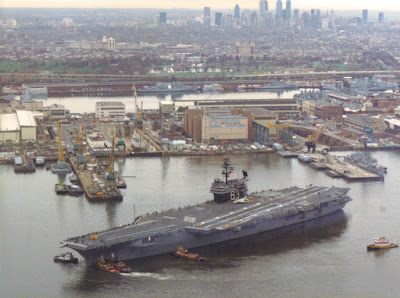
1987, the USS Kitty Hawk returned to the Philadelphia Navy
Yard for an overhaul. Accompanied by my wife and infant daughter, I was on hand
when the great warship pulled into the yard where she was commissioned in 1961.
Wearing my public affairs “hat,” I organized tours of the carrier for the
military and civilian employees of my Defense Department command.
Like
thousands of Navy employees, local residents and companies who did business
with the Navy, I was saddened when the Navy Yard closed in 1996. As a tribute,
I had Captain Jon C. Bergner, the Navy Yard’s commander, and Captain John R.
Hutchison, the commanding officer of the USS John F. Kennedy, the
last aircraft carrier worked on at the yard, as my guests on the “Inside
Government” radio program.
I
was then a producer and on-air host of the public affairs interview program,
which aired on Sunday mornings on WPEN 950 AM and WMGK 102.5 FM. The two Navy
captains discussed the Service Life Extension Program (SLEP) overhaul of
the Kennedy, the mission and history of the yard, and the
planned closing of the Navy Yard.
The
Navy Yard’s history began in 1776 when the Continental Congress leased land
along Philadelphia’s Front Street docks to support naval defense. Southwark
Yard was established at Front and Federal Streets, officially becoming part of
the U.S. Navy. In 1868, League Island was purchased by the federal government
for one dollar, establishing the Philadelphia Naval Shipyard at the base of
South Philadelphia.
The
Navy Yard provided key support to the Navy during WWI, WWII, the Korean War,
and the Vietnam War. On September 26, 1995, the Base Realignment and Closure
Commission (BRAC) ruled that the Navy Yard was to be closed.
In
2000, the Philadelphia Industrial Development Corporation (PIDC), took control
of the Navy Yard on behalf of the City of Philadelphia and the Philadelphia
Authority for Industrial Development (PAID). According to the PIDC, the
post-Navy base is considered the most successful redevelopment of a former
military facility in the country.
The
PIDC stated that more than $1 billion has been invested in the yard, creating a
vibrant, waterfront home for more than 13,500 employees and more than 160
companies in the office, industrial/manufacturing, and R&D sectors. These
companies occupy over 7.5 million square feet of real estate in spaces of
varying heights, vintages, and floorplates — all powered by a nationally
recognized microgrid.
On
May 8, Pennsylvania Governor Josh Shapiro visited the Philadelphia
Navy Yard and announced a $30 million investment through
the Pennsylvania Strategic Investments to Enhance Sites (PA SITES).
According to the Governor’s office, the funding supports the development of the
Philadelphia Navy Yard Greenway District and will transform 54 acres into
shovel-ready sites for advanced manufacturing, life sciences, and commercial
use that will help grow Pennsylvania’s economy, foster innovation, and create
jobs.
The
investment in Philadelphia is part of the Governor’s first-round of PA
SITES funding, a total of $64 million awarded to eleven strategic sites
across the Commonwealth.
The
Governor announced that the $30 million grant awarded to Ensemble/Mosaic Navy
Yard LLC will fund utility infrastructure, soil excavation, grading, and
stormwater management to develop the Greenway District. This accelerates a
transformative redevelopment at one of the Commonwealth’s most strategic
business campuses. This work will prepare six lots for up to 700,000 square
feet of advanced manufacturing and commercial space — part of a broader $6
billion redevelopment effort expected to generate 12,000 new jobs.
Ensemble/Mosaic
is a joint venture between national developer Ensemble Real Estate Investments
and Mosaic Development Partners, a Philadelphia-based, Minority Certified
commercial real estate development company. In 2020, the Philadelphia
Industrial Development Corporation (PIDC) awarded the partnership development
rights to 109 acres at the Navy Yard, which they are transforming into a
vibrant, mixed-use district. The master plan includes 9 million square feet of
new development — with lab and manufacturing space for life sciences companies,
4,000 apartments, and 235,000 square feet of retail — reinforcing the Navy
Yard’s position as a regional hub for innovation and growth.
I’m
pleased to see the Navy Yard’s commercial businesses grow alongside the U.S.
Naval Warfare Center and the other Navy commands that are at the yard. But in
addition to the new business ventures, I’d like to see the development of a
Philadelphia Navy Yard Museum on a decommissioned aircraft carrier, much like
the former USS Intrepid in New York City.
The
Navy Yard Museum would highlight and honor the yard workers, sailors, Marines
and contractors who helped to support our Navy in wartime and the overall
defense of our great nation.
Paul Davis, a Philadelphia writer and frequent contributor to Broad + Liberty, also contributes to Counterterrorism magazine and writes the “On Crime” column for the Washington Times. He can be reached at pauldavisoncrime.com.
Note: The top photo of me standing along the aircraft carrier USS Kitty Hawk at the Philadelphia Navy Yard in 1987 was taken by Joe Piazza.