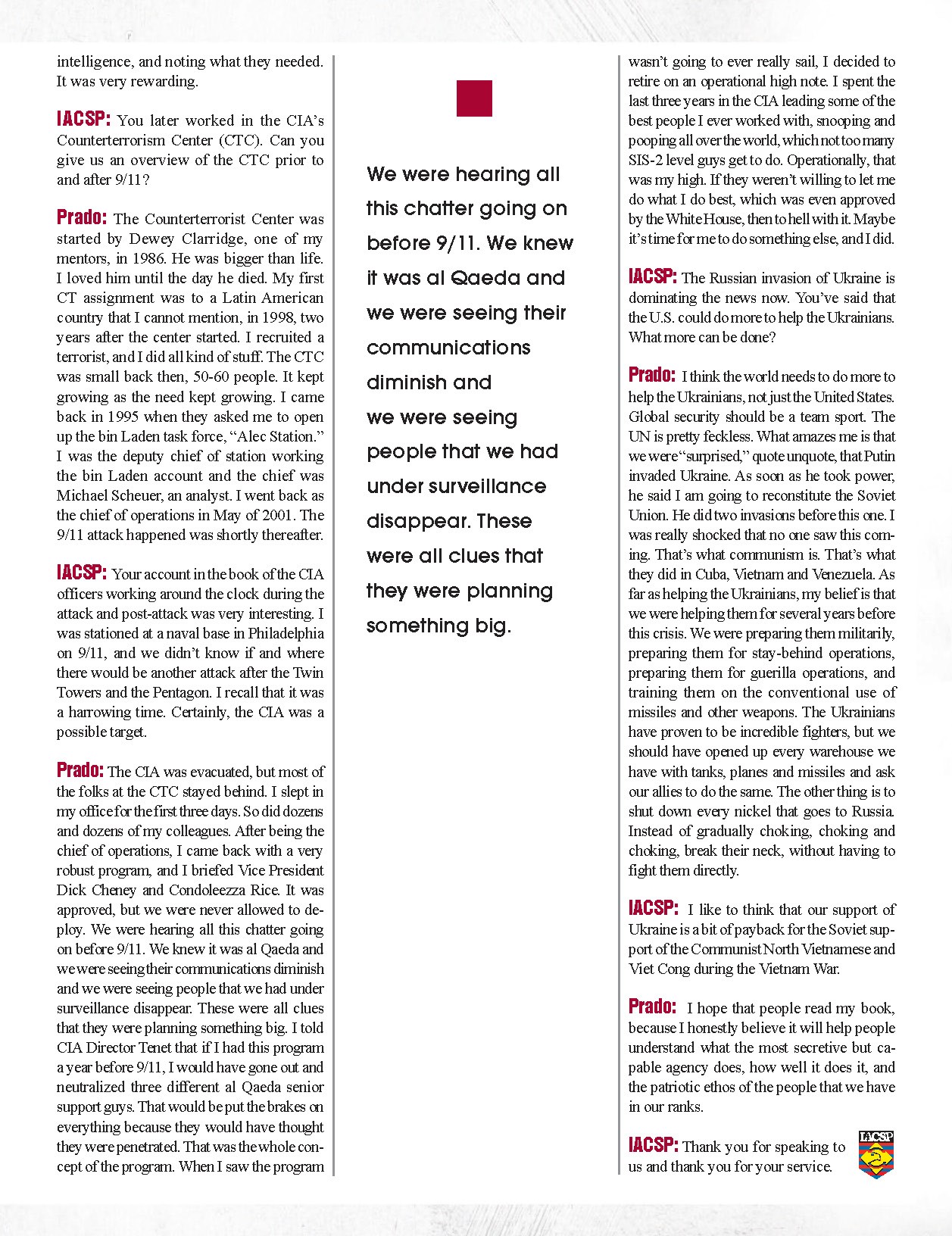
Counterterrorism magazine ran my piece on how the FBI caught the traitorous Cuban spies.
You can read the
piece via the below pages or the below text:


How the FBI Caught the Traitorous Cuban
Spies
By Paul Davis
When one thinks of the threat of spies in the
United States, one usually thinks of the Soviet KGB and Communist China’s MSS.
But as many CIA officers and FBI special agents are quick to note, Communist
Cuba’s Intelligence Directorate (DI) is a
formidable foe and a true threat to American national security.
The Directorate General of
Intelligence (DGI) was established in 1961 when Fidel Castro took over of the
Caribbean Island. Tutored by the Soviet KGB, the DGI became responsible for
intelligence, counterintelligence, and disinformation both inside Cuba and
abroad. The name of Cuban intelligence was changed to the DI in 1989.

On December 4,
2023, the U.S. Attorney’s Office, Southern District of Florida, in Miami announced
that they had charged Victor Manuel Rocha (seen in the above photo), 73, of Miami, Florida, with
committing multiple federal crimes by secretly acting for decades as an agent
of the government of Communist Cuba.
Like Kendall Myers, a former State Department official, who along
with his wife Gwendolyn, was convicted of spying for Cuba in 2010, and Ana
Montes (seen in the above photo receiving an award from then-CIA Director George Tenet), a former Defense Intelligence Agency (DIA) analyst who was convicted of
spying for Cuba in 2002, Rocha stands accused of being run successfully as a
spy for many years by Cuba intelligence.
Rocha, a former
U.S. Department of State employee, served on the National Security Council from
1994 to 1995 and ultimately as the U.S. Ambassador to Bolivia from 2000 to 2002.
“This action
exposes one of the highest-reaching and longest-lasting infiltrations of the
United States government by a foreign agent,” Attorney General Merrick B.
Garland said. “We allege that for over 40 years, Victor Manuel Rocha served as
an agent of the Cuban government and sought out and obtained positions within
the United States government that would provide him with access to non-public
information and the ability to affect U.S. foreign policy. Those who have the
privilege of serving in the government of the United States are given an
enormous amount of trust by the public we serve. To betray that trust by
falsely pledging loyalty to the United States while serving a foreign power is
a crime that will be met with the full force of the Justice Department.”
Also weighing in
was FBI Director Christophr Wray, who stated, “Like all federal officials, U.S.
diplomats swear an oath to support and defend the Constitution of the United
States. Acting as an agent for Cuba – a hostile foreign power – is a blatant
violation of that oath and betrays the trust of the American people.”
According to the federal
criminal complaint, beginning approximately in 1981, and continuing to the
present, Rocha, a naturalized U.S. citizen originally from Colombia, secretly
supported the Republic of Cuba and its clandestine intelligence-gathering
mission against the United States by serving as a covert agent of Cuba’s DGI.
Rocha obtained
employment in the U.S. Department of State between 1981 and 2002, in positions
that provided him access to nonpublic information, including classified
information, and the ability to affect U.S. foreign policy. After his State
Department employment ended, Rocha engaged in other acts intended to support
Cuba’s intelligence services. From around 2006 until 2012, Rocha was an advisor
to the Commander of the U.S. Southern Command, a joint command of the United
States military whose area of responsibility includes Cuba.
The complaint further
alleges that Rocha kept his status as a Cuban agent secret in order to protect
himself and others and to allow himself the opportunity to engage in additional
clandestine activity. Rocha provided false and misleading information to the
United States to maintain his secret mission; traveled outside the United
States to meet with Cuban intelligence operatives; and made false and
misleading statements to obtain travel documents.
Rocha began his
State Department career in 1981, rising through the ranks to serve in a variety
of roles, including being the First Secretary at the U.S. Embassy in Mexico
City, Mexico, the Deputy Chief of Mission at the U.S. Embassy in Santo Domingo,
Dominican Republic, the Director of Inter-American Affairs on the U.S. National
Security Council, with special responsibility for, among other things, Cuba, the
Deputy Principal Officer at the U.S. Interests Section in Havana, Cuba, the
Deputy Chief of Mission at the U.S. Embassy in Buenos Aires, Argentina, and he served as the Ambassador to Bolivia at the
U.S. Embassy in La Paz, Bolivia.
The Justice
Department alleges that, in a series of meetings during 2022 and 2023 with an FBI
undercover agent posing as a Cuban intelligence officer, Rocha made repeated
statements admitting his “decades” of work for Cuba, spanning “40 years.”
When the
undercover agent told Rocha he was “a covert representative here in Miami”
whose mission was “to contact you, introduce myself as your new contact, and
establish a new communication plan,” Rocha answered “Yes,” and proceeded to
engage in a lengthy conversation during which he described and celebrated his
activity as a Cuban intelligence agent.
Throughout the
meetings, Rocha behaved as a Cuban agent, consistently referring to the United
States as “the enemy,” and using the term “we” to describe himself and Cuba.
Rocha additionally praised Fidel Castro as the “Comandante,” and referred to
his contacts in Cuban intelligence as his “Compañeros” (comrades) and to the
Cuban intelligence services as the Dirección.” Rocha described his work
as a Cuban agent as “a grand slam.”
Rocha is charged
with conspiring to act as an agent of a foreign government without prior
notification to the Attorney General; acting as an agent of a foreign
government without prior notification to the Attorney General; and with using a
passport obtained by false statement.

Cuban American Enrique “Ric” Prado (seen in the above photo), a retired CIA official and the author of “Black Ops: The Life of a CIA Shadow Warrior,” spoke of the arrest of Rocha and Ana Montes, who was recently released from prison after serving 20 years for spying for Cuba.
“We should enforce harder measures on those who betray our
government’s trust.”
When asked if Rocha appears to be a
different sort of spy than Montes, he replied, “The cases are similar and the
damage to our security is immeasurable. My colleagues opine that Rocha did more
damage than Montes based on his greater access as an ambassador.’
Prado believes Rocha and Montes should
rot in jail.
Prado, who stated that he fought
communism as a CIA officer in five different incarnations, especially his three
years working in the Contra camps and helping to “dethrone” the Soviet and
Cuban-back Sandinista regime, said the DGI did a good job running these two for
as long as they did.
“Remember, however, Cuban intelligence has
only one enemy, the US of A. Unlike western intelligence services, who have to
deal with all the “isms,” such as communism, terrorism, anarchism, and
radicalism, Cuban intelligence is omni-focused on the U.S.”

The Cuban DI ran Ana Montes (seen in the above mugshot) as a spy for 17 years. At the Defense Intelligence Agency, Ana Montes was the go-to expert on Cuba. Her colleagues called her the “Queen of Cuba,” but they were unaware that she was also spying for the communist nation.
Montes is the daughter of a former U.S. Army colonel, sister of an FBI translator, sister of an FBI agent, and briefly the girlfriend of a defense analyst for the Southern Command, but she chose to betray her country.
She led a double life, working as a senior analyst for the DIA and as a spy for Cuban intelligence. According to the FBI, her downfall began in 1996, when an astute DIA colleague named Scott W. Carmichal - acting on a gut feeling - reported to a security official that he felt Montes might be under the influence of Cuban intelligence. The official interviewed her, but she admitted nothing.
Four
years later, Carmichael learned that the FBI was working to uncover an
unidentified Cuban agent operating in Washington. He contacted the Bureau with
his suspicions. After a careful review of the facts, the FBI opened an
investigation.
Through
physical and electronic surveillance and covert searches, some of which remains
classified, the FBI was able to build a case against Montes. Agents also wanted
to identify her Cuban handler and they were waiting for a face-to-face meeting
between the two of them, putting off her arrest. But as Montes was about to be
assigned work related to U.S. war plans after 9/11, she was finally arrested.

Peter Lapp (seen in the above photo) was the FBI’s co-case agent, along with FBI agent Steve McCoy, of the espionage investigation of Ana Montes, who was arrested ten days after 9/11. Lapp, now retired from the FBI after serving 22-years, wrote about Montes in his book, “Queen of Cuba: An FBI Agent's Insider Account of the Spy Who Evaded Detection for 17 Years.”
He was asked about the Rocha case. “I’m not surprised at his arrest, because the Cubans for decades have targeted the State Department for agents and sources. Kendall Myers (seen in the below mugshot) is a good example of a successful Cuban intelligence operation against the State Department.

“Rocha had access to classified information in his career at various points. But Ana Montes would sit down every day and log onto a top-secret computer system. There were times in his career, such as when he worked at the White House National Security Council, he would do those kind of things. But he’s at a higher level. He’s in the diplomatic corps, he’s in positions where he’s not just looking at intelligence. He’s interacting and trying to execute the policy of the president at that point in time.”
Lapp said he saw Rocha as being more beneficial to the Cubans than Montes from a policy influence perspective, with the ability to shape or influence U.S. policy.
“But day in and day out, Montes clearly had a lot more hands-on access to top secret classified information that the Cubans would have benefited from. The Cubans got value out of both of them in different ways.”
Rocha was arrested after an FBI sting. Lapp was asked to explain in general terms how FBI counterintelligence stings work.
“The mannerisms of the sting operation against Wendall Myers were almost a carbon copy of the Rocha sting. Clearly, Myers had not been in touch with the Cubans for a while and he didn’t have an active DGI handler,” Lapp explained. “The FBI used an individual who walked like a duck and talked like a duck. He didn’t know the secret handshake, but he handed Myers a Cuban cigar and said happy birthday on behalf of your former friends. And that started a new relationship that was orchestrated by the FBI.
“Myers completely implicated himself in passing national defense information. He sat down with the undercover FBI agent in multiple meetings and almost did a recounting of a lot of the classified information that he had passed over the years, which was his downfall. It was very stupid of Myers to do that. The undercover did a great job of eliciting more information out of him that really made the case. So he, so to speak, hung himself. He’s spending a lifetime in prison because of what he told that undercover.”
Lapp said that he was very involved with the Kendall Myers undercover operation. Lapp was the first FBI agent that Myers had encountered.
“So fast forward to Rocha. Rocha makes admissions to a guy who walks like a duck and talks like a duck, to validate the fact that he had been doing this for years. But what he didn’t do was cross that line,” Lapp said. “He didn’t give the undercover an accounting of classified information he passed, so the Bureau didn’t have the espionage charge, because Rocha didn’t help them like Kendall Myers did. The FBI had enough to charge him with being an unregistered agent, which is a crime, but it is a much lesser charge than espionage.”
“Pound for pound, Cuban intelligence is one of the best in the world. They only have about 1,500 or 2,000 people worldwide but look what they have been able to accomplish against the United States intelligence community, which includes the FBI. They kicked our asses for years,” Lapp said.
“They have the ability to find individuals who aren’t motivated by greed, unlike slimeballs spies like Hanssen and Ames. The spies the Russians find are only motivated by money and they have other psychological issues.”
Lapp noted that the Cubans barter their gained intelligence with the Russians and other likeminded people and governments.
When asked about Ana Montes, Lapp said, “I had three different sets of interactions with her. There was the day of her arrest, when Steve McCoy and I arrested her, and I put the handcuffs on her. I was with her for the seven months we debriefed her. We would sit with her for hours and hours and debrief what she did and how she did it. I later visited her in prison in 2004. It was a brief 30-minute meeting, just her and I.
“Ana Montes was very intelligent, intellectually arrogant, and she had a degree of hypocrisy to her. And she is unfortunately free right now.”
Montes is believed to have passed along intelligence that was responsible directly for the death of a Green Beret in Latin America When asked if he felt she was responsible for the Green Beret death, Lapp replied yes, but he could not prove it.
Rocha recently changed his initial not guilty plea in
a court in Miami. He admitted to being a longtime spy for Cuba. Rocha will be
sentenced at a hearing on 12 April.
After the arrest
of Rocha, FBI Director Christopher Wray stated, “The FBI will continue to
rigorously defend against foreign governments targeting America, and we will
find and hold accountable anyone who violates their oath to the United States,
no matter how long it takes.”
Paul Davis, a long-time contributor to The Journal, also writes the IACSP’s online “Threatcon” column.