Showing posts with label Ana Montes. Show all posts

Thursday, March 7, 2024

My Counterterrorism Magazine Piece On How The FBI Caught The Traitorous Cuban Spies

Counterterrorism magazine ran my piece on how the FBI caught the traitorous Cuban spies.

You can read the piece via the below pages or the below text:


How the FBI Caught the Traitorous Cuban Spies

By Paul Davis

 When one thinks of the threat of spies in the United States, one usually thinks of the Soviet KGB and Communist China’s MSS. But as many CIA officers and FBI special agents are quick to note, Communist Cuba’s Intelligence Directorate (DI) is a formidable foe and a true threat to American national security.

The Directorate General of Intelligence (DGI) was established in 1961 when Fidel Castro took over of the Caribbean Island. Tutored by the Soviet KGB, the DGI became responsible for intelligence, counterintelligence, and disinformation both inside Cuba and abroad. The name of Cuban intelligence was changed to the DI in 1989.

On December 4, 2023, the U.S. Attorney’s Office, Southern District of Florida, in Miami announced that they had charged Victor Manuel Rocha (seen in the above photo), 73, of Miami, Florida, with committing multiple federal crimes by secretly acting for decades as an agent of the government of Communist Cuba.

Like Kendall Myers, a former State Department official, who along with his wife Gwendolyn, was convicted of spying for Cuba in 2010, and Ana Montes (seen in the above photo receiving an award from then-CIA Director George Tenet), a former Defense Intelligence Agency (DIA) analyst who was convicted of spying for Cuba in 2002, Rocha stands accused of being run successfully as a spy for many years by Cuba intelligence.

Rocha, a former U.S. Department of State employee, served on the National Security Council from 1994 to 1995 and ultimately as the U.S. Ambassador to Bolivia from 2000 to 2002.

“This action exposes one of the highest-reaching and longest-lasting infiltrations of the United States government by a foreign agent,” Attorney General Merrick B. Garland said. “We allege that for over 40 years, Victor Manuel Rocha served as an agent of the Cuban government and sought out and obtained positions within the United States government that would provide him with access to non-public information and the ability to affect U.S. foreign policy. Those who have the privilege of serving in the government of the United States are given an enormous amount of trust by the public we serve. To betray that trust by falsely pledging loyalty to the United States while serving a foreign power is a crime that will be met with the full force of the Justice Department.”

Also weighing in was FBI Director Christophr Wray, who stated, “Like all federal officials, U.S. diplomats swear an oath to support and defend the Constitution of the United States. Acting as an agent for Cuba – a hostile foreign power – is a blatant violation of that oath and betrays the trust of the American people.”

According to the federal criminal complaint, beginning approximately in 1981, and continuing to the present, Rocha, a naturalized U.S. citizen originally from Colombia, secretly supported the Republic of Cuba and its clandestine intelligence-gathering mission against the United States by serving as a covert agent of Cuba’s DGI.

Rocha obtained employment in the U.S. Department of State between 1981 and 2002, in positions that provided him access to nonpublic information, including classified information, and the ability to affect U.S. foreign policy. After his State Department employment ended, Rocha engaged in other acts intended to support Cuba’s intelligence services. From around 2006 until 2012, Rocha was an advisor to the Commander of the U.S. Southern Command, a joint command of the United States military whose area of responsibility includes Cuba.

The complaint further alleges that Rocha kept his status as a Cuban agent secret in order to protect himself and others and to allow himself the opportunity to engage in additional clandestine activity. Rocha provided false and misleading information to the United States to maintain his secret mission; traveled outside the United States to meet with Cuban intelligence operatives; and made false and misleading statements to obtain travel documents.

Rocha began his State Department career in 1981, rising through the ranks to serve in a variety of roles, including being the First Secretary at the U.S. Embassy in Mexico City, Mexico, the Deputy Chief of Mission at the U.S. Embassy in Santo Domingo, Dominican Republic, the Director of Inter-American Affairs on the U.S. National Security Council, with special responsibility for, among other things, Cuba, the Deputy Principal Officer at the U.S. Interests Section in Havana, Cuba, the Deputy Chief of Mission at the U.S. Embassy in Buenos Aires, Argentina, and  he served as the Ambassador to Bolivia at the U.S. Embassy in La Paz, Bolivia.

The Justice Department alleges that, in a series of meetings during 2022 and 2023 with an FBI undercover agent posing as a Cuban intelligence officer, Rocha made repeated statements admitting his “decades” of work for Cuba, spanning “40 years.”

When the undercover agent told Rocha he was “a covert representative here in Miami” whose mission was “to contact you, introduce myself as your new contact, and establish a new communication plan,” Rocha answered “Yes,” and proceeded to engage in a lengthy conversation during which he described and celebrated his activity as a Cuban intelligence agent.

Throughout the meetings, Rocha behaved as a Cuban agent, consistently referring to the United States as “the enemy,” and using the term “we” to describe himself and Cuba. Rocha additionally praised Fidel Castro as the “Comandante,” and referred to his contacts in Cuban intelligence as his “Compañeros” (comrades) and to the Cuban intelligence services as the Dirección.” Rocha described his work as a Cuban agent as “a grand slam.”

Rocha is charged with conspiring to act as an agent of a foreign government without prior notification to the Attorney General; acting as an agent of a foreign government without prior notification to the Attorney General; and with using a passport obtained by false statement.

Cuban American Enrique “Ric” Prado (seen in the above photo), a retired CIA official and the author of “Black Ops: The Life of a CIA Shadow Warrior,” spoke of the arrest of Rocha and Ana Montes, who was recently released from prison after serving 20 years for spying for Cuba. 

“We should enforce harder measures on those who betray our government’s trust.” 


When asked if Rocha appears to be a different sort of spy than Montes, he replied, “The cases are similar and the damage to our security is immeasurable. My colleagues opine that Rocha did more damage than Montes based on his greater access as an ambassador.’


Prado believes Rocha and Montes should rot in jail.

Prado, who stated that he fought communism as a CIA officer in five different incarnations, especially his three years working in the Contra camps and helping to “dethrone” the Soviet and Cuban-back Sandinista regime, said the DGI did a good job running these two for as long as they did.


“Remember, however, Cuban intelligence has only one enemy, the US of A. Unlike western intelligence services, who have to deal with all the “isms,” such as communism, terrorism, anarchism, and radicalism, Cuban intelligence is omni-focused on the U.S.” 


The Cuban DI ran Ana Montes (seen in the above mugshot) as a spy for 17 years. At the Defense Intelligence Agency, Ana Montes was the go-to expert on Cuba. Her colleagues called her the “Queen of Cuba,” but they were unaware that she was also spying for the communist nation. 

Montes is the daughter of a former U.S. Army colonel, sister of an FBI translator, sister of an FBI agent, and briefly the girlfriend of a defense analyst for the Southern Command, but she chose to betray her country. 

She led a double life, working as a senior analyst for the DIA and as a spy for Cuban intelligence. According to the FBI, her downfall began in 1996, when an astute DIA colleague named Scott W. Carmichal - acting on a gut feeling - reported to a security official that he felt Montes might be under the influence of Cuban intelligence. The official interviewed her, but she admitted nothing.

Four years later, Carmichael learned that the FBI was working to uncover an unidentified Cuban agent operating in Washington. He contacted the Bureau with his suspicions. After a careful review of the facts, the FBI opened an investigation.

Through physical and electronic surveillance and covert searches, some of which remains classified, the FBI was able to build a case against Montes. Agents also wanted to identify her Cuban handler and they were waiting for a face-to-face meeting between the two of them, putting off her arrest. But as Montes was about to be assigned work related to U.S. war plans after 9/11, she was finally arrested.

Peter Lapp (seen in the above photo) was the FBI’s co-case agent, along with FBI agent Steve McCoy, of the espionage investigation of Ana Montes, who was arrested ten days after 9/11. Lapp, now retired from the FBI after serving 22-years, wrote about Montes in his book, “Queen of Cuba: An FBI Agent's Insider Account of the Spy Who Evaded Detection for 17 Years.” 

He was asked about the Rocha case. “I’m not surprised at his arrest, because the Cubans for decades have targeted the State Department for agents and sources.  Kendall Myers (seen in the below mugshot) is a good example of a successful Cuban intelligence operation against the State Department. 

“Rocha had access to classified information in his career at various points. But Ana Montes would sit down every day and log onto a top-secret computer system. There were times in his career, such as when he worked at the White House National Security Council, he would do those kind of things. But he’s at a higher level. He’s in the diplomatic corps, he’s in positions where he’s not just looking at intelligence. He’s interacting and trying to execute the policy of the president at that point in time.” 

Lapp said he saw Rocha as being more beneficial to the Cubans than Montes from a policy influence perspective, with the ability to shape or influence U.S. policy. 

“But day in and day out, Montes clearly had a lot more hands-on access to top secret classified information that the Cubans would have benefited from. The Cubans got value out of both of them in different ways.” 

Rocha was arrested after an FBI sting. Lapp was asked to explain in general terms how FBI counterintelligence stings work. 

“The mannerisms of the sting operation against Wendall Myers were almost a carbon copy of the Rocha sting. Clearly, Myers had not been in touch with the Cubans for a while and he didn’t have an active DGI handler,” Lapp explained. “The FBI used an individual who walked like a duck and talked like a duck. He didn’t know the secret handshake, but he handed Myers a Cuban cigar and said happy birthday on behalf of your former friends. And that started a new relationship that was orchestrated by the FBI. 

“Myers completely implicated himself in passing national defense information. He sat down with the undercover FBI agent in multiple meetings and almost did a recounting of a lot of the classified information that he had passed over the years, which was his downfall. It was very stupid of Myers to do that. The undercover did a great job of eliciting more information out of him that really made the case. So he, so to speak, hung himself. He’s spending a lifetime in prison because of what he told that undercover.” 

Lapp said that he was very involved with the Kendall Myers undercover operation. Lapp was the first FBI agent that Myers had encountered. 

“So fast forward to Rocha. Rocha makes admissions to a guy who walks like a duck and talks like a duck, to validate the fact that he had been doing this for years. But what he didn’t do was cross that line,” Lapp said. “He didn’t give the undercover an accounting of classified information he passed, so the Bureau didn’t have the espionage charge, because Rocha didn’t help them like Kendall Myers did. The FBI had enough to charge him with being an unregistered agent, which is a crime, but it is a much lesser charge than espionage.” 

“Pound for pound, Cuban intelligence is one of the best in the world. They only have about 1,500 or 2,000 people worldwide but look what they have been able to accomplish against the United States intelligence community, which includes the FBI. They kicked our asses for years,” Lapp said.    

“They have the ability to find individuals who aren’t motivated by greed, unlike slimeballs spies like Hanssen and Ames. The spies the Russians find are only motivated by money and they have other psychological issues.” 

Lapp noted that the Cubans barter their gained intelligence with the Russians and other likeminded people and governments. 

When asked about Ana Montes, Lapp said, “I had three different sets of interactions with her. There was the day of her arrest, when Steve McCoy and I arrested her, and I put the handcuffs on her. I was with her for the seven months we debriefed her. We would sit with her for hours and hours and debrief what she did and how she did it. I later visited her in prison in 2004. It was a brief 30-minute meeting, just her and I. 

“Ana Montes was very intelligent, intellectually arrogant, and she had a degree of hypocrisy to her. And she is unfortunately free right now.” 

Montes is believed to have passed along intelligence that was responsible directly for the death of a Green Beret in Latin America When asked if he felt she was responsible for the Green Beret death, Lapp replied yes, but he could not prove it. 

Rocha recently changed his initial not guilty plea in a court in Miami. He admitted to being a longtime spy for Cuba. Rocha will be sentenced at a hearing on 12 April.

After the arrest of Rocha, FBI Director Christopher Wray stated, “The FBI will continue to rigorously defend against foreign governments targeting America, and we will find and hold accountable anyone who violates their oath to the United States, no matter how long it takes.”

Paul Davis, a long-time contributor to The Journal, also writes the IACSP’s online “Threatcon” column. 

Friday, June 2, 2023

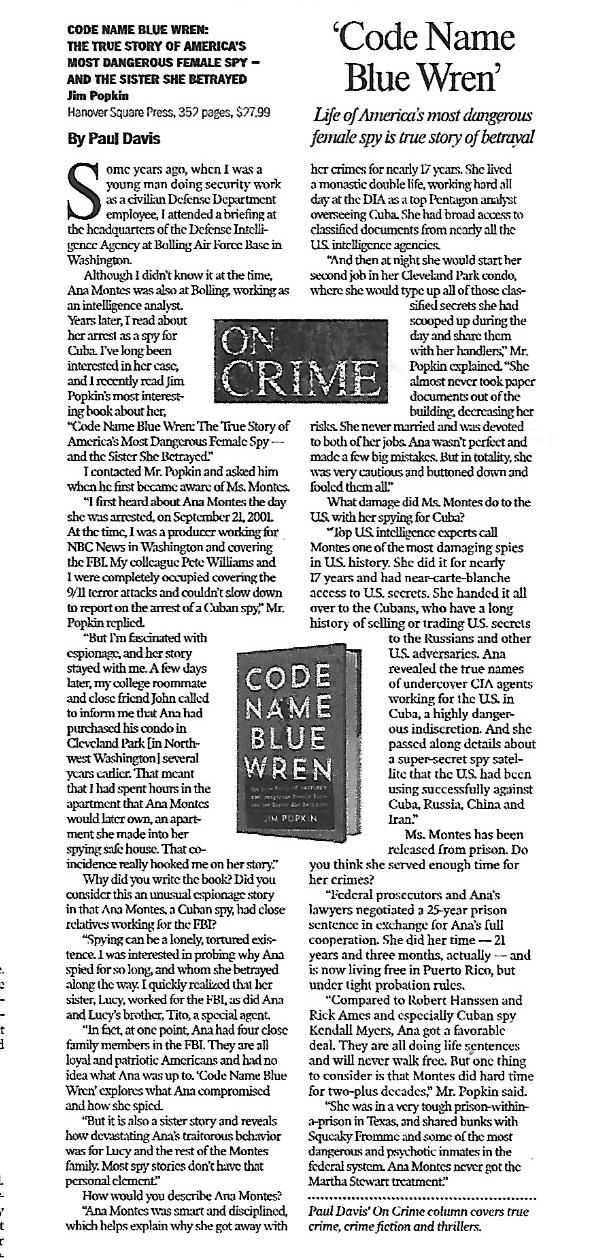
Code Name Blue Wren: My Washington Times On Crime Column On Cuban Spy Ana Montes

The Washington Times ran my On Crime column on Jim Popkin’s Code Name Blue Wren: The True Story of America’s Most Dangerous Female Spy — and the Sister She Betrayed. 

You can read the column via the below link or the below text:


BOOK REVIEW: 'Code Name Blue Wren' - Washington Times


Some years ago, when I was a young man performing security work as a civilian Defense Department employee, I attended a briefing at the headquarters of the Defense Intelligence Agency at Bolling Air Force Base in Washington.


Although I didn’t know it at the time, Ana Montes was also at Bolling, working as an intelligence analyst. Years later, I read about her arrest as a spy for Cuba. I’ve long been interested in her case, and I recently read Jim Popkin’s most interesting book about her, “Code Name Blue Wren: The True Story of America’s Most Dangerous Female Spy — and the Sister She Betrayed.”


I contacted Mr. Popkin (seen in the bottom photo) and asked him when he first became aware of Ms. Montes.


“I first heard about Ana Montes the day she was arrested, on September 21, 2001. At the time, I was a producer working for NBC News in Washington and covering the FBI. My colleague Pete Williams and I were completely occupied covering the 9/11 terror attacks and couldn’t slow down to report on the arrest of a Cuban spy,” Mr. Popkin replied.


“But I’m fascinated with espionage, and her story stayed with me. A few days later, my college roommate and close friend John called to inform me that Ana had purchased his condo in Cleveland Park [in Northwest Washington] several years earlier. That meant that I had spent hours in the apartment that Ana Montes would later own, an apartment she made into her spying safe house. That coincidence really hooked me on her story.”


Why did you write the book? Did you consider this an unusual espionage story in that Ana Montes, a Cuban spy, had close relatives working for the FBI?


“Spying can be a lonely, tortured existence. I was interested in probing why Ana spied for so long, and whom she betrayed along the way. I quickly realized that her sister, Lucy, worked for the FBI, as did Ana and Lucy’s brother, Tito, a special agent. In fact, at one point, Ana had four close family members in the FBI. They are all loyal and patriotic Americans and had no idea what Ana was up to. “Code Name Blue Wren” explores what Ana compromised and how she spied. But it is also a sister story and reveals how devastating Ana’s traitorous behavior was for Lucy and the rest of the Montes family. Most spy stories don’t have that personal element.”


How would you describe Ana Montes?


“Ana Montes was smart and disciplined, which helps explain why she got away with her crimes for nearly 17 years. She lived a monastic double life, working hard all day at the DIA as a top Pentagon analyst overseeing Cuba. She had broad access to classified documents from nearly all the U.S. intelligence agencies.


“And then at night she would start her second job in her Cleveland Park condo, where she would type up all of those classified secrets she had scooped up during the day and share them with her handlers,” Mr. Popkin explained. “She almost never took paper documents out of the building, decreasing her risks. She never married and was devoted to both of her jobs. Ana wasn’t perfect and made a few big mistakes. But in totality, she was very cautious and buttoned down and fooled them all.”


What damage did Ms. Montes do to the U.S. with her spying for Cuba?


“Top U.S. intelligence experts call Montes one of the most damaging spies in U.S. history. She did it for nearly 17 years and had near-carte-blanche access to U.S. secrets. She handed it all over to the Cubans, who have a long history of selling or trading U.S. secrets to the Russians and other U.S. adversaries. Ana revealed the true names of undercover CIA agents working for the U.S. in Cuba, a highly dangerous indiscretion. And she passed along details about a super-secret spy satellite that the U.S. had been using successfully against Cuba, Russia, China and Iran.”


Ms. Montes has been released from prison. Do you think she served enough time for her crimes?


“Federal prosecutors and Ana’s lawyers negotiated a 25-year prison sentence in exchange for Ana’s full cooperation. She did her time — 21 years and three months, actually — and is now living free in Puerto Rico, but under tight probation rules. “Compared to Robert Hanssen and Rick Ames and especially Cuban spy Kendall Myers, Ana got a favorable deal. They are all doing life sentences and will never walk free. But one thing to consider is that Montes did hard time for two plus decades,” Mr. Popkin said. “She was in a very tough prison-within-a-prison in Texas, and shared bunks with Squeaky Fromme and some of the most dangerous and psychotic inmates in the federal system. Ana Montes never got the Martha Stewart treatment.”


Paul Davis’ On Crime column covers true crime, crime fiction and thrillers.


Sunday, July 18, 2010

Traitors, Spies and Fidel Castro's True Believers: Walter Kendall Myers, Gwendolyn Myers & Ana Montes


While there has been front page news coverage about the roll up of the Russian spy ring and the subsequent spy swap, a much more serious spy case has concluded with lessor fanfare on July 16th.
 
Walther Kendall Myers, a former U.S. State Department official, was sentenced to life in prison and his wife Gwendoyn was sentenced to 81 months. The elderly couple (seen in the above photo) spied for Cuba for nearly 30 years.
 
Although Cuba is a pitiful little Communist dictatorship on a small island 90-miles off Key West, Florida, their intelligence service is very aggressive and they share their intelligence with other adversaries of America. The Myers are the latest Americans to betray America because they are true believers in Fidel Castro and his evil little country.
 
Ana Montes, a former Defense Intelligence Agency analyst, also spied for Cuba. She was sentenced to 25 years in prison in 2002.
 
You can read more below about the traitors, spies and Castro's true believers; Walter Kendall Myers, Gwendolyn Myers, and Ana Montes:
 
Below is a U.S. Justice Department release on the Myers' sentencing:

Former State Department Official Sentenced to Life in Prison for Nearly 30-year Espionage Conspiracy, Wife of Official Sentenced to Nearly Seven Years in Prison for Her Role.

WASHINGTON -- Walter Kendall Myers, a former State Department official, and his wife, wendolyn Steingraber Myers, have been sentenced to life in prison without the possibility of parole and 81 months in prison, respectively, for their roles in a nearly 30-year conspiracy to provide highly-classified U.S. national defense information to the Republic of Cuba.

The sentences, handed down today by Judge Reggie B. Walton in U.S. District Court for the District of Columbia, were announced by David Kris, Assistant Attorney General for National Security; Ronald C. Machen Jr., U.S. Attorney for the District of Columbia; Shawn Henry, Assistant Director for the FBI’s Washington Field Office; and Ambassador Eric J. Boswell, Assistant Secretary of State for Diplomatic Security.

On Nov. 20, 2009, defendant Kendall Myers, 73, aka “Agent 202,” pleaded guilty to a three-count criminal information charging him with conspiracy to commit espionage and two counts of wire fraud. His wife, Gwendolyn Myers, 72, aka “Agent 123,” and “Agent E-634,” pleaded guilty to a one-count criminal information charging her with conspiracy to gather and transmit national defense information. The defendants, both residents of Washington, D.C., were arrested on June 4, 2009, by FBI agents and have remained in custody ever since.

Both defendants have agreed to the entry of a monetary judgment against them in the amount of $1,735,054. The assets that will be forfeited to the government towards satisfaction of that judgment include the proceeds from the sale of the defendants’ apartment and vehicle, and various bank and investment accounts.

“For nearly 30 years, this couple proudly committed espionage on behalf of a long-standing foreign adversary. Today, they are being held accountable for their actions. Their sentences should serve as a clear warning to others who would willingly compromise our nation’s most sensitive classified information,” said David Kris, Assistant Attorney General for National Security.

“Kendall and Gwendolyn Myers were brought to justice not because they were careless, but because of an extremely well-planned and executed counterintelligence investigation that required the unprecedented cooperation of multiple agencies of the U.S. government tasked with protecting our national security,” said Ronald C. Machen Jr., U.S. Attorney for the District of Columbia. “Others like the Myers who are presently betraying the trust that this country has placed in them should know that they are not safe from prosecution regardless of how careful they think they are being. As with Kendall and Gwendolyn Myers, they will be caught and brought to justice.”

Shawn Henry, Assistant Director of the FBI’s Washington Field Office, said: “The Myers made a conscious decision to betray the United States and its citizens. The FBI, along with its partners in the U.S. Intelligence Community, will continue to aggressively pursue anyone who seeks to cause the same harm.”

“Walter Kendall Myers betrayed his country. By committing acts of espionage Myers grievously violated the confidence placed in him by the U.S. Department of State and the American people. Today, he has been rightfully sentenced for crimes against our nation,” said Assistant Secretary for State for Diplomatic Security Eric J. Boswell.

Background

According to the sentencing memorandum, plea agreements and other documents filed in court by the United States:

Kendall Myers began working at the State Department in 1977 as a contract instructor at the Department’s Foreign Service Institute (FSI) in Arlington, Va. After living briefly with Gwendolyn in South Dakota, he returned to Washington, D.C., and resumed employment as an instructor with FSI. From 1988 to 1999, in addition to his FSI duties, he performed work for the State Department’s Bureau of Intelligence and Research (INR). He later worked full-time in INR and, from July 2001 until his retirement in October 2007, was an intelligence analyst for Europe in INR where he specialized on European matters and had daily access to classified information through computer databases and otherwise. He received a “Top Secret” security clearance in 1985 and, in 1999, received access to “Sensitive Compartmental Information.”

Gwendolyn Myers moved to Washington, D.C., in 1980 and married Kendall Myers in May 1982. She later obtained employment with a local bank as an administrative analyst and later as a special assistant. Gwendolyn Myers was never granted a security clearance by the U.S. government.

Recruitment

In December 1978, while an employee of the State Department’s FSI, Kendall Myers traveled to Cuba after being invited by a Cuban government official who had made a presentation at FSI. That Cuban official was an intelligence officer for the Cuban Intelligence Service (CuIS). This trip provided CuIS with the opportunity to assess or develop Myers as a Cuban agent. Myers kept a diary of his two-week trip to Cuba in which he explicitly declared his affinity for Fidel Castro and the Cuban government. The diary was recovered by the FBI in the investigation.

In 1979, Kendall and Gwendolyn Myers were visited in South Dakota by the same Cuban intelligence officer who had invited Kendall Myers to Cuba. During the visit, the Cuban intelligence officer recruited both of them to be clandestine agents for Cuba, a role in which they served for the next 30 years. Their recruitment by CuIS as “paired” agents is consistent with CuIS’s past practice in the United States. Afterwards, CuIS directed Kendall Myers to pursue a job at the State Department or the CIA to gain access to classified information. Kendall Myers, accompanied by his wife, returned to Washington, D.C., where he pursued a position at the State Department.

During the time frame in which Kendall and Gwendolyn Myers were serving as clandestine agents for Cuba, the CuIS often communicated with its clandestine agents in the United States by broadcasting encrypted radio messages from Cuba on shortwave radio frequencies. Clandestine agents in the United States monitoring the frequency on shortwave radio could decode the messages using a decryption program provided by CuIS. Kendall and Gwendolyn Myers communicated with CuIS by this method. The shortwave radio they used to receive clandestine communications was purchased with money provided by CuIS. The shortwave radio was later recovered by the FBI.

Undercover Operation

According to the court documents, in April 2009, the FBI launched an undercover operation against the pair. Kendall and Gwendolyn Myers met four times with an undercover FBI source, on April 15th, 16th and 30th, and on June 4, 2009. The meetings were all video- and audio-taped.

During the meetings, Kendall and Gwendolyn Myers made a series of statements about their past activities on behalf of CuIS, including how they used code names and how they had transmitted information to their CuIS handlers through personal meetings, “dead drops,” “hand-to-hand” passes, and in at least one case, the exchange of shopping carts in a grocery store. The couple also stated that they had traveled to meet Cuban agents in Trinidad and Tobago, Jamaica, Mexico, Brazil, Ecuador, Argentina and other locations.

When asked by the undercover FBI agent if he had ever transmitted information to CuIS that was classified higher than “Secret,” Kendall Myers replied, “oh yeah…oh yeah.” He said he typically removed information from the State Department by memory or by taking notes, although he did take some classified documents home. Gwendolyn Myers admitted she would process the classified documents at home for delivery to their CuIS handlers. In the final meeting with the FBI source, Kendall Myers disclosed “Top Secret” national defense information related to sources and methods of gathering intelligence. He also admitted that he had previously disclosed the information to CuIS.

Corroboration

The admissions by Kendall and Gwendolyn Myers were corroborated by other evidence collected in the investigation. The FBI seized a shortwave radio in their apartment and confirmed overseas trips by the couple that corresponded to statements they made. The FBI also identified encrypted shortwave radio messages between CuIS and a handler for the couple that were broadcast in 1996 and 1997.

Furthermore, an analysis of Kendall Myers’ State Department computer revealed that, from August 22, 2006, until his retirement on Oct. 31, 2007, he viewed more than 200 intelligence reports concerning the subject of Cuba. Of these reports concerning Cuba, the majority was classified and marked “Secret” or “Top Secret.” The FBI also located handwritten notes by Kendall Myers reflecting the gathering and retention of “Top Secret” information which he intended to provide the CuIS, but never did.

Finally, since at least 1983 and until 2007, Kendall Myers made repeated false statements to government investigators responsible for conducting background investigations which determined his continued suitability for a “Top Secret” security clearance. By not disclosing his and his wife’s clandestine activity on behalf of CuIS and by making false statements to the State Department about their status as clandestine Cuban agents, he defrauded the United States whenever he received his government salary. Based on these false representations and promises, Kendall Myers obtained at least $1,735,054 in salary from the U.S. government for the benefit of him and his wife.

This investigation was conducted jointly by the FBI’s Washington Field Office and the State Department’s Bureau of Diplomatic Security. The prosecution was handled by Assistant U.S. Attorney G. Michael Harvey, from the U.S. Attorney’s Office for the District of Columbia, and Senior Trial Attorney Clifford I. Rones, from the Counterespionage Section of the Justice Department’s National Security Division.

 
I reviewed True Believer: Inside the Investigation and Capture of Ana Montes, Cuba's Master Spy, by Scott W. Carmichael for The Philadelphia Inquirer in 2007.
 
Carmichael was a Defense Intelligence Agency investigator who worked with the FBI and federal prosecutors on the Montes case.
 
You can read my review via the two links below:
 
 
And Below is the FBI's account of the Ana Montes case:
 
The Case of the Cuban Spy

A "cheat sheet" provided by Cuban intelligence that Ana Montes used to help her encrypt and decrypt messages to and from her handlers.

Just 10 days after the attacks of 9/11, the FBI arrested a 44-year-old woman named Ana Belen Montes.

She had nothing to do with the terrorist strikes, but her arrest had everything to do with protecting the country at a time when national security was of paramount importance.

Montes, it turned out, was spying for the Cubans from inside the U.S. intelligence community itself—as a senior analyst with the Defense Intelligence Agency, or DIA. And she was soon to have access to classified information about America’s planned invasion of Afghanistan the following month.

Montes was actually the DIA’s top Cuban analyst and was known throughout the U.S. intelligence community for her expertise. Little did anyone know how much of an expert she had become…and how much she was leaking classified U.S. military information and deliberately distorting the government’s views on Cuba.

It began as a classic tale of recruitment. In 1984, Montes held a clerical job at the Department of Justice in Washington. She often spoke openly against the U.S. government’s policies towards Central America. Soon, her opinions caught the attention of Cuban “officials” who thought she’d be sympathetic to their cause. She met with them. Soon after, Montes agreed to help Cuba.

She knew she needed a job inside the intelligence community to do that, so she applied at DIA, a key producer of intelligence for the Pentagon. By the time she started work there in 1985, she was a fully recruited spy.

Montes was smart. To escape detection, she never removed any documents from work, electronically or in hard copy. Instead, she kept the details in her head and went home and typed them up on her laptop. Then, she transferred the information onto encrypted disks. After receiving instructions from the Cubans in code via short-wave radio, she’d meet with her handler and turn over the disks.
 
Below is a photo of Montes' "cheat sheet."
 

During her years at DIA, security officials learned about her foreign policy views and were concerned about her access to sensitive information, but they had no reason to believe she was sharing secrets. And she had passed a polygraph.

Her downfall began in 1996, when an astute DIA colleague—acting on a gut feeling—reported to a security official that he felt Montes might be under the influence of Cuban intelligence. The official interviewed her, but she admitted nothing.

The security officer filed the interview away until four years later, when he learned that the FBI was working to uncover an unidentified Cuban agent operating in Washington. He contacted the Bureau with his suspicions. After a careful review of the facts, the FBI opened an investigation.

Through physical and electronic surveillance and covert searches, the FBI was able to build a case against Montes. Agents also wanted to identify her Cuban handler and were waiting for a face-to-face meeting between the two of them, which is why they held off arresting her for some time.
 
However, outside events overtook the investigation—as a result of the 9/11 attacks, Montes was about to be assigned work related to U.S. war plans. The Bureau and DIA didn’t want that to happen, so she was arrested.

What was Montes’ motivation for spying? Pure ideology—she disagreed with U.S. foreign policy. Montes accepted no money for passing classified information, except for reimbursements for some expenses.

Montes, who acknowledged revealing the identities of four American undercover intelligence officers working in Cuba, pled guilty in 2002 and was sentenced to 25 years in prison.