Showing posts with label Cuban Spy. Show all posts

Sunday, May 10, 2026

Justice Department Sues To Revoke US Citizenship Of Convicted Cuban Spy

The Justice Department released the information below:

The U.S. Department of Justice filed a civil denaturalization complaint yesterday against Victor Manuel Rocha in the United States District Court for the Southern District of Florida. Rocha is a native of Colombia who was convicted of serving as an unregistered agent for the Republic of Cuba.

“Under no circumstances should an agent of a foreign adversary be permitted to hold the title of American citizen,” said Assistant Attorney General Brett Shumate. “Our mission is clear: to root out these fraudsters and preserve the sanctity of the naturalization process for those who adhere to our laws. Any individual who lied during the naturalization process to gain a foothold in this country will be met with the full weight of the Department of Justice.”  

“Victor Manuel Rocha was not a low-level operative. He was a former United States Ambassador and senior government official who admitted he secretly served the Cuban regime for decades,” said U.S. Attorney Jason A. Reding Quiñones for the Southern District of Florida. “The Southern District of Florida helped take down one of the most prolific Cuban spies ever uncovered in the United States. This civil denaturalization case is about finishing the job. The complaint alleges that Rocha obtained American citizenship through lies, concealment, and betrayal. A person who secretly serves communist Cuba should not keep the privilege of United States citizenship, even while in prison.”

The U.S. seeks an order revoking Rocha’s naturalization based on his admission in criminal proceedings that he began spying for Cuba in 1973 before he naturalized in 1978. When he applied for naturalization, Rocha represented under penalty of perjury that he had not committed crimes for which he had not been arrested; he was not affiliated with the Communist Party of Cuba; he had not advocated, believed in, or knowingly supported and furthered the interests of Communism; and he believed in the U.S. Constitution and the form of government of the U.S. None of these were true.

In 2023, Rocha was charged with several counts related to spying for the Republic of Cuba and passport fraud. U.S. v. Rocha, No. 1:23-cr-20464-Bloom (S.D. Fla. Dec. 5, 2023). In April 2024, Rocha admitted that, starting in or around 1973, he secretly supported the Republic of Cuba and its clandestine intelligence-gathering mission against the U.S. by serving as a covert agent of Cuba’s intelligence services. He pleaded guilty and was convicted of Conspiracy to Act as an Agent of a Foreign Government and to Defraud the United States and Acting as an Illegal Agent of a Foreign Government. He was sentenced to and is serving a 15-year sentence.

The U.S. will bring seven independent counts seeking the revocation of his U.S. citizenship. Rocha was not qualified for naturalization for several reasons, including that he committed unlawful acts, gave false testimony during his naturalization examination, was not attached to the principles of the U.S. Constitution and not well-disposed to the good order and happiness of the U.S., was affiliated with the Communist Party of Cuba, and advocated for communism. The U.S. will also seek the revocation of his naturalization because he procured his citizenship by concealing material facts or willful misrepresenting several facts in naturalization proceedings related to spying for Cuba.

The case was investigated by the Federal Bureau of Investigation, Homeland Security Investigations, and U.S. Immigration and Customs Enforcement. The Denaturalization Unit of the Civil Division’s Office of Immigration Litigation and the U.S. Attorney’s Office for the Southern District of Florida are litigating the case.

The claims made in the complaint are allegations only, and there has been no determination of liability.                                                              


Monday, December 4, 2023

Former U.S. Ambassador And National Security Council Official Charged With Secretly Acting As An Agent Of the Cuban Government

The U.S. Attorney’s Office, Southern District of Florida released the below information:

MIAMI – Federal prosecutors have charged Victor Manuel Rocha, 73, of Miami, Florida, a former U.S. Department of State employee who served on the National Security Council from 1994 to 1995 and ultimately as U.S. Ambassador to Bolivia from 2000 to 2002, with committing multiple federal crimes by secretly acting for decades as an agent of the government of the Republic of Cuba.

“This action exposes one of the highest-reaching and longest-lasting infiltrations of the United States government by a foreign agent,” said Attorney General Merrick B. Garland. “We allege that for over 40 years, Victor Manuel Rocha served as an agent of the Cuban government and sought out and obtained positions within the United States government that would provide him with access to non-public information and the ability to affect U.S. foreign policy. Those who have the privilege of serving in the government of the United States are given an enormous amount of trust by the public we serve. To betray that trust by falsely pledging loyalty to the United States while serving a foreign power is a crime that will be met with the full force of the Justice Department.”

“The Southern District and our law enforcement partners stand ready to protect the United States from individuals who act unlawfully as agents of foreign governments,” said U.S. Attorney Markenzy Lapointe for the Southern District of Florida. “Individuals who violate federal law by engaging in clandestine activity for hostile foreign states, and by providing false information about those activities to the U.S. government, endanger American democracy. That is especially so for past or present employees of the United States who took an oath to uphold the U.S. Constitution, and for U.S. citizens who benefit from the freedoms and opportunities of this country. The U.S. Attorney’s Office and our law enforcement partners in South Florida, and elsewhere, will continue to vigorously enforce all federal laws.”

“Like all federal officials, U.S. diplomats swear an oath to support and defend the Constitution of the United States. Acting as an agent for Cuba – a hostile foreign power – is a blatant violation of that oath and betrays the trust of the American people,” said FBI Director Christopher Wray. “The FBI will continue to rigorously defend against foreign governments targeting America, and we will find and hold accountable anyone who violates their oath to the United States, no matter how long it takes.”

“For decades, Rocha allegedly worked as a covert agent for Cuba and abused his position of trust in the U.S. government to advance the interests of a foreign power,” said Assistant Attorney General Matthew G. Olsen of the Justice Department’s National Security Division. “However long it might take, we will deliver justice to those who betray their solemn oaths to the American people.”

According to the complaint, beginning no later than approximately 1981, and continuing to the present, Rocha, a naturalized U.S. citizen originally from Colombia, secretly supported the Republic of Cuba and its clandestine intelligence-gathering mission against the United States by serving as a covert agent of Cuba’s General Directorate of Intelligence.

To further that role, according to the complaint, Rocha obtained employment in the U.S. Department of State between 1981 and 2002, in positions that provided him access to nonpublic information, including classified information, and the ability to affect U.S. foreign policy. After his State Department employment ended, Rocha engaged in other acts intended to support Cuba’s intelligence services. From in or around 2006 until in or around 2012, Rocha was an advisor to the Commander of the U.S. Southern Command, a joint command of the United States military whose area of responsibility includes Cuba.

The complaint alleges that Rocha kept his status as a Cuban agent secret in order to protect himself and others and to allow himself the opportunity to engage in additional clandestine activity. Rocha provided false and misleading information to the United States to maintain his secret mission; traveled outside the United States to meet with Cuban intelligence operatives; and made false and misleading statements to obtain travel documents.

According to the complaint, Rocha began his State Department career in 1981, rising through the ranks to serve in a variety of roles, including (1) from in or around February 1989 until in or around November 1991, as the First Secretary at the U.S. Embassy in Mexico City, Mexico; (2) from in or around November 1991 until in or around July 1994, as the Deputy Chief of Mission at the U.S. Embassy in Santo Domingo, Dominican Republic; (3) from in or around July 1994 until in or around July 1995, as a Department of State employee, as the Director of Inter-American Affairs on the U.S. National Security Council, with special responsibility for, among other things, Cuba; (4) from in or around July 1995 until in or around July 1997, as Deputy Principal Officer at the U.S. Interests Section in Havana, Cuba; (5) from in or around July 1997 until in or around November 1999, as Deputy Chief of Mission at the U.S. Embassy in Buenos Aires, Argentina; and (6) from in or around November 1999 until in or around August 2002, as Ambassador to Bolivia at the U.S. Embassy in La Paz, Bolivia.

The complaint alleges that, in a series of meetings during 2022 and 2023, with an undercover agent from the FBI posing as a covert Cuban General Directorate of Intelligence representative, Rocha made repeated statements admitting his “decades” of work for Cuba, spanning “40 years.” When the undercover told Rocha he was “a covert representative here in Miami” whose mission was “to contact you, introduce myself as your new contact, and establish a new communication plan,” Rocha answered “Yes,” and proceeded to engage in a lengthy conversation during which he described and celebrated his activity as a Cuban intelligence agent. Throughout the meetings, Rocha behaved as a Cuban agent, consistently referring to the United States as “the enemy,” and using the term “we” to describe himself and Cuba. Rocha additionally praised Fidel Castro as the “Comandante,” and referred to his contacts in Cuban intelligence as his “Compañeros” (comrades) and to the Cuban intelligence services as the “Dirección.” Rocha described his work as a Cuban agent as “a grand slam.”

Rocha is charged with conspiring to act as an agent of a foreign government without prior notification to the Attorney General; acting as an agent of a foreign government without prior notification to the Attorney General; and with using a passport obtained by false statement. He is expected to make an initial appearance before a U.S. Magistrate Judge in Miami today, Dec. 4.

The FBI Miami Field Office is investigating the case, with valuable contributions by the Department of State’s Diplomatic Security Service and the FBI’s Washington Field Office.

Assistant U.S. Attorneys Jonathan D. Stratton and John C. Shipley of the Southern District of Florida, along with Trial Attorneys Heather M. Schmidt and Christine A. Bonomo of the National Security Division’s Counterintelligence and Export Control Section are prosecuting the case. 

Anyone with tips can call 1-800-CALL-FBI (800-225-5324) or visit tips.fbi.gov.

A criminal complaint is merely an allegation. All defendants are presumed innocent until proven guilty beyond a reasonable doubt in a court of law.

Note: The above photo is of Rocha meeting with an undercover FBI agent.  

Friday, June 2, 2023

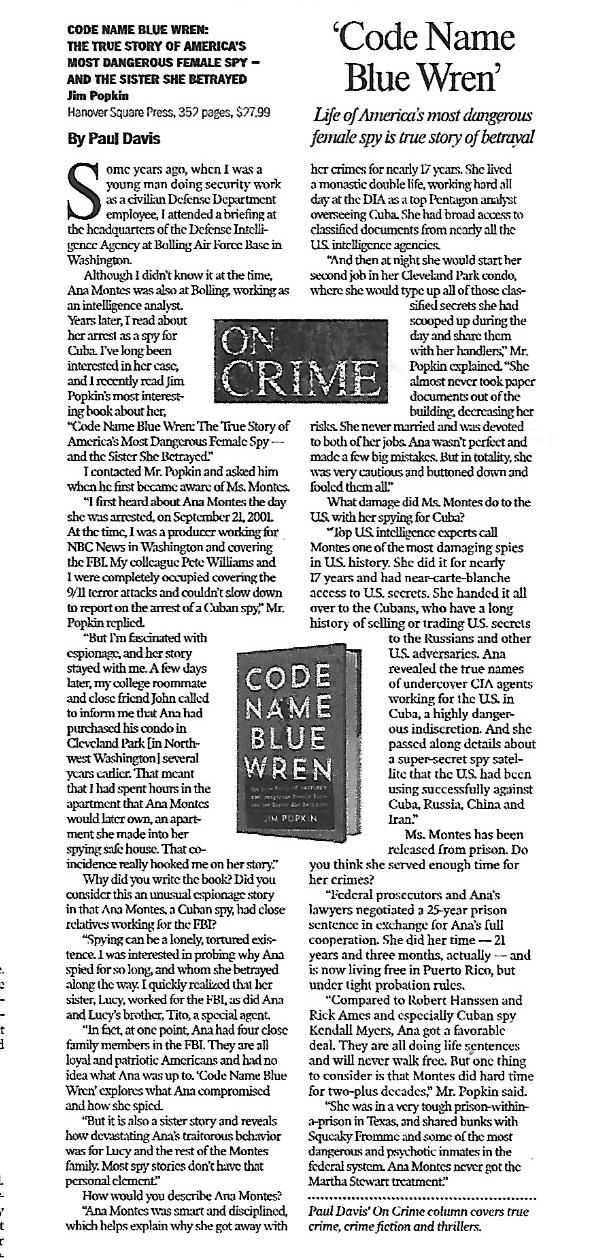
Code Name Blue Wren: My Washington Times On Crime Column On Cuban Spy Ana Montes

The Washington Times ran my On Crime column on Jim Popkin’s Code Name Blue Wren: The True Story of America’s Most Dangerous Female Spy — and the Sister She Betrayed. 

You can read the column via the below link or the below text:


BOOK REVIEW: 'Code Name Blue Wren' - Washington Times


Some years ago, when I was a young man performing security work as a civilian Defense Department employee, I attended a briefing at the headquarters of the Defense Intelligence Agency at Bolling Air Force Base in Washington.


Although I didn’t know it at the time, Ana Montes was also at Bolling, working as an intelligence analyst. Years later, I read about her arrest as a spy for Cuba. I’ve long been interested in her case, and I recently read Jim Popkin’s most interesting book about her, “Code Name Blue Wren: The True Story of America’s Most Dangerous Female Spy — and the Sister She Betrayed.”


I contacted Mr. Popkin (seen in the bottom photo) and asked him when he first became aware of Ms. Montes.


“I first heard about Ana Montes the day she was arrested, on September 21, 2001. At the time, I was a producer working for NBC News in Washington and covering the FBI. My colleague Pete Williams and I were completely occupied covering the 9/11 terror attacks and couldn’t slow down to report on the arrest of a Cuban spy,” Mr. Popkin replied.


“But I’m fascinated with espionage, and her story stayed with me. A few days later, my college roommate and close friend John called to inform me that Ana had purchased his condo in Cleveland Park [in Northwest Washington] several years earlier. That meant that I had spent hours in the apartment that Ana Montes would later own, an apartment she made into her spying safe house. That coincidence really hooked me on her story.”


Why did you write the book? Did you consider this an unusual espionage story in that Ana Montes, a Cuban spy, had close relatives working for the FBI?


“Spying can be a lonely, tortured existence. I was interested in probing why Ana spied for so long, and whom she betrayed along the way. I quickly realized that her sister, Lucy, worked for the FBI, as did Ana and Lucy’s brother, Tito, a special agent. In fact, at one point, Ana had four close family members in the FBI. They are all loyal and patriotic Americans and had no idea what Ana was up to. “Code Name Blue Wren” explores what Ana compromised and how she spied. But it is also a sister story and reveals how devastating Ana’s traitorous behavior was for Lucy and the rest of the Montes family. Most spy stories don’t have that personal element.”


How would you describe Ana Montes?


“Ana Montes was smart and disciplined, which helps explain why she got away with her crimes for nearly 17 years. She lived a monastic double life, working hard all day at the DIA as a top Pentagon analyst overseeing Cuba. She had broad access to classified documents from nearly all the U.S. intelligence agencies.


“And then at night she would start her second job in her Cleveland Park condo, where she would type up all of those classified secrets she had scooped up during the day and share them with her handlers,” Mr. Popkin explained. “She almost never took paper documents out of the building, decreasing her risks. She never married and was devoted to both of her jobs. Ana wasn’t perfect and made a few big mistakes. But in totality, she was very cautious and buttoned down and fooled them all.”


What damage did Ms. Montes do to the U.S. with her spying for Cuba?


“Top U.S. intelligence experts call Montes one of the most damaging spies in U.S. history. She did it for nearly 17 years and had near-carte-blanche access to U.S. secrets. She handed it all over to the Cubans, who have a long history of selling or trading U.S. secrets to the Russians and other U.S. adversaries. Ana revealed the true names of undercover CIA agents working for the U.S. in Cuba, a highly dangerous indiscretion. And she passed along details about a super-secret spy satellite that the U.S. had been using successfully against Cuba, Russia, China and Iran.”


Ms. Montes has been released from prison. Do you think she served enough time for her crimes?


“Federal prosecutors and Ana’s lawyers negotiated a 25-year prison sentence in exchange for Ana’s full cooperation. She did her time — 21 years and three months, actually — and is now living free in Puerto Rico, but under tight probation rules. “Compared to Robert Hanssen and Rick Ames and especially Cuban spy Kendall Myers, Ana got a favorable deal. They are all doing life sentences and will never walk free. But one thing to consider is that Montes did hard time for two plus decades,” Mr. Popkin said. “She was in a very tough prison-within-a-prison in Texas, and shared bunks with Squeaky Fromme and some of the most dangerous and psychotic inmates in the federal system. Ana Montes never got the Martha Stewart treatment.”


Paul Davis’ On Crime column covers true crime, crime fiction and thrillers.