Showing posts with label American sailors. Show all posts

Sunday, March 12, 2023

A Sea Story: A Look Back At American Sailors Hunting Sharks In Loch Fyne

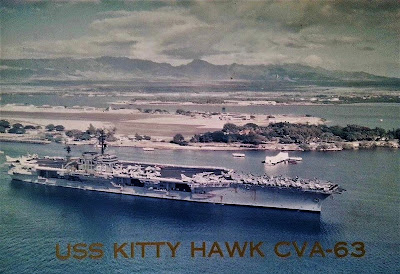
As I’ve noted here before, after serving two years on the aircraft carrier USS Kitty Hawk in 1970-1971 during the Vietnam War, I was separated from the Navy.

I went on to study journalism at Penn State, but I dropped out due to a lack of money. I took a job as a DOD civilian at the Defense Personnel Support Center in South Philadelphia, but as I was bored and did not see an immediate future as a writer, I re-upped and returned to the Navy in 1974. 

Serving on the USS Kitty Hawk two years prior, I had some unique experiences. The aircraft carrier sailed to Southeast Asia for a WESTPAC combat cruise, serving on “Yankee Station” in the Gulf of Tonkin off the coast of North Vietnam during the final years of the Vietnam War.

We worked long and hard hours while on Yankee Station as our aircraft flew combat air sorties, taking the war to the Communist North. Air combat operations were fast-paced and precarious as the carrier launched and recovered aircraft around the clock. 

I had an admin job in the Communications Radio Division, and I served on a Damage Control Team. The teams were called out to fight fires and quell other emergencies. With vast amounts of jet fuel, bombs, missiles and rockets on board, an accident or a fire on a carrier can be a truly deadly affair, which we saw happen on the USS Forrestal and other carriers during the war.  

The long Yankee Station line periods were broken up by memorable port of calls to Hong Kong, Sasebo, Japan, and frequent visits to Subic Bay in the Philippines. No one who encountered the bizarre times in the wide-open city of Olongapo will ever forget it.  

I certainly have not.

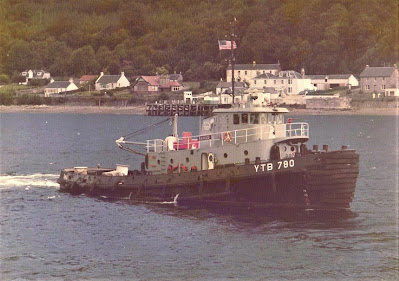
After re-enlisting, I reported to the Norfolk, Virginia naval base to await my orders. I hoped to receive orders to another aircraft carrier that would cruise the Mediterranean, called the “Med” by American sailors, but I received orders to the USS Saugus (YTB-780), a Navy harbor tugboat attached to Submarine Squadron 14 (SUPRON 14) at the U.S. nuclear submarine base at Holy Loch, Scotland. 

I went from serving on one of the largest warships in the U.S. Navy to one of the smallest boats. 

I reported aboard the tugboat in January of 1974. I regretted immediately my decision to return to the Navy – what the hell was I thinking? I went from a boring but easy job in a comfortable government office surrounded by pretty girls to doing hard physical work aboard a Navy tugboat while enduring the wet and cold Scottish winter.

But looking back after all these years, I achieved what I had set out to do, which was to have some interesting travel experiences and a bit of adventure.

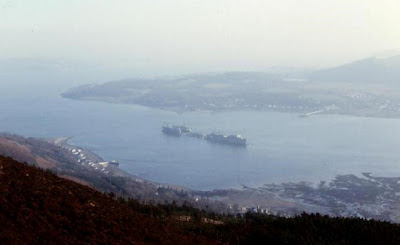
During the Cold War years, Submarine Squadron 14, called "Site One," consisted of the USS Canopus, a 644-foot-long ship called a submarine tender, a floating dry dock that could accommodate submarines, and a large barge with a super crane. All were anchored in the middle of the loch.

Submarines reported to Site One from the sea before and after their patrols and tied up to the anchored submarine tender. The submarines received supplies, maintenance and repairs at the floating Navy base. The base also had several small boats that tied up to the barge.

Two of the boats were 100-foot harbor tugboats, which were the workhorses of the bustling naval base.

The crew consisted of a chief petty officer and twelve other enlisted sailors.   

The USS Saugus and the USS Natick (YTB 760) towed ships, oil barges, submarines and other craft in, out, and around the site. The tugboats also put out fires and broke up oil slicks. Most days during those two years I was a cold and wet sailor working on the deck of the tugboat at the floating submarine base.

The work was hard, physical and dangerous, but we were proud of our small boat and line-handling skills. Working with the rugged and independent crew on the tugboat felt like I was serving in McHale's Navy, one of my favorite TV shows from my youth. 

I worked on deck, stood helm watches while at sea, stood security watches in port, and during my second year onboard I was the boat's supply petty officer.
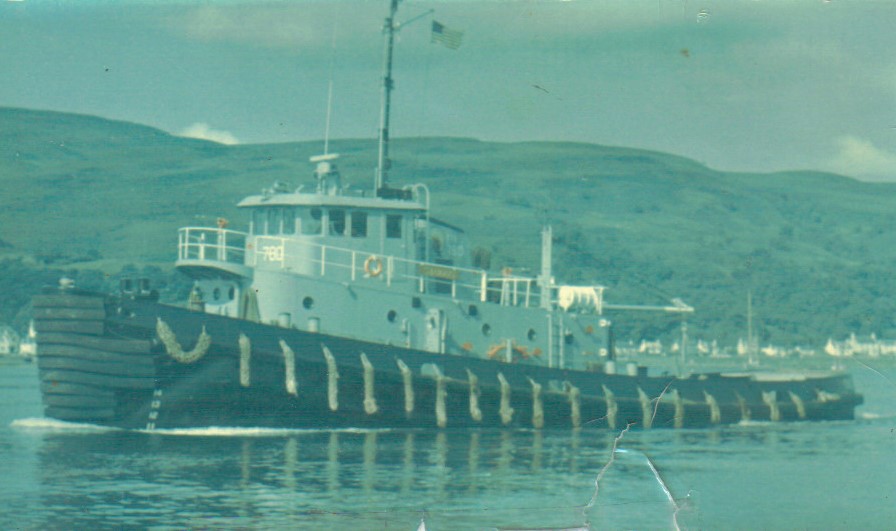

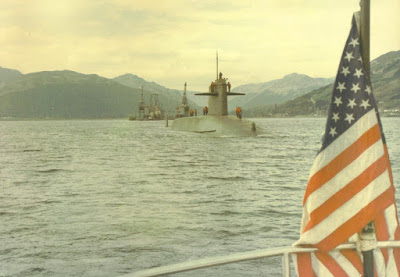
The Saugus, along with the USS Natick, were often sent to sea to rendezvous with submarines for medivacs, classified missions and transfers of the Commodore and his staff. We would throw over a short brow to the submarine and the Commodore and his staff walked precariously across the brow from the pitching, rolling and bobbing tugboat to the submarine. Once aboard, the submarine submerged.

Under the sea was calm, but it was certainly not calm on the surface. The tugboat then served as a target for the submarine’s torpedoes. In the exercises, the unarmed torpedoes were aimed to pass near us.

After the torpedo passed us, we had to go and retrieve them, which was like someone shooting a gun at you and you then had the further indignity of picking up the shells for the shooter.

Retrieving the torpedoes was not an easy task in winter, as both the tug and the tip of the torpedo bobbed up and down in the rough sea at different intervals. We went to the tug’s fantail and attempted to bring in the torpedo with a thick wire lasso. It often took several attempts before we lassoed the long torpedo.

Once the wire took hold, we used our hydraulic capstan to twirl the line up and in, bringing the torpedo out of the sea into the air, where it swung mightily from the rocking of the boat and the strong winds. We threw another line on the back of the torpedo and with some difficulty, we brought the torpedo to rest on the fantail.         


I recall in the summer of 1975 we were ordered to sail to Loch Fyne to pick up a floating torpedo that was spotted by local fishermen. Normally, the fishermen find and haul in the American torpedo, which had a message on it that read “If found, call U.S. Navy and claim award.” For some reason, the fishermen did not find this torpedo.

A squadron officer ordered our chief to assemble his crew and head out to Loch Fyne and bring in the torpedo. The chief, whom I nicknamed “Chief Cool,” a stern man who rarely spoke and had a deadpan face much like the silent film comedian Buster Keaton, was not happy with being called out on an early Saturday morning, as he was hung over and thought the mission was a bullshit one.

I had the weekend duty with another deckhand and an engineman, so I was onboard, but the chief called the rest of the crew in.

When everyone reported aboard, the chief told us to get out to Loch Fyne and cruise around, and if we saw the torpedo, haul it in. But don’t look too hard, he added. With that, the chief retired to his cabin and went to sleep.

It was a beautiful sunny and warm day as we entered Loch Fyne. The sea was calm and clear and there was a soft breeze.

Loch Fyne, which means “Loch of the Vine” in Scottish Gaelic, is off the Firth of Clyde and located on the west coast of Argyll, Scotland. 

Loch Fyne was teaming with wildlife on that summer day. As we cruised along slowly, we saw dolphins, porpoises and various fish in the water. Flocks of seagulls and other birds formed an air force that flew overhead.

We also saw a huge number of large dorsal fins protruding from the water. The dorsal fins belonged to basking sharks, a huge, fierce-looking creature that resembles a great white shark.


The basking shark (Cetorhinus maximus) is the world’s second largest shark, but despite its size and looks, the shark is quite docile and passive and eats plankton rather than fish and people. The small-brained creatures are called basking sharks due to their swimming slowly and feeding near the surface, which makes them appear to be “basking” in the sun.

The average basking shark weighs more than ten thousand pounds and grows to about twenty-six feet long.

As we cruised among the many dorsal fins, we were all out on deck snapping photos of the huge sharks. Most of us would later show the photos and neglect to mention that the sharks were harmless.

I don’t know who first had the idea, but someone at the helm in the pilothouse decided to ram one of the sharks. As we were cruising slowly, and the tug’s bow was swathed in rubber, the shark was not harmed. Everyone laughed as the shark dashed away from the tug, and we went on to bump several of the sharks in the loch.    

After a bit, most of the crew left the pilothouse, leaving me and a seaman whose name I don’t recall. The seaman decided to turn the tug towards another fin in the loch. I felt the bump as the tug shook from the encounter.   

“Oh, shit!” I heard the seaman say.

I looked towards the seaman at the helm and beyond him out of the pilothouses’ starboard window. I saw 50-feet of white underbelly as a huge creature breached the sea just off the tug.

I grabbed the tug’s big wheel and swung it to port sharply. The boat seemed to lift from the water with the maneuver just as a huge wave enveloped the pilothouse as the creature crashed back into the sea.

The seaman stood there in shock. He managed finally to say, “I didn’t know a shark could jump that high out of the water.”

“That wasn’t a shark, you fucking idiot,” I said. “You rammed an orca – a killer whale.”

I knew that an orca could punch a hole in the hull and sink us, so I was happy to see the killer whale swim away from us. 

By the way, we failed to find the torpedo.

As I noted above, I went back into the Navy seeking more travel experiences and a bit of adventure.

While serving in Scotland for two years, I had some unique adventures in Holy Loch and out in the Irish Sea. And during my time off, I traveled all over the United Kingdom and visited Italy, Spain and France.

I also spent a day at Loch Fyne among basking sharks and a killer whale. 

Note: You read my other sea stories, vignettes, humor pieces and short stories via the below link:

link:

Paul Davis On Crime: Sea Stories: Vignettes, Short Stories And Humor Pieces About My Time In The U.S. Navy  

Thursday, October 28, 2021

A Look Back At American Sailors And Scottish Hooligans

After serving two years on the aircraft carrier USS Kitty Hawk in 1970-1971 during the Vietnam War, I was separated from the Navy. I attended Penn State and majored in journalism, but left as I could afford to live on the G.I. Bill alone.

I took a civilian DoD clerk job at the Defense Personnel Support Center in South Philadelphia, known locally as the "Quartermaster," but I was bored with the job, and not seeing an immediate future as a writer, I decided to re-up and go back into the Navy in 1974. 

Did I mention alcohol was involved?

Having made a WESTPAC cruise to Southeast Asia aboard the Kitty Hawk, I had hoped to sail to the Med on another aircraft carrier. But my orders sent me to the Navy tugboat USS Saugus (YTB-780), which was assigned to the U.S. nuclear submarine base at Holy Loch, Scotland.

I went from serving on one of the largest warships in the U.S. Navy to one of the smallest boats.  

Although I regretted going back into the Navy, and I was not too thrilled with the Scottish winter, I liked the Scottish people, especially the Scottish lasses. Scotland was a peaceful place in those days, with low crime with little violence compared to Philadelphia and other American cities. 

But there were occasional incidents.   

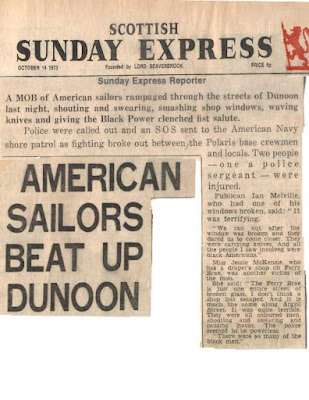
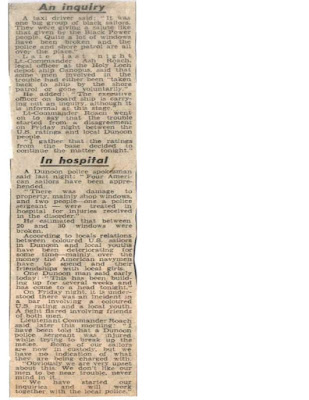
A year before I arrived, in October 1973, the newspapers across the world reported that an angry mob of Black American sailors from Holy Loch went on a rampage in Dunoon, the small Scottish town near the Holy Loch base. 

According to newspaper accounts, the Black sailors broke store windows, beat up locals and brandished knives. I spoke to a sailor who was there, and he told me that the story was blown way out of proportion. The Scots were just not used to public street fights, he explained. 

Unless it involved soccer - or football, as they call it. 

Groups of loud, drunk and violent Scottish football fans supported their team by bashing the other team’s fans. They were, and are, known as football hooligans. 


I recall after one contentious game, a group of hooligans, having mixed it up with the opposing team’s fans, visited a Chinese restaurant in Glasgow. 

I was walking down the street that night towards my flat when a pile of screaming, brawling hooligans and Chinese waiters burst out of the restaurant’s door and began fighting in the street. 

As an aspiring reporter and crime writer, I stood across the street from the battle and watched. There appeared to be more hooligans than waiters, and the Scots were bigger men, but the Chinese men gave as good as they got. 

One waiter, like Bruce Lee in a karate movie, squared off against a big, drunk Scot. He launched into a short run and then leaped into the air and delivered a solid kick to the Scot’s chest. 

It looked good, but unlike the karate movies, the kick hardly moved the hooligan. The hooligan swung a wild roundhouse that laid out the would-be-Bruce Lee. 

The Scottish police arrived, and they broke up the fight by beating down both the hooligans and the waiters with their clubs. British police didn’t carry guns like American cops, but they could fight.  

As the combatants were rounded up and arrested, one of the cops came over to me and asked what I was doing. Just watching, I replied. I showed my U.S. Navy ID card and the cop, who sported a black eye and torn shirt, told me to move on. 

I moved on.


Sometime later, a Black sailor I knew, an affable young guy, asked me what a “nig-nog” was. 

“The Scottish equivalent to the N-word,” I told him. 

“I thought so,” he said. “I didn’t know what it was, but I knew it wasn’t a complement.” 

He told me how he was at a train station when a group of drunken football hooligans began calling him a nig-nog from across the platform. He had been drinking a bottle of soda, and he hurled the bottle at the hooligans. 

“You know how you throw a bottle and it just smashes near a group? Well, my bottle hit one the Scottish guys right in the head." 

He was promptly arrested.


In 1975, towards the end of my two-year tour, I was in a Glasgow pub with my Scottish girlfriend when I had my own encounter with football hooligans. 

While we were having a drink at the bar, I noticed a group of about a dozen hooligans looking over at me, pointing towards me, and grumbling. I told the girl to go across the street and wait for me. 

“Let’s go together,” she said. 

“I’m from South Philly. I don’t run,” I said with a sense of bravado.  

Although carrying a weapon in Scotland was a serious criminal offense, I had a small but sharp pocketknife, and my right hand went to my back pocket and held the knife. 

One of the hooligans staggered over to me. I took my hand off of my knife and balled a fist. I planned to “Sunday punch” this drunk if he got aggressive. 

“Are you English?” he asked. 

“No. I’m an American.” 

He stepped back, smiled at me, and turned towards his fellow hooligans and yelled, “He’s a fookin' Yank!” 

Everyone relaxed. The hooligan told me they thought I was English, and as Scotland had just defeated England in a football match, they planned to celebrate the win by beating the hell of a Englishman. 

I bought a round of drinks for the hooligans and the other patrons at the bar.


Over the years, I’ve read about and watched TV news coverage of wild hooligan violence at soccer games, which always makes me think of my days in Scotland. 

Note:  You can read my other sea stories, vignettes, short stories and humor pieces about my time in the U.S. Navy via the below link:

Paul Davis On Crime: Sea Stories: Vignettes, Short Stories And Humor Pieces About My Time In The U.S. Navy

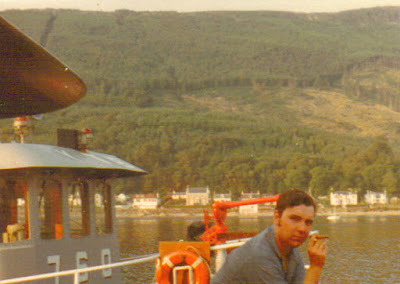
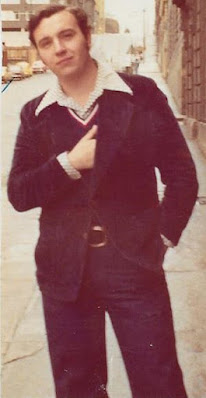
Below are photos of the USS Saugus, me on the bow of the tugboat, the Holy Loch submarine base, a newspaper account of the Dunoon riot, me in Glasgow, and the USS Kitty Hawk.     


Saturday, July 4, 2015

Hashtag USA: U.S. Navy Celebrates July 4th American Independence on Aircraft Carrier


Sailors spell out #USA next to the American flag to mark Independence Day on the flight deck of the aircraft carrier USS Theodore Roosevelt in the Arabian Sea.

The carrier is deployed to the U.S. 5th Fleet area of operations to support Operation Inherent Resolve and strike operations in Iraq and Syria.

The above U.S. Navy photo was taken by Petty Officer 3rd Class Jackie Hart.

Note: You can click on the photo to enlarge.

Monday, February 10, 2014

My Washington Times Review Of "Act Of War: Lyndon Johnson, North Korea, And the Capture Of The Spy Ship Pueblo


My review of Jack Cheevers' Act of War: Lyndon Johnson, North Korea, and the Capture of the Spy Ship Pueblo appeared today in the Washington Times.

I was a high school student in 1968 eagerly waiting for my 17th birthday in 1969 so I could enlist in the U.S. Navy when the USS Pueblo was captured by the North Koreans. I recall that I was angry with the communists for taking the Pueblo, and I was especially angry with President Johnson  for doing so little to rescue the ship and the crew.

Reading Jack Cheever’s “Act of War: Lyndon Johnson, North Korea and the Capture of the Spy Ship Pueblo” rekindled my earlier anger — and then some.

Mr. Cheevers' book recounts the famous Cold War drama in January 1968 when a 176-foot electronic intelligence ship, equipped with tall antennae rather than top guns, and manned by a youthful crew of 83, was captured by North Korean patrol boats off the coast of Wonsan.

When the Pueblo’s commanding officer, Cmdr. Lloyd "Pete" Bucher, tried to sail away, the spy ship was pursued by the patrol boats. The patrol boats opened fire with shells and machinegun fire, killing one American sailor and wounding 10 others. Bucher felt he had no choice but to heave to and allow the North Koreans to board the Pueblo. The North Koreans took the crew prisoner and took control of the U.S. spy ship.

“Act of War” goes on to tell the horrific story of the crew’s brutal treatment by North Korea and the crew’s heroic — and humorous — efforts to survive while resisting the communists as much as possible.

You can read the rest of the review via the below link:

http://www.washingtontimes.com/news/2014/feb/10/book-review-act-of-war/?page=all#pagebreak

Tuesday, November 19, 2013

Seven Score And 10 Years Later, USS Lincoln Sailors Honor Gettysburg Address


The U.S. Navy released a piece by Captain Karl Thomas, the Commanding Officer of the USS Lincoln.

As the Commanding Officer of the proud warship USS Abraham Lincoln (CVN 72), I am reminded every day of the sacrifices our service men and women make for their nation. I get an opportunity to interact with these great Americans on a daily basis, and witness their patriotism first hand. Every day I’m also reminded of our warship’s namesake, our 16th president, President Abraham Lincoln, and strive to pass on Lincoln’s teachings and leadership principles.  

You can read the rest of the piece via the below link:

http://navylive.dodlive.mil/2013/11/19/seven-score-and-10-years-later-lincoln-sailors-honor-gettysburg-address/