Showing posts with label Glasgow. Show all posts

Wednesday, June 16, 2021

A Little Humor: Scottish Lasses

As I’ve noted here before, I served on the USS Saugus (YTB-780), a Navy harbor tugboat assigned to  the U.S. nuclear submarine base at Holy Loch, Scotland in 1974-1975. 

I was not crazy about the cold, damp and rainy winter weather or the rough seas when the tugboat ventured into the Irish Sea, but I liked the open and friendly Scottish people – especially the “wee Scottish lasses.” 

The U.S. dollar was in good shape in the early 1970s, so from a Scot point-of-view, American sailors were rich. We were also considered to be generous, buying the girls drinks, food and gifts. Most Scottish young men considered us to be overly generous, as they could not compete with the cash-heavy “Yanks.”   

I spent some time at the U.S. Enlisted Men’s Club and the local pubs in the nearby town of Dunoon, but as I thought there were too many sailors there, and I was a South Philly city kid, I mostly took the ferry and train to Glasgow. 

I had a friend on the tug named Billie Bob Rutledge. He was a Southern country boy, so I took him with me to Glasgow one weekend to show him the city’s bright lights and vibrant night life. 

We visited a Glasgow club and sat at a table. After we were served our drinks, I took out a pack of Marlboro cigarettes and laid them on the table. 

“I thought you smoke cigars, not cigarettes,” Rutledge said. 

“I don’t smoke cigarettes,” I replied. 

“Then why…?” 

“Count to ten,” I told him. 

On the count of four, a pretty young girl came over to our table and asked me, “Are those American cigarettes?” 

“Yes,” I replied. “Do you want one?” 

She nodded and accepted a cigarette. I lit it for her and asked to sit down and have a drink with us. She sat down at our table and motioned for her girlfriend to come over and join us. 

Rutledge and I had a fine time that night with the two Scottish lasses. Rutledge later told me that he was amazed at my somewhat cheap but effective way to attract Scottish girls. 

Of course, Scottish men resented Americans like me. Going back to World War II, when Americans were stationed in the U.K. en masse, the Brits have considered American troops to be ostentatious.

One British wit in WWII complained about the presence of American servicemen, stating famously, “They’re oversexed, overpaid and over here.” 

I recall a story about Brit troops in England in WWII watching the Disney film “Bambi.” 

When Bambi’s mother calls out for Bambi in the film, a Brit soldier yelled out, “She’s probably out with a fooking Yank!”


Monday, April 26, 2010

Site One: A Look Back At The American Nuclear Submarine Base At Holy Loch, Scotland


I recently contacted an old shipmate who served with me on the USS Saugus (YTB 780), a Navy harbor tugboat, in 1974 and 1975. The tugboat was assigned to the American nuclear submarine base at Holy Loch, Scotland.

Speaking to my old Navy pal brought back some good memories. The people of Scotland were friendly and kind to me and the many American sailors who were stationed there during the Cold War.

I spent a good bit of time in Dunoon, which was the town nearest to the base, and I had a flat in Glasgow. I also visited Edinburgh quite often, ventured north to visit Inverness and Loch Ness, and I visited a good number of other Scottish cities, towns and offshore islands during my time there. I also visited London.

The Scottish winters are cold and rainy, but Scotland is quite beautiful in the summer. As a student of history, and being Scot-Welsh on my father's side, I enjoyed visiting the many historical sites in Scotland. I also enjoyed visiting the Scottish pubs.

I traveled all over Scotland, the United Kingdom and Europe during those years. 

Below is a photo of me as a young man in "civies" on a Scottish street, circa 1974.


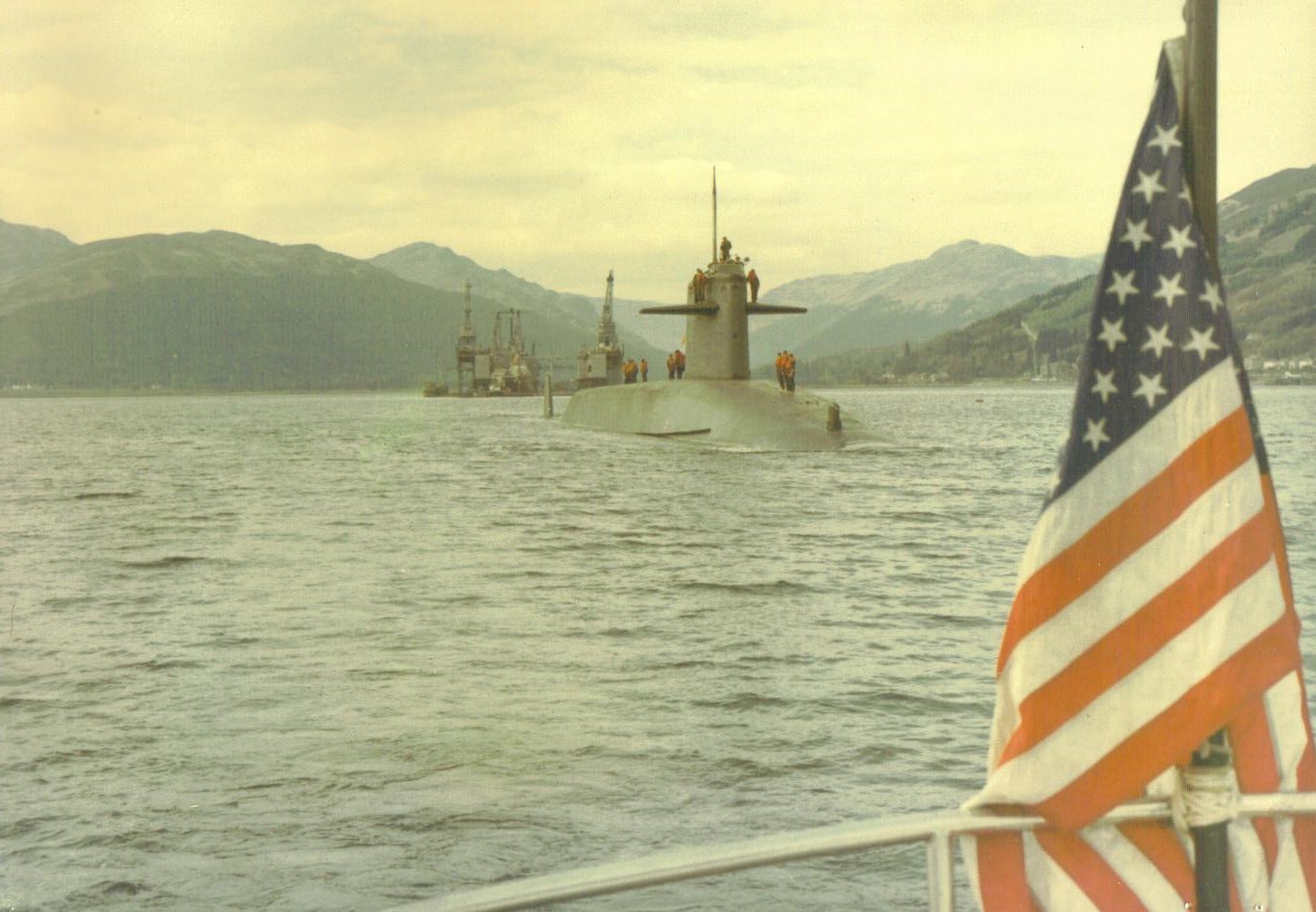
During the Cold War the U.S. Navy base at Holy Loch was the headquarters of Submarine Squadron 14 (COMSUBRON 14). The base, called "Site One," consisted of the USS Canopus, a 644 foot long ship called a submarine tender, a floating dry dock that could accommodate submarines, and a large barge with a super crane. All were anchored in the middle of the loch.

Submarines ventured to Site One from the sea before and after their patrols and tied up to the anchored submarine tender. The submarines received supplies, maintenance and repairs at the floating Navy base.

The base also had several small boats that tied up to the barge. Two of the boats were 100-foot harbor tugboats, which were the workhorses of the bustling naval base.


The USS Saugus and the USS Natick (YTB 760) towed ships, barges, submarines and other craft in, out and around the site, as well as put out fires and broke up oil slicks.

The tugboats were often sent to sea to rendezvous with submarines for medivacs, classified missions and transfers of the COMSUBRON 14 Commodore and his staff. The tugboats also went to sea to perform in exercises with the submerged submarines and then retrieved the torpedoes used in the exercises from the sea.

During the winter months the tugboat sailed into rough and cold seas, gale force winds and high waves.

Working on the tugboat was hard, physical and dangerous, but we were proud of our service. Working with the rugged and independent crew on the tugboat felt like I was serving in McHale's Navy, one of my favorite TV shows from my youth. 

I worked on deck, stood helm watches while at sea, stood security watches in port, and during my second year onboard I was the boat's supply petty officer.     

In the photo of Holy Loch above, the floating dry dock is on the right and the submarine tender is on the left..

Below are photos of the base, the tugboat and me:


Note: You can click on some of the above photos to enlarge.