Showing posts with label On This Day in History. Show all posts

Monday, January 19, 2026

On This Day In History Edgar Allan Poe Was Born

On this day in history the late. great American writer Edgar Allan Poe was born. 

You can read about his life and work via the link below: 

Edgar Allan Poe is born | January 19, 1809 | HISTORY 

You can also read my Philadelphia Weekly Crime Beat column on Poe in Philadelphia via the link below:

Paul Davis On Crime: A Look Back At Poe In Philadelphia: My Philadelphia Weekly 'Crime Beat' Column On Edgar Allan Poe's Creative Peak In Philly 

Monday, July 21, 2025

On This Day In History American Writer Ernest Hemingway Was Born

As History.com notes, the late, great American writer Ernest Hemingway was born on this day. 

On this day in 1899, Ernest Miller Hemingway, author of such novels as “For Whom the Bell Tolls” and “The Old Man and the Sea,” is born in Oak Park, Illinois. The influential American literary icon became known for his straightforward prose and use of understatement. Hemingway, who tackled topics such as bullfighting and war in his work, also became famous for his own macho, hard-drinking persona. 

You can read the rest of the piece via the below link: 

http://www.history.com/this-day-in-history/ernest-hemingway-is-born?cmpid=email-hist-tdih-2017-0721-07212017&om_rid=de5e4076c942a595dbda53f758321d197499484f6d117f61b6ac5c08e0d6f0aa&om_mid=215102284&kx_EmailCampaignID=13846&kx_EmailCampaignName=email-hist-tdih-2017-0721-07212017&kx_EmailRecipientID=de5e4076c942a595dbda53f758321d197499484f6d117f61b6ac5c08e0d6f0aa  

You can also read my Philadelphia Inquirer review of Hemingway’s Letters below: 

A newspaper with a person in a hat

AI-generated content may be incorrect.

And you can also read my Washington Times review of Hemingway at War via the below link:

http://www.pauldavisoncrime.com/2017/01/my-washington-times-review-of-hemingway.html  

A book cover of a group of men

AI-generated content may be incorrect.


Thursday, May 29, 2025

On This Day In History Ian Fleming, The Creator Of James Bond, Was Born

 Yesterday was the birthday of the late, great thriller writer Ian Fleming, the creator of James Bond, the world’s most famous fictional spy.

He died of a heart attack at age 56 in 1964. 

As History.com notes, Ian Lancaster Fleming was born into a well-to-do family in London on May 28, 1908.

"As an adult, he worked as a foreign correspondent, a stockbroker and a personal assistant to Britain’s director of naval intelligence during World War II–experiences that would all provide fodder for his Bond novels. The series of novels about the debonair Agent 007, based in part on their dashing author’s real-life experiences, spawned one of the most lucrative film franchises in history.  

"The first Bond book, Casino Royale, was published in 1953. In all, Fleming wrote 12 novels and two short story collections about Agent 007, which together sold more than 18 million copies. According to The New York Times: “Bond himself, Fleming said, was ‘a compound of all the secret agents and commandos I met during the war,’ but his tastes– in blondes, martinis ‘shaken, not stirred,’ expensively tailored suits, scrambled eggs, short-sleeved shirts and Rolex watches–were Fleming’s own. But not all the comparisons were ones the author liked to encourage. Bond, he said, had ‘more guts than I have’ as well as being ‘more handsome. 

"The first Bond film, Dr. No, was released in 1962; it starred the Scottish actor Sean Connery in the title role. Connery played Bond in six films altogether; From Russia With Love (1963) and Goldfinger (1964) were the only ones made during Fleming’s lifetime. Since that time, five other actors—George Lazenby, Roger Moore, Timothy Dalton, Pierce Brosnan and Daniel Craig—have played the superspy in some two dozen films from EON Productions."

You can read three of my Crime Beat columns on Ian Fleming via the below links:  

Paul Davis On Crime: WWII's Great Deception Plan: My Crime Beat Column On Ian Fleming And 'Operation Mincemeat'

Paul Davis On Crime: My Crime Beat Column: The Ian Fleming and James Bond Phenomenon

Paul Davis On Crime: My Crime Beat Column: A Look Back At Ian Fleming's Iconic James Bond Character


Friday, April 18, 2025

On This Day In History The Doolittle Raid Attacked Imperial Japan

The Defense Department's Army Major Wes Shinego offers a look back at the famous Doolittle Raid.

On April 18, 1942, a small group of Army Air Forces aviators changed the momentum of World War II with a single, audacious strike. Known as the Doolittle Raid, this operation — launched from the deck of the USS Hornet — was the first U.S. air attack on Japan's home islands. 

You can read the rest of the piece via the link below: 

Honoring the Doolittle Raid: A Legacy of Courage, Innovation > U.S. Department of Defense > Story


Sunday, January 19, 2025

On This Day In History Edgar Allan Poe Was Born

As History.com notes, on this day in history, Edgar Allan Poe was born.

You can read about Poe’s life and work via the below link:

Edgar Allan Poe is born | January 19, 1809 | HISTORY

Back in May of 2021, Philadelphia Weekly published my Crime Beat column on Edgar Allan Poe's time in Philadelphia.

I interviewed Scott Peeples, author of Man in the Crowd: Edgar Allan Poe and the City.

You can read the column via the pages below (click on them to enlarge), the below link, or the below text:


How Philly shaped Edgar Allan Poe's pessimistic poetry - Philadelphia Weekly 

Poe in Philadelphia: 

Edgar Allan Poe Had Creative Peak While Living in Philly 

By Paul Davis  

I visited Edgar Allan Poe’s house in Philadelphia on a school trip many years ago. I revisited the historical house in my twenties when I was rereading and enjoying Poe, especially “The Murders on the Rue Morgue,” which is credited as the very first detective crime story. 

I recently read Scott Peeples’ “The Man of the Crowd: Edgar Allan Poe and the City,” which covers Poe’s time in Richmond, Baltimore, New York, and of course Philadelphia. Scott Peeples, a professor of English at the College of Charleston, also co-edited, with J. Gerald Kennedy, “The Oxford Handbook of Edgar Allan Poe,” and he wrote two other books on Poe as well. 

I reached out to Peeples and asked him about Poe’s time in Philadelphia, which was from 1838 to 1844. 

“In some ways, it was the most stable period of his adult life,” Peeples replied.” That’s not saying much, but still, Poe lived in the same house for about four of the six years in Philadelphia, which was very unusual for him. And he had steady employment for a few years, as editor of Burton’s Gentleman’s Magazine and then Graham’s Magazine. He got to know a lot of other writers and editors; he met Charles Dickens when Dickens toured the city. 

“Poe even came close to launching his own magazine, something that he greatly desired. But he never made a lot of money, and then in 1842 his wife Virginia began showing symptoms of tuberculosis. Poe’s mother-in-law, who was also his aunt, lived with Edgar and Virginia, and the three of them moved a couple of times between 1842 and ’44, before finally leaving for New York. During that last year or so Poe began drinking more, and his wife’s illness weighed heavily on him. So things were pretty shaky by the time he left Philadelphia.” 

I asked what significant work Poe produced while living in Philadelphia. 

“It was his creative peak --- I think that would be hard to argue with. He wrote and published most of the stories he’s best known for today: “Ligeia,” “The Fall of the House of Usher,” “The Tell-Tale Heart,” “The Black Cat,” “The Pit and the Pendulum,” “The Masque of the Red Death,” “The Murders in the Rue Morgue,” “The Gold-Bug,” “The Man of the Crowd,” and more,” Peeples said. “He wrote a lot of satirical fiction as well, and a steady stream of book reviews.” 

Peeples described Poe’s house, which is now the National Historic Site on Spring Garden Street, as relatively spacious considering how little money the family had. 

“It was attached to a much larger house owned by his landlord, but Poe’s place was a pretty nice little home on the outskirts. Apparently, the landlord admired Poe as a writer and didn’t really worry too much about the rent.”  

Peeples said Poe moved to Philadelphia in the wake of the Panic of 1837, as the city was trying to bounce back from a recession. 

“Even so, it was growing pretty quickly --- not at the speed of New York, but definitely expanding,” Peeples said. “Some impressive new public buildings were going up --- Eastern State Penitentiary, the Second Bank of the US, the US Mint, the Philadelphia Arcade --- but at the same time back lots were getting filled in with smaller, shoddier houses. It probably felt kind of chaotic, despite the city’s image as the Quaker City with the orderly grid of streets.  There were labor disputes and riots, including the burning of Pennsylvania Hall in 1838 by a racist mob, because they had hosted an abolitionist lecture. And the city published a lot of newspapers and magazines, and that was probably the main thing that drew Poe to Philadelphia in the first place.” 

Peeples said he wrote “Man of the Crowd” to show how much Poe engaged with the places he lived. 

“Poe lived an itinerant life --- he moved from city to city and within cities very frequently, largely because he was never financially secure. Cities shaped Poe’s life and career, and that was something I wanted to explore.”   

Peeples said Poe’s work has endured for many reasons. 

“Poe’s stories are more than creepy --- they confront some basic human questions in unsettling ways: what’s it like to be dead? Why am I my own worst enemy? Poe’s posthumous image --- to some extent the one I’m implicitly challenging with this book --- took on a life of its own, as he sort of became the face of gothic horror in the twentieth century, thanks to comic books, movies, and a lot of other adaptations.” 

Paul Davis’ Crime Beat column appears here each week. You can contact him via pauldavisoncrime.com. 


Saturday, December 7, 2024

On This Day In History The Imperial Japanese Attacked Pearl Harbor

As History.com notes, on this day in 1941 the Japanese attacked Pearl Harbor.

At 7:55 a.m. Hawaii time, a Japanese dive bomber bearing the red symbol of the Rising Sun of Japan on its wings appears out of the clouds above the island of Oahu. A swarm of 360 Japanese warplanes followed, descending on the U.S. naval base at Pearl Harbor in a ferocious assault. The surprise attack struck a critical blow against the U.S. Pacific fleet and drew the United States irrevocably into World War II. 

You can read the rest of the piece via the below link: 

http://www.history.com/this-day-in-history/pearl-harbor-bombed 

Note: It was on December 7, 1976, that my late father, Edward M. Davis, died. 

He was a proud veteran who enlisted in the U.S. Navy after the attack on Pearl Harbor and fought in the Pacific as a Navy chief and UDT frogman. (He is seen in the center of his UDT 5 team in the above photo). 

Influenced greatly by my father, I too joined the Navy when I was 17 and served on the aircraft carrier USS Kitty Hawk during the Vietnam War. 

Above is a photo of my old ship, circa 1970, as she passes the USS Arizona Memorial at the Pearl Harbor naval base in Hawaii.


Thursday, November 14, 2024

On This Day In History: Herman Melville’s Great American Novel, ‘Moby-Dick,’ Only Got Mixed Reviews When It First Hit Bookstores

Eli Wizevich at Smithsonian magazine offers a piece on Herman Melville’s great novel Moby Dick:  

November 14, 1851, marked the first day that the American public could purchase Moby-Dick; or, The Whale, the latest novel by the modestly successful author Herman Melville, for $1.50 (around $60 today).

At the time, Melville already had five books to his name. Several, including TypeeOmoo and White-Jacket, drew on his experiences living and traveling at sea. His third, Mardi, flirted with romance and deeper philosophy but lacked overall coherence, critics said.5heMysterious Death of Edgar Allan Poe Skip Ad

Moby-Dick, which Melville wrote mainly at his Arrowhead estate in Pittsfield, Massachusetts, masterfully married his deep personal experience and research on whaling tales with philosophy, natural science and revelatory biblical prose. In late June 1850, the novelist proposed the partially written novel to his British publisher, Richard Bentley, and promised that he would have it completed by “the latter part of the coming autumn.”

But the writing process took much longer than expected. Moby-Dick was becoming a whale of a book, dense with detail, emotion and plot. To make matters worse, Melville’s American publisher, Harper & Brothers, refused to give him an advance because he still owed the company money from past book deals.

Melville sought loans from friends to sustain himself through another year of writing. To expedite the publishing process and hopefully limit editorial changes, he opted to typeset and copy-edit Moby-Dick independently while he was still writing later sections of the book.

Finally, in the fall of 1851—a year behind schedule—Moby-Dick was ready for publication. Bentley released the first British edition, titled The Whale, on October 18. Harper & Brothers, notwithstanding Melville’s debt, published the first American edition of Moby-Dick on November 14.

In total, the British first edition was 2,000 words shorter than the American one, despite being published in an ornate three-volume set. Bentley only ordered 500 copies of The Whale—significantly lower than the number printed for Melville’s earlier efforts. Harper & Brothers, meanwhile, printed 2,915 copies of Moby-Dick. The American publisher’s printings of Melville’s previous novels ranged from just over 3,000 to roughly 4,000 copies.

The quality of the single-volume edition of Melville’s latest book attracted some scorn. The New Bedford, Massachusetts, Daily Mercury, the hometown paper of the American whaling industry, called it “a bulky, queer-looking volume, in some respects ‘very like a whale’ even in outward appearance.”

The response to the content of the book itself was similarly lukewarm. The Hartford Courant, in a review, wrote that Moby-Dick somewhat confoundingly straddled the line between fiction and nonfiction. Nevertheless, the reviewer added, “It is well worth reading as a book of amusement.”

To many literary critics, Moby-Dick was simply an adventure tale, not even a patricianly sensational one at that, and certainly not a work of fine literature. A review in the Springfield Daily Republican politely noted Melville’s “quaint though interesting style.”

Reviewers’ apathy was reflected in the novel’s sales figures. Three years after Moby-Dick’s release, the first American printing had still not sold out.

Only some contemporary reviews offered a glimpse of the success and admiration that Moby-Dick would earn in the decades after Melville’s death in 1891. Nathaniel Hawthorne, Melville’s neighbor and friend, to whom the text is dedicated, reproached one negative review with a simple exclamation: “What a book Melville has written! It gives me an idea of much greater power than his preceding ones.” 

You can read the rest of the piece via the below link:

 Herman Melville's Great American Novel, 'Moby-Dick,' Only Got Mixed Reviews When It First Hit Bookstores | Smithsonian 

Tuesday, October 1, 2024

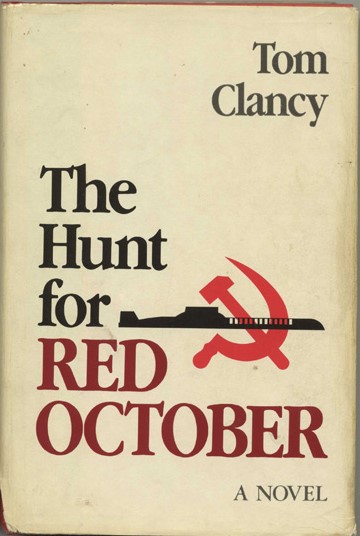
On This Day In History Techno-Thriller Novelist Tom Clancy Passes Away At Age 66

Erica Lamberg at Fox News notes that on this day in history thriller author Tom Clancy died. 

Tom Clancy, author of such bestselling novels as "The Hunt for Red October" and "Patriot Games," and a lifelong Republican who counted President Ronald Reagan among his fans, died at the age of 66 on this day in history on Oct. 1, 2013, according to multiple sources. 


Clancy was an American author best known for his espionage, military science and technological thrillers, noted Biography.com.  


He was the author of 17 New York Times bestsellers — and had his career launched by President Reagan.

"'The Hunt for Red October,' his first novel, had been bought for a lowly $5,000 by the Naval Institute Press. When Reagan pronounced it ‘the perfect yarn’ in 1984, Clancy, then a Maryland insurance agent, was propelled into a hugely successful writing career," said The Guardian.

You can read the rest of the piece via the below link:

On this day in history, October 1, 2013, techno-thriller novelist Tom Clancy passes away at age 66 | Fox News


Note: I was a huge Tom Clancy fan, and I enjoyed his thrillers and his nonfiction books on the military. I was saddened by his early death.


Tuesday, May 28, 2024

On This Day In History Ian Fleming, The Creator Of James Bond, Was Born

On this day in 1908 the late, great thriller writer Ian Fleming, the creator of James Bond, the world’s most famous fictional spy, was born. 

Fleming died of a heart attack at age 56 in 1964. 

As History.com notes, Ian Lancaster Fleming was born into a well-to-do family in London on May 28, 1908.

"As an adult, he worked as a foreign correspondent, a stockbroker and a personal assistant to Britain’s director of naval intelligence during World War II–experiences that would all provide fodder for his Bond novels. The series of novels about the debonair Agent 007, based in part on their dashing author’s real-life experiences, spawned one of the most lucrative film franchises in history.  

"The first Bond book, Casino Royale, was published in 1953. In all, Fleming wrote 12 novels and two short story collections about Agent 007, which together sold more than 18 million copies. According to The New York Times: “Bond himself, Fleming said, was ‘a compound of all the secret agents and commandos I met during the war,’ but his tastes– in blondes, martinis ‘shaken, not stirred,’ expensively tailored suits, scrambled eggs, short-sleeved shirts and Rolex watches–were Fleming’s own. But not all the comparisons were ones the author liked to encourage. Bond, he said, had ‘more guts than I have’ as well as being ‘more handsome. 

"The first Bond film, Dr. No, was released in 1962; it starred the Scottish actor Sean Connery in the title role. Connery played Bond in six films altogether; From Russia With Love (1963) and Goldfinger (1964) were the only ones made during Fleming’s lifetime. Since that time, five other actors—George Lazenby, Roger Moore, Timothy Dalton, Pierce Brosnan and Daniel Craig—have played the superspy in some two dozen films from EON Productions."


You can read three of my Crime Beat columns on Ian Fleming via the below links: 

Paul Davis On Crime: My Crime Beat Column: The Ian Fleming and James Bond Phenomenon

Paul Davis On Crime: My Crime Beat Column: A Look Back At Ian Fleming's Iconic James Bond Character


Sunday, February 18, 2024

On This Day In History Mark Twain Published The Great American Novel, 'The Adventures Of Huckleberry Finn'

As History.com notes, on February 18, 1885, Mark Twain published his famous - and famously controversial - novel The Adventures of Huckleberry Finn in the U.S.

Twain (the pen name of Samuel Clemens) first introduced Huck Finn as the best friend of Tom Sawyer, hero of his tremendously successful novel The Adventures of Tom Sawyer (1876). Though Twain saw Huck’s story as a kind of sequel to his earlier book, the new novel was far more serious, focusing on the institution of slavery and other aspects of life in the antebellum South.


At the book’s heart is the journey of Huck and his friend Jim, a runaway enslaved person, down the Mississippi River on a raft. Jim runs away because he is about to be sold and separated from his wife and children, and Huck goes with him to help him get to Ohio and freedom. 


Huck narrates the story in his distinctive voice, offering colorful descriptions of the people and places they encounter along the way. The most striking part of the book is its satirical look at racism, religion and other social attitudes of the time. 


While Jim is strong, brave, generous and wise, many of the white characters are portrayed as violent, stupid or simply selfish, and the naive Huck ends up questioning the hypocritical, unjust nature of society in general.


You can read the rest of the piece via the below link:

Mark Twain publishes “The Adventures of Huckleberry Finn” | February 18, 1885 | HISTORY


Thursday, December 7, 2023

On This Day In History The Imperial Japanese Attacked Pearl Harbor

As History.com notes, on this day in 1941 the Japanese attacked Pearl Harbor.

At 7:55 a.m. Hawaii time, a Japanese dive bomber bearing the red symbol of the Rising Sun of Japan on its wings appears out of the clouds above the island of Oahu. A swarm of 360 Japanese warplanes followed, descending on the U.S. naval base at Pearl Harbor in a ferocious assault. The surprise attack struck a critical blow against the U.S. Pacific fleet and drew the United States irrevocably into World War II. 

You can read the rest of the piece via the below link: 

http://www.history.com/this-day-in-history/pearl-harbor-bombed 

Note: It was on December 7, 1976, that my late father, Edward M. Davis, died. 

He was a proud veteran who enlisted in the U.S. Navy after the attack on Pearl Harbor and fought in the Pacific as a Navy chief and UDT frogman. (He is seen in the center of his UDT 5 team in the above photo). 

Influenced greatly by my father, I too joined the Navy when I was 17 and served on the aircraft carrier USS Kitty Hawk during the Vietnam War. 

Above is a photo of my old ship, circa 1970, as she passes the USS Arizona Memorial at the Pearl Harbor naval base in Hawaii.