Showing posts with label Senator John McCain. Show all posts

Sunday, May 4, 2025

My Crime Fiction: 'Admiral McCain'

The story below is another chapter in my crime novel Olongapo, which I hope to publish in the near future. 

The story originally appeared in American Crime Magazine.


Admiral McCain

By Paul Davis

One of the good things about working in the Communications Radio Division aboard an aircraft carrier during the Vietnam War was that radiomen were the first to know about everything. 

For example, when fleet headquarters ordered the carrier to leave “Yankee Station” off the coast of North Vietnam and sail towards Subic Bay on such and such a date, the word spread quickly among the radio division. The radiomen in turn told their friends in other divisions aboard the ship the good news about heading to Subic Bay and the great wide-open liberty town of Olongapo. 

The Kitty Hawk’s captain often complained that the entire ship’s crew and air wing knew about the order to proceed to Subic Bay before he did. 

While on watch in the Message Processing Center one evening in 1971 during our final Yankee Station line period, I saw a copy of a classified CIA report that was sent to the Task Force 77 admiral and the Kitty Hawk captain. 

The report announced the capture of a North Vietnamese spy in Manila. The spy, named Thanh Ban, was the subject of a nation-wide manhunt in the Philippines. He had been posing in Olongapo as a Filipino Chinese merchant named Shi Chen as he spied on the massive Subic Bay U.S. naval base. But after an assassination plot had been uncovered, Ban fled to Manila and was hidden by the New People’s Army (NPA), the communist guerrillas at war with the Philippine government. 

An elite Filipino police unit, accompanied and assisted by an unnamed CIA officer, raided a NPA hideout in Manila. Four Filipino NPA communist guerrillas were killed in the shootout with the elite unit. One NPA officer and Ban were captured.

The report noted that although Ban was a dedicated Communist, he did not relish being executed by the Filipinos or spending many years in an awful Filipino prison, so he confessed to the commander of the elite unit and the CIA officer. 

Ban told of the plan to execute Admiral John S. McCain aboard the USS Kitty Hawk while the aircraft carrier was off the coast of North Vietnam.  


On our very first line period on Yankee Station in December of 1970, Admiral John S. McCain, the Commander-in-Chief, Pacific Command, known as CINCPAC, flew aboard. As CINPAC, Admiral McCain was the commander of all American forces in the Vietnam War.  

I was working in the Message Processing Center when I heard a commotion.

Admiral McCain, escorted by the Task Force admiral, the ship’s captain and other ranking officers, entered the center for a brief tour. I stood at attention like the other sailors in the center and heard McCain yell “At ease.” 

The admiral, a short, thin and wizened officer, with a cigar as big as a pony’s leg, walked by me and other sailors on watch. He stopped, looked me in the eye, and said in a gruff voice, “Get a haircut, sailor!” 

“Yes, Sir,” I replied. 

The admiral and his entourage all laughed. 

As they were passing by, I heard the admiral ask what movie was showing on our closed-circuit television on that evening. An aide responded that MASH was scheduled to air three times for the ship’s three different watches on their down time.   

I saw the admiral grimace and say that we should be watching the movie Patton with the great actor George C. Scott, and not some anti-war crap. 

I liked both films, but the good admiral did not ask me for my opinion. 

After Patton showed in the early evening, McCain appeared on our closed-circuit TV. Noted for his profane language, the admiral opened with, "Good goddamn evening.” He went on to give a rousing and profane speech about our mission to contain the Vietnamese Communists in Vietnam. He praised our Navy commanders on the carrier as well as the young crew. 

He ended his speech by stating, “The hippies back home say ‘make love not war.” I say if you’re man enough, you can do both.” 

There were both cheers and groans from the more than 5,000 sailors and airmen about the ship. 

“Cut him some slack,” I told a friend who had groaned loudly next to me. 

“Do you know his son, a Navy carrier pilot, is a POW in North Vietnam? How would you like to be the top officer in the war while the enemy is holding your son? And you don’t know if he is being tortured because of you?” 

Admiral McCain’s son was U.S. Navy Lieutenant Commander John S. McCain III. The future U.S. Senator and presidential candidate was then a prisoner of war being held in North Vietnam having been shot down in 1967. The admiral said little about his POW son, and I can only imagine how he suffered in silence.


Later, reading messages to and from the Subic Bay naval station and our message center, I learned about the plot to assassinate Admiral McCain aboard the Kitty Hawk. 

Lieutenant Colonel Cesar Rosa of the Olongapo City Police was a short and thin officer, but he was wiry and hard, and he had a stern face and cruel dark eyes that frightened the people that he investigated and subsequently arrested. He also had a reputation for being relentless and ruthless. 

Luz dela Cruz was an unattractive older woman with a skeletal body, a taunt face and protruding buck teeth. Still, she had her customers in The Ritz, an Olongapo bar that catered to American sailors. Most of her customers who bought her drinks were “Cherry Boy” young virgins and older American sailors that were not too fussy about looks. 

She also had customers she sold shabu crystal meth to at the bar. Luz dela Cruz was her own best customer. When a young sailor went wild on shabu and took on two American Marines in The Ritz, the Olongapo police arrested the sailor. 

Prior to handing over the young sailor to the American Shore patrol, he was questioned by Rosa. 

"Where did you get the shabu?"

The sailor, who was still jumpy from the drug, replied, "I bought the meth from Luz."

He said that he had never taken the drug before and he had never felt so strong and invincible.  

"So why did those two Marines I picked a fight with beat the living shit out of me?" 

After turning over the sailor to the Shore Patrol, Rosa and Mario Dizon, his huge sergeant, drove to The Ritz and arrested dela Cruz. Back at the police station, the scared and desperate bar girl quickly gave up her shabu supplier. As a bonus, she confessed to collecting information about U.S. 7th Fleet ships from the drunk and high sailors and passed on the information on to an NPA agent. 

Rosa and Dizon headed out to arrest the NPA spy. Fernado Diaz, a muscular and seasoned warrior, fought the two Filipino police officers when they tried to arrest him. Diaz swung punches widely and tried to pull a knife from his pants pocket, but Dizon pinned the spy's arms and Rosa punched Diaz repeatedly in the face. Dizon took Diaz to the ground and placed handcuffs on him. 

Diaz was taken to the police station. Rosa called Boone Cantrell, a Naval Investigative Service special agent who worked at the Subic Bay naval base. 

Diaz, bruised by his fight with the Filipino police officers, was quiet as he sat in a chair and faced Cantrell, who was tall and Lincolnesque, and the much shorter Rosa. 

Worried about what Rosa and the American agent might do to him, he confessed to being an NPA spy. He asked for a deal. He would not only confess to passing on intelligence tidbits to his NPA superior in Manila, he would also confess to working with a North Vietnamese spy. Rosa and Cantrell looked at each other in amazement. Rosa agreed to a deal. 

To their amazement, Diaz told them that the NPA had a spy aboard the USS Kitty Hawk. The spy, Roberto Santos, was a Filipino serving in the U.S. Navy as a disbursing clerk aboard the aircraft carrier. Santos was ordered to meet with Diaz whenever the ship visited Olongapo. Santos, the son of an NPA guerrilla, had been ordered to join the American Navy. Although as a disbursing clerk, he did not have access to classified information, he was useful to a point. 

During the Kitty Hawks first port of call to Subic Bay for the 1970-1971 combat cruise, Diaz and the North Vietnamese spy, called Shi Chen, spoke about Santos. Chen said that Santos should be assigned to assassinate Admiral McCain when he visited the aircraft carrier later that month. 

Diaz objected and told his Vietnamese Communist brother-in-arms that Santos was not trained for assassinations, but the North Vietnamese spy said that it did not matter. Even if the assassination failed, it would be a psychological victory for the Communists. 

Since Diaz’s orders were to assist Chen in any matter, he met Santos at an Olongapo hotel and handed him a .25 semi-automatic pistol. Santos cried and pleaded with Diaz. He had never killed anyone, he said. He was also concerned with his own safety. What will happen to him after he shot the famous admiral?  

Diaz was adamant. Santos will follow his orders. 

After listening to Diaz’s confession, Cantrell rushed back to his Subic Bay NIS office and sent an urgent message to the USS Kitty Hawk. 


Aboard the Kitty Hawk, the message was received and distributed quickly. The admiral appeared unconcerned when told of the assassination plot. Two Marines armed with .45’s were added to the admiral’s group, and the Marine Division’s captain and two enlisted Marines armed with M-16 rifles rushed to Santos’ berthing compartment. 

Santos raised his hands in surrender and told the Marines that the pistol was in his locker. He seemed almost relieved to be arrested and therefore he would not have to shoot the admiral.

Admiral McCain later flew off the carrier. His son, John McCain, a 31-year-old Navy lieutenant commander, was held as a POW for five and a half years. He was finally released on March 14, 1973.

And looking back, I didn’t get a haircut after being ordered to do so by Admiral McCain. 

I’m proud, somewhat perversely, of the fact that I disobeyed a direct order from a four-star admiral.   

© 2024 Paul Davis 


Note: You can read other chapters from my crime novel Olongapo via the links below:

Paul Davis On Crime: My Crime Fiction: 'Salvatore Lorino'

Paul Davis On Crime: My Crime Fiction: The Old Huk

Paul Davis On Crime: My Crime Fiction: Join The Navy And See Olongapo

Paul Davis On Crime: My Crime Fiction: 'Boots On The Ground'

Paul Davis On Crime: My Crime Fiction: 'The 30-Day Detail'

Paul Davis On Crime: My Crime Fiction: 'Cat Street'

Paul Davis On Crime: Chapter 12: On Yankee Station 

Paul Davis On Crime: My Crime Fiction: 'The Cherry Boy'

Paul Davis On Crime: My Crime Fiction: 'The Hit'

Paul Davis On Crime: My Crime Fiction: Welcome To Japan, Davis-San

Paul Davis On Crime: My Crime Fiction: 'Murder By Fire'

Paul Davis On Crime: My Crime Fiction: 'Hit The Head'

Paul Davis On Crime: My Crime Fiction: 'A Night At The Americano'

Paul Davis On Crime: My Crime Fiction: 'Missing Muster'

Paul Davis On Crime: My Crime Fiction: 'The Barracks Thief'

Paul Davis On Crime: My Crime Fiction: 'The City of Bizarre Happenings'

Paul Davis On Crime: My Crime Fiction: 'The Refrigerator Thieves'

Paul Davis On Crime: My Crime Fiction: 'Go Forth, Goforth'

Sunday, October 16, 2022

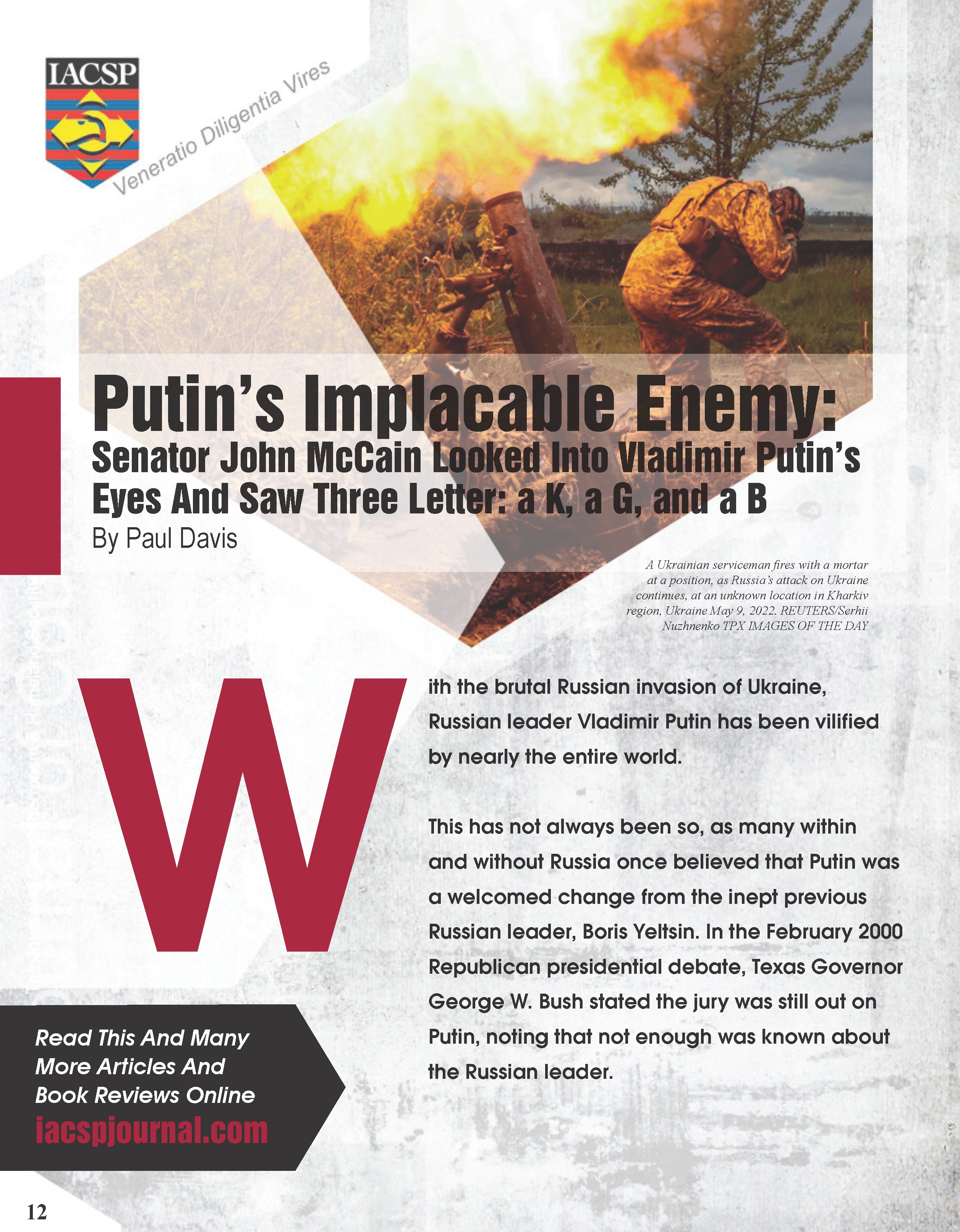
Putin's Implacable Enemy: My Counterterrorism Magazine Piece On Senator John McCain And Vladimir Putin


Counterterrorism magazine published my piece on the late John McCain and Russian leader Vladimir Putin. You can read the pages below or the below text:


Putin’s Implacable Enemy: Senator John McCain Looked Into Vladimir Putin’s Eyes And Saw Three Letter: a K, a G, and a B

By Paul Davis


With the brutal Russian invasion of Ukraine, Russian leader Vladimir Putin has been vilified by nearly the entire world.

This has not always been so, as many within and without Russia once believed that Putin was a welcomed change from the inept previous Russian leader, Boris Yeltsin. In the February 2000 Republican presidential debate, Texas Governor George W. Bush stated the jury was still out on Putin, noting that not enough was known about the Russian leader.

Senator John S. McCain (R-Az) disagreed.

“We know that he was an apparatchik. We know that he was a member of the KGB,” McCain countered. “We know that he came to power because of the military brutality in Chechnya. I’m very concerned about Mr. Putin.”

Senator McCain would go on to become Putin’s most persistent American critic.

Valdimire Putin was a Lieutenant Colonel in the KGB and served in Communist East Germany during the Cold War. He resigned from the KGB in 1991 and entered politics in Saint Petersburg. Russian journalist Masha Gessen states in her book on Putin, “The Man Without a Face: The Unlikely Rise of Vladimir Putin,” that Putin remained a reserve KGB officer and was probably a covert operator for the Soviet intelligence agency. He was later promoted to colonel in the KGB.

Putin moved to Moscow and became an assistant to Russian President Boris Yeltsin in 1996. He went on to serve as the director of the Federal Security Service (FSB), the successor to the KGB, and in 1999 became the prime minister under Yeltsin. He became the acting president after Yeltsin resigned and was elected to be president in 2000.

Putin’s critics have accused him of using GRU (military intelligence) “wet work” murder squads to kill and critically injury Russian critics residing in the West via radiation poisoning. His critics also accuse the Russian leader of leading institutional corruption in Russia and amassing a personal illicit fortune worth billions.

Putin critics believe that Putin wants to restore Russia to the country’s former “glory” as a world power. Putin once described the collapse of the Soviet Union as “the greatest geopolitical catastrophe of the 20th century,” 

President Bush met Putin in 2001 and famously said, “I looked the man in the eye. I found him to be very straightforward and trustworthy. I was able to get a sense of his soul.”

In the presidential debate in October of 2008, while debating his Democratic opponent, Illinois Senator Barack Obama, McCain mentioned President Bush’s statement about Putin. He then added, “I looked into his eyes and saw three letters: a K, a G and a B.”

McCain went on to say that Putin had repressed liberties in Georgia and issued a warning about Ukraine. He said Ukraine was in Putin’s sights.

McCain lost the election to Obama and the new president and his Secretary of State, Hillary Clinton, declared a “reset” in dealing with Russia. That effort ended with Putin’s annexation of Crimea and his first attack of Ukraine in 2014.

The son and grandson of U.S. Navy admirals, John S. McCain graduated from the U.S. Naval Academy and entered flight training in 1958. An A-4 Skyhawk pilot, McCain flew combat sorties against North Vietnam in 1967. On July 29, 1967, stray voltage from a mobile engine starter triggered a Zuni rocket to launch from an F-4 waiting for takeoff on the deck of the USS Forrestal. The rocket struck the belly fuel tank of McCain’s aircraft, killing Airman Thomas D. Ott. McCain jumped out of his cockpit and into a fire. A bomb exploded, which sent him flying about ten feet and killed a number of sailors. McCain suffered from burns and shrapnel wounds

It took the ship’s damage control teams 24 hours to contain the fire, which killed 134 Sailors, injured 161, and destroyed 21 aircraft. As the Forrestal headed to Pearl Harbor, Hawaii for repairs, McCain and other pilots from his squadron volunteered to transfer to VA-163 on the aircraft carrier USS Oriskany.

According to the Naval History & Heritage Command, McCain was shot down over North Vietnam on 26 October 1967, but the shootdown was not the result of poor airmanship.

“Rather, it resulted from a willingness of McCain to take a calculated risk to destroy an important target: the Hanoi thermal power plant,” the Navy history command wrote. “The day before, he pleaded with the squadron operations officer to put him on the roster for the large Alpha strike scheduled the next day. Four Navy squadrons participated in the raid. It was McCain’s twenty-third mission and his first attack on Hanoi. The strike force was tracked by North Vietnamese radars as it went feet dry, and soon McCain could see smoke plumes from SA-2 launches. At the time of his shootdown, McCain’s aircraft was at 3,500 feet. He had received a good warning tone, indicating that a missile was tracking him, but he felt he had time to drop his bombs on the target next to a small lake and then outmaneuver the missile. He managed to release his bomb load just before the missile impacted.

“The missile shattered one of the wings of McCain’s A-4, forcing him to bailout upside down at high speed. The force of the ejection broke his right leg, his right arm in three places, his left arm, tore his helmet off, and knocked him unconscious. He nearly died when he descended into a lake in the middle of Hanoi. He made it to the surface and was bayoneted by an angry mob of North Vietnamese. He was sent to Hoa Lo prison (the Hanoi Hilton). He was interrogated for four days before his captors brought him to a hospital after learning that his father was a four-star admiral and the Commander-in-Chief of the Pacific Command.”

McCain was 31 years old when he became a prisoner. Tortured and often kept in solitary confinement, McCain was a Prisoner of War from 26 October 1967–14 March 1973: 

Following his release, McCain spent five months recuperating and receiving medical treatment. He then attended the National War College and became the commanding officer of VA-174, In 1979, he served as the Navy’s Office of Legislative Liaison in the Senate. Captain McCain retired from the Navy in 1981. His decorations include the Silver Star Medal, the Legion of Merit with Combat ‘V’ and one gold star, the Distinguished Flying Cross, the Bronze Star Medal with Combat ‘V’ and two gold stars, and the Purple Heart Medal with one gold star.

McCain was elected to the House in 1983 and the Senate in 1987. He ran unsuccessfully for President in 2008.

In 2011, Vladimir Putin spoke for four and a half hours on Russian TV and took calls from viewers. He was asked about McCain.

“He has a lot of blood of peaceful civilians on his hands,” Putin said of McCain, referring to McCain’s background as a combat pilot and prisoner of war during the Vietnam War. “Mr. McCain was captured in Vietnam, and they kept him not just in prison, but in a pit for several years. Anyone would go nuts.”

McCain responded to Putin calling him “nuts” with a tweet: “Dear Vlad, is it something I said?”

In 2014, Putin ordered sanctions against the U.S. Senator.

“He sanctioned me, which means no spring break in Siberia,” McCain joked to a TV talk show host. “Russia is a gas station run by a mafia that is masquerading as a country.”

In 2015, returning from a visit to Ukraine, McCain said, “Russia is kleptocracy. It’s corruption. It’s a nation that’s really only dependent upon oil and gas for their economy, and so economic sanctions are important.”            

Senator McCain passed away on 25 August 2018 from glioblastoma, a form of brain cancer. Russian media reported McCain’s death as the passing of “an implacable enemy of Russia.”

The late senator was certainly an implacable enemy of Vladimir Putin.

Senator-John-McCain-with-sailors-aboard-USS-John-S-McCain-2017

“John McCain was right: Vladimir Putin is a thug. He saw KGB in Putin’s eyes, and that’s exactly what the rest of the world is seeing now,” the McCain Institute at Arizona State University noted in a released statement. “Putin’s actions demonstrate the grave dangers of authoritarianism and underscore the need for free nations to stand firm in defense of democracy.

“Flexing unchecked power, Putin’s belligerence toward Ukraine is proving the case we’ve been making for so long – that democracy is the best way to unify society, secure peace and create broad prosperity. Accordingly, Western nations are uniting in a reaffirmation of their commitment to democratic principles, a goal that has eluded presidents since the end of the Cold War. Ultimately, the weight of authoritarianism is its biggest flaw. It crushes opportunity and forces people into bondage. Putin’s power grab in Ukraine represents a watershed moment in shifting the global balance of power away from authoritarianism and toward freedom.”

About the Author

Paul Davis is a longtime contributor to the Journal. He writes the IACSP Threatcon column.


Wednesday, March 21, 2018

McCain Rips Trump's Congratulatory Call To Putin As An Insult To Russian People


Max Greenwood at The Hill offers a piece on Senator John McCain’s response to President Trump’s congratulatory call to Russian Putin.

Sen. John McCain (R-Ariz.) blasted President Trump on Tuesday over news that Trump phoned Russian President Vladimir Putin to congratulate him on his recent electoral win.

Putin won reelection in a landslide on Sunday — but both election observers and Putin's political opponents have charged that the vote was tainted by widespread fraud.

In a statement, McCain called Trump's phone call to Putin an insult to "every Russian citizen who was denied the right to vote in a free and fair election to determine their country's future."

“An American president does not lead the Free World by congratulating dictators on winning sham elections," McCain said.

"And by doing so with Vladimir Putin, President Trump insulted every Russian citizen who was denied the right to vote in a free and fair election to determine their country's future, including the countless Russian patriots who have risked so much to protest and resist Putin's regime."

You can read the rest of the piece via the below link:

Friday, July 21, 2017

John McCain: Senator, Warrior, Hero


Sad to read of Senator John McCain's medical problems. I wish him well and hope he can return soon to the Senate.

I've not always agreed with Senator John McCain, but I voted for him for president and I respect his service as a Navy pilot, POW and as a senator. 


Senator McCain's actions as a POW in North Vietnam were indeed heroic. He was tortured but he never gave in to his Communist tormentors. The North Vietnamese wanted to release him early because his father, Admiral John McCain, was then the commander of all American forces in Vietnam. But the young and gravely injured Navy pilot refused, as the Code of Conduct clearly states that POWs should be released according to their date of capture. 

As a POW, McCain was the epitome of what Ernest Hemingway called "grace under pressure."

To learn more about John McCain's service and sacrifice in the Vietnam War, I suggest that readers pick up John McCain’s Faith of My Fathers and Robert Timberg’s The Nightingale's Song.


Saturday, August 9, 2014

McCain Calls Obama's "Pinprick" Iraq Strikes "Meaningless" And "Almost Worst Than Nothing"


Josh Rogin at the Daily Caller offers a piece on Senator John McCain's response to President Obama's Iraqi air strikes.

President Obama’s limited strikes on ISIS in northern Iraq are “pinpricks” that are “meaningless” and “worse than nothing,” according to one of his fiercest foreign policy critics, Sen. John McCain.

By committing U.S. military forces to fight again in Iraq while explicitly limiting the mission to protection of American personnel and Iraqi minorities, Obama has failed to come up with a plan that has any hope of stopping the ISIS advances across Iraq and Syria, said McCain. It’s a position that puts him somewhat at odds with other Republicans, who are offering cautious support for the airstrikes in Iraq – and concern that the president doesn’t have a comprehensive strategy to combat the growing threat of ISIS..

McCain, a consistent advocate for the application of American military power around the world, has long pushed for greater U.S. involvement in Iraq. But these strikes Friday were not what McCain had in mind.

“This is a pinprick,” McCain told The Daily Beast in an interview Friday, about the two 500-pound smart bombs U.S. airplanes dropped on ISIS convoys Friday. The vehicles were approaching Erbil, the capital city of Iraqi Kurdistan, were many U.S. diplomatic and military personnel reside.
“It’s almost worse than nothing because I fear the president is threatening and then he won’t follow through,” said McCain. “It’s the weakest possible response and we cannot allow them to take Erbil. What [the administration has] done so far is almost meaningless.”

You can read the rest of the piece via the below link:

http://www.thedailybeast.com/articles/2014/08/08/mccain-calls-obama-s-pinprick-iraq-strikes-meaningless-and-worse-than-nothing.html 

Friday, June 13, 2014

Conficts End When The Enemy Is Defeated: Senator McCain Calls For Obama To Fire National Security Team


Evan McMurry at mediaite.com offers a piece on Senator John McCain:

Senator John McCain (R-AZ) took to the floor of his chamber Thursday morning and called upon President Barack Obama to replace his entire national security staff in the wake of Islamic militant victories in several large Iraqi cities.

“I say to the President of the United States, get a new national security team in place,” McCain said. “You have been ill-served by the national security team you have in place now, and the decisions you have made. Have that new national security team come up with a strategy to do whatever we can to prevent this direct threat to the national security of this nation.”

McCain blamed the deterioration of the Iraq situation on Obama’s “withdrawal without victory,” and warned the same thing could now occur in Afghanistan without a change of policy.

“Because the President of the United States declares a conflict over does mean that in the eyes of the enemy it is over,” McCain said. “Conflicts end when the enemy is defeated.”

You can watch the video of Senator McCain via the below link:

http://www.mediaite.com/tv/mccain-to-obama-fire-your-entire-national-security-staff/

Tuesday, October 30, 2012

McCain's Last Laugh


Robert Costa at National Review Online offers a piece on the reception Senator John McCain received at an American Legion in Virginia.

Four years ago, McCain lost a presidential election by 192 electoral votes, but to Vietnam veterans and other former service members, he remains a towering figure. The second McCain steps inside, the packed banquet hall erupts with applause. As he walks toward the lectern, past a table piled high with Romney-Ryan posters, several men stand up and salute him. McCain squints and nods. This isn’t a mere rally; it’s a homecoming.  

... As a decorated veteran, a former presidential nominee, and the ranking member of the Senate Armed Services Committee, McCain gives the Romney campaign a certain gravitas among military audiences. In his 15-minute speech, he hits on two key themes: President Obama’s mishandling of the Benghazi mess, and his failure to take action to stop “sequestration,” a series of looming (and large) defense cuts that was brokered by the White House and congressional leaders in the effort to cut a spending deal.

But this speech and the others he has made this cycle are more than rote pro-Romney orations. They are a reminder that McCain, at 76 years old, is still in the game. After his loss four years ago, many of his friends urged him to retire. McCain ignored them. He yearned to remain a force, and that meant spending Sunday mornings in television green rooms, not on an emerald-green golf course. He became a fierce critic of the administration during Obama’s first year in office, and a year later, he won reelection to the Senate.

You can read the rest of the piece via the below link:

http://www.nationalreview.com/articles/331884/mccain-s-last-laugh-robert-costa