The
FBI recently released its annual publication Law Enforcement Officers Killed and
Assaulted, 2001.
The report stated that 142 law enforcement officers were
feloniously killed in the line of duty. The terrorist attacks of September 11th
claimed the lives of 72 officers. The FBI reported that the attacks on the World
Trade Center claimed 71 officers and a law enforcement officer with the U.S.
Fish and Wildlife Service also died on September 11th when the airplane in which
he was traveling was hijacked as part of the terrorist attacks and crashed in
rural Pennsylvania.
The officers killed in incidents unrelated to the
September 11th attacks represented a 37.3 percent increase in the number of law
enforcement officers feloniously killed in 2000.
In my view, there is
nothing more dangerous than a cop killer. The criminal who is willing to take on
an armed police officer will not hesitate to kill anyone. A cop killer is a
total outlaw.
As a writer I’ve spent a good amount of time with law
enforcement officers. I’ve interviewed FBI, DEA and other agents from the
alphabetized federal law enforcement community. I’ve spoken to military
investigators, park rangers, sheriffs and cops from other cities, but I’ve
probably spent the most time with Philly cops.
I’ve talked to them in the
station houses, in patrol cars, on the street and in bars. I’ve listened to
their concerns, prideful boasts and sorrowful confessions. I’ve accompanied
Philly cops on patrol and witnessed them handle insane, intoxicated and violent
people. I’ve observed how they consol crime victims and their families. I’ve
seen how they cope with the aftermath of criminal violence and man’s inhumanity
to man. And I’ve come to appreciate their black humor, which like military
humor, is a necessary safety valve to get them through the day.
There is
one cop killer in particular who rankles the rank and file of the Philadelphia
police. In what can be called one of Philadelphia’s most celebrated criminal
cases, Mumia Abu-Jamal was convicted of murder and sentenced to death in 1982
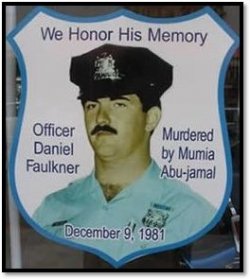
for the shooting of Philadelphia police officer Daniel Faulkner in 1981.
Faulkner was only 25-years-old.
Last year Abu-Jamal’s death sentence was
overturned by a federal judge in Philadelphia but denied him the right to a new
trial. This decision made both sides of the issue unhappy.
The long,
drawn out case of Abu-Jamal continues to this day. Abu-Jamal is the poster child
of the death penalty opponents. A photo of Abu-Jamal, dressed in prison garb and
sporting a beard and dreadlocks, adorns t-shirts and posters from Philadelphia
to Paris. The anti-American international crowd, as well as celebrities like
Alec Baldwin and Whoppi Goldberg, have called for a new trial.
Abu-Jamal
supporters traveled to Philadelphia and Los Angeles, the sites of the 2000
political conventions to protest his death sentence. In Philadelphia there were
also counter-demonstrations against Abu-Jamal. Faulkner’s widow, Maureen has
campaigned steadily in an attempt to offset the publicity Abu-Jamal has
garnered.
"If Abu-Jamal goes free, it will become open season on police
officers," one angry cop told me during the Philadelphia convention. The cops
are upset with the celebrity status and media attention bestowed on
Abu-Jamal.
Popular among some Philadelphia police officers was a t-shirt
made to counter the Abu-Jamal one. The off-duty cops’ t-shirt displays a photo
of the slain officer and his badge on the front side and reads "In Memory of
Daniel Faulkner." The backside of the t-shirt reads, "He killed Officer
Faulkner. Let’s Kill Him Now."
The controversy rages on in the judicial
system and on t-shirts.
Although some have made a racial issue out of the
case (Abu-Jamal is black, and Faulkner was white), I don’t know of a single
black police officer that favors Abu-Jamal.
Abu-Jamal can be viewed
however as a study in militant, radical race relations in Philadelphia. A former
Black Panther and supporter of the militant back to nature group MOVE, his case
is set against the backdrop of a history of contentious relations between the
police and militants in the black communities of Philadelphia.
Abu-Jamal
was a young Black Panther when the Philadelphia Police, under the command of
Police Commissioner Frank Rizzo, raided the Black Panther headquarters. Rizzo,
known as a "cop’s cop" who was called "The Cisco Kid" during his early career,
would go on to become the city’s populist, law and order mayor.
A big,
physically impressive man, Rizzo was equally loved and hated along racial and
geographic lines in Philadelphia. In South Philly, where Rizzo was born and
raised, he remains a revered figure years after his death.
In response
to the shooting of two police officers in 1970, Rizzo ordered the Panther
headquarters to be raided. After a brief gunfight, the Panthers were arrested
and lined up against a wall. A UPI photographer captured the scene. The photo of
the Panthers, nude, with their hands against the wall, was carried in newspapers
across the country.
Abu-Jamal would go on to become a radio reporter but
was later fired for his obsession with and open advocacy of the MOVE group. A
handyman named Vincent Leapheart, who renamed himself John Africa, founded the
group. All of his followers also took the name Africa to identify themselves as
members of one "family."
Africa instructed his followers to lick their
children clean rather than wash them the conventional way. The group had many
other unusual practices as well. They settled into an armed, barricaded compound
in a black middle class neighborhood called Powelltown. The neighbors complained
about piled garbage, human and animal waste and rats. MOVE members would not
allow city workers to enter the compound to inspect for health violations.
In 1978 the police raided the compound and police officer James Ramp was
killed in the assault. Rizzo had bulldozers flatten the compound. Nine MOVE
members were convicted of 3rd degree murder and other offenses.
John
Africa, who was not at the compound during the time of the raid, moved his
remaining members to another black middle class neighborhood in West
Philadelphia. The neighbors there soon complained to the city about garbage,
dogs, rats and the openly hostile MOVE members who brandished weapons and used
loudspeakers to harass the neighbors.
Three years later, after Abu-Jamal
was convicted and imprisoned, the MOVE house would make headlines around the
world when the Philadelphia police ended an armed standoff by dropping an
explosive device on the rooftop bunker. The bunker housed MOVE riflemen who were
firing on the police.
The fire than ensued was allowed to burn out of
control and destroyed the MOVE house and 60 others in the neighborhood. John
Africa and five other MOVE members were killed in the blaze. Tragically, five
children were also killed in the fire.
Several police officers and former military men have told me that the dropping of the C-4 explosive on the rooftop bunker was a tactically sound
decision – MOVE had the high ground in the urban battlefield – but the decision to
allow the fire to burn on was a bad one.
The police officials under the
city’s first black mayor, Wilson Goode, who succeeded Rizzo as mayor, made that
call.
In the midst of the long-running MOVE controversy,
Abu-Jamal, fired by WUHY Radio for his lack of objectivity and his intimate
involvement with MOVE, began to drive a cab.
According to the testimony
that convicted Abu-Jamal, Philadelphia police officer Daniel Faulkner was shot
and killed on December 9, 1981 at 4AM on 13th and Locust Streets in Center City
Philadelphia.
Faulkner had stopped William Cook, Abu-Jamal’s brother, for
driving the wrong way on 13th Street. Cook and Faulkner were wrestling when
Abu-Jamal drove up in his cab. According to three witnesses, a man in dreadlocks
ran through the parking lot and shot Faulkner. Two of the three witnesses
positively identified Abu-Jamal as the murderer.
Abu-Jamal came up behind
Faulkner and shot him in the back. Faulkner returned fire as he fell to the
street and was able to place a round in Abu-Jamal’s chest.
Although
wounded, Abu-Jamal shot Faulkner again, but this time it was point-blank between
Faulkner’s eyes. Abu-Jamal then collapsed in the street alongside
Faulkner.
Police responding to the scene found Abu-Jamal sitting in the
street and suffering from a gunshot wound from Faulkner’s gun. Abu-Jamal’s
legally registered .38 caliber revolver was discovered at the scene, along with
five spent shell casing.
Abu-Jamal was taken to the hospital by the
police and was overheard by a police officer and a security guard as saying, "I
shot the mother...and I hope he dies."
A ballistics expert testified that
the bullet that killed Faulkner was too damaged to be identified as being from
Abu-Jamal’s gun, but it bore tracings consistent with the type of gun he owned.
Both Abu-Jamal and his brother have steadfastly refused to testify or
publicly give their side of the night’s events.
The lawyer who originally
defended Abu-Jamal admits to making crucial mistakes. He says he failed to offer
character witnesses and interviewed key witnesses only on the day of their
testimony. Abu-Jamal’s later defense team also contends that Abu-Jamal had the
right to select his own counsel. He wanted to be defended by MOVE founder John
Africa. He cursed the judge and the jury and had to be restrained and once was
removed from the courtroom.
"Abu-Jamal was represented by a an
experienced former prosecutor who was not foisted on him, but took the case at
the request of one of Abu-Jamal’s friends," wrote Philadelphia District
Attorney, Lyn Abraham in a
New York Times op-ed, which was later
carried in the
Philadelphia Daily News..
Abraham, who was once
called "one tough cookie" by Frank Rizzo, went on to say that the jury was
composed of blacks and whites chosen with Abu-Jamal’s personal participation.
They voted unanimously to convict him of first-degree murder for executing a
police officer in cold blood.
Abraham went on to state that the crime was
committed at a well-lighted intersection in full view of numerous people.
"When the police happened on the scene, almost immediately after it
occurred, the evidence of guilt, both eyewitness and physical, was at the scene
along with the perpetrator. There was no reason or opportunity to fabricate the
evidence, all of which corroborated each other. There is no question of guilt,"
Abraham wrote.
Even though Abu-Jamal’s supporters were successful in
having the death penalty dropped; they are still appealing for a new trial. Lyn
Abraham’s office is also appealing. Abu-Jamal is serving a life sentence at
Graterford Prison in Philadelphia
Cop killers were glorified in a
"gangsta" rap song by Ice-T some time ago. Today, ironically, Ice-T is
portraying a police officer on the TV program
Law & Order: Special
Victims. He is somewhat convincing as a streetwise former narc.
If
Hollywood ever makes a film or TV movie about the Abu-Jamal case, I would cast
Ice-T as Abu-Jamal.
I’m not sure who I would cast as Danny Faulkner. But
with so many of the Hollywood types supporting Abu-Jamal, I don’t suppose it
would a fair or balanced film.
Perhaps Abu-Jamal’s celebrity supporters,
like Ed Asner and Mike Farrell, should take leave of their TV-sound stages and
try patrolling the mean streets of Philadelphia one weekend.
Let them
try living and working with the knowledge that they may be targeted at any time
by any criminal, radical or nut who fancies himself a public enemy.
Police officers, who make a lot less than TV actors, do this every day.
Note: The column originally appeared in the
Orchard Press Online Mystery Magazine in 2003.