Showing posts with label book review. Show all posts

Thursday, May 4, 2023

A Look Back At William F. Buckley's Spy Thrillers


I’ve been watching old videos of William F. Buckley’s TV program Firing Line. 

The program aired on PBS from 1966 to 1999. There was nothing else on TV quite like Firing Line. I thought that William F. Buckley was brilliant, and he was a huge influence on my thinking. 

You can watch an episode of Firing Line via the below link:

 Firing Line with William F. Buckley Jr.: War Crimes: Part II - YouTube 

In addition to his TV program, newspaper columns, political books and editing his conservative magazine, National Review, William F. Buckley also wrote spy thrillers. 

His series of pro-American and pro-CIA spy thrillers (Buckley served briefly as a CIA officer in Mexico) featured his fictional CIA officer Blackford Oakes involved with actual historical events and real historical figures. 

I enjoyed the novels immensely.

I reviewed his final thriller, Last Call for Blackford Oakes, for the Philadelphia Inquirer in 2005. 

You can read the review below:  

Note: You can click on the above to enlarge: 

You can also read about his spy thriller series via the below link: 

Blackford Oakes Series by William F. Buckley Jr. (goodreads.com) 

Friday, November 5, 2021

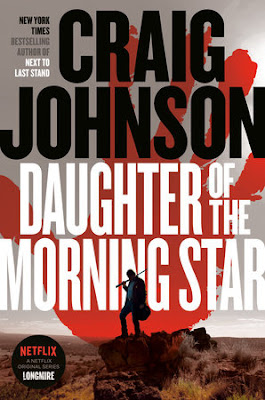
'Daughter Of The Morning Star': My Washington Times On Crime Column On Craig Johnson's New Longmire Crime Novel

 The Washington Times published my On Crime column on Craig Johnson’s Daughter of the Morning Star. 

Although the series “Longmire" ended on Netflix, fans of the modern Western Sheriff Walt Longmire can still read Craig Johnson’s popular crime series of novels where Longmire is still on the job as the sheriff of a fictional Wyoming county. 


I reached out to Craig Johnson and asked what inspired him to write his latest crime novel, “Daughter of the Morning Star.”


“I was doing a library event up in Hardin on the Crow Reservation a few years back when I looked up and noticed a missing persons poster on the community bulletin board. It was a simple computer copy with the face of a young woman, bright-eyed and smiling and now… Gone,” Mr.Johnson replied. “The words were desperate, and pleading and a reward was posted. 


Her face was faded, and the paper wrinkled and yellowed with age — a fervent and unanswered prayer that fluttered against the bulletin board like a turning page every time the door of the library opened and closed.  I can’t think of anything worse than losing a loved one—I mean, having them turn up missing and then never knowing what happened to them. I’ve spoken with people to whom this has happened, and the thing I have heard repeatedly is that the worst part is the not knowing — the lack of closure, having no idea if they are alive or dead or if they suffered or are still suffering.”


Mr. Johnson went on to say that he wanted to write a novel about the plight of murdered and missing indigenous women, so he had to come up with the idea that would take Walt Longmire somewhere he’d never been before, like a bus full of teenaged girl basketball players.


A young star basketball player, Jaya Long, was receiving death threats. The tribal police chief invites Sheriff Longmire to the Cheyenne Reservation, hoping that his involvement would bring additional attention to the case. Longmire discovers that Jaya Long’s older sister Jeanie had also been receiving threats, and she has been missing for more than a year.

You can read the rest of the column via the below link:


https://www.washingtontimes.com/news/2021/nov/4/book-review-daughter-of-the-morning-star/


Saturday, January 30, 2021

My Crime Beat Column: Michael Connelly's Lincoln Lawyer In 'The Law Of Innocence'

Earlier this month crime novelist Michael Connelly announced on his website that his character Mickey Haller, the Lincoln Lawyer, would debut in a series on Netflix. The character previously appeared in the 2011 film The Lincoln Lawyer and starred Matthew McConaughey. 

The announcement came as his latest novel, The Law of Innocence, his sixth novel that features Mickey Haller, is now in bookstores.

“I’m excited to announce that after a bit of a journey, Mickey Haller will come to life once again on screen - this time in the TV series adaptation of The Lincoln Lawyer coming to Netflix and starring the wonderful and talented Manuel Garcia-Rulfo," (seen in the above photo), Michael Connelly wrote.

 “The Lincoln Lawyer series will be adapted to serve up the complex and mysterious arcs fans know and love with a mix of light-hearted humor and a dose of family dynamics. 

“Mickey Haller, an iconoclastic idealist, runs his law practice out of the back seat of his Lincoln Town Car, as he takes on cases big and small across the expansive city of Los Angeles,” Mr. Connelly explains. “Manuel is the ideal Mickey Haller, as Haller follows in the footsteps of his attorney father with the showmanship of his Mexican movie star mother. Manuel brings a powerful dynamic and dimension to the role - one that aligns with the books and will give the show the opportunity to celebrate the Latinx heritage and roots of this Los Angeles-based story.” 

In The Law of Innocence, Mickey Haller faces his toughest criminal case as he is also the client. Falsely accused of murder, the seasoned lawyer represents himself, despite the adage that a lawyer who represents himself has a fool for a client. 

After celebrating his victory in a criminal case with friends and colleagues at a bar, Haller is arrested and charged with first-degree murder after he is pulled over by a police officer and during the stop the officer discovers a body in the trunk of his Lincoln Town Car. The dead body in the trunk is Sam Scales, a despicable grifter and con artist who bilked victims out of their donations to phony charitable campaigns. Haller had represented Scales in the past. 

Haller is held in jail without bail due to a judge who holds a grudge against the defense lawyer. He martials his defense behind bars with the help of his legal team. The team includes Michael Connelly’s popular character, retired LAPD homicide detective Harry Bosch, Haller’s half-brother. The team also includes Haller’s investigator, former biker Dennis “Cisco” Wojciechowski, and his law partner Jennifer Aronson. 

As Haller, the first-person narrator of the crime novel, notes, one is proven guilty or not guilty in a trial, but the defendant is not proven innocent. 

“The law of innocence is unwritten It will not be found in a leather-bound codebook. It will never be argued in a courtroom. It cannot be written into law by the elected. It is an abstract idea and yet it closely aligns with the hard laws of nature and science,” Haller explains.” In the law of physics, for every action, there is an equal and opposite reaction. In the law of innocence, for every man not guilty of a crime, there is a man out there who is. And to prove true innocence, the guilty man must be found and exposed to the world.” 

Haller’s plan is to go further than a jury verdict and expose the true guilty party and make his own innocence clear. 

“The only way to prove I didn’t do it is to prove who did,” Haller tells Scales’ former cell mate in an interview. “That’s the law of innocence.” 

As Haller tells it, a trial often comes down to who is a better storyteller, the prosecutor or the defense. “There is evidence, of course, but physical evidence is at first interpreted for the jury by the storyteller.” 

Haller’s investigation leads to a biofuel scam called “bleeding the beast,” in which the government is cheated out of subsidies for producing recycled oil. The scam is run by Louis Opparizio, a mobster that Haller once humiliated on the stand in a case some years prior. By exposing Opparizio’s shady dealings in court, the mobster lost millions when the Federal Trade Commission reversed a merger he had developed.     

Michael Connelly, a former Los Angeles Times crime reporter, uses detailed research to infuse his crime novels with realistic situations and current events. That realism makes his characters more believable and the plots more interesting.     

Michael Connelly’s The Law of Innocence is a fast-paced, well-written legal thriller. 

The Law of Innocence

By Michael Connelly

Little, Brown, $29, 432 pages.


You can also read my Q&A with Michael Connelly via the below link:

Friday, April 17, 2020

My Washington Times Review Of Don Winslow's 'Broken'


The Washington Times published my review of Don Winslow’s Broken.

After publishing a big crime novel like “The Cartel,” “The Force” and “The Border” every two years, Don Winslow decided to publish “Broken,” a collection of five novellas and one short story. Inspired by the novella collections of Jim Harrison and Stephen King, Don Winslow sees the quick potential of selling the six stories to television and films.

FX is working on his cartel drug trafficking trilogy — “Power of the Dog,” “The Cartel” and “The Border” — into a television series called “The Cartel.” TV and film producers are also buying or bidding on other Winslow crime novels. At 65, Mr. Winslow, a former private detective and safari guide, is considered a hot property.

In “Broken,” the stories are connected by themes of crime, corruption, tragedy and humor.  

Mr. Winslow offers an Ernest Hemingway quote, “The world breaks everyone and afterward many are strong in the broken places,” to open his story, “Broken.”  

“You ain’t gotta tell Eva the world is a broken place,” Mr. Winslow writes. “A 911 dispatcher on a night shift, Eva McNabb hears humanity’s brokenness for eight hours straight, five nights a week, more when she’s pulling doubles. She hears the car accidents, the robberies, the shootings, the murders, the maiming’s, the deaths. She hears the fear, the panic, the anger, the rage, the chaos, and she sends men racing toward it.”   

Her two sons are New Orleans police officers. One is a sensitive patrol officer and the other is a brutal narcotics officer. The sensitive cop is murdered by a drug trafficker who sought to punish the narcotics officer who busted his drug shipment. The murder sets off a tale of revenge and murder.

In “Crime 101,” which Mr. Winslow dedicates to the late actor Steve McQueen, a clever jewel thief travels California Highway 101 in San Diego, robbing jewel couriers and merchants with a minimum of force and maximum speed. The crook admires Steve McQueen, the definition of California cool, and adheres to a set of principals he calls Crime 101 (“Crime 101: There’s a word for a man who believes in coincidences: the defendant”). The crook is pursued by an old school San Diego detective in this clever and interesting story.

You can read the rest of the review via the below link:

https://www.washingtontimes.com/news/2020/apr/16/book-review-broken/ 

Tuesday, March 31, 2020

My Washington Times Review Of 'Mengele: Unmasking The Angel of Death'


The Washington Times published my review of Mengele; Unmasking the Angel of Death.

Josef Mengele was one of the most notorious war criminals in history. During World War II the Nazi doctor performed medical experiments in a concentration camp on unwilling children and adults, and with a jerk of his thumb he sent many unlucky men, women and children to their immediate deaths.

He escaped justice after the Third Reich fell by fleeing the country and although his death was later confirmed, and his body uncovered in a cemetery in Brazil, his victims’ demand for justice has not been fulfilled, nor has it satisfied an abundant interest in his life and crimes.

David Marwell’s “Mengele: Unmasking the Angel of Death” is a fine addition to other biographies of the evil doctor, as it is partly a biography and partly a memoir, as historian David Marwell was the U.S. Justice Department’s chief of investigative research in the Office of Special Investigations in the 1980s.

Mr. Marwell was involved in the Mengele investigation and he performed numerous interviews of victims and other parties, examined documents and visited Germany and other countries around the world gathering evidence. He also coordinated the investigation with partners in Israel, Germany and other governments and private organizations. He even held Mengele’s bones in his hands.

“While this book is based on both primary sources from archives throughout the world and the careful research of a host of brilliant scholars, it also relies on the writings of Mengele himself,” Mr. Marwell writes. “I read his correspondence and diaries from his later life and was exposed to the intimate details of his health complaints, frustrations, and private reflections, and to the style and rhythm of his thoughts. In addition, I had access to Mengele’s own attempt at the very enterprise in which I was engaged.”

Mr. Marwell notes that late in Mengele’s life, he wrote but never published an autobiographical novel, which was about a man shaped in a very special way by his time, as Mengele put it.

You can read the rest o the review via the below link:

https://www.washingtontimes.com/news/2020/mar/30/book-review-mengele/  

Wednesday, March 25, 2020

Chinese Spies, Agents And Assassins: My Washington Times Review Of 'Chinese Communist Espionage'


The Washington Times published my review of Chinese Communist Espionage.

Speaking at the Justice Department’s China Initiative Conference on Feb. 6 at the Center for Strategic and International Studies in Washington, D.C., FBI Director Christopher Wray noted that one long-term threat to the country’s information, intellectual property and economic vitality was espionage from China.  

“China is using a wide range of methods and techniques — everything from cyber intrusions to corrupting trusted insiders. They’ve even engaged in physical theft,” Mr. Wray explained. “And they’ve pioneered an expansive approach to stealing innovation through a wide range of actors — including not just Chinese intelligence services but state-owned enterprises, ostensibly private companies, certain kinds of graduate students and researchers, and a variety of other actors all working on their behalf.”

He added that the Chinese are targeting Fortune 100 companies, Silicon Valley start-ups, defense contractors, government and academia, and agriculture. He further stated that the FBI has about 1,000 investigations involving China’s attempted theft of U.S.-based technology, in all 56 of the FBI field offices.

“The Chinese government is taking an all-tools and all-sectors approach — and that demands our own all-tools and all-sectors approach in response,” Mr. Wray said. “To respond to the China threat more effectively, I believe we need to better understand several key aspects of it.”

One could add that we should also know the history of Chinese espionage, so the publication of “Chinese Communist Espionage: An Intelligence Primer” is timely.

Peter Mattis, a research fellow in China studies at the Victims of Communism Memorial and a former CIA counterintelligence analyst, and Matthew Brazil, a non-resident fellow at The Jamestown Foundation and a former U.S. Army officer who worked in Asia for more than 20 years, offer a studious history of Communist China’s intelligence services.

The authors mined numerous Chinese publications, books and other materials and sources to tell the history and current state of Chinese Communist intelligence operations, and of the often shadowy figures who planned and carried out those operations.

You can read the rest of the review via the below link:

https://www.washingtontimes.com/news/2020/mar/24/book-review-chinese-communist-espionage/ 

Tuesday, February 25, 2020

My Washington Times Review Of Bernard Cornwell's 'Sword Of Kings'


The Washington Times published my review of Bernard Cornwell’s Sword of Kings.

I first became acquainted with Bernard Cornwell by watching the “Sharpe” TV series, which was based on his historical novels that featured Richard Sharpe, portrayed by actor Sean Bean, a Napoleonic-era British soldier up from the ranks. Bernard Cornwell described Richard Sharpe as a rogue, but a rogue on our side.

I read the entire Sharpe series and I went on to read his other historical fiction, including his Saxon stories. The Saxon stories cover the bloody path that led to the creation of England in the 9th and 10th centuries.

The hero of the Saxon stories is Uhtred of Bebbanburg, a Saxon lord from Northumbria who was captured by the Danes as a young man and adopted into their tribe. He later fights for Alfred the Great, the King of Wessex.

Alfred the Great’s dream was to unite the Anglo-Saxon kingdoms into one kingdom called England. Mr. Cornwell’s Saxon stories were adapted for television and called “The Last Kingdom,” with actor Alexander Dreymon as Uhtred. The series appears on Netflix.

In Mr. Cornwell’s “King of Swords,” the 12th installment in the Saxon stories, Uhtred, who narrates the stories, becomes involved in the succession of Alfred the Great’s son, King Edward. Edward rules over Wessex, Mercia and East Anglia, and as he lay dying, Uhtred swears an oath to Edward’s likely successor, Aethelstan, to kill his rivals to the throne, Aethelhelm and his evil and rotten nephew, Aelfweard.

Uthred, a pagan and a feared warrior, would like to sit out the medieval game of thrones, but the oath is important to him, although he calls it a “fool’s errand.” With a small army he boards “Spearharfoc,” a warship equipped with sail and 40 rowers, and sails into the fray.

Uthred is soon engaged in numerous sea and land battles, which Mr. Cornwell describes in vivid and accurate historical detail. 

You can read the rest of the review via the below link:

https://www.washingtontimes.com/news/2020/feb/24/book-review-sword-of-kings/  

Monday, February 3, 2020

The Seabees in Vietnam: My Washington Times Review Of 'Seabee 71 In Chu Lai'


The Washington Times published my review of Seabee 71 in Chu Lai.

David H. Lyman, like a good number of potential draftees in the 1960s, joined the military reserves in a desire to stay out of Vietnam during the war. Ironically, he ended up in Vietnam as a member of the Seabees (construction battalion) in 1967.

“I joined the Naval Reserve in 1963, primarily to avoid the draft and stay out of a foxhole in Vietnam,” Mr. Lyman writes in the preface of his slim memoir. “With my background and education in journalism, I wound up a JO3 Journalist Third Class. In 1966 I was commandeered off a Navy ship because a newly forming Seabee outfit, Mobile Construction Battalion 71, needed a journalist. I was not a real Seabee, I was a ‘fleet-bee,’ one of the office guys from the fleet.”

He said it was his job to publicize the battalion’s actions and accomplishments by writing press releases for the service members’ families back in the states and by writing stories and taking photographs that appeared in the battalion’s monthly newspaper, The Transit, which he edited.

“I was more PR hack than journalist,” Mr. Lyman notes.

In his book, “Seabee 71 in Chu Lai: A Navy Journalist’s Memoir of His 14 Months with MCB 71, 1966-67,” Mr. Lyman recounts his time serving with the Seabees in Chu Lai, where the Seabees built roads, airfield runways, buildings and other projects.

Mr. Lyman describes the battalion’s combat training given by Marines who served in Vietnam, as Seabees are trained and required to fight to protect themselves if attacked. After shipping out to Chu Lai in South Vietnam, the then-27-year-old sailor and the other men of the battalion lived in plywood huts called “hooches” with basic (some would call it primitive) facilities in a camp set up along the beach and the South China Sea.

“A Seabee outfit, or Naval Mobile Construction Battalion, is sort of like MASH (Mobile Army Surgical Hospital) unit, as seen in the popular movie and TV series. It is a self-contained unit of around 800 men and officers with its own cooks, office personnel, chaplain, engineers, architects, construction workers, doctors, and a monthly newspaper,” explains the author. 

You can read the rest of the review via the below link:

https://www.washingtontimes.com/news/2020/feb/1/book-review-seabee-71-in-chu-lai/ 

Sunday, January 19, 2020

Tale Of Crooks, Drugs, Prostitution And Murder: My Washington Times Review Of "Many Rivers To Cross'


The Washington Times ran my review of Peter Robinson’s Many Rivers To Cross.

Peter Robinson’s fictional character Detective Superintendent Alan Banks has been the protagonist of a long series of popular crime novels, beginning with 1987’s “Gallows View.” 

Originally a detective working in London, Banks grew disillusioned with the big city and transferred to a fictional English town near Yorkshire called Eastvale.

Mr. Robinson’s detective character and stories were adapted for a British TV series called “DCI Banks,” which aired on British TV from 2010 to 2016.

Banks has moved up the ranks to become a detective superintendent, and in “Many Rivers To Cross” he and his squad must investigate the murder of a teenage boy left in a trash can, what the British call a “rubbish bin.”  

“Banks put on his thin latex gloves, slowly opened the bin and recoiled from what he saw there: a boy’s body with his knees tucked under his chin, curled up, almost like a fire victim,” Mr. Robinson writes. “But it wasn’t a pugilistic position, and there had been no fire; the boy had been deliberately crammed into the bin.”

The rubbish bin belonged to an elderly retired nurse who told Banks that she didn’t know the boy and didn’t how he ended up in the bin outside of her house.

Banks’ investigating team consisted of Detective Inspector Annie Cabbot and Detective Constable Gerry Masterson. They discovered a bit of cocaine in the boy’s pocket, and after a medical examination they learned the boy had been stabbed to death. He was identified as a Syrian immigrant who had managed to travel to England all on his own,

The police later investigated another victim not far from the boy in the bin. Howard Stokes, a down-and-out diabetic and heroin addict in a wheelchair was found dead by two young boys who were playing in an abandoned house in a housing area being cleared for redevelopment.

Banks interviews a wealthy property developer named Connor Clive Blaydon, whom the coppers call “dodgy.” Although he had no criminal record, his partners in redevelopment deals are well-known to Banks. His partners are Timmy and Tommy Kerrigan, a pair of brothers who are local “villains,” as the British call criminals.

“Timmy and Tommy Kerrigan were, on paper at least, owners of the old Bar None nightclub, now renamed The Vaults, just across the market square from where Banks and Joanna were sitting, along an amusement arcade, also on the square. They were crooks and thugs, suspected of involvement in drug dealing and prostitution, but Banks and his team had never been able to find enough evidence to charge them with anything,” Mr. Robinson writes. “Timmy was suspected of an unhealthy interest in teenage girls, whereas Tommy was gay and preferred young boys. Tommy also had a sadistic streak and a nasty temper, ready to explode at a moment’s notice."

You can read the rest of the review via the below link: 

https://www.washingtontimes.com/news/2020/jan/18/book-review-many-rivers-to-cross/ 

Monday, January 13, 2020

My Washington Times Review of 'El Dorado: A History Of The American West'


The Washington Times published my review of Dreams of El Dorado: A History of the American West.

H.W. Brands opens his book on the exploration and settling of the American West by noting that any work of history must have a beginning and an end.

“This one commences with the Louisiana Purchase at the start of the nineteenth century, when the United States first gained a foot-hold — a very large one — beyond the Mississippi. It ends in the early 20th century, when the West had become enough like the East to make the Western experience most comprehensible as a piece of America whole rather than a thing apart,” Mr. Brands writes in the prologue of “Dreams of El Dorado: A History of the American West.”

“Western dreams didn’t die; Hollywood and Silicon Valley would be built on such dreams. But the dreams were no longer as distinctively Western as they once were.”

 “Dreams of El Dorado” is the story of the migrants, missionaries and mountain men, as well as the rovers, ranchers and railroad men who explored and settled the American West.

Mr. Brands recounts the story behind the Louisiana Purchase. Negotiated by President Thomas Jefferson, the purchase of Louisiana created the American West as it would be understood for the next century, Mr. Brands tells us.

“Only a comparative handful Americans — traders, working out of St. Louis, mostly — had penetrated much beyond the Mississippi into the new West. Otherwise Louisiana was terra incognita to nearly all but the Indians who called it home. Jefferson set about filling in the blank space on the map between the great river and the crest of the Rocky Mountains,” Mr. Brands writes.

You can read the rest of the review via the below link:

https://www.washingtontimes.com/news/2020/jan/10/book-review-dreams-of-el-dorado/ 

Saturday, December 28, 2019

My Washington Times Review Of 'From Russia With Blood: The Kremlin's Ruthless Assassination Program And Vladimir Putin's Secret War On The West'


The Washington Times ran my review of From Russia With Blood.

Ben Macintyre, a columnist for the London Times and the author of “The Spy and the Traitor: The Greatest Espionage Story of the Cold War,” “A Spy Among Friends: Kim Philby and the Great Betrayal,” and other fine books on spies and espionage, wrote about a Russian GRU (military intelligence) assassination group operating in Europe that is the descendant of the Soviet assassination organization SMERSH, the counterintelligence unit that inspired Ian Fleming.

“If the idea of a ruthless spy-killing unit sounds like the stuff of fiction, that’s because it became precisely that,” Ben Macintyre wrote in his Times column. “In the James Bond novels, Ian Fleming portrayed Smersh (director of operations: Rosa Klebb) as a massive counterintelligence network that more closely resembled the KGB.”

Ben Macintyre wrote that the real SMERSH was effective in not only murdering Soviet traitors (some of whom were undoubtedly innocent, he noted), but SMERSH also instilled terror among potential enemies and enforced obedience in Soviet citizens.

“And now it is back, with a new name and a new remit but essentially the same purpose: to put the fear of God, and assassination, into Russia’s enemies, traitors and deserters,” Mr. Macintyre wrote. “According to intelligence sources, Unit 29155 is an elite sub-unit of GRU assassins that operated out of the Haute-Savoie in the French Alps, conducting a variety of wet jobs across Europe: notably the attempted poisoning in Salisbury of GRU officer-turned-MI6 spy Sergei Skripal, and the attempt to kill a Bulgarian arms dealer in 2015.”

In Ian Fleming’s classic 1957 thriller “From Russia With Love,” James Bond was the target of a SMERSH plot to assassinate him and discredit British intelligence in a scandal. SMERSH sent out from Russia a psychopath assassin named Red Grant to kill Bond. Ian Fleming admitted that his plots were fantastic, but he also said they often lifted the tip of the veil to reveal the real world of espionage. 

Heidi Blake’s “From Russia With Blood” (a clever take on Ian Fleming’s “From Russia With Love” title), lifts the veil off a series of murders in the United Kingdom and places blame squarely on Russian leader Vladimir Putin.

You can read the rest of the review via the below link:

https://www.washingtontimes.com/news/2019/dec/27/book-review-from-russia-with-blood/ 

Wednesday, December 18, 2019

My Washington Times Review Of 'The Many Lives Of James Bond: How The Creators Of 007 Have Decoded The Superspy'


The Washington Times published my review of The Many Lives of James Bond: How the Creators of 007 Have Decoded the Superspy.

I’ve been a James Bond fan since I first saw “Dr. No” back when I was a pre-teen. I was hooked the moment I saw actor Sean Connery introduce himself with what would become his signature line, “Bond. James Bond.”

Viewing the early Bond films with Connery led to my reading Ian Fleming’s James Bond novels as a teenager. I was pleased to discover that the novels were darker, more complex and more interesting than the films.

I’ve been an Ian Fleming aficionado ever since. I’ve read all his novels and short stories and nearly all of his journalism. I’ve been to the building in London where Ian Fleming once lived, and I even spent a week with my wife at the Mecca for James Bond fans, Ian Fleming’s Jamaican villa Goldeneye, where he wrote all of the Bond stories.  

I love Ian Fleming’s vivid descriptions of exotic locales, beautiful women and evil villains. The stories are suspenseful, atmospheric and compelling. Dedicated to queen and country, Fleming’s Bond is a British patriot and a modern knight who fights the good fight against Soviet assassins, international criminal syndicates and megalomaniacal masterminds who would wreak havoc on the world if not for Bond. And along the way, he enjoys a good drink, a fine meal and the companionship of attractive women.

So, what’s not to love?  

Mark Edlitz, another Bond fan, albeit from a later generation, offers a book for Bond fans called “The Many Lives of James Bond: How the Creators of 007 Have Decoded the Superspy.”    

“Pick a Bond, any Bond. When you hear the name James Bond, what comes to mind? For many, it is likely to be a favorite Bond movie or one of the actors who has portrayed the secret agent,” writes Mark Edlitz in his introduction. “After all, it is natural to think first of the cinematic Bond. The multibillion-dollar franchise has retained its remarkable box office power for nearly 60 years — the first Bond movie, “Dr. No,” appeared in 1962 — and its popularity shows no sign of waning. Still, another Bond aficionado might think first of the twelve novels and nine short stories written by Bond’s creator Ian Fleming.

“But the movies and books are just the most prominent facets of the diverse and ever-expanding James Bond universe. Bond fandom extends to continuation novels, video games, comic books, comic strips, radio dramas, and even to an animated television series.”

You can read the rest of the review via the below link:

https://www.washingtontimes.com/news/2019/dec/18/book-review-the-many-lives-of-james-bond/ 


Tuesday, December 3, 2019

DEA Take Down Of Drug Lord Pablo Escobar: My Washington Times Review of 'Manhunters: How We Took Down Pablo Escobar'


The Washington Times ran my review of Manhunters: How We Took Down Pablo Escobar.

The general public first became aware of Drug Enforcement Administration (DEA) Special Agents Steve Murphy and Javier Pena when they were portrayed by actors in the Netflix series, “Narcos.”

The first two seasons of the outstanding drama series was about the takedown of the world’s most wanted criminal in the 1990s, Pablo Escobar.

In the 1980s and early 1990s, Pablo Escobar was the world’s most wealthy and powerful criminal. He was the head of the Medellin Cartel, the leading drug cartel in Colombia. He was a vicious, brutal, mass murderer. He made millions by flooding America and the world with cocaine, and he oversaw a reign of terror in Colombia.

He had his men plant a bomb aboard an airliner that killed every passenger on board. He backed the M-19 guerrillas that attacked the Palace of Justice in Bogota, in which judges, soldiers and innocents were killed. He had his men plant car bombs around the country that killed and injured many innocent people. He had his hit men, called “sicarios,” assassinate thousands of criminal rivals, police officers, soldiers, journalists and politicians.

In “Manhunters,” retired DEA agents Steve Murphy and Javier Pena tell of their role in the hunt, capture and death of Pablo Escobar. In the first part of the book, the two DEA agents write of their careers and adventures prior to being assigned to Colombia. Mr. Murphy was assigned to Miami, a hotbed of drug traffickers and murders, and Mr. Pena was assigned to Texas on the dangerous Mexican border.

You can read the rest of the review via the below link:

https://www.washingtontimes.com/news/2019/dec/3/book-review-manhunters-how-we-took-down-pablo-esco/

Friday, November 29, 2019

From Page To Screen: My Washington Times Review Of 'The Big Book Of Reel Murders'


The Washington Times ran my review of The Big Book of Reel Murders: Stories That Inspired Great Crime Films.

Almost as much as I love novels and short stories, I love films, especially crime films. 

Throughout my life I’ve watched many good films that led me to read the novels or short stories that the films were based on. Likewise, I’ve also gone to see films that were based on novels and short stories I’ve read and enjoyed.

Delving behind the movie theater’s curtain, as it were, “The Big Book of Reel Murders: Stories That Inspired Great Crime Films” offers a collection of fine short stories that were later made into classic crime films. The book is edited by Otto Penzler, who previously edited other books in “The Big Book” series. Mr. Penzler knows crime stories. In addition to being an editor, he is the president of MysteriousPress.com and the owner of the Mysterious Bookshop in New York City.

In “The Big Book of Reel Murders” he has selected a good variety of stories from well-known writers, as well as some writers that are not as well-known by today’s readers. From Robert Louis Stevenson’s story that was the basis for “The Body Snatchers” film, to Aldous Huxley’s story that was the basis for “A Woman’s Vengeance,” Mr. Penzler offers notes on the film adaptations and the accompanying stories.

“The history of motion pictures is closely intertwined with mystery, crime, suspense, espionage, and detective fiction,” Mr. Penzler writes in his introduction to the stories. “Crime is a greater motivating factor in motion pictures than any other — even love — and audiences delight in seeing the criminal confronted and defeated on the silver screen.

“The detective, whether amateur sleuth, official crime fighter, private eye, or espionage agent, is a necessary component of these narratives. These (mostly) heroic figures have had a rich life in films, and this volume barely scratches the surface as it focuses on a single literary form, the short story.”

You can read the rest of the review via the below link:

https://www.washingtontimes.com/news/2019/nov/28/book-review-the-big-book-of-reel-murders/ 

Sunday, November 24, 2019

Wartime Historical Spy Novel Set In Nazi-Occupated France: My Washington Times Review of Alan Furst's 'Under Occupation'


The Washington Times published my review of Alan Furst’s Under Occupation.

Alan Furst, author of the historical spy novel “Hero of France,” returns to France during the period the country was under Nazi occupation in World War II in his latest novel, “Under Occupation.”

As we see in the stories of the late, great spy novelist Eric Ambler, whom Mr. Furst references several times in “Under Occupation,” the hero of Mr. Furst's story is not a seasoned secret agent, but rather an “everyman” protagonist, a French Parisian detective novelist with zero experience in actual intrigue.

In 1942, Parisian writer Paul Ricard is comfortable physically and safe living in Paris under Nazi rule in France. The ruling Nazis allow Paul Ricard to continue writing his non-political detective novels (much like the real-life writer George Simenon, author of the Inspector Maigret stories). Detective novels are popular in occupied France.

“The French, cities blacked out, apartments frigid, rationed food hard to come by, soap a rare treasure, were intent on reading their way through the occupation, the detective novel by far the genre of choice because it took the reader away from the grim reality of daily life,” Mr. Furst tells us.

Yet, like many French citizens, Ricard seethes secretly at the brutal Nazis who occupy his country. While walking the streets of Paris, a man being pursued by the French police slams into Ricard. The fleeing man, who has been shot, handed the writer a slip of notebook paper and then dies as the French police officers, called the “flics” in French slang, surround the body.

The slip of paper handed to Ricard was an engineering schematic of a detonator. The schematic leads Ricard into the world of the French Resistance and he becomes an underground Resistance operative against the Nazis. He later comes into contact with brave, anti-Nazi Polish workers.

Based on actual history, as Mr. Furst notes, the German Occupation Authority rounded up Poles who were electricians, welders and machinists, and forced them into slave labor at the German U-Boats naval yards in Germany. The Poles fought back by stealing technical information about the U-Boats and smuggled the valuable information to Paris, where it was forwarded to the British Secret Intelligence Service.  

You can read the rest of the review via the below link:

https://www.washingtontimes.com/news/2019/nov/22/book-review-under-occupation/ 

Thursday, November 21, 2019

My Washington Times Review Of Martin Cruz Smith's 'The Siberian Dilemma'


The Washington Times published my review of Martin Cruz Smith’s The Siberian Dilemma.

Investigator Arkady Renko is a popular series character enjoyed by crime aficionados ever since readers were first introduced to the Moscow detective in Martin Cruz Smith’s 1981 thriller “Gorky Park.” A fine film based on the novel and starring Lee Marvin and William Hurt as Arkady Renko came out in 1983.

Arkady Renko is an independent and somewhat insubordinate investigator with a dry wit and a strong sense of justice, as well as a strong sense of irony. Throughout the series he has faced dangers and difficulties not only from the criminals he investigates, but also from his superior officers and other apparatchiks in the service of the oppressive and corrupt Communist regime in the Soviet Union.

In “The Siberian Dilemma,” Renko is now an investigator serving under the oppressive and corrupt Vladimir Putin regime. He must contend with crooked politicians, bent cops, criminal gangs, criminal oligarchs — and bears.

At four in the morning, Renko and his partner, Victor, a good detective when he was sober, as Mr. Smith notes, were called to the zoo to help deal with two free and ferocious bears. The zoo director, Victor’s sister, had shot the two bears with tranquilizer darts, but they were still alert and still dangerous.

“Sasha’s eyes were set in a huge pan-shaped head and he studied Arkady as someone who might share his misery. The bear was a towering beast but his customary roar was weakened by alcohol. His mate, Masha, sat on her rump, a half-empty bottle of champagne pressed to her breast. A plaque on the zoo guardrail read ‘Sasha and Masha, American Brown Bear (Ursus arctos horribilis).’ That sounded about right, Arkady thought,” Martin Cruz Smith writes.

“The bears had been released by somebody who had left a poster that declared ‘We Are Animals Too.’ Arkady wasn’t going to dispute this.

“Arkady was an Investigator of Special Cases, and if a bear running loose in the heart of Moscow was not a special case, he didn’t know what was.”     

Renko later faces wild bears and other dangers in Siberia. Prosecutor Zurin, Renko’s boss, sent him to Siberia to deal with a Chechen terrorist held prisoner for attempting to murder the prosecutor in Moscow. Although he assumes that he is being shipped off to Siberia to be out of his boss’ hair, he’s thankful, as his part-time girlfriend, Tatiana Petrovna, a bold and fearless investigative journalist, is in Siberia working on a story for the news magazine Russia Now.

She’s working on a story about Mikhail Kuznetsov, known as the “hermit billionaire.” Russia Now’s editor tells Arkady Renko that Kuznetsov is an idealistic oligarch who spent five years in a Siberian prison for daring to criticize Mr. Putin and his cronies.


You can read the rest of the review via the below link: 

https://www.washingtontimes.com/news/2019/nov/21/book-review-the-siberian-dilemma/ 

Sunday, November 3, 2019

My Washington Times Review Of John le Carre's 'Agent Running In The Field'


The Washington Times ran my review of John le Carre’s new spy novel, Agent Running in the Field.

On the eve of John le Carre publishing his latest spy novel, “Agent Running in the Field,” Sir Richard Dearlove, the former director of the British Secret Intelligence Service (SIS), more popularly known as MI6, said that British intelligence officers are displeased with the otherwise well-regarded and popular espionage novelist.

Speaking at the Cliveden Literary Festival, the former spymaster said that John le Carre portrayed the SIS in a negative light. He said that the novels are exclusively about betrayal and they portray the dedicated SIS officers as untrustworthy. Trust between officers is at the heart of the SIS, he explained.

The former director said they have all enjoyed enormously John le Carre’s George Smiley novels, and he admitted that the author did in fact capture some of the essence of what it was like in the Cold War. But he added that John le Carre was so corrosive in his view of SIS that the author angered most professional SIS officers. Sir Richard Dearlove stated that the author, who worked for MI5 and SIS in the late 1950s and early 1960s, was “obsessed” with his relatively brief time as a “spy.”

The late John Bingham, John le Carre’s boss and mentor at MI5, and the man some say inspired the character of George Smiley, also disliked how his protege portrayed the secret services.

In my years performing security work for the U.S. Navy and the Defense Department, and later as a writer, I’ve spoken to many intelligence officers who also dislike John le Carre’s portrayal of intelligence officers, especially his dim view of American intelligence officers. Yet, like me, nearly all of the intelligence officers I know read John le Carre’s novels.

Although I disagree with his leftist worldview, I find Carre’s novels to be interesting and compelling, especially my two favorites: “Tinker, Tailor, Soldier, Spy,” and “The Honorable Schoolboy.” His novels are worth wading through his bouts of anti-Americanism and his dark view of the world of intelligence.  

In “Agent Running in the Field” the 88-year-old author’s narrator is a 47-year-old named Nat.

“I was christened Anatoly, later anglicized to Nathaniel, Nat for short. I am five feet ten inches tall, clean-shaven, tufty hair running to gray, married to Prudence, partner for general legal matters of a compassionate nature at an old-established firm of City of London solicitors, but primarily pro bono cases,” Nat says. 

“In build I am slim, Prue prefers wiry. I love all sport. In addition to badminton, I jog, run and work out once a week in a gymnasium not open to the general public. I possess a rugged charm and the accessible personality of a man of the world. 

“I am in appearance and manner a British archetype, capable of fluent and persuasive argument in the short term. I adapt to circumstance and have no insuperable moral scruples. I am not by any means immune to female charms. I am not naturally suited to deskwork or the sedentary life, which is the understatement of all time. I can be headstrong and do not respond naturally to discipline. This can be both a defect and a virtue.

“I am quoting from my late employers’ confidential reports on my performance and general allure over the last twenty-five years.”

Nat, a veteran British SIS officer and agent-runner, has returned to the United Kingdom after serving overseas and he expects to be forced into retirement. Instead, he is offered the job as head of a run-down London sub-station called the Haven. Supervising a misfit group of officers, Nat discovers a young woman in the Haven named Florence. Nat’s bosses have described her as talented but immature.

Florence is obsessed with a Ukrainian oligarch and London-based criminal code-named “Orson.” Nat likes the operation she has authored and he takes it to his bosses, who take their time in deciding to approve or disapprove.

In the meantime, Nat, a dedicated badminton (racquet ball) player and champion of his club, enters into a series of matches with a young man named Ed. After the matches, the two players have a drink at the athletic club’s bar, where Ed passionately decries President Trump, the Russian leader Vladimir Putin and Brexit, the British move to leave the European Union. Nat, who agrees generally with his younger friend’s view of Brexit, the American president and Putin, hardly gets in a word in as Ed pontificates over his lager.

You can read the rest of the review via the below link:

https://www.washingtontimes.com/news/2019/nov/1/book-review-agent-running-in-the-field/

Thursday, October 31, 2019

The Fire That Makes A Good Detective: My Washington Times Review Of Michael Connelly's 'The Night Fire'


The Washington Times ran my review of Michael Connelly’s The Night Fire.

In Michael Connelly’s latest crime novel, he brings together his character Hieronymus “Harry” Bosch and his other character Renee Ballard together. His defense attorney character Mickey Haller from “The Lincoln Lawyer” also appears in a minor role in the novel.

For those unfamiliar with the popular series, Harry Bosch, now pushing 70 in real-time, was raised in an orphanage after his prostitute mother was murdered and he went on to serve in the Vietnam War as a “tunnel rat,” one of the soldiers who crawled through narrow Viet Cong-built tunnels in pursuit of the wily and deadly Communist guerrillas. He later joined the LAPD and for more than 30 years he was a stubbornly independent and dedicated detective whose personal credo was “Everybody counts, or nobody counts.”

In Mr. Connelly’s novel “The Late Show,” the author introduced Renee Ballard, an attractive, 30ish, smart and tough detective who was banished from Robbery-Homicide, the elite division that investigated the most complex, serious and media-covered cases, such as the Manson murders, to the night shift after she accused her lieutenant of making a physical pass at her. The daughter of a Hawaiian surfer, she is part Polynesian and sleeps mostly in a tent on Venice Beach with her dog after her night shift. (the character is based on LAPD Detective Mitzi Roberts, a consultant on the “Bosch” TV series).

With Harry Bosch retired from the LAPD, he and Ballard team up — him on the outside and her on the inside — and they agree to take on cases that interest them and do not appear to interest anyone else.

“The Night Fire” begins with Harry Bosch attending the funeral of his old mentor, John Jack Thompson.

“John Jack — he was always called that — was a good man who gave forty years of service to the Los Angeles Police Department in uniform and as a detective. He put many bad people away and taught generations of detectives how to do the same,” Mr. Connelly writes in the opening of the novel. 

“One of them was Bosch — paired with the legend as a newly minted homicide detective in Hollywood Division more than three decades earlier. Among other things, John Jack had taught Bosch how to read the tells of a liar in an interrogation room. He once told Bosch it took a liar to know a liar but never explained how he had come by that piece of wisdom.”

John Jack’s widow gives Harry Bosch a 20-year-old “murder book” that her husband stole from the LAPD when he retired. She asked her husband’s old partner to return the murder book — a thick three-ring binder used by homicide detectives as a formal case file that includes an investigative chronology, crime scene and victim photos, medical reports and other evidence — to the LAPD.

You can read the rest of the review via the below link:

https://www.washingtontimes.com/news/2019/oct/31/book-review-the-night-fire-by-michael-connelly/