Showing posts with label Ben Macintyre. Show all posts

Sunday, May 26, 2024

Spies, Lies And Deception: Proof That Ian Fleming’s Imagination Wasn't So Fanciful After All

Simon Heffer at the British newspaper the Telegraph offers a piece on an upcoming exhibit at the Imperial War Museum

A ghetto blaster from the early 1980s is just one fascinating object in an exhibition called Spies, Lies and Deception opening this Friday at the Imperial War Museum in London, running until next April. This particular blaster is unusual: from the Soviet era, it contained Russian surveillance equipment. In James Bond mode, there is also a fountain pen that fired jets of tear gas, a clutch bag designed by the KGB with a camera in it, a box of matches one of which was a stylus for writing secret messages, and a hollowed-out brush whose cavity could contain film. They were the utensils of the Cold War, proving that Ian Fleming’s imagination was not unduly wild.

The displays include deception in warfare, such as netting covered with camouflage used to conceal trenches from enemy aircraft in the Great War, observation posts disguised as trees and a yeti-like camouflage suit. We learn of the artist Solomon J Solomon, whose such camouflage was. The technique was advanced in the Second World War, and among the exhibits are aerial photographs (for me one of the great surprises of the exhibition) showing how another artist, Christopher Ironside, successfully camouflaged factories to disguise them from German bombers; and the Germans used camouflage in Hamburg to convince the RAF it was bombing factories when it was bombing a lake. Experts from the film studios at Shepperton helped design decoy RAF airfields to mislead the Luftwaffe.

 You can read the rest of the piece via the below link:

Spies, Lies and Deception: proof that Ian Fleming’s imagination wasn't so fanciful after all (msn.com)

You can also read my Crime Beat column interview with Ben Macintyre, the author of For Your Eyes Only: Ian Fleming & James Bond via the below link:

Note: The top photo is of a matchbox containing one match adapted for writing secret messages from WWII. And the above photo is of Ian Fleming. 

Tuesday, January 9, 2024

Putin Goes Full Bond Villain

Brendon Cole at Newsweek.com offers a piece on the reemergence of SMERSH, the Russian murder organization.

A counterintelligence directorate created by former Soviet Union leader Joseph Stalin and made famous by the James Bond novels of author and former British spy Ian Fleming has reportedly made a return to Russia.

SMERSH is a portmanteau of the Russian for "death to spies," or "smert shpionam." It was announced in 1943 as a move to target Nazi spy rings, traitors and foreign agents during the World War II, before it was disbanded in 1946.


Fleming portrayed the group as cold-blooded foes of James Bond. One of his characters was Rosa Klebb—an assassin handy with a flick-knife shoe, who was played by Austrian actress Lotte Lenya in the 1963 film version of From Russia with Love.


A former British diplomat has told Newsweek that the reported re-emergence of SMERSH was "inevitable" given Vladimir Putin's comments about cracking down on "traitors" since the start of his full-scale invasion of Ukraine.


Not just a byword for the brutality of the Stalin era, SMERSH has been recreated in the present day to hunt down intelligence officers Moscow believes are targeting Russia, the British Ministry of Defence said on Monday.


You can read the rest of the piece via the below link:


Putin Goes Full Bond Villain (newsweek.com)


Ben Macintyre, a columnist for the London Times and the author of “The Spy and the Traitor: The Greatest Espionage Story of the Cold War,” “A Spy Among Friends: Kim Philby and the Great Betrayal,” and other fine books on spies and espionage, wrote about a Russian GRU (military intelligence) assassination group operating in Europe that is the descendant of the Soviet assassination organization SMERSH, the counterintelligence unit that inspired Ian Fleming, I wrote in my Washington Times review of Heidi Blake's From Russia With Blood.

“If the idea of a ruthless spy-killing unit sounds like the stuff of fiction, that’s because it became precisely that,” Ben Macintyre wrote in his Times column. “In the James Bond novels, Ian Fleming portrayed Smersh (director of operations: Rosa Klebb) as a massive counterintelligence network that more closely resembled the KGB.”

Ben Macintyre wrote that the real SMERSH was effective in not only murdering Soviet traitors (some of whom were undoubtedly innocent, he noted), but SMERSH also instilled terror among potential enemies and enforced obedience in Soviet citizens.


“And now it is back, with a new name and a new remit but essentially the same purpose: to put the fear of God, and assassination, into Russia’s enemies, traitors and deserters,” Mr. Macintyre wrote. “According to intelligence sources, Unit 29155 is an elite sub-unit of GRU assassins that operated out of the Haute-Savoie in the French Alps, conducting a variety of wet jobs across Europe: notably the attempted poisoning in Salisbury of GRU officer-turned-MI6 spy Sergei Skripal, and the attempt to kill a Bulgarian arms dealer in 2015.”

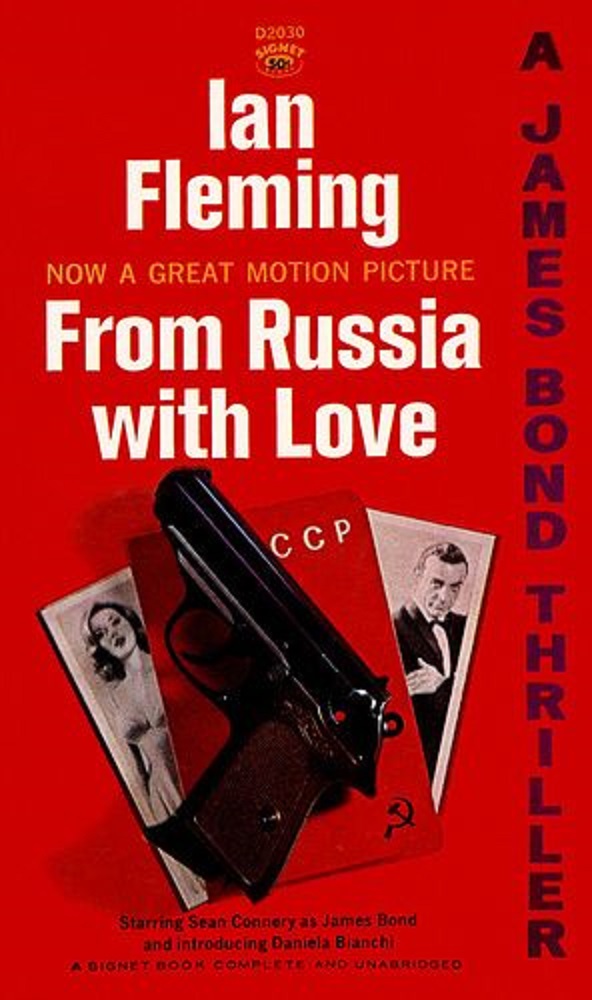
In Ian Fleming’s classic 1957 thriller “From Russia With Love,” James Bond was the target of a SMERSH plot to assassinate him and discredit British intelligence in a scandal. SMERSH sent out from Russia a psychopath assassin named Red Grant to kill Bond. Ian Fleming admitted that his plots were fantastic, but he also said they often lifted the tip of the veil to reveal the real world of espionage. 

Heidi Blake’s “From Russia With Blood” (a clever take on Ian Fleming’s “From Russia With Love” title), lifts the veil off a series of murders in the United Kingdom and places blame squarely on Russian leader Vladimir Putin.
 

You can read the rest of the piece via the below link:


BOOK REVIEW: 'From Russia With Blood' - Washington Times 


Thursday, March 23, 2023

A Look Back At Commander Ian Fleming: My Washington Times On Crime Column On 'Ian Fleming's War: The Inspiration of 007'

I’m watching A Spy Among Friends on MGM+, which is a true story about the British spy, traitor and KGB agent Kim Philby and his fellow British intelligence officer and friend, Nicholas Eliot. The series is based Ben Macintyre’s fine book. 


Fleming was also a principal character featured in the Netflix series Operation Mincemeat, another series based on a Ben Macintyre book. I find Ian Fleming’s wartime experiences as interesting as the fictional exploits of his iconic character James Bond.  

Back in December of 2021, I interviewed Mark Simmons, the author of Ian Fleming’s War: The Inspiration of 007, in my On Crime column in the Washington Times.

You can read the column via the below link or the below text:

BOOK REVIEW: 'Ian Fleming's War: The Inspiration of 007' - Washington Times 

With the 25th James Bond film “No Time To Die” doing well in theaters, fans of the hugely successful film series may be interested in reading about the genesis of the most popular fictional character in cinema.  

Ian Fleming, the late, great thriller writer who created Bond, was a British naval intelligence officer in World War II, and much of what he experienced during the war found its way into his James Bond thrillers.


Mark Simmons, a former British Marine commando, journalist, and author, explores Commander Fleming’s wartime experiences and points out direct links between reality and the plots and characters in the Bond thrillers in his book, “Ian Fleming’s War: The Inspiration of 007.”


I reached out to Mark Simmons and asked him why he wrote the book.


“In 2018, I wrote `Ian Fleming and Operation Golden Eye: Keeping Spain out of World War II.’ In research for that book, I read the two main biographies of Fleming by Andrew Lycett and John Pearson, both of which only devoted a chapter or two to his wartime work. Yet there was a wealth of material on his time at naval intelligence, and I felt it deserved a book,” Mr. Simmons replied.


How would you describe Ian Fleming?


“He was a man embedded in his time the 1930s-1950s, and the highlight of his life was his wartime role in naval intelligence, even more so than becoming a bestselling author.” 


How did Ian Fleming’s WWII experiences in naval intelligence inspire his James Bond novels? 


“As I explain in the book, all the Bond stories are rooted in WWII, and 007 often refers to the war,” Mr. Simmons said.


What primary intelligence operations was Ian Fleming directly or indirectly involved in?


“The list would be rather large, to say the least. Operation Golden Eye, which involved keeping Spain neutral, was one of the main ones. Another was the creation of the OSS in the United States, the forerunner of the CIA, which he had a hand in.”


Ian Fleming assembled an intelligence-gathering commando group known as the 30 Assault Unit. What major successful operations did 30 AU accomplish?  


“Two examples spring to mind among several, on Sicily they captured Italian Air Force Ciphers which led directly to safer missions for RAF bombers. And in northwest Europe, they captured German radar coding which led to a virtual blackout of German radar for several weeks,” Mr. Simmons said.


Ian Fleming’s biographers state that he was a desk man rather than a man of action like Bond. But as you note in your book, Mr. Fleming did serve in the field at various times and did, in fact, face a measure of danger.


“Fleming’s trips to Spain, Portugal and North Africa were probably the nearest he came to being a secret agent in the field,” Mr. Simmons said. “While certainly in France in 1940, he came under fire during the retreat to Bordeaux and the evacuation there.”


I noted that Commander Ian Fleming was aboard a British Navy destroyer off the coast of Dieppe, France, in August of 1942 during “Operation Jubilee,” the disastrous amphibious landing that involved his 30 AU commandos in their first raid.


What aspects of Ian Fleming’s war can you most directly link to his Bond novels?  


“Probably “Casino Royale” is the most obvious, which directly came out of Fleming’s time in Portugal and gambling at the Estoril Casino. “Moonraker” was heavily influenced by operations with 30 AU against the V1 and V2 rocket sites they came across as Europe was liberated from the Nazis,” Mr. Simmons said.


Did one person inspire James Bond, or did Mr. Fleming create Bond with several commandos and intelligence officers in mind? Did he also infuse Bond with some of his own personality, tastes and views?


“007 shared many of Fleming’s traits. As far as the influence of other people is concerned, Fleming remained rather reticent on this point.”


Are the James Bond novels and films relevant today?


“Ian Fleming’s Bond books are very much of their time, but still remain very readable, a testament to his skill as a writer,” Mr. Simmons said. “As to the films, I am no expert, and after Sean Connery stopped playing 007, I confess to losing interest. Although I always felt George Lazenby did a pretty good job in ‘On Her Majesty’s Secret Service.’”


Fans of the Bond films will enjoy this well-researched and fascinating look back at Ian Fleming. I also suggest they read Ian Fleming’s James Bond novels, which are darker and more complicated than the films.


• Paul Davis’ On Crime column covers true crime, crime fiction and thrillers.


You can also read my Counterterrorism magazine piece on Commander Ian Fleming wartime experiences via the below link: 


Paul Davis On Crime: My Piece On The 30 Assault Unit, The British WWII Commando Group Created By Ian Fleming, The Creator Of James Bond 

Sunday, May 22, 2022

WWII's Great Deception Plan: My Crime Beat Column On Ian Fleming And 'Operation Mincemeat'

I watched and enjoyed the Netflix film Operation Mincemeat, the true story of how British intelligence fooled the Nazis into believing the allies were going to invade Greece rather Sicily in World War II.

As an Ian Fleming aficionado, I was pleased to see the late Ian Fleming portrayed fairly accurately in the film, as well as seeing his role in the grand deception plan acknowledged.  

The deception plot involved the Germans reading and believing the fake secret letters on the corpse of a drowned British Royal Marine who washed up ashore in Spain. The corpse was in fact that of a derelict man who killed himself. British intelligence created a fake background for the corpse, proving him with love letters, a photo of his girlfriend and other personal items, in addition to the fake secret letters from British senior officers.

The bold deception plan worked, as the fake secret documents convinced Hitler that the allies were set to invade Greece, and the Nazi leader moved crack troops from Sicily to Greece. The deception plan saved the lives of countless allied troops who successfully invaded Sicily on July 10, 1943.

The germ of this brilliant plan was one of several suggested ideas in what was called the “Trout Memo” from British Admiral John Godfry, the director of Naval Intelligence. But according to Ben Macintyre, the author of Operation Mincemeat: How a Dead Man and a Bizarre Plan Fooled the Nazis and Assured an Allied Victory, the book the film is based on, the true author of the Trout Memo was Commander Ian Fleming.

Commander Fleming (seen in the above photo) was then Admiral Godfrey’s personal assistant and according to Macintyre, Fleming read a spy thriller before the war that utilized a corpse in the plot, and Fleming placed the outrageous idea in the memo. Fleming would, of course, go on to write spy thrillers of his own that featured a certain character called James Bond.

The now iconic and world-famous Bond character was based on several spies and commandos Fleming met during the war, and Fleming said he also infused Bond with many of his own quirks and characteristics. 

In the Netflix film, Ian Fleming is portrayed by Johnny Flynn (seen in the top photo), who narrates the film in Fleming’s sardonic voice. The two officers who headed the deception plot were naval intelligence officer Ewan Montagu and Royal Air Force officer Charles Cholondley, and they were portrayed in the film by Colin Firth and Matthew MacFadyen. Admiral Godfrey was portrayed by Jason Isaacs and Jean Leslie was portrayed by Kelly Macdonald. All of the actors were spot on, and the film was directed well by John Madden.  

The film takes some liberty with the facts, as films often do, but overall, I think it is a fine film that is well worth watching, not only for entertainment, but also as a vital history lesson. 

The deception plan was made into an earlier film in 1956 called The Man Who Never Was, which was based on the memoir by Ewan Montagu. But Montagu’s book and the film were unable to tell the whole story as the details were still classified at the time.

Ben Macintyre (seen in the above photo), a London Times columnist and author of several fine books on espionage history, was more fortunate, as he was given access to the declassified files of the operation.  


"This is the thrilling true story of the greatest and most successful wartime deception ever attempted. One April morning in 1943, a sardine fisherman spotted the corpse of a British soldier floating in the sea off the coast of Spain and set in train a course of events that would change the course of the Second World War,” Bloomsbury, Macintyre’s publisher, wrote when the book came out in 2010.

“Operation Mincemeat was the most successful wartime deception ever attempted, and certainly the strangest. It hoodwinked the Nazi espionage chiefs, sent German troops hurtling in the wrong direction, and saved thousands of lives by deploying a secret agent who was different, in one crucial respect, from any spy before or since: he was dead. His mission: to convince the Germans that instead of attacking Sicily, the Allied armies planned to invade Greece.

“The brainchild of an eccentric RAF officer and a brilliant Jewish barrister, the great hoax involved an extraordinary cast of characters including a famous forensic pathologist, a gold-prospector, an inventor, a beautiful secret service secretary, a submarine captain, three novelists, a transvestite English spymaster, an irascible admiral who loved fly-fishing, and a dead Welsh tramp. Using fraud, imagination and seduction, Churchill’s team of spies spun a web of deceit so elaborate and so convincing that they began to believe it themselves. The deception started in a windowless basement beneath Whitehall. It travelled from London to Scotland to Spain to Germany. And it ended up on Hitler’s desk.

“Ben Macintyre, bestselling author of Agent Zigzag, weaves together private documents, photographs, memories, letters and diaries, as well as newly released material from the intelligence files of MI5 and Naval Intelligence, to tell for the first time the full story of Operation Mincemeat. " 

Ian Fleming never wrote about the operation, or his role in it, due to his oath of secrecy. Sadly, he died in 1964 before the documents were declassified. 

Back in 2012, the British were honoring Ian Fleming with Royal Mail stamps and the Imperial War Museum in London was marking the Fleming centenary with a major exhibition that explores his life and the influences that guided him in his creation of his famous character James Bond. Ben Macintyre wrote a companion book for the Imperial War Museum exhibition called For Your Eyes Only: Ian Fleming & James Bond.    

Fleming’s father died in combat in WWI and his younger brother died in combat in WWII. So considering his family’s sacrifices and his own military experience, Fleming, I believe, would have been proud. 

I had previously interviewed Ben Macintyre about his earlier excellent book on WWII crook and British spy Eddie Chapman, called Agent Zigzag, and I reached out to him again and interviewed about his book on Fleming. 

He said the book was not a full biography, but rather “a personal investigation into the intersection of two lives, one real and one fictional."

"All novelists find inspiration in reality, but Ian Fleming, more than any writer I know, anchored the imagined world of James Bond to the people, things and places he knew," Macintyre noted.

“Espionage is itself a shadow trade between truth and untruth and is a complex interweaving of imagination, deception and reality. As a former officer in naval intelligence, Fleming thought like a spy, and wrote like one. This book is an attempt to explore a remarkable double life and to establish, as nearly as possible, where the real world of Ian Fleming ended, and the fictional world of James Bond begins."

I asked Macintyre why he wrote the book.

“I have always been a fan, but I was asked by the family, partly because of Agent Zigzag and partly because of articles I have written in the past about Bond and Fleming.”

I asked him to describe how Fleming was inspired by his late father who died in WWI and his own military service in WWII?

“Val Fleming is a large part of the Bond myth. His early tragic death and gallantry provide, I think, the template for the Bond character. Fleming’s wartime service is critical: plots, characters, events, gadgets, places and politics all flow directly from that war. Bond is very much a World War II personality, fighting a Cold War.”

Many people find his novels and the films to be utterly fantastic, but Macintyre said that Fleming’s plots, as well as his characters, were in fact based largely on reality. I asked him to explain this.

“Fleming always based his books firmly in reality. "Everything I write has a basis in truth". True, Bond is able to carry out exploits that would be hard to believe in fact, yet the world of spying quite often beggars belief: Agent Zigzag being a good example,” Macintyre explained. 

“As a former officer in naval intelligence, Fleming thought like a spy and wrote like one,” Ben Macintyre told me. “This book is an attempt to explore a remarkable double life and to establish, as nearly as possible, where the real world of Ian Fleming ended, and the fictional world of James Bond begins.” 

And now with Netflix’s Operation Mincemeat, we can see the role that Ian Fleming played in the real world of espionage. 

Note: You can read my Counterterrorism magazine piece about Ian Fleming’s WWII experience and his creation of a commando group via below: 


Friday, May 28, 2021

On This Day In History Ian Fleming, The Creator Of James Bond, Was Born

On this day in 1908 Ian Fleming, the former British naval intelligence officer and journalist who created the world-famous iconic character James Bond, was born. 


Wednesday, March 18, 2020 - With the release of latest James Bond film “No Time to Die” postponed from April to November due to the COVID-19 outbreak, millions of Bond fans around the world will have to be content to watch the older Bond films, or perhaps they should go back to the original source — Ian Fleming’s James Bond novels. 

They could also read some of the many books written about the popular character and his creator, such as two fine biographies of the late Ian Fleming, John Pearson’s “The Life of Ian Fleming” and Andrew Lycett’s “Ian Fleming: The Man Behind James Bond.”


Ben Macintyre, a columnist for the London Times and the author of “The Spy and the Traitor: The Greatest Espionage Story of the Cold War,” (which I reviewed in these pages) “A Spy Among Friends: Kim Philby and the Great Betrayal” and “Agent Zigzag: A True Story of Nazi Espionage, Love and Betrayal,” also wrote an interesting book called “For Your Eyes Only: Ian Fleming and James Bond.”


He wrote the book in 2008 as a companion to the Imperial War Museum exhibition that was held to celebrate the centenary of Ian Fleming’s birth. The exhibition examined the late thriller writer and his fictional character in historical context. The exhibition also looked at Ian Fleming’s experiences as a naval intelligence officer in World War II and how they informed his plots and characters.


Ben Macintyre was chosen to write the companion book because of his nonfiction books on espionage and his many columns on Ian Fleming and James Bond, including one column that revealed that there was a Nazi plot to rob the Bank of England, which perhaps inspired Ian Fleming to use a similar plot to rob Fort Knox in his great thriller “Goldfinger.”


Ian Fleming admitted his plots in the novels were fantastic (the films much more so), but he also said they were often based on the real world of intelligence.  


I recall Ben Macintyre telling me that his book on Fleming and Bond was a personal investigation of two lives, one real and one fictional.        


Sans gun and fistfights, Ian Fleming led a life at least as interesting than Bond. He was a reporter for Reuters prior to WWII and covered the Soviet espionage show trial of British engineers. During WWII he was a naval commander and served as the personal assistant to the director of naval intelligence.


After the war he became the foreign manager for the London Sunday Times, wrote a column and many articles, and traveled around the world for the newspaper.


I asked Mr. Macintyre how his work in journalism played a role in his novels, and he replied, “His ability to write to deadline, to get the facts right, and ensure a pacey narrative can all be traced directly to his early journalistic training.”


As for the line between fact and fiction in Ian Fleming’s thrillers, Mr. Macintyre said, “Fleming always based his books firmly in reality. “Everything I write has a basis in truth.” True, Bond is able to carry out exploits that would be hard to believe in fact, yet the world of spying quite often beggars’ belief: Agent Zigzag being a good example. All novelists find inspiration in reality, but Ian Fleming, more than any writer I know, anchored the imagined world of James Bond to the people, things and places he knew.”


Ben Macintyre said that espionage was a shadow trade between truth and untruth, and it is a complex interweaving of imagination, deception and reality.


In a recent column in the London Times, Ben Macintyre wrote about a Russian hit squad that murdered and attempted to murder former Russian intelligence officers in the United Kingdom.


“If the idea of a ruthless spy-killing unit sounds like the stuff of fiction, that’s because it became precisely that,” Mr. Macintyre wrote. “In the James Bond novels, Ian Fleming portrayed Smersh (director of operations: Rosa Klebb) as a massive counterintelligence network that more closely resembled the KGB.”


The column went on to explain that the real Smersh, or Smert Shpionam, meaning Death to Spies, murdered traitors, innocent or not, and instilled terror among potential enemies as well as Soviet citizens.


Mr. Macintyre said that according to his intelligence sources, the Russian counterintelligence unit that inspired Ian Fleming was now operating in Europe under a new name: Unit 29155, an elite sub-unit of the GRU. 


“As a former officer in naval intelligence, Fleming thought like a spy and wrote like one,” Mr. Macintyre told me. “This book is an attempt to explore a remarkable double life and to establish, as nearly as possible, where the real world of Ian Fleming ended, and the fictional world of James Bond begins.”


• Paul Davis’ On Crime column covers true crime, crime fiction and thrillers. 


You can also read my Counterterrorism magazine piece on Ian Fleming’s WWII experiences via the below link:


Paul Davis On Crime: My Piece On The 30 Assault Unit, The British WWII Commando Group Created By Ian Fleming, The Creator Of James Bond 


And you can read my online Crime Beat column on Ian Fleming and James Bond via the below link:


Paul Davis On Crime: My Crime Beat Column: The Ian Fleming and James Bond Phenomenon 

Thursday, March 19, 2020

My Washington Times 'On Crime' Column On Ben Macintyre On Ian Fleming And James Bond


The Washington Times published my weekly On Crime column on Ben Macintyre’s take on the late, great thriller writer Ian Fleming and his iconic character James Bond.

With the release of latest James Bond film “No Time to Die” postponed from April to November due to the COVID-19 outbreak, millions of Bond fans around the world will have to be content to watch the older Bond films, or perhaps they should go back to the original source — Ian Fleming’s James Bond novels.

They could also read some of the many books written about the popular character and his creator, such as two fine biographies of the late Ian Fleming, John Pearson’s “The Life of Ian Fleming” and Andrew Lycett’s “Ian Fleming: The Man Behind James Bond.”

Ben Macintyre, a columnist for the London Times and the author of “The Spy and the Traitor: The Greatest Espionage Story of the Cold War,” (which I reviewed in these pages) “A Spy Among Friends: Kim Philby and the Great Betrayal” and “Agent Zigzag: A True Story of Nazi Espionage, Love and Betrayal,” also wrote an interesting book called “For Your Eyes Only: Ian Fleming and James Bond.”

He wrote the book in 2008 as a companion to the Imperial War Museum exhibition that was held to celebrate the centenary of Ian Fleming’s birth. The exhibition examined the late thriller writer and his fictional character in historical context. The exhibition also looked at Ian Fleming’s experiences as a naval intelligence officer in World War II and how they informed his plots and characters.

Ben Macintyre was chosen to write the companion book because of his nonfiction books on espionage and his many columns on Ian Fleming and James Bond, including one column that revealed that there was a Nazi plot to rob the Bank of England, which perhaps inspired Ian Fleming to use a similar plot to rob Fort Knox in his great thriller “Goldfinger.”

Ian Fleming admitted his plots in the novels were fantastic (the films much more so), but he also said they were often based on the real world of intelligence.  

I recall Ben Macintyre telling me that his book on Fleming and Bond was a personal investigation of two lives, one real and one fictional.     

You can read the rest of the column below or via the below link:


https://www.washingtontimes.com/news/2020/mar/18/ben-macintyre-on-ian-fleming-and-james-bond/ 

Note: The below photos are of Ben Macintyre, Ian Fleming. Sean Connery as James Bond in Dr. No, and Ian Fleming as a WWII naval intelligence officer:


Saturday, January 18, 2020

Ben Macintyre: World Of The Digital Footprint Leaves Spies With Nowhere To Run


Ben Macintyre (seen in the below photo), author The Spy and the Traitor: The Greatest Espionage Story of the Cold War, and A Spy Among Friends: Kim Philby and the Great Betrayal, as well as other fine books on espionage, writes about how the spy game has changed in today’s digital world in his London Times column.

The essence of espionage is concealment: since classical times spies have relied on being able to hide their identities and thus slip from one jurisdiction to another using a different identity, fake papers, a false history. The spy has no name, and many names.

Not any more. In the digital world of continual interconnected surveillance, facial recognition and ubiquitous CCTV, where every computer keystroke leaves a digital fingerprint and our lives are recorded online, it is becoming ever harder to hide an identity. This is a problem for terrorists and criminals but also for spies.

The two principal branches of intelligence-gathering are signals intelligence (Sigint), intercepting exchanges of information via technology ranging from wartime wireless messages to modern day texts and emails; and human intelligence (Humint), information gathered from, and by, individuals. The flood of Sigint in the modern age is a direct threat to Humint, and changing the very nature of espionage.

Intelligence officers have traditionally been sent abroad to operate under diplomatic cover. In 2014 the computers of the US Office of Personnel Management were penetrated by hackers believed to be working for China, and the employment data of 22 million former and serving civil servants, including intelligence officers, were stolen. At a stroke the hackers had exposed the identities of CIA personnel around the world and details of their lives, postings, pensions and pay rises.

Undercover intelligence officers (“legals”) are only one species of spy. Far more numerous are those operating under non-official cover (known as NOCs, or illegals), undercover agents posing as private citizens, businessmen, journalists, extremists, criminals and others, gathering information on the ground. These are also increasingly exposed, since digital sleuthing offers extensive opportunities to check when an identity is real. An absence of online footprints is likely to arouse suspicion.

… In December the US military sent out a memo advising all personnel to avoid using consumer DNA kits, since these might leave permanent digital identifiers. James Bond never bothered about the DNA he left around on his martini glasses: today that DNA could be compared to a signature in a commercial DNA database, or that of a relative, immediately proving that 007 is not who he claims to be.

Even though signals intelligence has expanded hugely (GCHQ, the signals branch, is now the biggest spy agency in Britain), human intelligence remains vitally important. Digital information can be falsified, obscured, deleted and encrypted. The most valuable espionage asset is still a spy on the ground, with direct access to, and the skills to assess the value of, secret information.

One of the best recent examples of the importance, and liability, of human intelligence was the case of Oleg Smolenkov (seen in the above photo), a CIA asset inside the Russian government who supplied high-grade intelligence from within the Kremlin. Smolenkov was exfiltrated in 2017 but he was swiftly found by reporters in the US, who tracked his digital trace. In the same way, the name and address of Sergei Skripal, the MI6 double agent targeted by Russian assassins in 2018, appeared on the Salisbury electoral roll.

You can read the rest of the column via the below link:

https://www.thetimes.co.uk/article/world-of-the-digital-footprint-leaves-spies-with-nowhere-to-run-3bd89l7qz 

Saturday, December 28, 2019

My Washington Times Review Of 'From Russia With Blood: The Kremlin's Ruthless Assassination Program And Vladimir Putin's Secret War On The West'


The Washington Times ran my review of From Russia With Blood.

Ben Macintyre, a columnist for the London Times and the author of “The Spy and the Traitor: The Greatest Espionage Story of the Cold War,” “A Spy Among Friends: Kim Philby and the Great Betrayal,” and other fine books on spies and espionage, wrote about a Russian GRU (military intelligence) assassination group operating in Europe that is the descendant of the Soviet assassination organization SMERSH, the counterintelligence unit that inspired Ian Fleming.

“If the idea of a ruthless spy-killing unit sounds like the stuff of fiction, that’s because it became precisely that,” Ben Macintyre wrote in his Times column. “In the James Bond novels, Ian Fleming portrayed Smersh (director of operations: Rosa Klebb) as a massive counterintelligence network that more closely resembled the KGB.”

Ben Macintyre wrote that the real SMERSH was effective in not only murdering Soviet traitors (some of whom were undoubtedly innocent, he noted), but SMERSH also instilled terror among potential enemies and enforced obedience in Soviet citizens.

“And now it is back, with a new name and a new remit but essentially the same purpose: to put the fear of God, and assassination, into Russia’s enemies, traitors and deserters,” Mr. Macintyre wrote. “According to intelligence sources, Unit 29155 is an elite sub-unit of GRU assassins that operated out of the Haute-Savoie in the French Alps, conducting a variety of wet jobs across Europe: notably the attempted poisoning in Salisbury of GRU officer-turned-MI6 spy Sergei Skripal, and the attempt to kill a Bulgarian arms dealer in 2015.”

In Ian Fleming’s classic 1957 thriller “From Russia With Love,” James Bond was the target of a SMERSH plot to assassinate him and discredit British intelligence in a scandal. SMERSH sent out from Russia a psychopath assassin named Red Grant to kill Bond. Ian Fleming admitted that his plots were fantastic, but he also said they often lifted the tip of the veil to reveal the real world of espionage. 

Heidi Blake’s “From Russia With Blood” (a clever take on Ian Fleming’s “From Russia With Love” title), lifts the veil off a series of murders in the United Kingdom and places blame squarely on Russian leader Vladimir Putin.

You can read the rest of the review via the below link:

https://www.washingtontimes.com/news/2019/dec/27/book-review-from-russia-with-blood/