Showing posts with label spying. Show all posts

Sunday, April 28, 2024

Rook: A Look Back At A Vietnam Era Spy Sentenced In Philadelphia

My Crime Beat column below originally appeared in the South Philadelphia American in October of 1997:

Spy stories traditionally unfold in Berlin, Hong Kong or some other exotic locale, but a 30-year espionage drama ended right here in a Philadelphia courthouse last week when Robert Stephen Lipka was sentenced to 18 years in prison for spying for the Soviet Union.

Lipka, 51, a coin collector from Lancaster, PA, admitted to spying from 1965 to 1974, the years of the Vietnam War, while serving as a young soldier attached to the National Security Agency (NSA). (NSA HQ at Fort Meade in Maryland is seen in the below photo).

A series of FBI investigations originating in the 1960's led to Lipka's sentencing day in the federal court at 6th and Market Streets. U.S. District Judge Charles r. Weiner, a WWII Navy veteran, admonished Lipka by saying that the parents of military servicemen might feel his crimes caused their children's deaths or maiming during the Vietnam War. Weiner also imposed a fine of $10,000 to repay the $10,000 the FBI paid him during the undercover "sting" operation that ultimately netted him.

Lipka, who resembles the actor who plays the despicable character Newman on TV's Seinfeld, no doubt shares some of Newman's more unsavory characteristics. 

Lipka aided the Viet Cong and North Vietnamese while I, my brother and thousands of other soldiers, sailors, Marines and airmen were fighting over there. Lipka sold out his brothers-in-arms for a paltry $27,000.

Lipka's spy story began when he enlisted in the U.S. Army in 1963. He was assigned to NSA at Fort Meade in Maryland, a cushy headquarters job far from the combat zone. 

NSA, the super-secret organization we called "No Such Agency" when I was in the Navy, intercepts foreign electromagnetic, radio, radar and other transmissions for the U.S. military and intelligence agencies. Lipka's clerical job was to simply make distribution of NSA's highly classified reports. 

We now know that Lipka took it upon himself to add the Soviet Union to his mailing list.

According to the FBI, Lipka used special spy cameras to clandestinely photograph sensitive documents. He also hid classified documents inside his shirt and wrapped around his legs to slip past NSA security. Using common "tradecraft" such as a prearranged "dead drop," he passed the documents to the Komitet Gosudarstevennoy Bezopasnosti (KGB), the Soviet Committee of State security. He later retrieved payment at another prearranged site.

Lipka left the Army and NSA and moved to Lancaster in 1967 and attended college. Lipka took some "souvenirs" when he left NSA and was still meeting with the KGB as late as 1974.

It was an independent FBI investigation of a couple who lived near Philadelphia that led to FBI to Lipka. Peter Fischer, whom the FBI suspected was a KGB agent, Ingeborg Fischer, whom the FBI suspected of assisting her husband in his KGB activities, made contact with Lipka in 1968. Evidence suggests the Fischers passed NSA documents from Lipka to a Soviet citizen, Artem Shokin, who worked at the United Nations in New York. The Fischers and Shokin subsequently flew the coup and returned to Mother Russia.

An FBI undercover agent posing as an official Glavnoye Razvedyvatelnoye Upravleniye (GRU), the Chief Intelligence Directorate of the Soviet General Staff, met with Lipka several times in Lancaster and Baltimore in 1993. Lipka insisted that the undercover FBI special agent provide Lipka's code word or he would end their contact. 

The undercover agent mentioned Lipka's code word "Rook," which the FBI discovered during the Fischer investigation. Lipka, ever the greedy little spy, told the undercover agent that the Soviets had not paid him enough money. He would complain again and again about money and even wrote the undercover agent letters demanding more money.

The undercover agent mailed Lipka a copy of a book called The First Directorate, which was written by former KGB Major General Oleg Kalugin. The book implicates Lipka in its detailed description of espionage committed by a "young soldier at NSA," who provided "reams of top-secret material to the KGB in the mid-1960's.

According to the FBI, an unnamed "cooperating witness" who was granted immunity told the FBI that Lipka said he took NSA documents and sold them to the KGB. Lipka told the witness he gave them to a Russian contact named "Ivan" for money. Lipka said he would contact "Ivan" and have face-to-face meetings over a chess game in a park, hence the code name "Rook."

The witness was shown the three cameras, one of which was only an inch in height. Lipka told the witness that the Russian had sent him a postcard and Lipka, accompanied by the witness, met in Maryland with the Russian.

Faced with overwhelming evidence of the cooperating witness and the FBI undercover agent, Lipka had no choice but to plead guilty. He thought he had gotten away with espionage, but the long arm of the FBI and justice finally caught up with him. 

Note: Robert Lipka died in 2013.


You can also read my later Counterterrorism magazine interview with one of the FBI special agents involved with the Lipka investigation via the below link:

http://www.pauldavisoncrime.com/2014/06/before-snowden-look-back-at-nsa-spy.html 

Sunday, April 14, 2024

Victor Manuel Rocha, Former U.S. Ambassador And National Security Council Official, Admits To Secretly Acting As Agent Of The Cuban Government And Receives 15-Year Sentence

The U.S. Justice Department released the below information:

Victor Manuel Rocha, 73, of Miami, a former U.S. Department of State employee who served on the National Security Council from 1994 to 1995 and as U.S. Ambassador to Bolivia from 2000 to 2002, pleaded guilty today to secretly acting for decades as an agent of the government of the Republic of Cuba. Immediately thereafter, a federal judge sentenced Rocha to the statutory maximum penalty of 15 years in prison.

“Today’s plea and sentencing brings to an end more than four decades of betrayal and deceit by the defendant,” said Assistant Attorney General Matthew G. Olsen of the Justice Department’s National Security Division. “Rocha admitted to acting as an agent of the Cuban government at the same time he held numerous positions of trust in the U.S. government, a staggering betrayal of the American people and an acknowledgement that every oath he took to the United States was a lie."

“Victor Manuel Rocha secretly acted for decades as an agent of a hostile foreign power. He thought the story of his covert mission for Cuba would never be told because he had the intelligence, knowledge, and discipline to never to be detected. Rocha underestimated those same skills in the prosecutors and law enforcement agents who worked tirelessly to bring him to justice for betraying his oath to this country,” said U.S. Attorney Markenzy Lapointe for the Southern District of Florida. “I am mindful that Rocha’s decades-long criminal activity on behalf of the Cuban Government is especially painful for many in South Florida. Rocha’s willingness to cooperate, as required by his plea agreement, is important, but does not change the seriousness of his misconduct or his clandestine breach of the trust placed in him. Rocha’s 15-year prison sentence, the maximum punishment for his crimes of conviction, sends a powerful message to those who are acting or seek to act unlawfully in the United States for a foreign government: we will seek you out anywhere, at any time, and prosecute you to the fullest extent of the law.”

U.S. District Court Judge Beth Bloom accepted Rocha’s guilty plea to counts 1 and 2 of the indictment, which charged him with conspiring to act as an agent of a foreign government and conspiring to defraud the United States and acting as an agent of a foreign government without notice as required by law.

The court then sentenced Rocha to the statutory maximum penalty on his counts of conviction: 15 years in prison, a $500,000 fine, three years of supervised release and a special assessment. The court also imposed significant restrictions on Rocha.

Under the terms of the parties’ plea agreement, Rocha must cooperate with the United States, including assisting with any damage assessment related to his work on behalf of the Republic of Cuba. Rocha must relinquish all future retirement benefits, including pension payments, owed to him by the United States based upon his former State Department employment. Rocha must also assign to the United States any profits that he may be entitled to receive in connection with any publication relating to his criminal conduct or his U.S. Government service.

“Despite swearing an oath to defend the Constitution of the United States, Rocha betrayed the U.S. by secretly working as a Cuban agent for decades,” said Executive Assistant Director Larissa L. Knapp of the FBI’s National Security Branch. “After years of lying and endangering national security and U.S. citizens, he finally accepted responsibility for his actions and received the maximum prison sentence. This should serve as a notice to our adversaries that the FBI will work tirelessly to stop foreign intelligence services and any who work with them against the interests of the United States and prosecute them to the fullest extent of the law.”

“Victor Manuel Rocha was sentenced to 15 years in prison today for deceiving our nation,” said Special Agent in Charge Jeffrey B. Veltri of the FBI Miami Field Office. “He blatantly violated the oath of office he willingly took as an employee of the State Department and disregarded the loyalty to the United States that is inherent with that oath. As this case demonstrates, the counterintelligence threat facing our nation is real, pervasive, and has the potential to cause great harm to our national security. I want to commend the U.S. Attorney’s Office for the Southern District of Florida for their close partnership on this highly sensitive matter. I also want to thank our Washington Field Office and our Counterintelligence Division, as well as the Department of Justice’s National Security Division and the Department of State’s Diplomatic Security Service for their valuable contributions to this case.”

“The investigation of this crime demonstrates the sustained threat from hostile intelligence services,” said Assistant Director for Domestic Operations Andrew Wroblewski of the U.S. Department of State’s Diplomatic Security Service (DSS). “Today’s guilty plea and sentencing are another example of our commitment to successfully work together with our federal law enforcement partners in the pursuit of those who compromise the security of the United States.”

In pleading guilty, Rocha admitted that, beginning in 1973, and continuing to the time of his arrest, he secretly supported the Republic of Cuba and its clandestine intelligence-gathering mission against the United States by serving as a covert agent of Cuba’s General Directorate of Intelligence.

By his own admission, to further that role, Rocha obtained employment at the U.S. Department of State, where he worked between 1981 and 2002, in positions that provided him access to nonpublic information, including classified information, and the ability to affect U.S. foreign policy. Aside from serving as the U.S. Ambassador to Bolivia and on the White House National Security Council, Rocha’s career included a stint as Deputy Principal Secretary of the State Department’s U.S. Interests Section in Havana, Cuba from 1995-97. After his State Department employment ended, Rocha engaged in other acts intended to support Cuba’s intelligence services.

Rocha kept his status as a Cuban agent secret to protect himself and others and to allow himself the opportunity to engage in additional clandestine activity. Rocha provided false and misleading information to the United States to maintain his secret mission and traveled outside the United States to meet with Cuban intelligence operatives.

In a series of meetings during 2022 and 2023, with an undercover FBI agent posing as a covert Cuban General Directorate of Intelligence representative, Rocha made repeated statements admitting his “decades” of work for Cuba, spanning “40 years.” When the undercover told Rocha he was “a covert representative here in Miami” whose mission was “to contact you, introduce myself as your new contact, and establish a new communication plan,” Rocha answered “Yes,” and proceeded to engage in lengthy conversations during which he described and celebrated his activity as a Cuban intelligence agent. Throughout the meetings, Rocha behaved as a Cuban agent, consistently referring to the United States as “the enemy,” and using the term “we” to describe himself and Cuba. Rocha additionally praised Fidel Castro as the “Comandante,” and referred to his contacts in Cuban intelligence as his “Compañeros” (comrades) and to the Cuban intelligence services as the “Dirección.” Rocha described his work as a Cuban agent as “enormous … More than a grand slam,” and asserted that what he did “strengthened the Revolution … immensely.”

The FBI Miami Field Office investigated the case, with valuable contributions by the FBI Washington Field Office and the U.S. Department of State’s Diplomatic Security Service (DSS).

Assistant U.S. Attorneys Jonathan D. Stratton and John C. Shipley for the Southern District of Florida and Trial Attorneys Heather M. Schmidt and Christine A. Bonomo of the National Security Division’s Counterintelligence and Export Control Section prosecuted the case. 

You can also read my Counterterrorism magazine piece on Rocha and how the FBI caught the Cuban spies via the below link: 

Paul Davis On Crime: My Counterterrorism Magazine Piece On How The FBI Caught The Traitorous Cuban Spies 

Friday, April 8, 2022

Chinese National Sentenced For Economic Espionage Conspiracy

The U.S. Justice Department released the below information:

A Chinese national formerly residing in Chesterfield, Missouri, was today sentenced to 29 months in prison followed by three years of supervised release and a $150,000 fine for conspiring to commit economic espionage.

Xiang Haitao, 44, pleaded guilty to the charge in January 2022.  According to court documents, Xiang conspired to steal a trade secret from The Climate Corporation, a subsidiary of Monsanto, an internationally based company doing business in St. Louis, Missouri, for the purpose of benefitting a foreign government, namely the People’s Republic of China (PRC).

“Xiang conspired to steal an important trade secret to gain an unfair advantage for himself and the PRC,” said Assistant Attorney General Matthew G. Olsen of the Justice Department’s National Security Division. “The victim companies invested significant time and resources to develop this intellectual property.  Economic espionage is a serious offense that can threaten U.S. companies’ competitive advantage, and the National Security Division is committed to holding accountable anyone who steals trade secrets to benefit a foreign government.”

“The defendant took advantage of living and working in the United States to steal a valuable trade secret for the benefit of PRC entities,” said Assistant Attorney General Kenneth A. Polite, Jr. of the Justice Department’s Criminal Division. “This type of theft threatens employers large and small in every state, and it imperils our economic competitiveness as a nation. Individuals entrusted with valuable trade secrets should be on notice that if they abuse that trust – especially for the benefit of foreign nations – we will hold them accountable.”

“Those who conspire to steal technology from U.S. businesses and transfer it to China cause tremendous economic damage to our country," said Assistant Director Alan E. Kohler Jr. of the FBI’s Counterintelligence Division. "The government of China does not hesitate to go after the ingenuity that drives our economy. Stealing our highly prized technology can lead to the loss of good-paying jobs here in the United States, affecting families, and sometimes entire communities. Our economic security is essential to our national security.  That’s why at the FBI protecting our nation’s innovation is both a law enforcement and a top national security priority.”

“This is the first economic espionage conviction ever in the history of the Eastern District of Missouri,” said Acting Special Agent in Charge Akil Davis of FBI’s St. Louis Field Office. There are less than two dozen such convictions nationwide. Economic espionage convictions are rare because the elements required to prove state-sponsored theft is extremely difficult,” “Today’s sentencing is a culmination of more than five years of tenacity and dedication by our agents and federal prosecutors. I commend their success in protecting the victim company and ultimately our U.S. economy.”

According to court documents, Xiang was employed by Monsanto and its subsidiary, The Climate Corporation, from 2008 to 2017, where he worked as an imaging scientist. Monsanto and The Climate Corporation developed a digital, online farming software platform that was used by farmers to collect, store and visualize critical agricultural field data and increase and improve agricultural productivity for farmers. A critical component to the platform was a proprietary predictive algorithm referred to as the Nutrient Optimizer. Monsanto and The Climate Corporation considered the Nutrient Optimizer a valuable trade secret and their intellectual property.

In June 2017, the day after leaving employment with Monsanto and The Climate Corporation, Xiang attempted to travel to China on a one-way airplane ticket. While he was waiting to board his flight, federal officials conducted a search of Xiang’s person and baggage. Investigators later determined that one of Xiang’s electronic devices contained copies of the Nutrient Optimizer. Xiang continued on to China where he worked for the Chinese Academy of Science’s Institute of Soil Science. Xiang was arrested when he returned to the United States in November 2019.

The FBI and the Department of Homeland Security, Customs and Border Protection investigated the case.

Assistant U.S. Attorneys Matthew Drake and Gwendolyn Carroll for the Eastern District of Missouri, Senior Trial Attorney Heather Schmidt and Trial Attorney Adam Small of the National Security Division’s Counterintelligence and Export Control Section, and Senior Counsel Jeff Pearlman and Assistant Deputy Chief Matthew Walczewski of the Criminal Division’s Computer Crime and Intellectual Property Section prosecuted the case.

Sunday, November 7, 2021

Jury Convicts Chinese Intelligence Officer Of Espionage Crimes, Attempting To Steal Trade Secrets

The U.S. Justice Department released the below information: 

A federal jury convicted Yanjun Xu, a Chinese national and Deputy Division Director of the Sixth Bureau of the Jiangsu Province Ministry of State Security, of conspiring to and attempting to commit economic espionage and theft of trade secrets. The defendant is the first Chinese intelligence officer to be extradited to the United States to stand trial. 

“This conviction of a card-carrying intelligence officer for economic espionage underscores that trade secret theft is integral to the PRC government’s plans to modernize its industries,” said Assistant Attorney General Matthew G. Olsen of the Justice Department’s National Security Division. “But this conviction also serves notice that the United States will not sit by as China, or any other nation-state, attempts to steal instead of researching and developing key technology. Instead, and with the support of our allies, we will continue to investigate, prosecute, and hold accountable those who try to take the fruits of American ingenuity illegally.” 

“The jury, by its guilty verdict here today, held Xu accountable for his classic spy techniques,” said Acting U.S. Attorney Vipal J. Patel for the Southern District of Ohio. “Xu conspired to commit economic espionage on behalf of the Chinese government, and he tried to steal the valuable innovation and trade secrets of industry-leading American aviation technology companies. This office will continue to seek to protect American innovation and hold accountable those who attempt to steal our nation’s science and technology, regardless of status or affiliation, whether civilian, military or spy.” 

“This was state-sponsored economic espionage by the PRC designed to steal American technology and put Americans out of work,” said Assistant Director Alan E. Kohler Jr. of the FBI’s Counterintelligence Division. “For those who doubt the real goals of the PRC, this should be a wakeup call; they are stealing American technology to benefit their economy and military. The FBI is partnering with over 50 U.S. Government agencies to share information and investigative resources to stop the PRC’s illegal activities.” 

According to court documents and evidence presented at trial, beginning in at least December 2013, Xu used multiple aliases to target specific companies in the United States and abroad that are recognized as leaders in the field of aviation. He identified experts who worked for the companies and recruited them to travel to China, often initially under the guise that they were traveling to give a presentation at a university. Xu and others paid the experts stipends on top of covering travel costs. According to today’s conviction, Xu attempted to steal technology related to GE Aviation’s exclusive composite aircraft engine fan – which no other company in the world has been able to duplicate – to benefit the Chinese state. 

In March 2017, a GE Aviation employee in Cincinnati, Ohio, was solicited to give a report at a university in China. The employee traveled to China two months later to present at the university and was introduced to Xu. Xu and others paid the employee’s travel expenses and a stipend.

In January 2018, Xu requested “system specification, design process” information from the employee and – with the cooperation of the company, who was working with the FBI – the employee emailed a two-page document from the company that included a label that warned about the disclosure of proprietary information. 

In February 2018, Xu began discussing with the employee the possibility of meeting in Europe during one of the employee’s business trips and asked the employee to send a copy of the file directory for his company-issued computer. 

Xu traveled to Belgium on April 1, 2018, to meet with the employee and was arrested at that time. 

Xu was convicted of two counts of conspiring and attempting to commit economic espionage, which carries a maximum statutory penalty of 15 years in prison for each count and a fine of up to $5 million. Xu was also convicted of conspiracy to commit trade secret theft and two counts of attempted theft of trade secrets, which carries a maximum statutory sentence of 10 years in prison for each count and a $250,000 fine. A federal district court judge will determine any sentence after considering the U.S. Sentencing Guidelines and other statutory factors.

The FBI investigated the case. 

Assistant Deputy Criminal Chief Timothy S. Mangan and Deputy Criminal Chief Emily Glatfelter for the Southern District of Ohio and Trial Attorney Matthew J. McKenzie of the National Security Division’s Counterintelligence and Export Control Section are prosecuting the case. 

The Criminal Division’s Office of International Affairs secured Xu’s extradition to the United States, with valuable assistance provided by the government of Belgium and the Belgian Federal Police. 

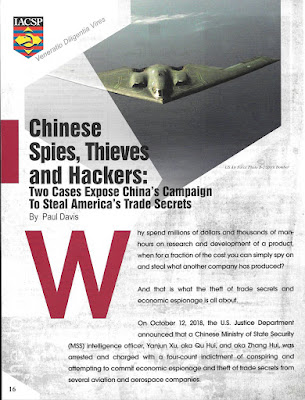
You can also read my Counterterrorism magazine piece that covered the Xu case and more via the below link:

Paul Davis On Crime: Chinese Spies, Thieves And Hackers: My Piece On Two Cases That Expose China's Campaign To Steal America's Trade Secrets 

Saturday, December 26, 2020

George Blake, Last In Line Of Cold War Spies Who Betrayed Britain, Dies at 98

 Reuters reports that British spy and traitor George Blake as died.

LONDON/MOSCOW (Reuters) - George Blake, who died in Russia on Saturday at the age of 98, was the last in a line of British spies whose secret work for the Soviet Union humiliated the intelligence establishment when it was discovered at the height of the Cold War.course,

 Britain says he exposed the identities of hundreds of Western agents across Eastern Europe in the 1950s, some of whom were executed as a result of his treason.

His case was among the most notorious of the Cold War, alongside those of a separate ring of British double agents known as the Cambridge Five.

Unmasked as a Soviet spy in 1961, Blake was sentenced to 42 years in London’s Wormwood Scrubs prison. In a classic cloak-and-dagger story, he escaped in 1966 with the help of other inmates and two peace activists, and was smuggled out of Britain in a camper van. He made it through Western Europe undiscovered and crossed the Iron Curtain into East Berlin.

He spent the rest of his life in the Soviet Union and then Russia, where he was feted as a hero.

You can read the rest of the piece via the below link:

George Blake, last in line of Cold War spies who betrayed Britain, dies at 98 | Reuters

You can also read my Washington Times On Crime column on George Blake via the below link:  

Paul Davis On Crime: Betrayal In Berlin: My Washington Times 'On Crime' Column On Steve Vogel's interview With Cold War Spy George Blake 

Saturday, October 10, 2020

Singaporean National Sentenced To 14 Months In Prison For Acting In The United States As An Illegal Agent Of Chinese Intelligence

 The U.S. Justice Department released the below information: 

Jun Wei Yeo, also known as Dickson Yeo, was sentenced today in federal court to 14 months in prison.  Yeo pled guilty on July 24, 2020 to acting within the United States as an illegal agent of a foreign power without first notifying the Attorney General, in violation of 18 U.S.C. § 951.  

The announcement was made by John G. Demers, Assistant Attorney General; Michael R. Sherwin, Acting United States Attorney for the District of Columbia; James A. Dawson, Acting Assistant Director in Charge of FBI Washington Field Office; Alan E. Kohler, Jr., Assistant Director of the FBI's Counterintelligence Division; and Deputy Assistant Secretary Ricardo Colón, Domestic OperationsDeputy Assistant Secretary Ricardo Colón, Domestic Operations.

Yeo was sentenced by The Honorable Tanya S. Chutkan of the United States District Court for the District of Columbia. 

“At the direction of the Government of the People’s Republic of China, Yeo recruited Americans to provide information that he would pass back to his PRC handlers,” said Assistant Attorney General for National Security John C. Demers.  “Yeo concealed his PRC affiliation from his recruits and, contrary to law, from the United States Government.  This criminal conduct is part of the PRC’s efforts to exploit the openness of American society by using agents who may appear innocuous, but who act upon taskings from a foreign government to obtain access and information.” 

“This case serves as a reminder that China is using professional networking social media sites to target U.S. citizens with government security clearances, and to try to gain non-public and classified information. The threat is real, and we will prosecute foreign agents who exploit those platforms,” said Michael R. Sherwin, Acting United States Attorney for the District of Columbia. 

“Today we are reminded yet again of the Chinese government's aggressive attempts to gain knowledge and information about U.S. policy and government," said James A. Dawson, Acting Assistant Director in Charge of the FBI's Washington Field Office. "The FBI’s warning is not new, but the message warrants repeating: the Chinese communist government is working to gain information and access by all means, including recruiting US-based individuals to provide classified and/or sensitive information. There is no doubt that if you are a former clearance holder, you are an ideal and vulnerable target because of your knowledge and access.  If you believe you have been the target of a recruitment scheme, the FBI is here to help. We remain committed to rebuffing the Chinese government’s attempts, and to protecting the American people, our ideas, and our national and economic security interests.” 

"Jun Wei Yeo admittedly acted as an illegal agent of a foreign power by using various social media sites, such as a professional networking website and other social networking applications, to recruit Americans with access to sensitive government information. He identified their vulnerabilities, like dissatisfaction with work or financial difficulties, and offered money in exchange for information and written reports,” said Alan E. Kohler Jr., Assistant Director of the FBI’s Counterintelligence Division.  "This is a sobering reminder that the U.S. needs to be clear-eyed about the scope of the Chinese government’s ambition to manipulate Americans for their own nation’s advancement; and confronting this threat remains the FBI’s top counterintelligence priority." 

“The close working relationship between the U.S. Department of State’s Diplomatic Security Service, the FBI, and the U.S. Attorney’s Office resulted in today's sentencing of Mr.Yeo before he could potentially harm the security of our country,” said Deputy Assistant Secretary Ricardo Colón, Domestic Operations, U.S. Department of State’s Diplomatic Security Service. “This was a great success by all of the agencies involved.” 

As outlined in the Statement of Offense, Yeo began working with Chinese intelligence officers as early as 2015, initially targeting other Asian countries, but then focusing on the United States.  In response to taskings from his Chinese intelligence contacts, Yeo worked to spot and assess Americans with access to valuable non-public information, including U.S. military and government employees with high-level security clearances.  After Yeo identified American targets, he solicited them for non-public information and paid them to write reports.  Yeo told these American targets that the reports were for clients in Asia, without revealing that they were in fact destined for the Chinese government. 

Yeo made use of various social media sites to carry out the taskings given to him by Chinese intelligence operatives.  In 2018, Yeo created a fake consulting company that used the same name as a prominent U.S. consulting firm that conducts public and government relations, and Yeo posted job advertisements under that company name.  Ninety percent of the resumes Yeo received in response were from U.S. military and government personnel with security clearances, and he passed resumes of interest to one of the Chinese intelligence operatives. 

Yeo also used a professional networking website that is focused on career and employment information to carry out the taskings he received from Chinese intelligence officials.  Yeo used the professional networking website to find individuals with resumes and job descriptions suggesting that they would have access to valuable information.  After he identified individuals worth targeting, Yeo followed guidance he received from Chinese intelligence operatives regarding how to recruit potential targets, including identifying their vulnerabilities, such as dissatisfaction with work or financial difficulties.  

The investigation into this matter was conducted by the Federal Bureau of Investigation’s Washington Field Office and the U.S. Department of State’s Diplomatic Security Service.  The case is being prosecuted by Assistant U.S. Attorneys Thomas N. Saunders and Erik M. Kenerson of the National Security Section of the U.S. Attorney’s Office for the District of Columbia, along with David Aaron of the Counterintelligence and Export Control Section of the National Security Division of the Department of Justice. 

If you suspect you have been the target of a recruitment scheme, contact your local FBI Field Office. 


Friday, August 21, 2020

Former Army Special Forces Officer Charged In Russian GRU Espionage Conspiracy: Former Green Beret Allegedly Conspired To Provide National Defense Information to Russian Intelligence


The U.S. Justice Department released the below information:

A Gainesville, Virginia, man was arrested today for conspiring with Russian intelligence operatives to provide them with United States national defense information.

According to court documents, from December 1996 to January 2011, Peter Rafael Dzibinski Debbins, 45, a former member of the U.S. Army, allegedly conspired with agents of a Russian intelligence service.  During that time, Debbins periodically visited Russia and met with Russian intelligence agents.  In 1997, Debbins was assigned a code name by Russian intelligence agents and signed a statement attesting that he wanted to serve Russia.

“Two espionage arrests in the past week — Ma in Hawaii and now Debbins in Virginia — demonstrate that we must remain vigilant against espionage from our two most malicious adversaries — Russia and China,” said John C. Demers, Assistant Attorney General for National Security. “Debbins violated his oath as a U.S. Army officer, betrayed the Special Forces and endangered our country’s national security by revealing classified information to Russian intelligence officers, providing details of his unit, and identifying Special Forces team members for Russian intelligence to try to recruit as a spy.  Our country put its highest trust in this defendant, and he took that trust and weaponized it against the United States.”

“Our military is tasked with the awesome responsibility of protecting our nation from its adversaries, and its service members make incredible sacrifices in service of that duty,” said G. Zachary Terwilliger, U.S. Attorney for the Eastern District of Virginia.  “When service members collude to provide classified information to our foreign adversaries, they betray the oaths they swore to their country and their fellow service members.  As this indictment reflects, we will be steadfast and dogged in holding such individuals accountable.”

"The facts alleged in this case are a shocking betrayal by a former Army officer of his fellow soldiers and  his country," said Alan E. Kohler, Jr.,  FBI Assistant Director of the Counterintelligence Division.  "Debbins is accused of giving Russian intelligence officers sensitive information about the units in which he once served and also providing the names of other service members so Russia could try to recruit them.  These actions cannot stand and the FBI will aggressively pursue such cases."

“According to the allegations, Mr. Debbins knowingly provided information to self-proclaimed members of Russia's Intelligence Service, the GRU,” said James A. Dawson, Acting Assistant Director in Charge of the FBI Washington Field Office. “As a member of the U.S. Armed Forces, the American people and his fellow service men and women should have been able to trust Debbins with secrets and information. Debbins allegedly fell very short of that and exploited his role in the military and his fellow service members to benefit one of our top adversaries for years. Today’s charges are another example of the dedicated and unrelenting efforts of the FBI and our partners, domestic and international, to aggressively pursue and bring to justice those who violate this sacred trust and place our national security at risk.”

Over the course of the conspiracy, Debbins allegedly provided the Russian intelligence agents with information that he obtained as a member of the U.S. Army, including information about his chemical and Special Forces units. In 2008, after leaving active duty service, Debbins disclosed to the Russian intelligence agents classified information about his previous activities while deployed with the Special Forces.  Debbins also provided the Russian intelligence agents with the names of, and information about, his former Special Forces team members so that the agents could evaluate whether to approach the team members to see if they would cooperate with the Russian intelligence service.

Debbins is charged with conspiring to provide United States national defense information to agents of a foreign government.  If convicted, Debbins faces a maximum penalty of life in prison.  Actual sentences for federal crimes are typically less than the maximum penalties.  A federal district court judge will determine any sentence after taking into account the U.S. Sentencing Guidelines and other statutory factors.

John C. Demers, Assistant Attorney General for National Security; G. Zachary Terwilliger, U.S. Attorney for the Eastern District of Virginia; James A. Dawson, Acting Assistant Director of FBI Washington Field Office made the announcement.  Assistant U.S. Attorneys Thomas W. Traxler and James L. Trump, and Trial Attorney David Aaron of the National Security Division’s Counterintelligence and Export Control Section are prosecuting the case.

Assistant Attorney General Demers and U.S. Attorney Terwilliger greatly appreciate the assistance of the FBI’s Minneapolis Field Office, and Army Counterintelligence, along with the United Kingdom's Metropolitan Police and MI5.

An indictment is merely an accusation.  The defendant is presumed innocent until proven guilty.

Monday, January 27, 2020

Cold War Spying In The Spy Capitol Of The World: My Washington Times Review Of 'Betrayal In Berlin'


The Washington Times ran published my review of Betrayal in Berlin:

As a teenager in the 1960s, I was a devoted reader of spy thrillers by Graham Greene, Ian Fleming, Len Deighton, Donald Hamilton, John le Carre and others. The spy thrillers led me to read about the Cold War and true espionage stories. 

Later, while serving in the U.S. Navy in Scotland in the mid-1970s, I went on leave and visited Berlin. As a student of espionage, I was drawn to Berlin, as the German city was the spy capital of the world at the time. I visited the Berlin Wall, Checkpoint Charlie, and the bars where criminals and spies gathered to drink, eat and swap secrets.

Steve Vogel’s “Betrayal in Berlin: The True Story of the Cold War’s Most Audacious Espionage Operation” took me back to Berlin, although the historical events of this story take place in 1955-56.

Mr. Vogel opens his book with what was known in intelligence lore as “Black Friday,” when the Soviets changed their cryptographic systems in 1948.

Since 1943, Mr. Vogel explains, the U.S. had been intercepting and decrypting secret Soviet radio communications, which gave American officials a comprehensive understanding of the Soviet military and intelligence agencies.

The U.S. Army Security Agency was producing valuable intelligence in a program call VENONA. VENONA exposed Soviet spies such as Klaus Fuchs, who gave up atomic secrets to the Soviets, and Donald Maclean, the first of the British Cambridge spy ring to be suspected. But then the Soviets stopped using UHF radio and began to communicate with Moscow via landlines.

American investigators believed it was a routine systems upgrade, but they later learned that VENONA had been betrayed by two Soviet spies. One was William Weisland, a Russian linguist working for the Army Security Agency. The second spy was Harold “Kim” Philby, a British Secret Intelligence Service (SIS) officer who was the liaison to the CIA and FBI in Washington.

You can read the rest of the review via the below link:

https://www.washingtontimes.com/news/2020/jan/24/book-review-betrayal-in-berlin/ 

Saturday, January 18, 2020

Ben Macintyre: World Of The Digital Footprint Leaves Spies With Nowhere To Run


Ben Macintyre (seen in the below photo), author The Spy and the Traitor: The Greatest Espionage Story of the Cold War, and A Spy Among Friends: Kim Philby and the Great Betrayal, as well as other fine books on espionage, writes about how the spy game has changed in today’s digital world in his London Times column.

The essence of espionage is concealment: since classical times spies have relied on being able to hide their identities and thus slip from one jurisdiction to another using a different identity, fake papers, a false history. The spy has no name, and many names.

Not any more. In the digital world of continual interconnected surveillance, facial recognition and ubiquitous CCTV, where every computer keystroke leaves a digital fingerprint and our lives are recorded online, it is becoming ever harder to hide an identity. This is a problem for terrorists and criminals but also for spies.

The two principal branches of intelligence-gathering are signals intelligence (Sigint), intercepting exchanges of information via technology ranging from wartime wireless messages to modern day texts and emails; and human intelligence (Humint), information gathered from, and by, individuals. The flood of Sigint in the modern age is a direct threat to Humint, and changing the very nature of espionage.

Intelligence officers have traditionally been sent abroad to operate under diplomatic cover. In 2014 the computers of the US Office of Personnel Management were penetrated by hackers believed to be working for China, and the employment data of 22 million former and serving civil servants, including intelligence officers, were stolen. At a stroke the hackers had exposed the identities of CIA personnel around the world and details of their lives, postings, pensions and pay rises.

Undercover intelligence officers (“legals”) are only one species of spy. Far more numerous are those operating under non-official cover (known as NOCs, or illegals), undercover agents posing as private citizens, businessmen, journalists, extremists, criminals and others, gathering information on the ground. These are also increasingly exposed, since digital sleuthing offers extensive opportunities to check when an identity is real. An absence of online footprints is likely to arouse suspicion.

… In December the US military sent out a memo advising all personnel to avoid using consumer DNA kits, since these might leave permanent digital identifiers. James Bond never bothered about the DNA he left around on his martini glasses: today that DNA could be compared to a signature in a commercial DNA database, or that of a relative, immediately proving that 007 is not who he claims to be.

Even though signals intelligence has expanded hugely (GCHQ, the signals branch, is now the biggest spy agency in Britain), human intelligence remains vitally important. Digital information can be falsified, obscured, deleted and encrypted. The most valuable espionage asset is still a spy on the ground, with direct access to, and the skills to assess the value of, secret information.

One of the best recent examples of the importance, and liability, of human intelligence was the case of Oleg Smolenkov (seen in the above photo), a CIA asset inside the Russian government who supplied high-grade intelligence from within the Kremlin. Smolenkov was exfiltrated in 2017 but he was swiftly found by reporters in the US, who tracked his digital trace. In the same way, the name and address of Sergei Skripal, the MI6 double agent targeted by Russian assassins in 2018, appeared on the Salisbury electoral roll.

You can read the rest of the column via the below link:

https://www.thetimes.co.uk/article/world-of-the-digital-footprint-leaves-spies-with-nowhere-to-run-3bd89l7qz 

Wednesday, January 8, 2020

The Takedown Of Robert Hanssen, America's First Cyber Spy: My Q&A With Former Undercover FBI Operative Eric O' Neill


My Q&A with former FBI operative Eric O'Neill, author of Gray Day: My Mission to Expose America's First Cyber Spy, was published by Counterterrorism magazine.

You can read the Q&A above and below:


Wednesday, August 14, 2019

How A Former CIA Officer Was Caught Betraying His Country


60 Minutes interviews FBI and Justice Department officials about the case of Kevin Mallory, a former CIA officer who spied for the Chinese.

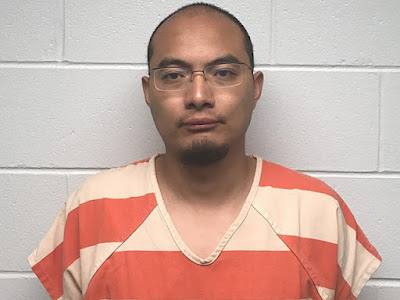
You can watch the piece and see videos of Mallory (seen in his mugshot above) in the act via the below link:

https://www.cbsnews.com/news/chinese-spy-how-a-former-cia-officer-was-caught-betraying-his-country-60-minutes-2019-08-11/

You can also read about Mallory's sentencing via the below link:

www.pauldavisoncrime.com/2019/05/former-cia-officer-sentenced-to-prison.html

Thursday, May 2, 2019

Former CIA Officer Pleads Guilty To Conspiracy To Commit Espionage


The U.S. Justice Department released the below information:
A former Central Intelligence Agency (CIA) case officer pleaded guilty today to conspiring to communicate, deliver and transmit national defense information to the People’s Republic of China.  Assistant Attorney General for National Security John C. Demers, U.S. Attorney G. Zachary Terwilliger for the Eastern District of Virginia, Assistant Director for Counterintelligence John Brown of the FBI and Assistant Director in Charge Nancy McNamara of the FBI’s Washington Field Office made the announcement after Senior U.S. District Judge T.S. Ellis III accepted the plea.
According to court documents, Jerry Chun Shing Lee, 54, left the CIA in 2007 and began residing in Hong Kong.  In April 2010, two Chinese intelligence officers (IOs) approached Lee and offered to pay him for national defense information he had acquired as a CIA case officer.  The IOs also told Lee they had prepared for him a gift of $100,000 cash, and they offered to take care of him “for life” in exchange for his cooperation.
Beginning sometime in May 2010 and continuing into at least 2011, Lee received requests for information, or taskings, from the Chinese IOs.  The majority of the taskings asked Lee to reveal sensitive information about the CIA, including national defense information.  On May 14, 2010, Lee made or caused to be made a cash deposit of $138,000 HKD (approximately $17,468 in USD) into his personal bank account in Hong Kong.  This would be the first of hundreds of thousands of dollars (USD equivalent) in cash deposits Lee made or caused to be made into his personal HSBC account from May 2010 through December 2013.
“This is the third case in less than a year in which a former US intelligence officer has pled or been found guilty of conspiring with Chinese intelligence services to pass them national defense information,” said Assistant Attorney General Demers.  “Every one of these cases is a tragic betrayal of country and colleagues.  The National Security Division will continue to prosecute individuals like Lee who abuse their former access to classified information for financial gain while threatening the security of America.  Many thanks to the agents, analysts and prosecutors whose work led to today’s outcome.”
“Those Americans entrusted with our government’s most closely held secrets have a tremendous responsibility to safeguard that information,” said U.S. Attorney Terwilliger.  “Instead of embracing that responsibility and honoring his commitment to not disclose national defense information, Lee sold out his country, conspired to become a spy for a foreign government, and then repeatedly lied to investigators about his conduct.  This prosecution should serve as a warning to others who would compromise our nation’s secrets and betray our country’s trust.  My thanks to the prosecutors, agents and our intelligence community partners for their terrific work on this important case.”
“Today, Mr. Lee accepts responsibility not only for his crimes but also for their dangerous ramifications” said Assistant Director Brown.  “By knowingly aiding a foreign government, Mr. Lee put our country’s national security at serious risk and also threatened the safety and personal security of innocent people, namely his former intelligence colleagues.  He deserves to answer for his treachery and he will do so as a result of the dedication of the FBI’s Counterintelligence Division, the Washington Field Office, and the Department of Justice in pursuing this case.”
“Today's guilty plea is an example of how the FBI and the Department of Justice successfully pursue threats to our nation's security and intelligence,” said Assistant Director McNamara.  “U.S. Government employees are entrusted by the American people to keep our country safe and secure from adversaries.  The targeting of former U.S. security clearance holders by Chinese intelligence services is a constant threat we face, and the FBI will continue to combat these threats and guard our nation against those who conspire to compromise our national security.  I would like to thank the hardworking people of the FBI who work each day to defend our security and intelligence.”
On May 26, 2010, Lee created on his laptop computer a document that described, among other things, certain locations to which the CIA would assign officers with certain identified experience, as well as the particular location and timeframe of a sensitive CIA operation.  After Lee created this document, he transferred it from his laptop to a thumb drive.  The document included national defense information of the United States that was classified at the Secret level.
In August 2012, the FBI conducted a court-authorized search of a hotel room in Honolulu, Hawaii registered in Lee’s name.  The search revealed that Lee possessed the thumb drive within his personal luggage.  The FBI forensically imaged the thumb drive and later located the document in the unallocated space of the thumb drive, meaning that it had been deleted.  The search also revealed that Lee possessed a day planner and an address book that contained handwritten notes made by Lee that related to his work as a CIA case officer prior to 2004.  These notes included, among other things, intelligence provided by CIA assets, true names of assets, operational meeting locations and phone numbers, and information about covert facilities.
During 2012, Lee had a series of interviews with the CIA.  Throughout these interviews, in response to questions about what the IOs had wanted from him, Lee intentionally failed to disclose that he had received taskings from them.  In May 2013, the FBI conducted three interviews with Lee.  During one of those interviews, Lee admitted that he had received taskings but stated that he had not kept the written requests because they would tend to incriminate him.
The FBI interviewers also confronted Lee with the sensitive document discovered on the thumb drive.  Lee falsely denied that he possessed it, claimed not to know who created it, and denied knowing why it would have been on his computer.  He also denied deleting the document.  Approximately one week later, in another FBI interview, Lee admitted that he created the document in response to two taskings from the IOs and transferred it to a thumb drive.  He also said he thought about giving it to the IOs but never did.
In a January 2018 interview with the FBI, Lee falsely denied that he ever kept any work-related notes at home.  When shown a photocopy of the front covers of the day planner and address book described above, as well as a copy of his handwriting therein, Lee falsely denied that he possessed the notebooks while transiting through Hawaii in August 2012.  Lee also falsely denied that either of the books contained notes from asset meetings but conceded that any such notes would be classified.  Further, Lee falsely denied that he ever put the sensitive document on a thumb drive, notwithstanding the fact that he had admitted having done so when interviewed by FBI agents in May 2013.  Finally, Lee also falsely told the interviewing agents that in drafting this document he was writing down things “more [like] a diary thing,” notwithstanding the fact that in May 2013 he had told FBI agents that he had created the document in response to two taskings from the Chinese IOs.
Lee pleaded guilty to conspiracy to deliver national defense information to aid a foreign government and faces a maximum penalty of life in prison when sentenced on Aug. 23, 2019.  Actual sentences for federal crimes are typically less than the maximum penalties.  A federal district court judge will determine any sentence after taking into account the U.S. Sentencing Guidelines and other statutory factors.
Assistant U.S. Attorney Neil Hammerstrom and Trial Attorneys Patrick T. Murphy and Adam L. Small of the National Security Division’s Counterintelligence and Export Control Section are prosecuting the case.

Thursday, April 25, 2019

Former State Department Employee Pleads Guilty To Conspiring With Foreign Agents: Defendant Admitted Receiving Tens Of Thousands Of Dollars In Benefits From Two Chinese Agents In Exchange For Internal State Department Documents


The U.S. Justice Department released the below information:

Candace Marie Claiborne, a former employee of the U.S. Department of State, pleaded guilty today to a charge of conspiracy to defraud the United States, by lying to law enforcement and background investigators, and hiding her extensive contacts with, and gifts from, agents of the People’s Republic of China (PRC), in exchange for providing them with internal documents from the U.S. State Department. 
The announcement was made by Assistant Attorney General for National Security John C. Demers, U.S. Attorney Jessie K. Liu of the District of Columbia, Assistant Director in Charge Nancy McNamara of the FBI’s Washington Field Office and Deputy Assistant Secretary Ricardo Colón, Domestic Operations, U.S. Department of State’s Diplomatic Security Service.
The plea took place before the Honorable Randolph D. Moss of the U.S. District Court for the District of Columbia. 
“Candace Marie Claiborne traded her integrity and non-public information of the United States government in exchange for cash and other gifts from foreign agents she knew worked for the Chinese intelligence service,” said Assistant Attorney General Demers.  “She withheld information and lied repeatedly about these contacts.  Violations of the public’s trust are an affront to our citizens and to all those who honor their oaths.  With this guilty plea we are one step closer to imposing justice for these dishonorable criminal acts.” 
“Candace Claiborne broke the public trust when she accepted gifts and money from foreign officials, and then lied about it to State Department background investigators,” said U.S. Attorney Liu. “The United States will continue to seek to hold accountable those who abuse their positions of trust.” 
“Candace Claiborne was entrusted with Top Secret information when she purposefully misled federal investigators about her repeated interactions with foreign contacts which violated her oath of office as a State Department employee,” said Assistant Director McNamara.  “The FBI will continue to investigate individuals who fail to report foreign contacts, which is a key indicator of potential insider threats posed by those in positions of public trust.”
“Our close working relationship with the FBI and the Department of Justice resulted in the conviction of Candace Claiborne who violated the public trust and damaged our national security,” said Deputy Assistant Secretary Colón.  “Diplomatic Security will continue working with our law enforcement partners to vigorously defend the interests and security of the United States of America.”
According to the plea documents, Claiborne, 63, began working as an Office Management Specialist for the Department of State in 1999.  She served overseas at a number of posts, including embassies and consulates in Baghdad, Iraq, Khartoum, Sudan, and Beijing and Shanghai, China.  As a condition of her employment, Claiborne maintained a TOP SECRET security clearance.  Claiborne also was required to report any contacts with persons suspected of affiliation with a foreign intelligence agency as well as any gifts she received from foreign sources over a certain amount.
Despite such a requirement, Claiborne failed to report repeated contacts with two agents of the People’s Republic of China Intelligence Service, even though these agents provided tens of thousands of dollars in gifts and benefits to Claiborne and her family over five years.  The gifts and benefits included cash wired to Claiborne’s USAA account, Chinese New Year’s gifts, international travel and vacations, tuition at a Chinese fashion school, a fully furnished apartment, a monthly stipend and numerous cash payments.  Some of these gifts and benefits were provided directly to Claiborne, while others were provided to a close family member of Claiborne’s.
In exchange for these gifts and benefits, as stated in the plea documents, Claiborne provided copies of internal documents from the State Department on topics ranging from U.S. economic strategies to visits by dignitaries between the two countries. 
Claiborne noted in her journal that she could “Generate 20k in 1 year” working with one of the PRC agents.  That same agent at one point tasked her with providing internal U.S. Government analyses on a U.S.-Sino Strategic Economic Dialogue that had just concluded.
Claiborne, who confided to a co-conspirator that the PRC agents were “spies,” willfully misled State Department background investigators and FBI investigators about her contacts with those agents, the plea documents state.  After the State Department and FBI investigators contacted her, Claiborne also instructed her co-conspirators to delete evidence connecting her to the PRC agents.  She was arrested on March 28, 2017, following a law enforcement investigation.
Judge Moss scheduled sentencing for July 9, 2019.  Claiborne, of Washington, D.C., was ordered detained pending sentencing, but will self-surrender for said detention on June 5, 2019.  The statutory maximum penalty for a person convicted of conspiracy to defraud the United States is five years in prison.  The maximum statutory sentences are prescribed by Congress and are provided here for informational purposes.  The sentencing of the defendant will be determined by the court after considering the advisory Sentencing Guidelines and other statutory factors.
The FBI’s Washington Field Office is leading the investigation into this matter.  The case was prosecuted by Thomas A. Gillice and investigated by John L. Hill, both Assistant U.S. Attorneys in the U.S. Attorney’s Office for the District of Columbia, and Deputy Chief Julie A. Edelstein and Trial Attorney Evan N. Turgeon of the National Security Division’s Counterintelligence and Export Control Section.

Thursday, February 14, 2019

Former U.S. Counterintelligence Agent Charged With Espionage On Behalf of Iran; Four Iranians Charged With A Cyber Campaign Targeting Her Former Colleagues


The U.S. Justice Department released the below information:
Monica Elfriede Witt, 39, a former U.S. service member and counterintelligence agent, has been indicted by a federal grand jury in the District of Columbia for conspiracy to deliver and delivering national defense information to representatives of the Iranian government.  Witt, who defected to Iran in 2013, is alleged to have assisted Iranian intelligence services in targeting her former fellow agents in the U.S. Intelligence Community (USIC).  Witt is also alleged to have disclosed the code name and classified mission of a U.S. Department of Defense Special Access Program. An arrest warrant has been issued for Witt, who remains at large.
The same indictment charges four Iranian nationals, Mojtaba Masoumpour, Behzad Mesri, Hossein Parvar and Mohamad Paryar (the “Cyber Conspirators”), with conspiracy, attempts to commit computer intrusion and aggravated identity theft, for conduct in 2014 and 2015 targeting former co-workers and colleagues of Witt in the U.S. Intelligence Community.  The Cyber Conspirators, using fictional and imposter social media accounts and working on behalf of the Iranian Revolutionary Guard Corps (IRGC), sought to deploy malware that would provide them covert access to the targets’ computers and networks.  Arrest warrants have been issued for the Cyber Conspirators, who also remain at large.
The announcement was made by Assistant Attorney General for National Security John Demers, U.S. Attorney Jessie K. Liu for the District of Columbia, Executive Assistant Director for National Security Jay Tabb of the FBI, U.S. Treasury Secretary Steven Mnuchin, Special Agent Terry Phillips of the Air Force Office of Special Investigations, and Assistant Director in Charge Nancy McNamara of the FBI’s Washington Field Office.
“Monica Witt is charged with revealing to the Iranian regime a highly classified intelligence program and the identity of a U.S. Intelligence Officer, all in violation of the law, her solemn oath to protect and defend our country, and the bounds of human decency,” said Assistant Attorney General Demers.  “Four Iranian cyber hackers are also charged with various computer crimes targeting members of the U.S. intelligence community who were Ms. Witt’s former colleagues. This case underscores the dangers to our intelligence professionals and the lengths our adversaries will go to identify them, expose them, target them, and, in a few rare cases, ultimately turn them against the nation they swore to protect.  When our intelligence professionals are targeted or betrayed, the National Security Division will relentlessly pursue justice against the wrong-doers.” 
“This case reflects our firm resolve to hold accountable any individual who betrays the public trust by compromising our national security,” said U.S. Attorney Liu.  “Today’s announcement also highlights our commitment to vigorously pursue those who threaten U.S. security through state-sponsored hacking campaigns.”
“The charges unsealed today are the result of years of investigative work by the FBI to uncover Monica Witt’s betrayal of the oath she swore to safeguard America’s intelligence and defense secrets” said Executive Assistant Director for National Security Tabb.  “This case also highlights the FBI’s commitment to disrupting those who engage in malicious cyber activity to undermine our country’s national security. The FBI is grateful to the Department of Treasury and the United States Air Force for their continued partnership and assistance in this case.”
Treasury is taking action against malicious Iranian cyber actors and covert operations that have targeted Americans at home and overseas as part of our ongoing efforts to counter the Iranian regime’s cyber-attacks,” said Treasury Secretary Steven Mnuchin.  “Treasury is sanctioning New Horizon Organization for its support to the IRGC-QF.  New Horizon hosts international conferences that have provided Iranian intelligence officers a platform to recruit and collect damaging information from attendees, while propagating anti-Semitism and Holocaust denial.  We are also sanctioning an Iran-based company that has attempted to install malware to compromise the computers of U.S. personnel.”
“The alleged actions of Monica Witt in assisting a hostile nation are a betrayal of our nation’s security, our military, and the American people,” said Special Agent Phillips. “While violations like this are extremely rare, her actions as alleged are an affront to all who have served our great nation.”  
“This investigation exemplifies the tireless work the agents and analysts of the FBI do each and every day to bring a complex case like this to fruition,’ said Assistant Director in Charge McNamara.  “Witt's betrayal of her country and the actions of the cyber criminals - at the behest of the IRGC - could have brought serious damage to the United States, and we will not stand by and allow that to happen.  The efforts by the Iranian government to target and harm the U.S. will not be taken lightly, and the FBI will continue our work to hold those individuals or groups accountable for their actions.”
According to the allegations contained in the indictment unsealed today:
Monica Witt’s Espionage
Monica Witt, a U.S. citizen, was an active duty U.S. Air Force Intelligence Specialist and Special Agent of the Air Force Office of Special Investigations, who entered on duty in 1997 and left the U.S. government in 2008.  Monica Witt separated from the Air Force in 2008 and ended work with DOD as a contractor in 2010.  During her tenure with the U.S. government, Witt was granted high-level security clearances and was deployed overseas to conduct classified counterintelligence missions.
In Feb. 2012, Witt traveled to Iran to attend the Iranian New Horizon Organization’s “Hollywoodism” conference, an IRGC-sponsored event aimed at, among other things, condemning American moral standards and promoting anti-U.S. propaganda.  Through subsequent interactions and communications with a dual United States-Iranian citizen referred to in the indictment as Individual A, Witt successfully arranged to re-enter Iran in Aug. 2013.  Thereafter, Iranian government officials provided Witt with a housing and computer equipment.  She went on to disclose U.S. classified information to the Iranian government official.  As part of her work on behalf of the Iranian government, she conducted research about USIC personnel that she had known and worked with, and used that information to draft “target packages” against these U.S. agents.   
Iranian Hacking Efforts Targeting Witt’s Former Colleagues
Beginning in late 2014, the Cyber Conspirators began a malicious campaign targeting Witt’s former co-workers and colleagues.  Specifically, Mesri registered and helped manage an Iranian company, the identity of which is known to the United States, which conducted computer intrusions against targets inside and outside the United States on behalf of the IRGC.  Using computer and online infrastructure, in some cases procured by Mesri, the conspiracy tested its malware and gathered information from target computers or networks, and sent spearphishing messages to its targets.  Specifically, between Jan. and May 2015, the Cyber Conspirators, using fictitious and imposter accounts, attempted to trick their targets into clicking links or opening files that would allow the conspirators to deploy malware on the target’s computer.  In one such instance, the Cyber Conspirators created a Facebook account that purported to belong to a USIC employee and former colleague of Witt, and which utilized legitimate information and photos from the USIC employee’s actual Facebook account. This particular fake account caused several of Witt’s former colleagues to accept “friend” requests.
*          *          *
The case is being investigated by the FBI’s Washington Field Office with assistance from the Air Force Office of Special Investigations.  The prosecution is being handled by Assistant U.S. Attorneys Deborah Curtis, Jocelyn Ballantine and Luke Jones of the U.S. Attorney’s Office for the District of Columbia with assistance from Trial Attorney Evan N. Turgeon of the National Security Division’s Counterintelligence and Export Control Section.