

Last month, the U.S. Naval Special Warfare
Command (NSWC) celebrated the 60th anniversary of the establishment
of the U.S. Navy SEALs.
The Navy SEALs saw combat in the Vietnam War and in Iraq, Afghanistan and other hotspots around the world. The SEALs were in the forefront in the worldwide war on terrorism and it was the Navy SEALs who killed the world’s most wanted terrorist, Osama bin Laden.
According to the NSWC, President Kennedy recognized the need for an increase in special forces and unconventional warfare during the Vietnam War. He directed the Secretary of Defense to increase and reorient U.S. special forces and unconventional warfare units in a speech to Congress, May 25, 1961.
“Our nation’s Naval commandos celebrate the 60th anniversary of the SEAL teams
this week with President John F. Kennedy’s order to establish SEAL Team 1 and 2
in January 1962,” said Rear Adm. H.W. Howard III (seen in the bottom photo), commander, NSWC. “We’re
reminded of the legacy that set our standard and the heroes whose shoulders we
stand upon today.”
The NSWC noted that eight months later, preexisting Underwater Demolition Teams
provided the manpower required to establish the first SEAL teams at Naval
Amphibious Base (NAB) Coronado, California, and NAB Little Creek, Virginia,
Jan. 1, 1962. Their mission was to conduct unconventional warfare,
counter-guerrilla warfare and clandestine operations.
The Naval Special Warfare community’s history pre-dates the
establishment of the SEAL teams by twenty years. In August 1942, the Amphibious
Scouts and Raiders, and the Special Mission Naval Demolition Unit were
established at Amphibious Training Base Little Creek, Virginia, to perform
specific missions during Operation Torch – the allied invasion of North Africa
– in November 1942. The Underwater Demolition Teams (UDT) were later formed.
“As we urgently adapt and innovate to meet new threats and missions of greater
complexity and risk, we honor the stewardship, integrity, grit and gallantry
that the founding members of our community demonstrated in their service,” said
Howard. “In marking this milestone, Naval Special Warfare also celebrates our
authentic and timeless team – a team anchored on earned trust, candor,
creativity and resilience – a humble team with an ironclad commitment to the
nation and all we serve.”
Capt. Donald G. Wetherbee, commodore, Naval Special Warfare Group
2, added that throughout the community’s 80-year history, naval commandos
engaged in operations from the beaches of North Africa and Normandy, the
islands of the Pacific, Korea and Vietnam, Iraq and Afghanistan, to countless
other areas of the world – on land and under the sea.
“Today’s SEAL teams, along with other components of Naval Special Warfare,
represent a unique ability to access denied environments, providing scalable
kinetic and non-kinetic effects that set the conditions to undermine adversary
confidence and provide diplomatic leverage in competition, and higher end
options in crisis and conflict,” said Wetherbee. “At the same time, the
incredible leadership, cognitive attributes and character of our people remain
the same as they did from day one of our community’s birth. I’m truly humbled
to have the privilege of working with the men and women of Naval Special
Warfare every day.”
My interest in naval special warfare stems from my late father, Edward Miller
Davis (seen in the below photo in the center of UDT 5), who served as a chief in UDT 5 during WWII and saw combat on Saipan,
Tinian and the Philippines.
In my piece in the Journal some years ago on how the Navy SEALs
evolved from UDT, I offered the views of the late Commander Robert Marshal
(retired), who was my father’s executive officer in UDT and later the
Commanding officer of UDT 3. Marshal, who was 83 when I interviewed him, spoke
of how the UDT’s number one influence was innovation, and attitude.
I’ve also interviewed a good number of SEALs in my Journal pieces,
including Robert O’Neill, the SEAL who shot and killed bin Laden, and Captain
Dick Couch.
In my Journal piece on the history of the SEALs, Couch
spoke of UDT, the SEALs’ forbearers.
“There was a need for reconnaissance before we put
people ashore in WWII,” Couch explained. “This really came into focus during
the battle for Tarawa, where we started this long march across the Pacific
island-hopping campaign. We suffered horrible casualties at Tarawa because we
lacked knowledge of the hydrographic conditions offshore and of the obstacles
placed on the beach by the enemy. We quickly needed guys who could go ashore
and find out what was there and at some future point, before the Marines went
ashore, go back in ahead of them and blow up those obstacles. That is where the
UDTs came into being and they ran in front of almost every major amphibious
operation across the Pacific.”
Couch said that early in the Vietnam War it was
determined that there was a need for an unconventional warfare and
counterinsurgency capability. So in 1962 the SEALs came into being with SEAL
One on the West Coast and SEAL Two on the East Coast. “They just came of age,
got funded and staffed and commissioned as entities and Vietnam was standing
right there in front of them,” Couch said. Couch said that the SEALs trained
the South Vietnamese SEALs and also participated in the Provincial
Reconnaissance Units (PRU) program. This was a CIA sponsored program and the
intelligence agency used Marine Recon, Army Special Forces and SEAL advisors.
“This was probably the most effective unit of all
special operations deployed during that conflict,” Couch said. “Declassified
North Vietnamese documents show that the PRUs were hurting them bad. The guys
who lived with those PRUs and went out and fought with them--they were a
special breed of fellas.”
The Navy SEALs remain a special breed.


Philadelphia Weekly published my Crime Beat column on the life and crimes of former Philly mob boss Ralph Natale.
You can read the column via below:


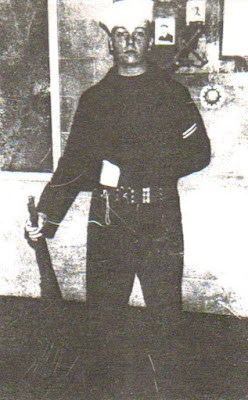
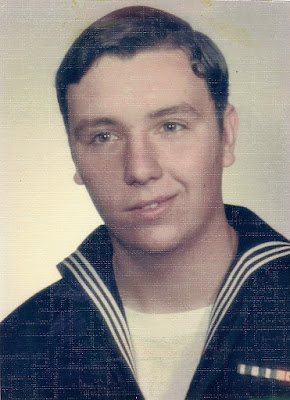
I was
17 years old.
I raised my hand and swore an oath to the U.S. Navy and the U.S. Constitution in Philadelphia, PA and then I boarded a train to Chicago and then on to the Naval Training Center at Great Lakes, Illinois.
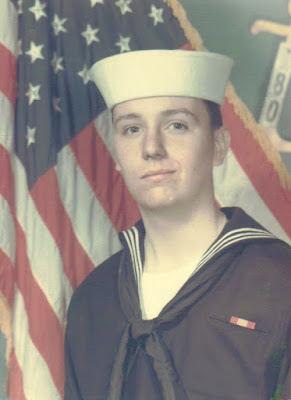
After
graduating from Boot Camp three months later, I received orders to report to
the aircraft carrier USS Kitty Hawk, which was undergoing a major overhaul in
Bremerton, Washington.
A few months later, the carrier sailed from
Bremerton to San Diego. The carrier and crew began sea trials and training for
our combat cruise to Southeast Asia.
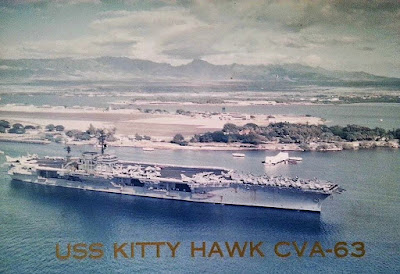
The Kitty Hawk later shoved off to take our place on "Yankee Station," in the Tonkin Gulf in the South China Sea off the coast of North Vietnam during the Vietnam War.
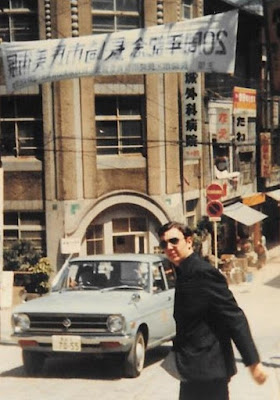
We
also made port of calls in Hawaii, the Philippines, Japan and Hong Kong.
I
was separated from the Navy in December of 1971.
I
attended Penn State and worked for the Defense Department, but I was bored, so
I decided to reenlist in the Navy in 1974.
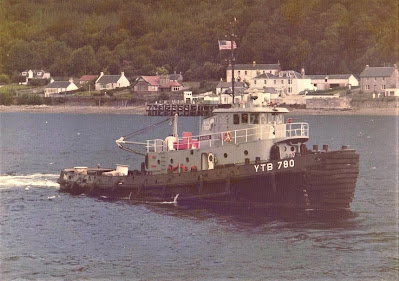
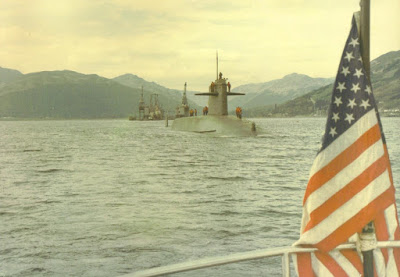
I
was assigned to the USS Saugus YTB 780, a Navy harbor tugboat stationed at the
floating nuclear submarine base in Holy Loch, Scotland. On leave, I traveled
all over the British Isles and Europe.
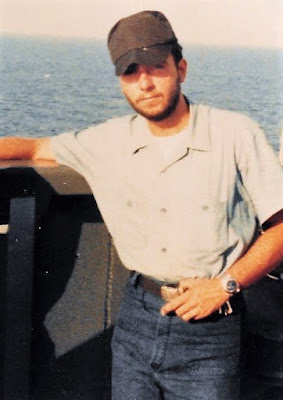
I
was finally discharged in January of 1976 at the Philadelphia Navy Base, which
was a dozen city blocks from my childhood home.
After my discharge from the Navy, I went back to the Defense Department at the Philadelphia “Quartermaster” where I went on to become the civilian administrative officer for the Defense Contract Management Agency.
We oversaw defense contractors across three states for the Navy, Army, Marine Corp, Air Force and NASA. As the administrative officer, I oversaw security, safety, public affairs and other support services for the command’s military and civilian employees.
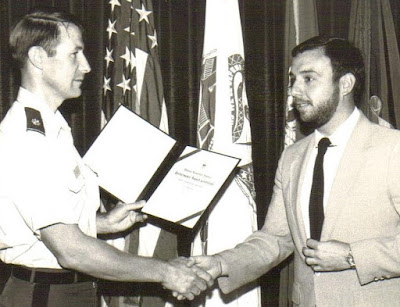
I also became a contributing writer to Defense Department in-house magazines, which led to my career as a writer after I retired from the Defense Department in 2007 after more than 37 years of combined U.S. Navy/U.S. Defense Department service.
After all these years, I remain proud of my service in the U.S. Navy and proud of my service in the Defense Department.
And it all began on this date in 1970.
Note: You can read my sea stories, vignettes, humor pieces and short stories via the below link:
The
Defense Department relies on the entrepreneurial companies and their
innovative, hard-working employees in the defense industrial base, or DIB, to
create capabilities for warfighters.
Through
procurements from private-sector sources, the department leverages the best
technologies and innovations to give service members the battlefield advantages
they need to win decisively, Deputy Defense Secretary Kathleen H. Hicks said.
"DIB cybersecurity is and will remain an expanding
priority for the U.S. Department of Defense. More than 220,000 companies provide
value to the department's force development, and the DIB is now facing
increasingly sophisticated and well-resourced cyber-attacks that must be
stopped," she said, referring to the defense industrial base.
These cyber-attacks threaten the U.S. and the rules-based
order on which the global economy relies, Hicks said. Markets cannot function
effectively in an environment where adversarial countries are leveraging their
national power to steal intellectual property, to sabotage commercial activity,
and to threaten supply chains.
You can read the rest
of the piece via the below link:

The New York Post offers a leaked video of an aircraft crashing on the deck of the Aircraft carrier USS Carl Vinson.
Leaked video captured the harrowing moment a fighter jet crashed onto the deck of the aircraft carrier USS Carl Vinson before plunging into the South China Sea last month.
The pilot was recovered after ejecting from the F-35C Lightning II, which was seen bobbing in the water without its canopy. Seven sailors were wounded in the Jan. 24 incident.
“The ship has assessed that the video and photo covered in the media … were taken on board USS Carl Vinson (CVN 70) during the crash,” US Navy 7th Fleet spokesperson Cmdr. Hayley Sims told Military.com in an email.
You can read the rest of the piece and watch the video via the below link:
Video shows Navy fighter jet crashing on carrier USS Carl Vinson (nypost.com)


