News and commentary on organized crime, street crime, white collar crime, cyber crime, sex crime, crime fiction, crime prevention, espionage and terrorism.
Veteran
national security reporter Bill Gertz offers a piece at the Washington Times on the Chinese Navy
surpassing the U.S. Navy.
China’s navy is now the world’s largest maritime military
force and will deploy 460 warships by the end of the decade, according to the
Pentagon ‘s latest annual report on Chinese military power.
The current warship arsenal for the People’s Liberation
Army Navy (PLAN) includes 355 naval platforms, including major surface ships,
submarines, aircraft carriers, amphibious warships and mine warfare craft.
By contrast, the U.S. Navy currently has 296 warships,
but that arsenal includes 11 aircraft carriers capable of projecting power at
long distances. Other Navy ships include 115 cruisers and destroyers, 68
submarines, 31 amphibious warfare ships and 59 small surface combatants and
combat logistics ships.
U.S.
analysts say the PLAN,
financed by China‘s
growing economic might, is building new warships at a rapid pace, mainly
guided-missile cruisers and destroyers and corvettes, while its submarine force
continues to expand.
“These assets will significantly upgrade the PLAN‘s
air defense, anti-ship, and anti-submarine capabilities and will be critical as
the PLAN expands
its operations beyond the range of the PLA’s shore-based air defense systems,”
the Pentagon report,
made public last week, states. “By the end of 2019, the PLAN had
commissioned its 30th Jiangkai II class guided-missile frigate (FFG),
completing the production run while it finalizes a follow-on class with additional
units under construction.”
You can read
the rest of the piece via the below link:
Veteran national security
reporter and author Bill Gertz (seen in the below photo) offers a piece in the Washington Times on China’s
involvement in Afghanistan.
China has reaped the benefits
of costly American military and security efforts in Afghanistan but now
faces a hostile Islamic regime near its western border, according to David Stilwell,
former assistant secretary of state for East Asia and Pacific affairs, who adds
that the Biden administration should not help Beijing deal with its
problems there.
Mr. Stilwell, a former
military attache in China, said the large and growing presence of Chinese
officials and businesses in Afghanistan will become more prominent once
more than 10,000 Americans depart the country. Then al Qaeda and other groups
will begin conducting terrorist attacks against the Chinese in Afghanistan.
Beijing has been quietly
developing economic relations with Afghanistan for the past decade or more
under its Belt and Road Initiative infrastructure program. Beijing also
has signaled its support for the new Taliban regime in Kabul.
Mr. Stilwell, who worked in
the State Department during the Trump administration, recalled an encounter in
China with a People’s Liberation Army (PLA) officer who criticized
him for what the officer said were “imperialist” U.S. policies that had turned
Afghanistan into an American colony.
Mr. Stilwell responded that he
agreed it was long past time for the United States to depart the country. “I
wished him and his PLA buddies luck in the graveyard of empires,” he told
Inside the Ring. “Publicly, he pounded his chest and said that suited him fine.
Afterward, he pulled me aside and said he hoped we wouldn’t leave anytime
soon.”
You can read the rest of the
piece via the below link:
Veteran national security reporter Bill Gertz
at the Washington Times offers a piece on a U.S. Navy admiral noting the
possibility of nuclear war with China and Russia.
The United
States must be ready for a nuclear war with China or Russia and seek new ways
to deter both countries’ use of newly acquired advanced strategic weapons, the
commander of the U.S. Strategic Command is warning in a major new review of the
global balance of nuclear forces.
Adm. Charles Richard (seen in the
below photo), writing in the current issue of the U.S. Naval Institute journal
Proceedings, offered a blunt and detailed assessment that the luxury of living
in a post-Cold War era when direct armed conflict with a rival nuclear power
was not possible is over.
“There is a real possibility that
a regional crisis with Russia or China could escalate quickly to a conflict
involving nuclear weapons, if they perceived a conventional loss would threaten
the regime or state,” the four-star admiral wrote.
Veteran national security reporter Bill Gertz at the Washington Times offers a piece on the radical
group Antifa.
Activists of the far-left Antifa movement began
planning to foment a nationwide anti-government insurgency as early as November
as the U.S. presidential campaign season kicked off in earnest, according to a
law enforcement official with access to intelligence behind the shadowy group.
The radical movement has
emerged as a key focus for investigators in the wake of violent protests and
looting across the country after the death of George Floyd
in police custody in Minneapolis,
according to U.S. law enforcement officials and private security experts.
The law enforcement official
would not speak on the record about Antifa’s plans as the
election season heats up, but longtime analysts of the group say such a move
would be entirely in character.
“Antifa’s actions represent
a hard break with the long tradition of a peaceful political process in the
United States,” said former National
Security Council staff member Rich Higgins.
“Their Marxist ideology seeks not only to influence elections in the short term
but to destroy the use of elections as the determining factor in political
legitimacy.”
Added Joe Myers, a former
Defense Intelligence Agency official and counterinsurgency expert, “President Trump’s
election and revitalization of America are a threat to Antifa’s nihilist goals.
They are fomenting this violence to create havoc, despair and to target the Trump
campaign for defeat in 2020.”
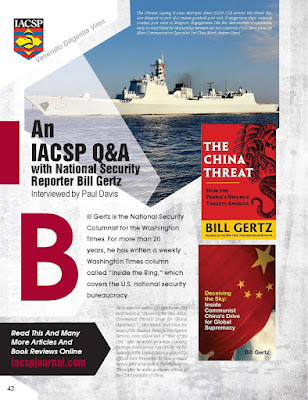
My Q&A with national security reporter Bill Gertz, who writes the Inside the Ring column for the Washington Times, appears in the latest issue of Counterterrorism magazine.
You can read the Q&A via the above and below pages or the text below:
An IACSP Q&A with National Security
Reporter Bill Gertz
Bill Gertz is the National Security Columnist for the Washington
Times. For more than 20 years, he has written a weekly Washington Times column
called “Inside the Ring,” which covers the U.S. national security bureaucracy.
He is also the author of eight books. His most recent is
“Deceiving the Sky: Inside Communist China’s Drive for Global Supremacy.”
Vyachaslav Trubnikov, the head of the Russian Foreign Intelligence Service,
once called him a “tool of the CIA” after he wrote an article exposing Russian
intelligence operations in the Balkans. In the United States, a senior CIA
official once threatened to have a cruise missile fired at his desk at The
Washington Times after he wrote a column critical of the CIA’s analysis of
China.
China’s communist government also has criticized him for his news
reports exposing China’s weapons and missile sales to rogues states, accusing
him of “spreading lies about China.” The state-run Xinhua news agency in 2006
identified him as the No. 1 “anti-China expert” in the world, although Bill
Gertz insists, he is very much pro-China – pro-Chinese people and opposed to
the communist system.
Bill Gertz studied English literature at Washington College in
Chestertown, Md., and journalism at George Washington University, Washington,
DC. In March 2014, he received the Reed Irvine Award for Investigative
Journalism by Accuracy in Media in March of 2014. In September of 1999, he was
awarded the Western Journalism Center award for investigative journalism. The
United States Business and Industrial Council awarded him the “Defender of the
National Interest Award” in June of 1998, and in 1997 he was recognized by The
Washington Times for excellence in achievement.
IACSP: What
does the title of your most recent book, “Deceiving the Sky,” mean?
Gertz: It is an ancient Chinese strategy.
Chinese military officials are steeped in ancient strategy and many people are
familiar with Sun Tzu’s “The Art of War” and how to defeat the enemy without
firing a shot, but this title is from “The Thirty-Six Strategies,” from around
300 or 200 B.C., what is known as the Warring States Era. It is the first of
the 36 strategies and it is called “Deceive the Sky to Cross the Ocean.” The
words are based on a legend and the legend was that a military commander was
trying to convince the Emperor to go to war against a neighboring province, and
so he invited him to a house of a wealthy peasant for dinner. When the Emperor
and the general stepped into the house, they felt it move and that they had
been tricked into getting on a boat and so the Emperor had to decide to either
go back or go to war. He decided to go to war. So, the point is for the Chinese
to succeed, they need to deceive even the sky or the Emperor, or God himself,
in order to achieve their goals. I felt this was a worthy title for the book
because it sums up the way Communist China is approaching the United States,
ready to use all means necessary, not just to modernize themselves and achieve
their goal of global supremacy, but more importantly, to defeat the United
States.
IACSP: Good title. Why did you write the
book?
Gertz: Back in 2000 I wrote a book called
“The China Threat,” which was a play on what Beijing calls “The China Threat
Theory.” It is actually something that their military people and diplomats were
tasked with: the measuring opposition to China’s modernization. They dismiss
the idea that they are a threat, but recognize people view them as a threat.
And I laid out why I think they are a threat. It was an early exposé of the
China threat. I felt that now is the time, under the Trump Administration,
where we have seen a major shift in policy towards China, to write a follow-on
to that book. In the intervening twenty years, I tried to capture everything
that had happened, and the China threat has increased dramatically since when I
first wrote “The China Threat” back in 2000.
IACSP: Would you describe Chinese
government “deception operations?”
Gertz: In order to understand the Chinese
system and their use of deception, it is extremely important for people to
understand the nature of the Communist system in China. I think that this has
been the biggest failing in the West, particularly the United States, in the
last forty years. We have failed to really understand that we are dealing with
a Marxist-Leninist state that was modeled after the Soviet Union. They saw the
collapse of the Soviet Union and they moderated their ideological approach to
things, but they have not abandoned Marxist-Leninism. A key feature of
Marist-Leninism is the use of strategic deception, disinformation, and
influence operations. This goes back to Sun Tzu – the ability to use all of
these to achieve their goals. I focused a lot in “Deceiving the Sky” on
identifying and understanding the Communist nature. I’ve met American
businesspeople who tell me they’ve done business in China for twenty years and
they’ve never met a Communist. That tells me there is really a lack of
understanding about the system there. I’m trying to educate people, especially
young people, about the nature of the Communist system.
One of the fundamental themes of “Deceiving the Sky” is that we,
the United States, are engaged in what I call, “a thirty-year gamble.” The idea
was that if we pretend that China was not a Communist state, and if we just
trade with them and if we ignore their human rights abuses, if we ignore their
arms proliferation to rogue states, like selling ICBMs and launchers to North
Korea, nuclear technology to Iran, and so on, that this would have a moderating
influence and that through trade and business interaction, China would become a
normal non-communist nation.
It was an utter failure. A failure that we are paying dearly for now, as we see how
Beijing mishandled and deceived the world about the Coronavirus outbreak.
IACSP: You’ve written in the
Washington Times about the “wet markets.” I can’t imagine eating a bat, let
alone a live bat, but apparently it is a delicacy there.
Gertz: The issue really is: what is the
origin of the coronavirus. The answer is no one knows. The reason no one knows
is because of Chinese secrecy and deception. The deception that the world is
finally waking up to is that the disease broke out in Wuhan, where China is
developing vaccines for coronaviruses and bat viruses. There is a strong
indication, and even the scientific experts, who tried to dismiss it as a
conspiracy theory early on, are now coming around to the idea that this virus
may have been captured by the study that was undertaken by two Chinese labs
very close to that wet market – and if they could have escaped from that lab.
IACSP: You write about China stealing
intellectual property. How can we curb that?
Gertz: I think the Trump Administration is
doing an excellent job. As I mentioned, President Trump has made a major shift
in U.S. policy towards China and it is based on what the White House has done
through the Peter Navarro office that looks at U.S. manufacturing. They did a
report called “China’s Economic Aggression.” In that 2017 report, they
disclosed that China was stealing between $250 billion and $600 billion
annually in American technology. As a nation that is highly dependent on its
technological innovation, no nation can survive losing that kind of information
and intellectual property. Trump has launched a major trade initiative, he
wants to continue trading with China, but he wants to do it in a way that’s
fair. That resulted in the big trade deal in January, but that deal is now in
jeopardy because of the pandemic. It has been based mostly on economic and
trade issues, but the Justice Department launched something they call “The
China Initiative.” This is a very aggressive law enforcement and prosecutorial
effort to crack down on Chinese intelligence activities. Almost on a weekly
basis, we are seeing Chinese intelligence activities, operatives and their
agents being indicted or arrested or otherwise exposed. I think this is having
a real impact.
IACSP: It is curious, but if you listen to
President Trump’s speeches, he sounds conciliatory towards China and Russia and
their leaders, but his administration is probably been the toughest on China
and Russia since the Reagan administration. Do you agree?
Gertz: Absolutely. In fact, I
believe that the Trump administration is pursuing the same strategy that the
Reagan Administration pursed. Early on in the Reagan Administration, they
recognized that the Soviet Union, our Cold War adversary, was living off of
stolen Western technology, so a major effort was launched to prevent the Soviet
Union from stealing Western technology. This effort definitely contributed to
the collapse of the Soviet Union. Trump is doing the same thing with our new
Cold War adversary, Communist China, by limiting as much as possible the theft
of American technology. His argument is basically, let’s see if this Chinese
miracle of economic growth can continue without stolen American and Western
technology.
IACSP: Are the Chinese meddling in
American politics with influence operations like the Russians?
Gertz: Yes. Vice President Mike Pence and
Secretary of State Mike Pompeo, and the president himself, have come out in
speeches and said starkly, China wants to see another president. In 2012 the
Chinese military took over a disputed island in the South China Sea off the
coast of the Philippines. The president of the Philippines invoked the defense
treaty with the U.S. and President Obama refused to do it. That was a green
light. The Chinese began rebuilding and militarizing islands. Xi Jinping, the
current leader, promised Obama he would not militarize those newly created
islands, but they have installed advanced anti-ship and anti-aircraft missiles.
They have turned the South China Sea into a flash point.
IACSP: You wrote about the “Chinese
Dream.” Would you explain that?
Gertz: Yeah, I call it the Chinese
nightmare, these drives for global supremacy. Each Chinese leader since Mao has
tried to identify themselves with a buzz phrase. For Dung Shao Ping, it was
bide our time and develop our capabilities. For Xi Jinping, it is the Chinese
Dream. The dream is that China will reassert its, quote, “rightful place in the
world.” The Chinese view themselves as the Middle Kingdom and they want to
dominate the world. This coincides with their ideology as well as their
nationalism. China is on the move. China is targeting the underdeveloped world,
going into countries and offering to build railroads and ports with loans to
the countries and afterwards the countries discover the loans have exorbitant
rates. When the countries can’t pay, the Chinese say, well, this is our
railroad and our seaport.
IACSP: That’s the way Cosa Nostra
organized crime operates.
Gertz: Yes, the Chinese leadership today
is very much like organized crime families, with power centers both in the
military and the Communist Party. There are competing interest and power
struggles. Xi Jinping has created quite a bit of instability, both within the
military and within the ruling party with his purges under the guise of
anti-corruption, but in reality, to consolidate power.
IACSP: The Chinese are Communists, but a
lot of leaders have amassed personal fortunes, haven’t they?
Gertz: Yes. They have utilized the
Communist system of total control through party membership of eighty million
people. But the higher you get within this hierarchy, the more access you get
to wealth. A good example of that is the current Vice President, Chen
Chien-Jen, who is in reality, the financial czar. He has over at least two or
three billion dollars in overseas accounts, according to the people I’ve talked
to for research for the book.
IACSP: You wrote about a Chinese
“intelligence storm.” Would you describe that?
Gertz: This was based on an interview with
a retired CIA counterintelligence official who used that term. He said the
approach of Chinese intelligence to the United States is on par with the Soviet
KGB and GRU threat of the Cold War. In other words, it is a multi-front
approach to gathering intelligence, both secrets and unclassified information,
bringing that back and using it for government and policy reasons, as well as
for commercial and economic reasons.
Their cyber efforts against the U.S. have been massive in terms
of data collection. The OPM hack was among the most viable. Twenty-two million
records of American officials, including our intelligence and law enforcement
personnel.
IACSP: How would you describe Xi Jinping?
Gertz: In my book I have some eye-opening
information about him. He has amassed more power than Mao. He is the most
feared official in China, which many people have said contributed to China’s
causing the global pandemic. One of the reasons local officials in Hubei
Provence, where Wuhan is located, were afraid of reporting to the center for
fear of being accused of corruption. This is the kind of system operating now.
Xi Jinping admires several people, including Hitler, Stalin and Mao. The people
he hates are Dung Shao Ping, the reformer, and Ronald Reagan, who got rid of
the Soviet Union.
IACSP: Thank
you for speaking for us.
Paul Davis is a regular contributor to the Journal of
Counterterrorism & Homeland Security Int’l.
You can also read my Washington Times review of Bill Gertz's Deceiving the Sky: Inside Communist China's Drive for Global Supremacy via the below link:
I interviewed veteran national security reporter and author Bill Gertz over the phone today.
Bill Gertz writes the Inside the Ring (as in Pentagon) column for the Washington Times.
Bill Gertz has also written eight books on national security, the latest of which is Deceiving the Sky: Inside China's Drive for Global Supremacy.
I reviewed Deceiving the Sky for the Washington Times and I interviewed him today for the upcoming issue of Counterterrorism magazine.
Bill Gertz spoke of how the Chinese Communists strive to become the world's sole superpower, bypassing the United States.
He also spoke of the Chinese bio labs located near Wusan, where the "wet markets" store, slaughter and sell bats and other exotic animals that some Chinese grave.
And he spoke of devastating Chinese cyber operations and Chinese influence operations that far surpass the Russian influence operations.
I'll post the interview here when the magazine comes out.
You can read my Washington Times review of Deceiving the Sky via the below link:
Veteran national security
reporter Bill Gertz
offers a piece in the Washington Times on how Chinese government researchers performed
scientific work on bat coronaviruses three miles from the "wet markets" identified
as ground zero in the COVID-19 pandemic.
Chinese
government researchers isolated more than 2,000 animal viruses,
including deadly bat coronaviruses, and carried out scientific work on them
just three miles from a wild animal market identified as the epicenter of the
COVID-19 pandemic.
Several Chinese state media
outlets in recent months touted the virus research and lionized in particular a
key researcher in Wuhan,
Tian Junhua,
as a leader in bat virus work.
The coronavirus strain now
infecting hundreds of thousands of people globally mutated from bats believed
to have infected animals and people at a wild animal market in Wuhan. The exact origin of
the virus, however, remains a mystery.
Reports of the extensive
Chinese research on bat viruses likely will fuel more calls for Beijing to make
public what it knows about such work.
“This is one of the worst
cover-ups in human history, and now the world is facing a global pandemic,”
Rep. Michael T. McCaul, Texas Republican and ranking member of the House
Foreign Affairs Committee, said last week. Mr. McCaul has said China should be held
accountable for the pandemic.
The Washington Times
published my review of Bill Gertz’s Deceiving the Sky: Inside Communist China’s
Drive for Global Supremacy.
Back in 1971, when I was a
teenage sailor serving on the aircraft carrier USS Kitty Hawk during the Vietnam
War, I recall when a Communist Chinese minesweeper came dangerously close to
the carrier as we sailed from “Yankee Station” off the coast of North Vietnam
to the Philippines.
The Chinese warship was
adorned with oversized white propaganda banners in Chinese, so most of the
American sailors couldn’t read them, but our captain had an intelligence
officer translate the banners. The captain announced over the ship’s public
address system that the banners read, “Down with U.S. Imperialism,” “Down with
Nixon” and “Down with U.S. Navy war criminals.”
The captain informed us that
he had sent the Chinese a message in response to the banners, “Since you are so
down with everything, up yours!”
The Chinese made no secret
that America was their avowed enemy in 1971, and according to Bill Gertz’s
“Deceiving the Sky: Inside Communist China’s Drive for Global
Supremacy,” we remain their avowed enemy today.
Mr. Gertz, a Washington Times
national security columnist and author of several books on intelligence, the
military and national security threats, offers a sobering look at the growing
threat from Communist China
and its ambition to replace the United States as the world’s No. 1 military and
economic power in the world.
In “Deceiving the Sky,” a
follow-up to Mr. Gertz’s “The China Threat: How the People’s Republic Targets
America,” which was published in 2000, Mr. Gertz notes that for more than 20
years, a willful blindness had descended over both Democratic and Republican
administrations that operated on a false assumption: They believed that by
simply conducting business with China, the Communist
Chinese would eventually evolve into a free market and democratic system.
“Today, however, the failure
of that decades-long policy has resulted in an expansive hard-line Communist
regime headed by a supreme leader with unchecked powers matching those of Mao —
General Secretary Xi Jinping,” Mr. Gertz writes. “The new leader who took power
in 2012 has ruled with an iron fist and made Communist ideology the centerpiece
of a Chinese drive for world domination, not just China.”
How that failure came about
is the subject of “Deceiving the Sky.”
Veteran national security reporter Bill Gertz offers a piece in the Washington Times on China’s Huawei company and Chinese intelligence.
An investigation of the
telecommunications equipment produced by China’s Huawei
Technologies Ltd. has uncovered numerous cases of secret access
points that could allow Chinese intelligence to conduct cyberoperations through
the equipment.
Finite State,
a cybersecurity research firm, conducted a survey of Huawei
equipment and discovered that 55% of Huawei
hardware devices it tested contained at least one backdoor access point.
The vulnerabilities in Huawei
products pose serious security threats of cyberattack and data exfiltration if
the equipment is used, according to Finite’s
report on Huawei
published Wednesday.
“The Chinese National
Intelligence Law of 2016 requires all companies ‘to support, provide
assistance, and cooperate in national intelligence work,’” the report stated.
“Even if Huawei
may be technically correct in saying that Chinese law doesn’t explicitly
‘compel’ the installation of backdoors, China’s intelligence and
counterespionage activities tend to be so expansive that these provisions could
be used to justify activities extending well beyond China’s borders.”
Paul Davis is a writer who covers crime. He has written extensively about organized crime, cybercrime, street crime, white collar crime, crime fiction, crime prevention, the military, espionage and terrorism. He is a contributor to the Washington Examiner, and his work has also appeared in the Washington Times, the Philadelphia Daily News, the Philadelphia Inquirer, Philadelphia Weekly and other publications. His 'Crime Beat' column, which covers crime news, crime issues and crime prevention in South Philadelphia, appears weekly in the South Philly Review, and his 'On Crime' column, which covers crime in the Greater Philadelphia region, appears weekly at Philly Daily and Broad and Liberty. He is also a longtime contributor to Counterterrorism magazine and writes their online 'Threatcon' column, which covers crime, espionage and terrorism. Paul Davis' crime fiction appears in American Crime Magazine. As a writer, he has attended police academy training, gone out on patrol with police officers, accompanied detectives as they worked cases, accompanied narcotics officers on drug raids, observed criminal court proceedings, visited jails and prisons, and covered street riots, mob wars and murder investigations. He has interviewed police commissioners and chiefs, FBI, DEA, HSI and other federal special agents, prosecutors, judges, public officials, WWII UDT frogmen, Navy SEALs, Army Delta operators, Israeli commandos, military intelligence officers, Scotland Yard detectives, CIA officers, former KGB officers, film and TV actors, film writers, directors and producers, journalists, novelists and true crime authors, gamblers, outlaw bikers, and Cosa Nostra organized crime bosses. Paul Davis has been a student of crime since he was a 12-year-old aspiring writer growing up in South Philadelphia. He enlisted in the U.S. Navy when he was 17 in 1970. He served aboard the aircraft carrier U.S.S. Kitty Hawk during the Vietnam War and he later served two years aboard the Navy harbor tugboat U.S.S. Saugus at the U.S. floating nuclear submarine base at Holy Loch, Scotland. He went on to become the civilian administrative officer of a Defense Department command in Philadelphia, where he oversaw security, safety and other programs for the command's military and civilian employees, and served as an investigating officer, while working part-time as a newspaper crime reporter and columnist. He retired in 2007 after more than 37 Navy/DOD years of service and became a full-time writer. From 1991 to 2005 he was a producer and on-air host of "Inside Government," a public affairs interview radio program that aired on Sunday mornings on WPEN AM and WMGK FM in the Philadelphia area. You can read Paul Davis' crime columns, crime fiction, book reviews and news and feature articles on this website. You can read his full bio by clicking on the above photo (by Brittany Davis-Pearson). And you can contact Paul Davis at pauldavisoncrime@aol.com.