Showing posts with label national security. Show all posts

Tuesday, November 9, 2021

Pentagon: China’s Navy Is Now World’s Largest With 460 Warships By 2030

Washington Times on the Chinese Navy surpassing the U.S. Navy. 

China’s navy is now the world’s largest maritime military force and will deploy 460 warships by the end of the decade, according to the Pentagon ‘s latest annual report on Chinese military power. 

The current warship arsenal for the People’s Liberation Army Navy (PLAN) includes 355 naval platforms, including major surface ships, submarines, aircraft carriers, amphibious warships and mine warfare craft. 

By contrast, the U.S. Navy currently has 296 warships, but that arsenal includes 11 aircraft carriers capable of projecting power at long distances. Other Navy ships include 115 cruisers and destroyers, 68 submarines, 31 amphibious warfare ships and 59 small surface combatants and combat logistics ships. 

U.S. analysts say the PLAN, financed by China‘s growing economic might, is building new warships at a rapid pace, mainly guided-missile cruisers and destroyers and corvettes, while its submarine force continues to expand. 

“These assets will significantly upgrade the PLAN‘s air defense, anti-ship, and anti-submarine capabilities and will be critical as the PLAN expands its operations beyond the range of the PLA’s shore-based air defense systems,” the Pentagon report, made public last week, states. “By the end of 2019, the PLAN had commissioned its 30th Jiangkai II class guided-missile frigate (FFG), completing the production run while it finalizes a follow-on class with additional units under construction.” 

You can read the rest of the piece via the below link:   

https://www.washingtontimes.com/news/2021/nov/8/chinas-navy-now-worlds-largest-460-warships-2030-p/  

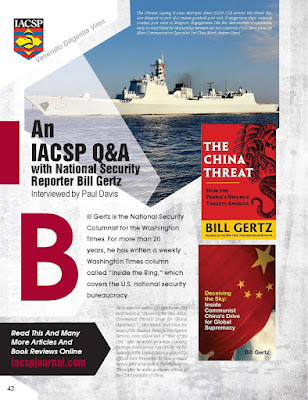
You can also read my Counterterrorism magazine Q&A with Bill Gertz via the below link:

Paul Davis On Crime: Communist China's Drive For Global Supremacy: My Q&A With National Security Reporter Bill Gertz 

Note: The above U.S. Navy photo is of  the Chinese Luyang II-class destroyer Jinan (DDG 152).

Monday, February 1, 2021

Nuclear War With China Or Russia 'A Very Real Possibility,' U.S. Strategic Command Chief warns

Veteran national security reporter Bill Gertz at the Washington Times offers a piece on a U.S. Navy admiral noting the possibility of nuclear war with China and Russia. 

The United States must be ready for a nuclear war with China or Russia and seek new ways to deter both countries’ use of newly acquired advanced strategic weapons, the commander of the U.S. Strategic Command is warning in a major new review of the global balance of nuclear forces.


Adm. Charles Richard (seen in the below photo), writing in the current issue of the U.S. Naval Institute journal Proceedings, offered a blunt and detailed assessment that the luxury of living in a post-Cold War era when direct armed conflict with a rival nuclear power was not possible is over.


 “There is a real possibility that a regional crisis with Russia or China could escalate quickly to a conflict involving nuclear weapons, if they perceived a conventional loss would threaten the regime or state,” the four-star admiral wrote.


Wednesday, July 8, 2020

FBI Director Wray: The Threat Posed By The Chinese Government And The Chinese Communist Party To The Economic And National Security Of The United States


FBI Director Christopher Wray spoke at the Hudson Institute on July 7, 2020 on China’s Attempt to Influence U.S. Institutions.

Below are his remarks, which the FBI released:
Good morning. I realize it’s challenging, particularly under the current circumstances, to put on an event like this, so I’m grateful to the Hudson Institute for hosting us today.
The greatest long-term threat to our nation’s information and intellectual property, and to our economic vitality, is the counterintelligence and economic espionage threat from China. It’s a threat to our economic security—and by extension, to our national security.
As National Security Advisor O’Brien said in his recent remarks, we cannot close our eyes and ears to what China is doing—and today, in light of the importance of this threat, I will provide more detail on the Chinese threat than the FBI has ever presented in an open forum. This threat is so significant that the attorney general and secretary of state will also be addressing a lot of these issues in the next few weeks. But if you think these issues are just an intelligence issue, or a government problem, or a nuisance largely just for big corporations who can take care of themselves—you could not be more wrong.
It’s the people of the United States who are the victims of what amounts to Chinese theft on a scale so massive that it represents one of the largest transfers of wealth in human history.
If you are an American adult, it is more likely than not that China has stolen your personal data.
In 2017, the Chinese military conspired to hack Equifax and made off with the sensitive personal information of 150 million Americans—we’re talking nearly half of the American population and most American adults—and as I’ll discuss in a few moments, this was hardly a standalone incident.
Our data isn’t the only thing at stake here—so are our health, our livelihoods, and our security.
We’ve now reached the point where the FBI is opening a new China-related counterintelligence case about every 10 hours. Of the nearly 5,000 active FBI counterintelligence cases currently underway across the country, almost half are related to China. And at this very moment, China is working to compromise American health care organizations, pharmaceutical companies, and academic institutions conducting essential COVID-19 research.
But before I go on, let me be clear: This is not about the Chinese people, and it’s certainly not about Chinese Americans. Every year, the United States welcomes more than 100,000 Chinese students and researchers into this country. For generations, people have journeyed from China to the United States to secure the blessings of liberty for themselves and their families—and our society is better for their contributions. So, when I speak of the threat from China, I mean the government of China and the Chinese Communist Party.
The Chinese Regime and the Scope of Its Ambitions
To understand this threat and how we must act to respond to it, the American people should remember three things.
First: We need to be clear-eyed about the scope of the Chinese government’s ambition. China—the Chinese Communist Party—believes it is in a generational fight to surpass our country in economic and technological leadership.
That is sobering enough. But it’s waging this fight not through legitimate innovation, not through fair and lawful competition, and not by giving their citizens the freedom of thought and speech and creativity that we treasure here in the United States. Instead, China is engaged in a whole-of-state effort to become the world’s only superpower by any means necessary.
A Diverse and Multi-Layered Approach
The second thing the American people need to understand is that China uses a diverse range of sophisticated techniques—everything from cyber intrusions to corrupting trusted insiders. They’ve even engaged in outright physical theft. And they’ve pioneered an expansive approach to stealing innovation through a wide range of actors—including not just Chinese intelligence services but state-owned enterprises, ostensibly private companies, certain kinds of graduate students and researchers, and a whole variety of other actors working on their behalf.
Economic Espionage
To achieve its goals and surpass America, China recognizes it needs to make leaps in cutting-edge technologies. But the sad fact is that instead of engaging in the hard slog of innovation, China often steals American intellectual property and then uses it to compete against the very American companies it victimized—in effect, cheating twice over. They’re targeting research on everything from military equipment to wind turbines to rice and corn seeds.
Through its talent recruitment programs, like the so-called Thousand Talents Program, the Chinese government tries to entice scientists to secretly bring our knowledge and innovation back to China—even if that means stealing proprietary information or violating our export controls and conflict-of-interest rules.
Take the case of scientist Hongjin Tan, for example, a Chinese national and American lawful permanent resident. He applied to China’s Thousand Talents Program and stole more than $1 billion—that’s with a “b”—worth of trade secrets from his former employer, an Oklahoma-based petroleum company, and got caught. A few months ago, he was convicted and sent to prison.
Or there’s the case of Shan Shi, a Texas-based scientist, also sentenced to prison earlier this year. Shi stole trade secrets regarding syntactic foam, an important naval technology used in submarines. Shi, too, had applied to China’s Thousand Talents Program, and specifically pledged to “digest” and “absorb” the relevant technology in the United States. He did this on behalf of Chinese state-owned enterprises, which ultimately planned to put the American company out of business and take over the market.
In one of the more galling and egregious aspects of the scheme, the conspirators actually patented in China the very manufacturing process they’d stolen, and then offered their victim American company a joint venture using its own stolen technology. We’re talking about an American company that spent years and millions of dollars developing that technology, and China couldn’t replicate it—so, instead, it paid to have it stolen.
And just two weeks ago, Hao Zhang was convicted of economic espionage, theft of trade secrets, and conspiracy for stealing proprietary information about wireless devices from two U.S. companies. One of those companies had spent over 20 years developing the technology Zhang stole.
These cases were among more than a thousand investigations the FBI has into China’s actual and attempted theft of American technology—which is to say nothing of over a thousand more ongoing counterintelligence investigations of other kinds related to China. We’re conducting these kinds of investigations in all 56 of our field offices. And over the past decade, we’ve seen economic espionage cases with a link to China increase by approximately 1,300 percent.
The stakes could not be higher, and the potential economic harm to American businesses and the economy as a whole almost defies calculation.

Clandestine Efforts
As National Security Advisor O’Brien discussed in his June remarks, the Chinese government is also making liberal use of hacking to steal our corporate and personal data—and they’re using both military and non-state hackers to do it. The Equifax intrusion I mentioned just a few moments ago, which led to the indictment of Chinese military personnel, was hardly the only time China stole the sensitive personal information of huge numbers of the American public.
For example, did any of you have health insurance through Anthem or one of its associated insurers? In 2015, China’s hackers stole the personal data of 80 million of that company’s current and former customers.
Or maybe you’re a federal employee—or you used to be one, or you applied for a government job once, or a family member or roommate did. Well, in 2014, China’s hackers stole more than 21 million records from OPM, the federal government’s Office of Personnel Management.
Why are they doing this? First, China has made becoming an artificial intelligence world leader a priority, and these kinds of thefts feed right into China’s development of artificial intelligence tools.
Compounding the threat, the data China stole is of obvious value as they attempt to identify people for secret intelligence gathering. On that front, China is using social media platforms—the same ones Americans use to stay connected or find jobs—to identify people with access to our government’s sensitive information and then target those people to try to steal it.
Just to pick one example, a Chinese intelligence officer posing as a headhunter on a popular social media platform recently offered an American citizen a sizeable sum of money in exchange for so-called “consulting” services. That sounds benign enough until you realize those “consulting” services were related to sensitive information the American target had access to as a U.S. military intelligence specialist.
Now that particular tale has a happy ending: The American citizen did the right thing and reported the suspicious contact, and the FBI, working together with our armed forces, took it from there. I wish I could say that all such incidents ended that way.
Threats to Academia
It’s a troublingly similar story in academia.
Through talent recruitment programs like the Thousand Talents Program I mentioned just a few moments ago, China pays scientists at American universities to secretly bring our knowledge and innovation back to China—including valuable, federally funded research. To put it bluntly, this means American taxpayers are effectively footing the bill for China’s own technological development. China then leverages its ill-gotten gains to undercut U.S. research institutions and companies, blunting our nation’s advancement and costing American jobs. And we are seeing more and more of these cases.
In May alone, we arrested both Qing Wang, a former researcher with the Cleveland Clinic who worked on molecular medicine and the genetics of cardiovascular disease, and Simon Saw-Teong Ang, a University of Arkansas scientist doing research for NASA. Both of these guys were allegedly committing fraud by concealing their participation in Chinese talent recruitment programs while accepting millions of dollars in American federal grant funding.
That same month, former Emory University professor Xiao-Jiang Li pled guilty to filing a false tax return for failing to report the income he’d received through China’s Thousand Talents Program. Our investigation found that while Li was researching Huntington’s disease at Emory, he was also pocketing half a million unreported dollars from China.
In a similar vein, Charles Lieber, chair of Harvard’s Department of Chemistry and Chemical Biology, was indicted just last month for making false statements to federal authorities about his Thousand Talents participation. The United States has alleged that Lieber concealed from both Harvard and the NIH his position as a strategic scientist at a Chinese university—and the fact that the Chinese government was paying him, through the Wuhan Institute of Technology, a $50,000 monthly stipend, more than $150,000 in living expenses, and more than $1.5 million to establish a laboratory back in China.
Malign Foreign Influence
There’s more. Another tool China and the Chinese Communist Party use to manipulate Americans is what we call malign foreign influence.
Now, traditional foreign influence is a normal, legal diplomatic activity typically conducted through diplomatic channels. But malign foreign influence efforts are subversive, undeclared, criminal, or coercive attempts to sway our government’s policies, distort our country’s public discourse, and undermine confidence in our democratic processes and values.
China is engaged in a highly sophisticated malign foreign influence campaign, and its methods include bribery, blackmail, and covert deals. Chinese diplomats also use both open, naked economic pressure and seemingly independent middlemen to push China’s preferences on American officials.
Just take one all-too-common illustration: Let’s say China gets wind that some American official is planning to travel to Taiwan—think a governor, a state senator, a member of Congress. China does not want that to happen, because that travel might appear to legitimize Taiwanese independence from China—and legitimizing Taiwan would, of course, be contrary to China’s “One China” policy.
So what does China do? Well, China has leverage over the American official’s constituents—American companies, academics, and members of the media all have legitimate and understandable reasons to want access to Chinese partners and markets. And because of the authoritarian nature of the Chinese Communist Party, China has immense power over those same partners and markets. So, China will sometimes start by trying to influence the American official overtly and directly. China might openly warn that if the American official goes ahead and takes that trip to Taiwan, China will take it out on a company from that official’s home state by withholding the company’s license to manufacture in China. That could be economically ruinous for the company, would directly pressure the American official to alter his travel plans, and the official would know that China was trying to influence him.
That would be bad enough. But the Chinese Communist Party often doesn’t stop there; it can’t stop there if it wants to stay in power—so it uses its leverage even more perniciously. If China’s more direct, overt influence campaign doesn’t do the trick, they sometimes turn to indirect, covert, deceptive influence efforts.
To continue with the illustration of the American official with travel plans that the Chinese Communist Party doesn’t like, China will work relentlessly to identify the people closest to that official—the people that official trusts most. China will then work to influence those people to act on China’s behalf as middlemen to influence the official. The co-opted middlemen may then whisper in the official’s ear and try to sway the official’s travel plans or public positions on Chinese policy. These intermediaries, of course, aren’t telling the American official that they’re Chinese Communist Party pawns—and worse still, some of these intermediaries may not even realize they’re being used as pawns, because they, too, have been deceived.
Ultimately, China doesn’t hesitate to use smoke, mirrors, and misdirection to influence Americans.
Similarly, China often pushes academics and journalists to self-censor if they want to travel into China. And we’ve seen the Chinese Communist Party pressure American media and sporting giants to ignore or suppress criticism of China’s ambitions regarding Hong Kong or Taiwan. This kind of thing is happening over and over, across the United States.
And I will note that the pandemic has unfortunately not stopped any of this—in fact, we have heard from federal, state, and even local officials that Chinese diplomats are aggressively urging support for China’s handling of the COVID-19 crisis. Yes, this is happening at both the federal and state levels. Not that long ago, we had a state senator who was recently even asked to introduce a resolution supporting China’s response to the pandemic.
The punchline is this: All of these seemingly inconsequential pressures add up to a policymaking environment in which Americans find themselves held over a barrel by the Chinese Communist Party.
Threats to the Rule of Law
All the while, China’s government and Communist Party have brazenly violated well-settled norms and the rule of law.
Since 2014, Chinese General Secretary Xi Jinping has spearheaded a program known as “Fox Hunt.” Now, China describes Fox Hunt as some kind of international anti-corruption campaign—it is not. Instead, Fox Hunt is a sweeping bid by General Secretary Xi to target Chinese nationals whom he sees as threats and who live outside China, across the world. We’re talking about political rivals, dissidents, and critics seeking to expose China’s extensive human rights violations.
Hundreds of the Fox Hunt victims that they target live right here in the United States, and many are American citizens or green card holders. The Chinese government wants to force them to return to China, and China’s tactics to accomplish that are shocking. For example, when it couldn’t locate one Fox Hunt target, the Chinese government sent an emissary to visit the target’s family here in the United States. The message they said to pass on? The target had two options: return to China promptly, or commit suicide. And what happens when Fox Hunt targets refuse to return to China? In the past, their family members both here in the United States and in China have been threatened and coerced, and those back in China have even been arrested for leverage.
I’ll take this opportunity to note that if you believe the Chinese government is targeting you—that you’re a potential Fox Hunt victim—please reach out to your local FBI field office.
Exploiting Our Openness
Understanding how a nation could engage in these tactics brings me to the third thing the American people need to remember: that China has a fundamentally different system than ours—and it’s doing all it can to exploit the openness of ours while taking advantage of its own closed system.
Many of the distinctions that mean a lot here in the United States are blurry or almost nonexistent in China—I'm talking about distinctions between the government and the Chinese Communist Party, between the civilian and military sectors, and between the state and the “private” sector.
For one thing, an awful lot of large Chinese businesses are state-owned enterprises—literally owned by the government, and thus the Party. And even if they aren’t, China’s laws allow its government to compel any Chinese company to provide any information it requests—including American citizens’ data.
On top of that, Chinese companies of any real size are legally required to have Communist Party “cells” inside them to keep them in line. Even more alarmingly, Communist Party cells have reportedly been established in some American companies operating in China as a cost of doing business there.
These kinds of features should give U.S. companies pause when they consider working with Chinese corporations like Huawei—and should give all Americans pause, too, when relying on such a company’s devices and networks. As the world’s largest telecommunications equipment manufacturer, Huawei has broad access to much that American companies do in China. It’s also been charged in the United States with racketeering conspiracy and has, as alleged in the indictment, repeatedly stolen intellectual property from U.S. companies, obstructed justice, and lied to the U.S. government and its commercial partners, including banks.
The allegations are clear: Huawei is a serial intellectual property thief, with a pattern and practice of disregarding both the rule of law and the rights of its victims. I have to tell you, it certainly caught my attention to read a recent article describing the words of Huawei’s founder, Ren Zhengfei, about the company’s mindset. At a Huawei research and development center, he reportedly told employees that to ensure the company’s survival, they need to—and I quote—“surge forward, killing as you go, to blaze us a trail of blood.” He’s also reportedly told employees that Huawei has entered, to quote, “a state of war.” I certainly hope he couldn’t have meant that literally, but it’s hardly an encouraging tone, given the company’s repeated criminal behavior.
In our modern world, there is perhaps no more ominous prospect than a hostile foreign government’s ability to compromise our country’s infrastructure and devices. If Chinese companies like Huawei are given unfettered access to our telecommunications infrastructure, they could collect any of your information that traverses their devices or networks. Worse still: They’d have no choice but to hand it over to the Chinese government if asked—the privacy and due process protections that are sacrosanct in the United States are simply non-existent in China.
Responding Effectively to the Threat
The Chinese government is engaged in a broad, diverse campaign of theft and malign influence, and it can execute that campaign with authoritarian efficiency. They’re calculating. They’re persistent. They’re patient. And they’re not subject to the righteous constraints of an open, democratic society or the rule of law.
China, as led by the Chinese Communist Party, is going to continue to try to misappropriate our ideas, influence our policymakers, manipulate our public opinion, and steal our data. They will use an all-tools and all-sectors approach—and that demands our own all-tools and all-sectors approach in response.
Our folks at the FBI are working their tails off every day to protect our nation’s companies, our universities, our computer networks, and our ideas and innovation. To do that, we’re using a broad set of techniques—from our traditional law enforcement authorities to our intelligence capabilities.
And I will briefly note that we’re having real success. With the help of our many foreign partners, we’ve arrested targets all over the globe. Our investigations and the resulting prosecutions have exposed the tradecraft and techniques the Chinese use, raising awareness of the threat and our industries’ defenses. They also show our resolve and our ability to attribute these crimes to those responsible. It’s one thing to make assertions—but in our justice system, when a person, or a corporation, is investigated and then charged with a crime, we have to prove the truth of the allegation beyond a reasonable doubt. The truth matters—and so, these criminal indictments matter. And we’ve seen how our criminal indictments have rallied other nations to our cause—which is crucial to persuading the Chinese government to change its behavior.
We’re also working more closely than ever with partner agencies here in the U.S. and our partners abroad. We can’t do it on our own; we need a whole-of-society response. That’s why we in the intelligence and law enforcement communities are working harder than ever to give companies, universities, and the American people themselves the information they need to make their own informed decisions and protect their most valuable assets.
Confronting this threat effectively does not mean we shouldn’t do business with the Chinese. It does not mean we shouldn’t host Chinese visitors. It does not mean we shouldn’t welcome Chinese students or coexist with China on the world stage. But it does mean that when China violates our criminal laws and international norms, we are not going to tolerate it, much less enable it. The FBI and our partners throughout the U.S. government will hold China accountable and protect our nation’s innovation, ideas, and way of life—with the help and vigilance of the American people.
Thank you for having me here today.

Tuesday, March 12, 2019

Addressing The Cyber Threat: FBI Director Discusses FBI Approach At Cybersecurity Conference


The FBI released the below information:
With cyber threats to the United States and across globe reaching unprecedented levels, the FBI uses a full spectrum of expertise, technology, and partnerships to root out cyber criminals, FBI Director Christopher Wray said at the annual RSA Conference in San Francisco yesterday.
“Today’s cyber threat is bigger than any one government agency—frankly, bigger than government itself,” Wray said in an on-stage interview at the cybersecurity conference. “But I think no agency brings the same combination of scope and scale, experience, tools, and relationships that the FBI has.”
You can read the rest of the piece and watch a video clip via the below link:

Tuesday, January 8, 2019

Why A Border Wall Matters


Republican Arizona Congressman Andy Biggs offers a piece on why we need a border wall in the Washington Times.

I was recently expressing my conviction that America needs a border wall to a friend and colleague from across the political aisle. He was convinced that we don’t need a wall, but rather that we need “border security.” Everyone has a pretty good idea what a border wall might be, but we’re all a bit fuzzy on what “border security” looks like.

Last week, I spent several hours talking to ranchers and residents who live along the border. Each one forcefully argued in favor of a border wall.

On one of my trips to the border, I asked my escorts, a couple of border patrol agents, if they thought we needed a border wall. They emphasized to me their support for a wall. I mentioned using more drones, manned aerial vehicles, cameras and ground sensors. They informed me, in no uncertain terms, that the Border Patrol has plenty of technology — lots of drones, cameras, sensors, etc. — and that a wall is necessary if we really want “border security.”

Remember, President Trump didn’t run on “border security.” He ran on building a wall and enforcing our laws.

Drones, cameras, sensors and other technology do not provide an impediment to illegal entry into the United States. Where we have these tools available, our agents can often spot the illegal crossers but do little about interdicting them. On the other hand, one must plan on how to cope with the physical barricade of a wall. 

You can read the rest of the piece via the below link: 

Tuesday, July 17, 2018

Charles Hurt On Trump's One Bad Day In Russia


Charles Hurt (seen in the below photo) offers his take on President Trump’s one bad day in Russia (and the many bad days of the previous administration) in his column in the Washington Times.

Well, that certainly was not The Art of the Deal. And that was not the tough guy from Queens we so enthusiastically elected.

President Trump is the most courageous, imaginative, and dynamic American political leader in more than a quarter-century. He is willing to tackle huge problems and fiercely pursue bold and inventive courses in search of solutions to problems that cowardly politicians have ignored for decades.

None of that was on display Monday in Helsinki.

Mr. Trump was defensive, short-sighted and small-minded in answering reporters’ questions.

He equivocated between Russian President Vladimir Putin and American intelligence officials on whether Russia tried interfering with the 2016 election. (Of course they did. They always do. And Mr. Putin is a murderous thug who’d belong in prison in a country that had the rule of law … Spoiler: Russia doesn’t.)

Instead of seeing the big picture of a hostile adversary attacking our country, President Trump was focused on defending himself from these absurd accusations he “colluded” with Russia. When he was not doing that, he used the global stage to defend the legitimacy of his 2016 victory.

No serious person cares about any of this nonsense. Nobody but the worst partisan hacks think Mr. Trump “colluded” with Russia. Nor do any serious people think his victory was somehow not legitimate.

For a guy who normally does majestic whale breaches in the open water, these were guppy flips in a tiny fish bowl. It was embarrassing and totally unworthy of the Donald Trump we know and love.

Mr. Trump is at his very best when he is standing toe-to-toe telling friends and foes alike the hard truths they don’t want to hear. That is the Art of the Deal that Americans love and that is what got him legitimately elected president.

Mr. Trump’s fearlessness in standing up to all of the worst, most weaselly politicians in both parties — kicking their teeth in when necessary — is what we love about Mr. Trump.

Still, as bad as Mr. Trump’s performance in Helsinki was, it is not nearly as bad as the performance of the entire political machine over the past decade.

For instance, it was not nearly as bad as allowing Russia to invade Ukraine.

It was not nearly as bad as, say, reneging on U.S. assurances to protect Eastern European allies with anti-missile systems.

It was not anywhere in the same galaxy as ignoring your own “red line” laid down in Syria after Syrian butcher and Putin-puppet Bashar Assad gassed his own people.

And, finally, it was no where near as bad as whispering to Russia that you will have more “flexibility” after re-election to surrender everything to Russian power.

You can read the rest of the column via the below link:


Monday, June 25, 2018

Defense Department: Chinese Actions Threaten U.S. Technological, Industrial Base


Lisa Ferdinando at the DoD News offers the below piece:

WASHINGTON, June 21, 2018 — Defense Department officials warned lawmakers today about the unprecedented threats DoD is facing to its technological and industrial base, as China and other nations actively seek out advanced technology and intellectual property.
"We are here to underscore the urgency with which all of us must focus our actions to maintain our technological and military dominance," Michael D. Griffin, undersecretary of defense for research and engineering, told the House Armed Services Committee’s military personnel subcommittee.

Chinese actions include theft of technology and intellectual property through the exfiltration of the work of others, Griffin said in a hearing on military technology transfer.

“The breadth and depth of Chinese malfeasance with regard not only to our technology, but also to our larger economy and our nation, is significant and intentional,” he said.

Griffin appeared before the committee with Kari A. Bingen, deputy undersecretary of defense for intelligence; Eric Chewning, deputy assistant secretary of defense for manufacturing and industrial base policy; and Anthony M. Schinella, national intelligence officer for military issues at the Office of the Director of National Intelligence.

Maintaining Global Military Advantage

The United States remains the world’s pre-eminent military power, Griffin and the other witnesses said in a joint written statement.

“However, in order to continue to maintain this advantage in an environment of vigorous world competition, we must remain vigilant and employ whole-of-government approaches to the problem set at hand,” they said.

To do that, they explained, the Defense Department not only must adapt to the environment, but also must remain the drivers of global technological advances.

“We must get within the decision loops of our adversaries,” they said. “We must increase the speed and efficiency at which we educate, invent, adapt, prototype and demonstrate to respond to current and future threats to ensure and preserve our dominance in the field.”

China Seeks Advanced U.S. Technologies

The threats are putting at risk the capabilities critical to the United States maintaining its military advantage, Bingen said.

“China, in particular, has made it a national goal to acquire foreign technologies to advance its economy and to modernize its military,” she said. “It is comprehensively targeting advanced U.S. technologies and the people, the information, businesses and research institutions that underpin them.”

China, she said, is using a variety of methods to steal information from the United States and to exploit and circumvent processes. The Defense Department is making significant changes in its approach to industrial and information security, as well as to counterintelligence, she pointed out.

‘Multifaceted Threat’ to United States

China has acquired proprietary technology and early stage ideas through cyber-enabled means, Schinella said. Some actors use largely legitimate legal transfers and relationships to gain access to research fields, experts and key enabling industrial processes that could, over time, erode America's long-term competitive advantages, he explained.

China and Russia are among the nations that recognize that investing in and acquiring technology is essential to achieving their strategic goals, Schinella said.

“They want to develop weapons systems that strike farther, faster, harder and more precisely as a means to erode the traditional pillars of U.S. military strength and challenge the United States in all warfare domains,” he said.

The threat from China, Chewning pointed out, has the potential for both long- and short-term impacts.

“Chinese industrial policies of economic aggression, such as investment-driven technology transfer and illegal intellectual property theft, pose a multifaceted threat to our entire national security innovation base,” he said. 

Monday, June 18, 2018

Groups Such As ISIS Cannot Be Allowed To Exist, Defense Secretary Mattis Says


Terri Moon Cronk at the DoD News offers the below piece:

WASHINGTON, June 8, 2018 — While Iraq has liberated all of its territory once captured and held by the Islamic State of Iraq and Syria, the U.S.-led military campaign against the rogue organization continues in Syria, Defense Secretary James N. Mattis said at a meeting of the defeat-ISIS coalition at NATO headquarters in Brussels today.

Mattis attended a conference of the alliance’s defense ministers this week.

“A little over 100 hours ago, our [Syrian] partner forces began the first of several offensives to diminish ISIS’ physical caliphate,” the secretary said. “As operations ultimately draw to a close, we must avoid leaving a vacuum in Syria that can be exploited by the [Syrian President Bashar Assad] regime or its supporters.”

Despite the successes of the last year, the enduring defeat of ISIS is not over, Mattis said, noting that NATO approved a training mission yesterday and called it a step in the right direction. “We look forward to working with the new government of Iraq on this as we assist a key partner in denying our common terrorist enemy any chance to recover,” he said.

“Every battlefield is also a humanitarian field, even after the fighting stops. To ensure a lasting defeat and prevent an ISIS 2.0 requires all elements of our collective national power,” the secretary said. “Initiating and maintaining stabilization activities are essential, as citizens cannot return to normal life in communities cleared of explosives and debris, and those conditions that initially allowed ISIS to take root return.”

While coalition members have contributed generously, short-term shortfalls remain, and continued support on an urgent basis will augment local security in liberated areas, Mattis said.

Foreign-Fighter Detainees

“Each of us also has an urgent responsibility to address the foreign-fighter detainee problem,” he added. “We all must ensure captured terrorists remain off the battlefield and off our streets by taking custody of detainees from our countries or quickly coming up with suitable options.”

The United States faces the same problem and is working diligently to find a way to solve it, Mattis emphasized. “Abrogating this responsibility is not an option, as it plants the seeds for the next round of violence against innocents,” he said.

As the U.S.-led coalition has repeatedly demonstrated, its greatest weapon against the enemy and the coalition’s greatest strength remains unity, he said.

It is critical that the strong spirit of collaboration fostered by the 75-member coalition be preserved as the coalition transitions from combat to stabilization operations, so other locations do not suffer the consequences witnessed in Iraq, Syria, the Philippines and elsewhere, the secretary said.

Guiding Principles

In the guiding principles of the defeat-ISIS coalition, it is noted that “’ISIS remains a serious threat to the stability of the region and to our common security,’” Mattis said, noting that the guiding principles provide a vision for the coalition’s future and reinforce the whole-of-government approach. “Today, we plan to follow these guiding principles with a joint statement highlighting our commitment to coordinate efforts to confront ISIS globally,” he said.

While the coalition is nearing the defeat of ISIS’ so-called physical caliphate in Iraq and Syria, terrorist operations elsewhere have increased, Mattis said, adding he’s seeking insight to further discussions.

“The [United States] remains committed to the conditions-based approach, underpinned by our shared investment in shared security, and the approach is reinforced by, with and through assistance from local partners to help consolidate our hard-earned military gains,” the secretary said. “Groups like ISIS cannot be allowed to exist. Today’s meeting provides an opportunity to recommit ourselves to this mission.” 

Saturday, April 7, 2018

Border Security: Joint Statement By Secretary Of Homeland Security Kirstjen Nielsen And Secretary of Defense James Mattis


The Secretary of Homeland Security and the Secretary of Defense released the below joint statement:  

"Tonight, National Guard troops are deploying to support border security missions along the U.S. southwest border.  Working closely with the border governors, the Department of Homeland Security identified security vulnerabilities that could be addressed by the National Guard.  We appreciate the governors' support and are dedicated to working with them to secure the national borders.

"Together, the Departments of Homeland Security and Defense are committed to using every lever of power to support the men and women of law enforcement defending our nation's sovereignty and protecting the American people.  We will continue to work with the governors to deploy the necessary resources until our nation's borders are secure." 

Thursday, March 15, 2018

White Flag: Shadowy Terrorist Group Emerges In Iraq: Could Be ISIS 2.0 Or False Flag Operation


Veteran national security reporter Bill Gertz (seen in the below photo) offers a piece at the Free Beacon on an emerging terrorist group in Iraq.

A new group in Iraq called White Flag is coming under close scrutiny by U.S. intelligence agencies amid concerns the terrorist organization could become a regional successor to the Islamic State.

White Flag is an armed group operating in areas of northwestern and central Iraq since late last year and appears to be a union of Kurdish terrorists and former ISIS fighters, according to U.S. defense and military officials.

"It's kind of a hodge-podge of people and a white flag with a lion on it is their emblem," said a military official familiar with the region.

Little is known about the new organization and some reports from the region say White Flag has adopted the Islamic State jihadist ideology.

But so far the group has not conducted suicide bombing attacks, a key ISIS terror tactic, and the lack of such attacks is raising suspicions White Flag may be a front group for Iraqi factions vying for power.

The military official said intelligence on the group is sketchy but preliminary indications are it poses a threat to the areas of Iraq where it has operated. White Flag, however, does not currently have capabilities for conducting terror attacks outside the country.

You can read the rest of the piece via the below link:


Tuesday, January 9, 2018

CIA Director Seeks Stronger Counterintelligence Against Spies And Leakers


Veteran national security reporter Bill Gertz offers a piece at the freebeacon.com on CIA Director Mike Pompeo (seen in the above photo) and his reform of CIA counterintelligence.

British spy novelist John le Carre elegantly called it the oldest question of all: Who can spy on the spies? He was talking about counterintelligence—the often arcane business of finding foreign spies who try to penetrate intelligence services.

Counterintelligence at CIA today is a far cry from its Cold War world of Soviet moles or penetration agents and neutralizing them or turning them into double agents.

Current CIA Director Mike Pompeo is working to change all that. Pompeo has elevated the status of CIA's counterintelligence center, a dedicated unit within the agency's Langley, Va., headquarters that is devoted to identifying and countering foreign intelligence agents and their activities.


CIA counterintelligence efforts, however, remain limited by a lack of both qualified personnel and strategic vision needed to deal with a growing spy threat that today includes both cyber operations and influence activities, in addition to traditional spying by nations such as China and Russia. The foreign spying threat is increasing in both scale and sophistication, according to intelligence experts.

As part of the reform, Pompeo is stepping up internal security at CIA in a bid to better identify leakers—employees who may be politically motivated to conduct more non-traditional digital-age crimes—such as exposing secrets in a bid to undermine American intelligence, or overall U.S. national security.

"The director has made counterintelligence a priority at CIA because if we don’t achieve perfection in this realm, all our other efforts at the agency are at risk," said Dean Boyd, CIA director of public affairs. "The last thing CIA can tolerate is to have a secret we’ve stolen re-stolen."

You can read the rest of the piece via the below link:

Friday, December 22, 2017

How Obama Manipulated Sensitive Secret Intelligence For Political Gain


Guy Taylor and Dan Boylan at the Washington Times offers a piece on the Obama administration’s manipulation of classified information for political gain.

They wanted him dead.

For years, a clandestine U.S. intelligence team had tracked a man they knew was high in the leadership of al Qaeda — an operative some believed had a hand in plotting the gruesome 2009 suicide attack in Afghanistan that killed seven CIA officers.

Their pursuit was personal, and by early 2014, according to a source directly involved in the operation, the agency had the target under tight drone surveillance. “We literally had a bead on this guy’s head and just needed authorization from Washington to pull the trigger,” said the source.

Then something unexpected happened. While agents waited for the green light, the al Qaeda operative’s name, as well as information about the CIA’s classified surveillance and plan to kill him in Pakistan, suddenly appeared in the U.S. press.

Abdullah al-Shami, it turned out, was an American citizen, and President Obama and his national security advisers were torn over whether the benefits of killing him would outweigh the political and civil liberties backlash that was sure to follow.

In interviews with several current and former officials, the al-Shami case was cited as an example of what critics say was the Obama White House’s troublesome tendency to mishandle some of the nation’s most delicate intelligence — especially regarding the Middle East — by leaking classified information in an attempt to sway public opinion on sensitive matters.

By the end of Mr. Obama’s second term, according to sources who spoke anonymously with The Washington Times, the practices of leaking, ignoring and twisting intelligence for political gain were ingrained in how the administration conducted national security policy.

Those criticisms have resurfaced in the debate over whether overall intelligence fumbling by the Obama White House in its final months may have amplified the damage wrought by suspected Russian meddling in the U.S. presidential election last year.

You can read the rest of the piece via the below link:

Wednesday, October 18, 2017

Why The United States Needs A 355-Ship Navy Now


Robert O’Brien and Jerry Hendrix state their case for a 350-ship Navy in National Review.

One of President Trump’s signature campaign promises to the American people was a 350-ship Navy. The Navy itself has stated unequivocally that it needs a bare minimum of 355 ships to meet the missions with which it has been tasked by our regional combatant commanders. Yet, sadly, it is becoming clear that no real budgetary steps have been or will be taken to fund this promise. Further, there is nothing on the horizon to suggest that anything will change on this front.

The failure to rebuild America’s fleet could not have come at a worse time. The world has grown increasingly dangerous, with a nuclear madman in North Korea testing an ICBM a month, mullahs in Tehran plotting the takeover of the Middle East, Russia engaging in “frozen conflicts” in Ukraine, Georgia, and Moldova, a very hot civil war in Syria, and China appropriating a vast swath of the Pacific to itself. The forgoing list does not even take into account the United States’ continuing wars in Iraq, Afghanistan, and dozens of other remote locales where we are in daily combat with al-Qaeda, ISIS, the Taliban, and their assorted jihadi fellow travelers.

You can read the rest of the piece via the below link:


Note: The above U.S. Navy photo is of the USS Chung-Hoon and the USS Nimitz.  

You can click on the photo to enlarge. 

Thursday, August 3, 2017

Director Pompeo Details How the CIA Is Changing Under President Trump


Veteran national security reporter Bill Gertz offers an interview with CIA Director Mike Pompeo at the Washington Free Beacon.

Bill Gertz: Tell me about your first six months at CIA.

CIA Director Mike Pompeo: The agency is frankly in a place where it's got great people out there doing the right thing, and the good news is we've got a president who's going to let them go do it. More than let them, he's going to demand that [the agency] give them the authority and capacity to take on those challenges in a way that is in the deepest traditions of what the CIA has done when it was at its best, when it was at its high points throughout its decades of service to the country.

The president—I'm with him often—turns to us for questions that are broad and complex, and is looking for answers and for our capacity to deliver them to him and to other senior leaders in government.

And so when you say, "Mr. President we've got work to do on that one," he says: "What do you need to go get it done?" And he has been willing to give us the scope and the authority to go do it and I know they'll hold us accountable too.

BG: How is the CIA going to be different under the Trump administration? We've heard the administration is decentralizing authority and giving field commanders more authority. Is a similar thing happening in intelligence?

MP: It is. Same thing. We have spent our first weeks identifying places where we needed authorities to go do our mission better, or we needed to make sure we had policy guidance, that is the law already permitted it but the previous administration had chosen not to do it. We need policy guidance to go get it right. In nearly every one of those cases it increases the risk level. It also greatly enhances the likelihood you'll achieve the outcome you're looking for.

And the president has, I think in every case it's fair to say we've come and said, "Here's the mission. Here's the authorities we have today. Here's what we think the gap is; here's how we think we mitigate risk if you provide us those authorities." And every time he's said, "Go do it."

You can read the rest of the interview via the below link:

Thursday, July 27, 2017

CIA On Chinese Cyberspying


Veteran national security reporter Bill Gertz offers a piece in the Washington Times on Communist Chinese cyberespionage and other national security items.

A senior CIA analyst said China is continuing to conduct aggressive cyberespionage operations against the U.S., contrary to claims by security experts who say Beijing curbed cyberattacks in the past few years.

“We know the Chinese are very active in targeting our government, U.S. industry and those of our partners through cyberespionage,” said Michael Collins, deputy assistant CIA director and head of the agency’s East Asia Mission Center.

“It’s a very real, big problem, and we need to do more about it,” Mr. Collins told a recent security conference in Aspen, Colorado.

Mr. Collins said solving the problem of Chinese cyberattacks will require an “all-of-government, all-of-country approach to pushing back against it.”

The comments contradict a number of cybersecurity experts who have said Beijing’s digital spying and information theft decreased sharply as a result of the 2015 agreement between President Obama and Chinese President Xi Jinping.

The two leaders announced the cyber deal with great fanfare and said both countries had agreed to curtail cyberespionage against businesses.

You can read the rest of the piece via the below link: