Showing posts with label Chairman of the Joint Chiefs Marine General Joe Dunford. Show all posts

Wednesday, October 25, 2017

Chairman Of The Joint Chiefs Marine General Joe Dunford: Chiefs of Defense Counter-ISIS Meeting ‘Historic’


Jim Garamone at the DoD News offers the below piece:

FORT BELVOIR, Va., Oct. 25, 2017 — Marine Corps Gen. Joe Dunford said the meeting here of more than 70 chiefs of defense at the Counter-Violent Extremist Organization Conference was a historic occasion.

The chairman of the Joint Chiefs of Staff hosted the meeting so the chiefs could chart the progress in the struggle against violent extremists and look at ways to improve the strategies in the long war against the terrorists.

Dunford; Brett McGurk, the president’s special envoy for the global coalition to defeat ISIS; and Australian Army Col. David Kelly, an exchange officer on assignment to the Joint Staff, spoke to the press following the conference.

During the meeting, the senior leaders from every part of the globe looked at the threats posed by extremist groups and examined strategies and tactics to combat them, the chairman said. The chiefs concluded “that we are dealing with a transregional threat and it is going to require more effective collective action by nations that are affected,” Dunford said.

Wide-Ranging Threat

He noted that in Iraq and Syria the coalition saw more than 40,000 foreign fighters from 120 different countries. The chairman added that figure describes the range of the threat in a nutshell.

The chiefs spoke mostly about the Islamic State of Iraq and Syria, Dunford said, because they regard ISIS as the most virulent example of violent extremism in the world today. Still, he added, they envision the military network that has been built to combat ISIS will also deal with other transregional extremist threats as they arise.

The key takeaway from the conference is that “the most effective action against these groups is local action, but local action has to be informed by the nature of the trans-regional aspect and so cooperation globally is important,” the chairman said. But, he noted, global actions must be informed by local actions.

Connections

Violent extremists are connected by three things that Dunford calls the “connective tissue” of terrorism: foreign fighters, finances and the narrative. Cutting the connectivity between these groups is key to defeating them, the general said. Doing this will enable local forces to deal with the challenges posed by these groups, he said.

One example is the five-month battle for Marawi in the Philippines, which the chiefs were briefed about yesterday, Dunford said. About 30 foreign fighters returned to the Mindanao region after fighting with ISIS and persuaded local extremist groups to pledge to ISIS and launch attacks in the city. “Small numbers of ISIS leaders are attempting to leverage local insurgencies,” the chairman said.

The coalition is seeing something similar in Africa, he said, where a number of local insurgencies rebranded themselves and pledged allegiance to ISIS.

The chiefs discussed the movement of these individuals and the need for intelligence- and information-sharing within the coalition to stop them, Dunford said.

Global Effort, Global Approach

McGurk helps coordinate the whole-of-government approach to the campaign against violent extremism. He said the chiefs spoke a great deal during the meeting about all the efforts against ISIS, including the stabilization and humanitarian programs that are included in every military campaign. He also said foreign fighters trying to get into or out of Iraq and Syria has come to a near halt. “We believe we’ve cut their revenue down to the lowest level ever,” he said.

“Most interestingly today, we did a little walk around the globe, because it is not just about Iraq and Syria,” McGurk said. “We had very detailed presentations of operations against ISIS in Marawi, in the Sahel, we talked about how we are tracking foreign fighters around the world … and we had a very good presentation from the Kingdom of Saudi Arabia about the leading efforts that they have taken on to counter the narrative and leading the counter-messaging campaign in that part of the world.”

The chairman said the campaign against ISIS is at an “inflection point” and that all the chiefs discussed what’s next. “One of the points that was made several times today is the need for the coalition to stay focused on Iraq and Syria for an enduring period of time,” Dunford said.

Counter-Messaging

Defeating the narrative of the terror groups is one of the toughest nuts to crack, he said, but progress is being made. “I’m not complacent, but I am encouraged by how the success on the ground in translated into undermining the credibility of the narrative,” the chairman said. “There have been some studies of young people who are radicalized and those numbers seem to go down. There are certainly indicators that fewer young people are being radicalized, and that’s as a result of us being able to demonstrate what ISIS is. They can only behead so many people and treat people they way they did in Mosul and Raqqa before those stories came out.”

The Saudi counter-ISIS messaging effort now has 41 nations involved. “Clearly, credible Islamic voices are going to be the ones that matter most in countering the narrative of ISIS, and countering it and discrediting it for what it is,” he said.

With 75 nations and entities such as NATO and the African Union Mission in Somalia, there are some who think the coalition is too big, Kelly said. But the coalition thrives on the diversity of views the coalition offers, he noted.

“What I bring to the Joint Staff, I feel, is a diversity of perspective,” the colonel said. “It’s that diversity of perspective that we are looking for in our planning. Can [the coalition] become too big? I don’t think so. I think the price of admission is wanting to be a part of solving the problem.”

The coalition is not a formal alliance, nor does any nation want it to be one, Dunford said. It all comes down to helping local and regional forces handle their security problems, and sharing information and intelligence to sever the connective tissue and defeat the narrative. “The bigger the coalition is, the better,” the chairman said. 

Monday, September 11, 2017

The Nation Grieves With 9/11 Survivors, Trump Tells Pentagon Victims’ Families


Terri Moon Cronk at the DoD News offers the below piece:

WASHINGTON, Sept. 11, 2017 — When the United States came under attack on Sept. 11, 2001, Americans turned their sorrow “into an unstoppable resolve to achieve justice” in the names of the fallen, President Donald J. Trump said at this morning’s Pentagon 9/11 Memorial observance.

“It was the worst attack on our country since Pearl Harbor, and even worse because this was an attack on civilians -- innocent men, women, and children whose lives were taken so needlessly,” the commander in chief said.

Trump noted that for the more than 300 family members at the Pentagon anniversary today, not a single day goes by when they don’t think about the loved ones stolen from their lives. “Today, our entire nation grieves with you and with every family of those 2,977 innocent souls who were murdered by terrorists 16 years ago,” he said.

Sanctified Grounds Prove Unity

“The [sanctified] grounds on which we stand today are a monument to our national unity and to our strength,” Trump said. “For more than seven decades, the Pentagon has stood as a global symbol of American might -- not only because of the great power contained within these halls, but because of the incredible character of the people who fill them. They secure our freedom, they defend our flag, and they support our courageous troops all around the world.”

Among the 184 Americans who perished at the Pentagon were young enlisted service members, dedicated civil servants who had worked In the Pentagon for decades and veterans who served the U.S. in Korea, Vietnam and the Middle East, he said, adding that all of them loved their nation and pledged their lives to protect it.

“That September morning, each of those brave Americans died as they had lived: as heroes doing their duty and protecting us and our country. We mourn them, we honor them, and we pledge to never, ever forget them,” Trump said.

Flight 77 Passengers Remembered

Trump also paid tribute to those who boarded American Airlines Flight 77 at Washington Dulles International Airport that morning, minutes before it slammed into the Pentagon’s west side.

“Every one of them had a family, a story and beautiful dreams. Each of them had people they loved and who loved them back. And they all left behind a deep emptiness that their warmth and grace once filled so fully and so beautifully,” he said.

The living, breathing soul of America wept with grief for every life taken on that day, Trump said. “We shed our tears in their memory, pledged our devotion in their honor, and turned our sorrow into an unstoppable resolve to achieve justice in their name.”

The terrorists who attacked the United States thought they could incite fear and weaken the spirit of the nation, he noted, adding, “But America cannot be intimidated, and those who try will soon join the long list of vanquished enemies who dared to test our mettle.”

Terrorists Can’t Break U.S. Resolve

Terrorists tried to break Americans’ resolve when they attacked the Pentagon, Trump said, adding, “But where they left a mark with fire and rubble, Americans defiantly raised the Stars and Stripes -- our beautiful flag, that for more than two centuries has graced our ships, flown in our skies, and led our brave heroes to victory after victory in battle; the flag that binds us all together as Americans who cherish our values and protect our way of life.”

Woven into the American flag is the story of the nation’s resolve, he said.

“We have overcome every challenge -- every single challenge, every one of them -- we've triumphed over every evil, and remained united as one nation under God. America does not bend. We do not waver. And we will never, ever yield,” Trump said.

At the Pentagon 9/11 memorial, he said, with hearts both sad and determined, the nation honors every hero who keeps Americans safe and free, and they pledge to work together, to fight together, and to overcome together every enemy and obstacle in the country’s path.

“Our values will endure,” Trump said. “Our people will thrive. Our nation will prevail. And the memory of our loved ones will never, ever die.”

Note: In the above DoD photo, taken by Air Force Tech Sgt. Brigitte N. Brantley,  from left, Chairman of the Joint Chiefs of Staff Marine Corps Gen. Joe Dunford, Defense Secretary Jim Mattis, First Lady Melania Trump and President Donald J. Trump face the flag during the 9/11 Observance Ceremony at the Pentagon in Washington, D.C. on Sept. 11, 2017. 

Sunday, September 3, 2017

Mattis, Dunford Brief President On Military Options Available To Deal With North Korea


Cheryl Pellerin at the DoD News offers the below report:

WASHINGTON, Sept. 3, 2017 — Defense Secretary Jim Mattis (seen in the above photo), standing in front of the White House this afternoon after the latest and largest nuclear test carried out by North Korea, said the United States has many military options for dealing with Kim Jong Un's provocations and that President Donald J. Trump wanted to be briefed on each one.

Marine Corps Gen. Joe Dunford (seen in the below photo), the chairman of the Joint Chiefs of Staff, joined Mattis for his announcement.


At about 11:30 p.m. EDT last night, the U.S. Geological Survey's Earthquake Hazards Program detected a magnitude 6.3 explosion, about 13 miles east-northeast of Sungjibaegam, North Korea, located near the site where North Korea has detonated nuclear explosions in the past, according to a USGS statement.

Other institutions and organizations specializing in seismic detection also reported the explosion and resulting seismic signature.

The Korean Central News Agency announced that North Korean scientists had carried out a test in the country's northern nuclear test ground of a hydrogen bomb built to sit on top of an intercontinental ballistic missile, describing the device as a two-stage thermonuclear weapon.

Media reports say that the test was the most powerful of the six, but there is no official measurement yet of the force of the hydrogen weapon.

Ironclad Commitment

In his remarks, Mattis said they had made clear to the president that the United States has the ability to defend itself and its allies -- South Korea and Japan -- from any attack.

"Our commitments among the allies are ironclad," the secretary added. "Any threat to the United States or its territories, including [the U.S. territory of] Guam or our allies, will be met with a massive military response, a response both effective and overwhelming."

This nuclear test was North Korea's sixth since 2006.

The weapon tested last night was a fusion bomb, also called a hydrogen bomb or thermonuclear weapon. Fission weapons, such as those that fell on Hiroshima and Nagasaki in World War II, are sometimes called atomic bombs.

In a hydrogen bomb, according to a 2012 paper by Martin E. Hellman, a Stanford University professor, a primary element is an implosion fission weapon that is used to ignite the secondary fusion reaction.

The Air Force Technical Applications Center at Patrick Air Force Base in Florida, is the only federal organization whose mission is to detect and report technical data from foreign nuclear explosions. The center operates and maintains a 3,600-sensor global network of nuclear event detection equipment called the U.S. Atomic Energy Detection Systems, the largest sensor network in the Air Force.

Once a disturbance is detected underground, underwater, in the atmosphere or in space, the event is analyzed for nuclear identification, and the findings are reported to national command authorities.

Unified Voice

This afternoon, Mattis said that Kim Jong Un should take heed of the United Nations Security Council's unified voice.

"All members unanimously agreed on the threat North Korea poses, and they remain unanimous in their commitment to the denuclearization of the Korean Peninsula," he said.

"We are not looking to the total annihilation of a country, namely North Korea. But as I said, we have many options to do so," Mattis added.


The U.N. Security Council announced that it will have a meeting about the nuclear test tomorrow morning. 

Saturday, December 24, 2016

Marine General Joe Dunford, The Chairman Of The Joint Chiefs Of Staff, USO Troupe Arrive in Baghdad for Holiday with Troops


Jim Garamone at the DoD News offers the below piece:

BAGHDAD, Dec. 24, 2016 — Marine Corps Gen. Joe Dunford, the chairman of the Joint Chiefs of Staff, arrived here today and brought a USO troupe to provide a taste of home during the holidays to deployed U.S. service members.
The troupe includes country music stars Kellie Pickler and her husband, Kyle Jacobs; chef Robert Irvine and his wife, wrestling superstar Gail Kim; and the Roastmaster General, comedian Jeff Ross.
For Pickler and Jacobs, this is their 11th USO trip, and the other members also are USO veterans.
Second USO Trip This Month
This is the second USO trip Dunford and his senior enlisted advisor, Army Command Sgt. Maj. John Troxell, have led this month, and it is the first chairman’s USO trip that arrives for the holidays.
“I thought it was important to be out there on the holiday itself,” the general said in a short interview prior to arriving. “All of the USO shows have great people, and we appreciate them going out, but for the folks that came out this time, they gave up their family time over the holidays. For them to do this is really special.”
Roughly 4,800 U.S. troops are in Iraq supporting Iraqi security forces as they take on the Islamic State of Iraq and the Levant. Over the past year, Iraqi forces – which include Kurdish peshmerga – have had notable successes, including the liberation of Beiji, Fallujah and Ramadi. In Syria, indigenous forces are driving on ISIL’s so-called capital of Raqqa.
And now the battle is on in Mosul, Iraq’s second-largest city. U.S. forces, working with coalition allies, provide support, air power and advice to Iraqi formations, and the effort is succeeding, Dunford said.
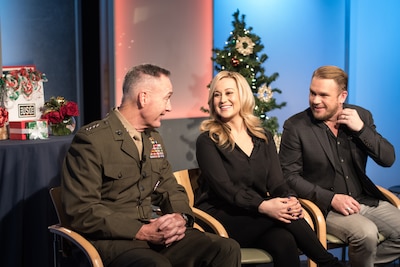
Marine Corps Gen. Joe Dunford, chairman of the Joint Chiefs of Staff, country music artist Kellie Pickler, and Pickler’s husband, country music songwriter Kyle Jacobs, speak between television and radio interviews at the National Press Club in Washington about their USO Tour to the Middle East to visit troops for the holidays, Dec. 23, 2016. DoD photo by Army Sgt. James K. McCann
Saying Thanks
The USO troupe is a way to say thanks to the service members and show them Americans remember and appreciate their sacrifices, the chairman said.
“During the holidays, everyone wants to be with their families,” Dunford said. “But there are families of blood – moms, dads, wives, husbands, kids – and there is the family that grows in units.
“If you are in a unit, that’s your family, too,” he continued. “If you can’t be with your blood family, the next best group of people to be with is your unit. It’s your family away from home.”
USO CEO and President J.D. Crouch II also is accompanying the troupe. He said he had no trouble getting performers for the holiday tour. “Kellie and Kyle immediately said yes,” he said. “They were on board from the start. Jeff, Robert and Gail also cleared their schedules in record time to be a part of this.”
Important Trip
Troxell said the troupe coming during the holidays is incredibly important, because service members are in tough places, superbly doing what needs to be done to further the campaign plan against ISIL.
A 1st Infantry Division soldier sings "Tough" with Kellie Pickler during a Dec. 24, 2016, Christmas Eve USO show at Union 3 in Baghdad, Iraq. Marine Corps Gen. Joe Dunford, the chairman of the Joint Chiefs of Staff, brought the show to Iraq to thank service members for their efforts and sacrifices during the holidays. DoD photo by Jim Garamone
“They are keeping America safe,” he added. “It’s a way to tell them that their service is appreciated. The chairman and I really wanted to come spend Christmas with those who are really getting after the defense of our country -- that’s those who are serving in harm’s way.”
Dunford and Troxell both have been in the shoes of the service members they are visiting, missing numerous Christmases with their families doing the nation’s business. Dunford said he has missed four or five Christmases at home just since 2001.
Troxell recalled the first Christmas he missed when he was assigned to the 82nd Airborne Division at Fort Bragg, North Carolina. “I left the house on the morning of 19 December 1989 and told my wife I would see her at noon to take her shopping,” he said. “I didn’t show back up until Jan. 11. I got alerted, marshaled, deployed, and parachuted into Panama City. That was the first one of many Christmases missed.” 

Wednesday, August 24, 2016

Marine General Dunford Details Implications Of Today’s Threats On Tomorrow’s Strategy


Jim Garamone at the DoD News offers the below piece:

FORT McNAIR, D.C., Aug. 23, 2016 — National security leaders must be able to confront today’s threats, and they must develop and maintain the personnel, strategies and equipment needed for an ever more uncertain world, the chairman of the Joint Chiefs of Staff told the new class at the National Defense University today.

Marine Corps Gen. Joe Dunford also shared with the members of the class of 2017 his thoughts on the strategic landscape, and the implications to the joint force.

Dunford agrees with assessments that the world is in the most uncertain time since the end of World War II. Still, the U.S. military “is recruiting and retaining quality people,” the chairman said.

“Across the board,” he added, “they are focused. They are committed. They are high quality.”

There are signs of wear in some military specialties and Dunford cited a pilot shortage and the near constant deployments of special operators and other small, but crucial specialties, specifically. But, he noted the closer to a combat environment, the higher the morale.

Assessing Risk

“In the environment we are in today, with the complexity and volatility and variety of challenges we have, how do we assess risk?” he asked. “How do we assess the capabilities or capacities that must exist in the joint force? A part of this is also how to prepare for the unexpected.”

The threat baseline, he said, is four-plus-one: Russia, China, Iran, North Korea and violent extremism. Four are nation states that can cause varying degrees of concern. The fifth threat, terrorism, can flare up in any part of the world.

“We use those four state actors and one nonstate actor … to get an appreciation for where is the force relative to where it needs to be,” Dunford said.

He addressed each of the threats starting with the campaign against the core of the Islamic State of Iraq and the Levant in Iraq and Syria. The military campaign against core ISIL is going well, he said. Iraqi security forces have proved in Fallujah and Ramadi that they can take on ISIL and win. They have set the stage for the battle against the terror group in Mosul -- Iraq’s second-largest city and the largest city anywhere under ISIL control.


Fighting ISIL in Iraq

Now, he said, “it is no longer the military campaign that is going to be the determining factor in the success in Iraq. The interactions of governments in Iraq, the role of Shia militia forces, the relationship of the Peshmerga in the north with the Shia and government -- all those things have to be sorted out.”

Meanwhile, the United States is supporting 14,000 Arab fighters and upwards of 30,000 Kurds during the counter-ISIL campaign in Syria, said Dunford, who noted there’s been much ground retaken there from ISIL.

ISIL in Libya

ISIL is not limited to Iraq and Syria and the United States is helping government forces in Libya strike at ISIL in Sirte, Dunford said. The U.S. needs to eliminate the group from the region for ISIL in Libya could be the headquarters for the group throughout Africa and for attacks into Europe, he said.

Dunford said the counter-ISIL campaign in Libya is making progress. “The trajectory that ISIL was on in Libya in January and February was concerning to me, but it is less so today,” the chairman said.

ISIL is also in Afghanistan, West Africa and is trying to gain adherents in Southeast Asia. The United States will confront the group wherever it goes, Dunford said.

The chairman discussed the capabilities that Russia and China are developing. “When I look at Russia, they are modernizing their nuclear enterprise, they are modernizing their submarine force, they are modernizing their conventional capabilities,” he said. All this is being done, he said, despite significant demographic and economic challenges facing Russia.

The U.S. competitive advantage in many of these areas is getting smaller, the chairman said.

Russian Actions

Dunford said he’s concerned about Russia’s behavior, including its annexation of Crimea, its actions in Eastern Ukraine, it threats to Georgia and Moldova, and its aid to Syria.

Russia is engaging in these actions in an attempt, Dunford said, to “undermine the most successful alliance in history -- the NATO alliance.”

He added: “From a U.S. perspective, I would tell you I believe our center of gravity as a nation, through a security lens, is the network of alliances. Russia is trying to erode that.”
Russia and China are separately concentrating on anti-access, area denial strategies, but for similar ends, the chairman said.

The Question of China

China is a bit more opaque, Dunford said. China has invested significant sums in building up its military, including its nuclear enterprise. Its actions in the South China Sea are cause for concern to the United States, the chairman said.

Meanwhile, Iran is trying to spread its influence across the Middle East, he said, and must be carefully monitored. And, the chairman said, North Korea is still building nuclear capabilities and intercontinental missiles and is the most unpredictable nation on the list.
All these risk assessments have implications for the joint force. The first, Dunford said, is the United States must have balanced capabilities. “In other words, we have to have capabilities that range from the nuclear down to conventional and special operations capabilities,” he said. “We as a nation with the challenges out there cannot afford not to have a robust capability.”

Another implication is the United States has to do better at integrating all aspects of the government into strategy and integrating allies and partners into plans, the chairman said.
Finally, the chairman believes any disagreement has the potential to grow to a transregional, multi-domain conflict. 

He cited the example of North Korea. In the 1990s, it was possible that if the armistice broke down, the conflict could be limited to the Korean Peninsula. With ballistic missiles, the cyber threat and conventional attacks, any conflict with North Korea would soon escalate to include the rest of U.S. Pacific Command, U.S. Northern Command, U.S. Strategic Command and U.S. Cyber Command.


This calls for a much greater degree of strategic integration in the future, Dunford said. The decision-making processes need to be streamlined, and leaders need a common operational picture. All this requires a strategic framework to build the plans for global operations.