Showing posts with label Francis Ford Coppola. Show all posts

Friday, December 31, 2021

Leave The Gun, Take The Cannoli: My Washington Times On Crime Column On The Making Of 'The Godfather'

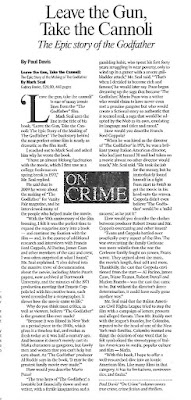
 The Washington Times published my On Crime column on the making of The Godfather.  

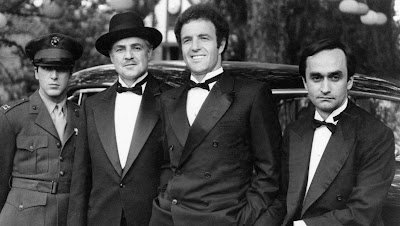
“Leave the gun, take the cannoli” is one of many iconic lines from the “The Godfather” film.

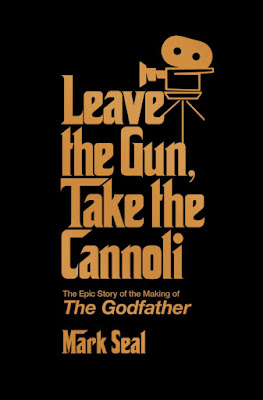
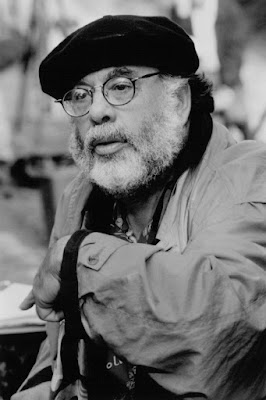
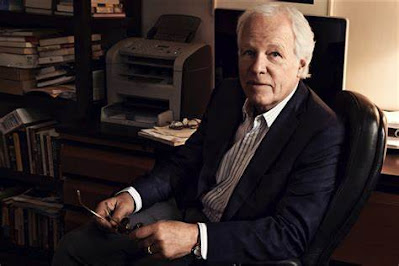
Mark Seal (seen in the bottom photo) uses the line in the title of his book, “Leave the Gun, Take the Cannoli: The Epic Story of the Making of The Godfather.” The backstory behind the near-perfect crime film is nearly as dramatic as the film itself.

I reached out to Mark Seal and asked him why he wrote the book.

“I have an almost lifelong fascination with the movie, which I first saw as a college freshman on spring break in 1972,” Mr. Seal replied.

He said that in 2009 he wrote about the making of “The Godfather” for Vanity Fair magazine, and he interviewed many of the people who helped make the movie.

“With the 50th anniversary of the film looming, I felt it was the perfect time to expand the magazine story into a book — and continue my fixation with the film — and, in the course of additional research and interviews with Francis Ford Coppola, Al Pacino, James Caan and other members of the cast and crew, I was often surprised at what I found,” Mr. Seal explained. “I also delved into the massive trove of documentation about the movie, including Mario Puzo’s papers, now archived at Dartmouth University, and the minutes of the 1971 production meeting that Francis Coppola led with his creative team, each word recorded by a stenographer. It shows how the movie came to life.”

Why do you think most critics, as well as viewers, believe “The Godfather” is the greatest film ever made?

“Because it was filmed in New York as a period piece in the 1940s, which gives it a timeless feel, andand makes as fresh today as it was half a century ago. And because it doesn’t merely cast its Mafia characters as gangsters, but family men and women that you can’t help but care about. As ‘The Godfather’ producer Al Ruddy says in the book, ‘It may be the greatest family movie ever made.’” 


You can read the rest of the column via the below link or below:

https://www.washingtontimes.com/news/2021/dec/30/book-review-leave-the-gun-take-the-cannoli-the-epi/

Thursday, December 12, 2019

The True Stories Behind 'The Godfather' Novel And Films


Eudie Pak at Biography.com offers a piece of the real-life people and events that inspired Mario Puzo’s The Godfather novel and the Francis Ford Coppola Godfather films.

Based on Mario Puzo's 1969 crime novel of the same name, Francis Ford Coppola's cinematic masterpiece The Godfather (1972) chronicles the fictional Corleone family and its rise to becoming one of the most powerful mafia families in America. 


Starring Marlon Brando as Vito Corleone and Al Pacino as his son Michael, The Godfather was lauded by both critics and audiences alike and spawned a pair of sequels: The Godfather II (1974) and The Godfather III (1990).

The Godfather franchise is heavily influenced by many real-life mobsters and events. Here are some of the true stories behind the films:

Real-life mobsters and entertainers served as inspiration for the characters

Vito Corleone was inspired by Frank Costello. 


You can read the rest of the piece via the below link: 

https://www.biography.com/news/godfather-true-stories-books-movies


You can also read my Washington Times review of The Godfather: 50th Anniversary Edition via the below link: 

www.pauldavisoncrime.com/2019/04/my-washington-times-review-of-mario.html


And you can read my Crime Beat column, Goodfellas Don’t Sue Goodfellas, which covers The Godfather, Goodfellas, organized crime and the Philly mob via the below link:   

www.pauldavisoncrime.com/2011/09/goodfellas-dont-sue-goodfellas-look.html 


Monday, April 8, 2019

My Washington Times Review Of Mario Puzo's 'The Godfather: 50th Anniversary Edition'


The Washington Times published my review of Mario Puzo’s The Godfather: 50th Anniversary Edition.

Mario Puzo’s novel “The Godfather” became one of the best-selling novels in publishing history in 1969, and the novel continues to sell well today, perhaps due in good part to new generations of readers who flock to the novel after viewing director Francis Ford Coppola’s classic films that were based on Mr. Puzo’s novel.

Now, 50 years later, “The Godfather: 50th Anniversary Edition” has been released. The new edition offers an interesting introduction by Francis Ford Coppola, who recalls his collaboration with Mario Puzo on the screenplay for the film.

The powerful and compelling story of Vito Corleone, a New York Italian-American organized crime boss, and his three sons — Sonny, Fredo and Michael — can be described as almost Shakespearian. Between the successful novel and the classic films, the epic story of the Corleone family is perhaps better known to most Americans than Shakespeare’s tragedies.

Although highly romanticized, “The Godfather” is a fine fictionalized study of organized crime’s history in America. Nearly all the major events in the Mario Puzo novel (and the films) were based on true events in crime history.

You can read the rest of the review via the below link:

https://www.washingtontimes.com/news/2019/apr/8/book-review-the-godfather-50th-anniversary-edition/


Saturday, March 2, 2019

A Look Back At Mario Puzo, The Author Of The Classic Crime Novel, 'The Godfather'


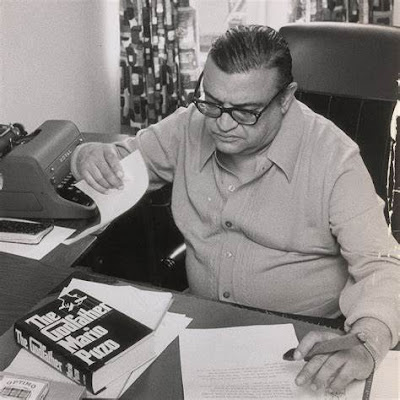
Mario Puzo, a writer and WWII veteran (seen in the above photo), was broke and deep in dept. He had written two fine novels, The Dark Arena and The Fortune Pilgrim, but the two novels made him little money.

The Fortune Pilgrim, a novel about a struggling Italian-American family in New York, had a mobster as one of its characters, and Puzo's publisher suggested that his next novel be a blockbuster about organized crime.

So Mario Puzo went on to write what he hoped would be a best-seller about the mob so he could make some serious money. The Godfather was the novel.

Puzo's The Godfather has some awful Harold Robbins-type trashy stuff in it, yet there was mostly a grand Cosa Nostra story and some fine writing as well. (Thankfully, Mario Puzo and Francis Ford Coppola left the trashy parts out of the screenplay and film).

And the rest, as they say, was history.


After reading The Godfather and viewing the great film, I bought and read Mario Puzo's interesting book about the making of the novel and the film, The Godfather Papers: And Other Confessions.  

Reed Tucker at the New York Post offers a piece on Mario Puzo and his classic crime novel.

You can read the piece via the below link:

https://nypost.com/2019/03/02/how-mario-puzo-penned-the-godfather-to-get-out-of-debt-and-made-bank/

Tuesday, January 22, 2019

A Little Night Music: The Godfather Orchestral Suite (Live) By The Danish National Symphony Orchestra


Director Francis Ford Coppola's The Godfather and The Godfather Part II, based on Mario Puzo's novel, are near perfect films that I and many others can watch over and over again.

One of the reasons to watch the films over and over is Nino Rota's beautiful, evocative, majestic and haunting soundtracks for the two films.

You can watch and listen to the Danish National Symphony perform The Godfather Orchestral Suite live via the below link:

https://www.youtube.com/watch?v=X-jdl9hcCeg

Saturday, November 18, 2017

Sicilian Town Of Corleone Had Long, Bloody Past Before "Godfather" Fame


Back in 1975 I was a student of crime, an aspiring crime writer and a sailor stationed on a U.S. Navy tugboat at the American nuclear submarine base at Holy Loch, Scotland.

Undecided if I wanted to go home to the USA or stay in the Navy and get stationed in Italy, I visited Naples, Italy and Palermo, Sicily before I made my decision.

Being half-Italian on my mother's side, I wanted to see where the Guardino clan came from in Sicily. And having read Mario Puzo's The Godfather several times and having seen Francis Ford Coppola's The Godfather and The Godfather, Part Two films several times, I simply had to visit the Sicilian town of Corleone.

I spent a day in Corleone, a quaint and quiet town that belies its' rich history of blood, murder and organized crime. Corleone is the town where The Godfather’s fictional Vito Corleone came from, and Corleone was also the town where true-life Cosa Nostra bosses, such as Salvatore "Toto" Riina, also came from.

I enjoyed my time in Naples, Palermo and Corleone, but I decided to leave the Navy and go home.


The San Francisco Chronicle offers a piece on today’s Corleone.

CORLEONE, Sicily (AP) — Corleone is a Sicilian medieval hill town whose bloody past began generations before "The Godfather" novels and films borrowed its name for a fictional Mafia don.

It is the birthplace of several convicted real-life Mafia bosses, among them Salvatore "Toto" Riina, the reputed "boss of bosses," who died Friday at 87 in a prison ward of a northern Italian hospital.

Corleone has witnessed recent signs of rebellion against an entrenched Mafia culture where religious pageants pay tribute to reigning mob bosses, with processions stopping outside the dons' homes.

A town square is named after two top anti-Mafia magistrates slain by Cosa Nostra bombings in 1992. Inaugurated in 2000, an anti-Mafia museum, together with the International Center for Anti-Mafia documentation, also educates visitors about the fallen heroes in the war against the Sicilian crime syndicate.

When native son Riina was arrested in 1993 in Palermo, schoolchildren ran into Corleone's streets in joy, rallying behind a banner that read "Finally" — their jubilation a reflection of a new and burgeoning resistance to the Mafia by a younger generation of Sicilians.

But the Mafia's grip on the town isn't easily removed.

Thursday, August 11, 2016

Italian Government: Corleone's City Hall Is Mafia-infested


While serving on a U.S. Navy harbor tugboat at the nuclear submarine base at Holy Loch, Scotland in 1975, I traveled to Sicily on vacation.

Being part-Italian on my mother's side, and as a student of crime since my early teens, I was curious to see the town of Corleone. Corleone, wrongly or rightly, is a town associated mostly with Cosa Nostra, Sicily's infamous organized crime group.

Prior to my trip to Sicily, I'd read a good number of travel and historical books on the island, as well as on Cosa Nostra, and of course I'd read the Mario Puzo novel, The Godfather. I also watched the first two films based on Puzo's novel a few years prior to my trip.

Corleone is the town that writer Mario Puzo used famously for his Godfather novel and he gave the name of the town to his main character. Film director Francis Ford Coppola also used the name of the town in his film series, but he filmed scenes in different towns in Sicily.

Hiring a car and driver in Palermo, I was driven through the beautiful countryside to Corleone and then given a tour of the picturesque Sicilian town with a dark and violent history. The people were warm, friendly and open, although the town held many criminal secrets, then and now.

It was an interesting day that I can still recall vividly.


The British newspaper The Telegraph offers a piece on how Corleone remains plagued by organized crime.        

The Italian government believes Mafiosi have infiltrated the local administration of Corleone, the Sicilian town which inspired the fictional crime clan's name in "The Godfather"novel and movie.
Premier Matteo Renzi's Cabinet on Wednesday dissolved Corleone's municipal government and put its City Hall under temporary control of the interior ministry.
Interior Minister Angelino Alfano had proposed the action. Corleone's mayor also voiced worries about Mafia infiltration.
Using intimidation, Sicily's Cosa Nostra frequently influences decisions and public contract bidding or backs local politicians sympathetic to the Mafia's economic interests.
You can read the rest of the piece and watch a video via the below link:

http://www.telegraph.co.uk/news/2016/08/10/italian-government-corleones-city-hall-is-mafia-infested/

You can also read an earlier post on the Sicilian Cosa Nostra via the below link:

http://www.pauldavisoncrime.com/2016/07/the-real-godfather-true-story-of.html

Tuesday, March 15, 2016

From Bestseller To Blockbuster, A Look Back at 'The Godfather' - Today in 1972, Francis Ford Coppola's Film 'The Godfather', Based On The Mafia Epic By Mario Puzo, Premiered. Here's A Look At How The Book Became A Hollywood Classic.


Robert Cashill at Biography.com offers a look back at the The Godfather novel and film.

“Behind every successful fortune—there is crime.” Mario Puzo, The Godfather (1969)
Mario Puzo grew up in New York’s Hell’s Kitchen. As a young writer he knocked around hardboiled men’s magazines, penning war stories. In his mid-40s, he wasn’t getting any younger, and with a wife and five kids to feed, and two flop novels behind him, he accepted a modest advance to write a third. It was based on stories he heard on the street. The author of the book most beloved by wiseguys had never met a gangster.
The Godfather proved a sensation, as a book and as a movie, released today in 1972. Puzo had no illusions about a novel that through the decades has sold more than 30 million copies. “I was 45 years old, I owed $20,000 to relatives, finance companies, banks and assorted bookmakers and loan sharks. It was really time to grow up and sell out,” he recalled.
Filmmaker Francis Ford Coppola was also in hock. He’d won an Oscar for co-writing 1970’s Best Picture winner, Patton, but the four features he’d directed, including the intimate drama The Rain People (1969), had a much lower profile in Hollywood. Unhappy with Tinseltown, he and fellow filmmakerGeorge Lucas opened a more experimental outfit, American Zoetrope, in San Francisco in 1969. Coppola borrowed $300,000 from Warner Bros. for his dream studio, and Lucas made his directorial debut with its first film, the downbeat science fiction story THX 1138 (1971). When it tanked, Warner Bros. wanted its money back. At 32, Coppola was at a crossroads.
You can read the rest of the piece via the below link:

http://www.biography.com/news/the-godfather-movie-facts


Friday, March 16, 2012

40th Anniversary Of The Classic Film 'The Godfather'

 
ABCNews.com reports that today is the 40th anniversary of the classic film The Godfather.

Today marks the 40th anniversary of what many consider to be one of the greatest films ever made: “The Godfather.”

Based on the book of the same name by author Mario Puzo, the film, originally released March 15, 1972, starred Marlon Brando as Don Vito Corleone, a leader of a Mafia family in 1940s New York. It was his character that uttered the famous line, “I’m going to make him an offer he can’t refuse.”

You can read the rest of the piece via the below link:

http://abcnews.go.com/blogs/entertainment/2012/03/40th-anniversary-of-the-godfather/ 

Note: I still believe Ernest Borgnine would have been a better choice to portray Vito Corleone. Borgnine is Italian, speaks Italian, and he would not have had to stuff his face with cotton and used heavy makeup like Brando. He was a great comedic actor - I loved him in McHale's Navy - but watch him in Marty, From Here To Eternity and Bad Day At Black Rock and you will see how fine an actor Borgnine was.