In 1963 an impressionable 11-year-old
boy attended a Saturday afternoon showing of Dr No at the
Colonial movie theater in South Philadelphia. I've been an admirer of Ian
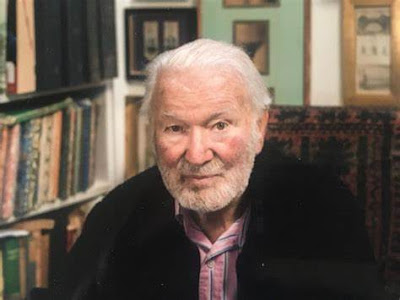
Fleming (seen in the below photo) ever since that initial film viewing.
The first nine books in my now extensive library were Fleming's and many of my
lifelong interests such as travel, crime and espionage were all sparked by
Fleming. As a teenager, I was fascinated by Fleming’s use of exotic locales,
women and villains in the stories.
Many years later, I was
thrilled to have been able to spend a week with my wife at Goldeneye, Fleming’s
villa in Oracabessa, Jamaica. Fleming wrote all of the James Bond novels at this
cliff top villa that overlooks the Caribbean Sea.
Fleming had steps carved out of the cliff, which lead down to a private beach
and a small cave. Like Fleming, I went free diving in the cove, and I worked at
Fleming’s original Jamaican Blue Mahoe writing desk.
The staff at the villa
included a wonderful woman named Violet, who was Fleming’s original
housekeeper, and Ramsey, who worked for Ian Fleming when he was a teenager. The
Jamaicans knew Fleming as "the Commander," his naval rank when he
first visited Jamaica.
When I asked Violet about Fleming, she had tears in her eyes when she
replied, "The Commander was a good man."
It was truly a dream vacation for a Fleming aficionado.
As an aficionado, I was quite pleased to discover that Penguin’s Modern
Classics re-released the complete set of 14 James Bond novels in April, marking
the fiftieth anniversary of one of fiction's most enduring characters. Casino
Royale, Ian Fleming's first James Bond thriller, was completed in
1952, the year I was born, and published in 1953.
In the publishing of the Fleming novels in hardback, paperback and Audi book,
Penguin praised Fleming’s work, noting that the novels were immediately
recognized as classic thrillers by his contemporaries Kingsley Amis, Raymond
Chandler and John Betjeman.
"Fleming was able to peer beyond the Cold War limitations of mere spy
fiction and to anticipate the emerging milieu of the Colombian cartels, Osama
bin Laden and, indeed the Russian Mafia, as well as the nightmarish idea that
some such fanatical freelance megalomaniac would eventually collar some
weapons-grade plutonium," Christopher Hitchens wrote in his introduction
to the newly released novels.
With the books back in print, my hope is that they will gain a new generation
of readers who only know the James Bond character from the hugely successful
film series. The twentieth Bond film will be coming out this November.
Although I loved Sean Connery’s portrayal of James Bond in the early films, the
series has sadly transformed from thrillers with a few humorous asides to
action-comedies and later turned to camp and self-parody. After Roger Moore
finally gave up the role to Timothy Dalton, and then to Pierce Brosnan, the
films have thankfully returned somewhat to being thrillers.
It seems to me that with each film after Goldfinger the producers
tried to top the previous Bond film in stunts, gadgetry and outlandishness.
Like most of Fleming’s faithful readers, I wish the films had followed the
novels more closely. The books, which have sold more than 60 million copies
worldwide, have little connection to the current James Bond films other than
the use of the character. To many who only know the films, James Bond is no
better than a comic book character.
Ian Lancaster Fleming often told friends that he was going to write "the
spy story to end all spy stories."
He was born in London, England on May 28th in 1908. Fleming’s father, Major
Valentine Fleming, was killed in France in 1917 during the First World War
shortly before Ian’s ninth birthday.
Fleming attended Eton, Sandhurst and the Universities of Geneva and Munich. In
his twenties, he worked as a correspondent for Reuters News Agency and he was
dispatched to the Soviet Union in 1933 to cover the famous spy trial of six
British engineers who worked for Metropolitan-Vickers.
He later worked as a stockbroker until the start of WWII when he became the
personal assistant to the director of Naval Intelligence, Admiral John Godfrey.
Royal Navy Commander Ian Fleming worked out of Room 39 at the Admiralty for the
course of the war.
Fleming accompanied Godfrey to the U.S. to establish closer relations and he
met with J. Edgar Hoover and William Stephenson, who was "The Man Called
Intrepid." He visited Camp X in Canada where allied spies and commandos
were being trained. Much of his wartime experience would find their way into
his books.
On another naval intelligence mission in 1942 he ventured to Jamaica to meet
with his American counterparts over concerns about German U-Boat in the
Caribbean. He fell in love with the tropical island and bought an old donkey
racetrack and built a house there he called Goldeneye.
After the war, Fleming returned to journalism and became the foreign manager
for the London Sunday Times. A long-time bachelor and
"womanizer" like his James Bond character, he finally married Ann O’
Neill. He often told reporters that he wrote the books to get over the shock of
getting married at the age of 42.
Each year he spent the months of January and February at Goldeneye,
where he wrote that year’s James Bond novel.
Not that it matters, as Ian Fleming himself wrote in the introduction to From
Russia With Love, but much of the background material in his books was
accurate.
He was a journalist and intelligence officer before he became a novelist, so
his books contain a good deal of what he called "incidental
intelligence."
From the practices of voodoo in Live and Let Die, to genealogy
in On Her Majesty's Secret Service, his books explained in detail a
wide variety of subjects. He also richly described places, products and events,
which added authentic touches to his stories.
Although Fleming has been criticized for creating unbelievable villains like
Ernst Stavro Blofeld and Dr. No, one should stop and consider real life
villains Martin Bormann, Al Capone, Idi Amin and Saddam Hussein.
Or consider Manuel Noriega, a tin-pot dictator who was involved in
international drug operations, believed in witchcraft and wore red bikini
underwear for protection from his enemies.
Top that, Mr. Goldfinger.
In a 1964 Playboy magazine interview, Fleming said that Bond
was a man of action, a cipher, and simply a blunt instrument in the hands of
the government. But Fleming also infused the character with some of his own
"quirks and characteristics."
He said he wanted Bond to be entirely an anonymous instrument and let the
action of the book carry him along. He wanted the character to more or less
follow the pattern of Raymond Chandler’s or Dashiell Hammett’s heroes –
believable people, believable heroes.
"He’s sort of an amalgam of romantic tough guys, dressed in 20th Century
clothes, using 20th Century language," Fleming told Playboy.
"More true to the type of commandos and secret service men than to the
heroes of ancient thrillers."
The double O license to kill was a fictional device to make Bond’s job more
interesting. He said he got the idea of the double O from the Admiralty, which
at the beginning of the war used the double O prefix on all of its top-secret
signals.
Bond battled SMERSH, which was a contraction of Smert Shpionam,
meaning Death to Spies. SMERSH was a real Soviet counterintelligence group that
hunted and executed anti-Soviet spies during WWII.
In the later books Bond took on SPECTRE – The Special Executive for
Counterintelligence, Terrorism, Revenge, and Extortion. SPECTRE was an
international crime organization that contained elements of SMERSH, the Gestapo
and international organized crime groups.
He readily admitted his plots were fantastic, yet he said they were often based
on the real world of intelligence. He noted that on occasion a news story would
"lift a corner of the veil" and reveal the real world of spies and
commandos.
Fleming made note of the case of the Russian assassin Captain Nikoly Khokhlov,
who came equipped with an electrically operated gun fitted with a silencer and
concealed in a gold cigarette case. The gun fired bullets tipped in cyanide, which
might lead a pathologist to rule the cause of death to be heart failure.
"I can trace most of the central incidents in my books to real
happenings," Fleming wrote in a magazine article. "The line between
fact and fiction is a very narrow one."
Fleming would often dismiss his books as mere entertainment, but he also said
that thrillers may not be "literature with a capital L," but it was
possible to write what he described as "thrillers designed to be read as
literature."
He went on to say that the practitioners of this form have included Edgar Allen
Poe, Dashiell Hammett, Raymond Chandler, Eric Ambler and Graham Greene. He said
he saw nothing shameful in his aiming as high as that.
Fleming died in August of 1964 when he was 56. He did not live to see the
film Goldfinger, which was released later that year. He died of a
heart attack, which his character Darko Kerim in the novel From Russia
With Love described as "the Iron Crab."
Fleming died, as he thought he would, from living too much, and from living too
well.
Most photos of Ian Fleming show him in the last years of his life, but I’ve
always liked an earlier photo of him, where he is standing in his Royal Navy
uniform before a fireplace in Room 39 at the Admiralty.

In this photo (see below) he is young and handsome, with dark hair and a cold
sardonic look on his face. He looks like an awful lot like his character James
Bond.
For more information on Ian
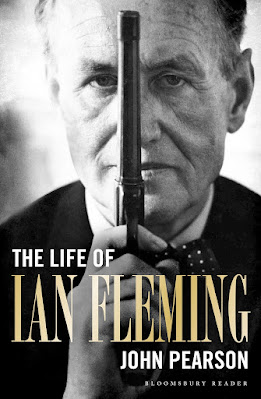
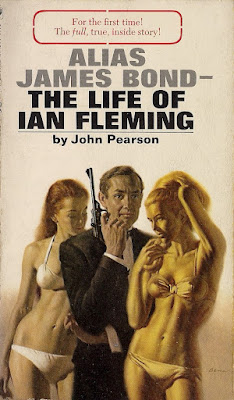
Fleming, you can read "The Life of Ian Fleming by John Pearson
and Ian Fleming: The Man Behind James Bond by Andrew Lycett.
And course you must read the James Bond novels:
Casino Royale
Live and Let Die
Moonraker
Diamonds are Forever
From Russia With Love
Dr No
Goldfinger
For Your Eyes Only
Thunderball
The Spy Who Loved Me
On Her Majesty’s Secret Service
You Only Live Twice
The Man With The Golden Gun
Octopussy and The Living Daylight
Note: The above column originally appeared in the Orchard
Press Online Mystery Magazine in 2002.