Friday, November 5, 2021

My Q&A With Former Navy SEAL Benjamin H. Milligan, Author of 'By Water Beneath the Walls: The Rise of the Navy SEALs'

 Counterterrorism magazine published my Q&A with Benjamin H. Milligan (seen in the below photos), a former Navy SEAL and the author of By Water Beneath The Walls: The Rise of the U.S. Navy SEALs.


You can read the interview via the above and 
below pages or the below text: 


IACSP Q&A With Former Navy SEAL Benjamin H. Milligan, Author of “By Water Beneath the Walls: The Rise of the Navy SEALs

Benjamin H. Milligan became a US Navy SEAL in 2001 and served until 2009. He is the author of “By Water Beneath the Walls: The Rise of the U.S. Navy SEALs.”

Milligan received a Bronze Star and other awards while serving as a SEAL. A native of Indianapolis, he received a BA in History at Purdue University and an MA in International Relations at the University of San Diego.

the U.S. Special Operations Command, said the book was “deeply researched, well organized and incredibly engaging… This is our legacy with all the warts, the challenges, and the heroics in one concise volume.”

Benjamin H, Millgan was interviewed by Paul Davis.

IACSP: I read and enjoyed your book. I’ve interviewed a good number of SEALs and I’ve read a good number of books on the SEALs, but I like the way you put your book together, showing chronologically how American special operations groups came and went and how all contributed and led to the development of the modern Navy SEALs.

I was especially interested in your coverage of the Underwater Demolition Teams (UDT) in World War II, as my late father, Edward Miller Davis, was a chief in UDT 5, and Draper Kauffman, the founder of UDT, was his commanding officer. My father is mentioned briefly in Douglas Fane’s book, “The Naked Warriors.”

Milligan: That was probably my hardest chapter to write. One of the more fun things I got to go through Draper Kauffman’s personal papers. They were at his daughter’s house. I spent a day or two going through multiple file cabinets with papers her dad saved.

IACSP: There have been many books written on the history of special operations and the Navy SEALs. How does your book differ from those other books? How would you describe your book?

Milligan: My book is not a comprehensive history of the SEAL teams. It asked a question about the SEAL teams – how did this happen? I don’t think that anyone would have predicted that a naval special operations unit would be as land focused as the SEAL teams are, or that a Navy unit would have been selected to go kill Osama bin Laden in Central Pakistan. I never understood why this had come to be, so that is what the book was trying to solve.

In order to explain how that happened, you can’t just look at the Navy’s experience in special warfare, you have to look in context. You have to understand why the Army and Marine Corp kind of turned up their noses at that mission for such a long time and allowed the Navy to move into that gap. I think of the book as not necessarily a history, but so more of a biography. I try to treat naval special warfare (NSW) as a character. But like every good biography, you’re not just learning about the character, you’re also learning about the time. I took this opportunely not just to tell the history of the SEAL teams, the reason the SEAL teams exist, but to showcase all these other units who were contributing to it.

IACSP: What sparked your interest in this? Why did you write the book?

Milligan: I wanted to put some context around this thing. This had been a monumentally important experience in my own life, personally. I felt like the SEALs community deserved this. I wanted the teams to have this history and I didn’t see anyone else doing it. Part of the reason was I saw a gap in the scholarship that was out there and part it was I was absolutely obsessed with getting the answer to this. It turned into a ten-year obsession.

IACSP: For the benefit for those who have not yet read the book, would you explain what the title, “By Water Beneath the Walls” means?

Milligan: The title was one of the hardest things to come up with. When I started the book, the working title was “The Evolution,” which is a metaphor for how the theme of this drastic transformation the Navy special operation teams went through, to go from the sea to the land. But the more I looked at this history, the more I realized that title just didn’t work. Evolution is sort of inevitable, it’s mindless, and survival of the fittest. The more I learned about this history, the more I realized there were individuals who either decided that the Navy was going to move into this direction, or that the Army wasn’t going to move in this direction. There was nothing inevitable. It was very decisive. At every fork in the road, the Navy seemed to always pick the path that was leading them towards the greater contribution ashore.

When I finally had the whole book finally laid out in front of me, I thought what was a great underdog story, if not Justinian the II’s raid on Constantinople? They used an unguarded aqueduct. The walls of Constantinople are almost like the walls of the Army and the Marine Corp, keeping the Navy from gaining access to this mission. But ultimately, the Navy used the water to springboard themselves ashore.

IACSP: It’s an intriguing title. As you note in the book, all of the special operations groups from WWII and Korea were disbanded except for UDT. How did UDT survive?

Milligan: They were the only one that proved themselves to be indispensable to their branch of service. Every special operations unit in the Army had been by the end of it, deemed to be, not superfluous, but most commanders felt that a regular infantry unit, if well-trained, could perform the same missions. The same with the Marine Corps. Where the UDTs were distinct was the Navy could not operate without them. The Navy wouldn’t go anywhere unless they had their own on-call reconnaissance and demolition troops. I should empathize, reconnaissance, because demolition was secondary to UDT. It is recon, recon, recon. The reason that the Navy wanted their own unit was because the Marine Corp had over the years become more autonomist. Yes, they were still Department of the Navy, but as far as the order of battle in the U.S. military went, they had an equal status as the Navy. The reason the UDTs were kept around is because the fleet can’t operate without them.

IACSP: How did the SEALs go from coastal commandos to jungle fighters in Vietnam?

Milligan: When the SEAL teams were created, the Navy didn’t give them a mission statement. They had a vague idea what their job was going to be, and that vague idea was something like the UDTs were at the tail end of the Korean War, which was coastal raiders. When they create them, sort of maritime rangers, almost. But when they get to Vietnam in 1966, they corner them in this little pocket of swamp territory called the Rung Sat Special Zone, and there are no train tunnels or command posts. The SEAL teams almost self-deselect out of the mission. Their commander didn’t recognize any of the things they were trained to do, so he essentially tells his men to stand down. The SEAL teams eventually found their footing. What it came down to was the Navy’s bias for action. They moved to the Mekong Delta and stayed engaged. It takes a couple of enterprising folks, but they eventually learn how to do this capture/kill operation.

IACSP: The book has so many stories and features so many interesting characters. If you had to name three figures who most influenced the development of the SEALs, who would you name?

Milligan: The Chief of Naval Operations Admiral Arleigh Burke is the indispensable character in the creation of the SEAL teams. The SEAL teams would not have happened without him. The myth that the SEAL teams came about due to enterprising frogmen who were continuing pushing the envelope of amphibious warfare towards the shore and when President Kennedy came along, he caught wind of this and he authorized the establishment of the SEAL teams, That’s wrong. It didn’t happen that way. Arleigh Burke was the one pushing the Navy into unconventional operations and into creating the SEAL teams.

After Burke, the next indispensable character is probably Phil Bucklew. He is the vessel of naval special warfare history. He’s been there since the beginning. He was with the Scouts and Raiders; he had a hand in preserving the NCDUs at Omaha Beach. He went to China and lead guerillas. He went to Korea, and he was an ever-present advocate of unconventional Navy operations. And he became the commander of West Coast UDTs and SEALs. He’s the one that not only writes the Bucklew Report, the survey assessment that ultimately commits the Navy to a riverine war in Vietnam, he’s the person in charge when the Navy is trying to kick the SEALs out of Vietnam.

If I had to pick a third, it would be a toss up between Bob Wagner and Bob Gallagher. The two Bobs. Bob Wagner was a wheeler-dealer that convinced the CIA to let the SEALs run the PRO program. The other person is Bob Gallagher, who is relentless. He is the archetypal SEAL chief. He is the SEAL chief everyone should aspire to be. He was constantly pushing Second Platoon to do more. He taught the SEAL teams how to fight.

IACSP: I read that Admiral Howard, the commander of the Naval Special Warfare Command, is shifting the SEALs focus from counterterrorism operations to global threats from nation states. They are going back to sea. That’s his expression. Is this a good thing, in your view?

Milligan: To say the Navy is going to shift back to the water is not a totally genuine way to describe it. I don’t think that what Howard is saying is anyway wrong. With the great power adversaries, the Navy has a lot more opportunities for involvement. I think that this is a natural transformation that the Navy will have to make.

IACSP: Of course, this might change with an increase in terrorism with the fall of Afghanistan.

Milligan: Yes, it might light back up again. I didn’t serve in Afghanistan, I served in Iraq, but I think there was much that could have been done better in Afghanistan. It was a gut-punch. Watching what was happening in Afghanistan was utterly heartbreaking. It was a heartbreaking as what is happening to the Kurds.

IACSP: Thank you for your service and thank you for speaking to us.


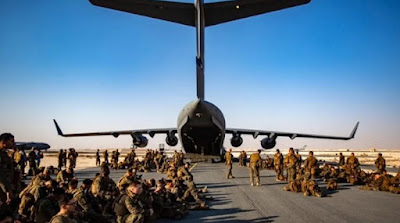
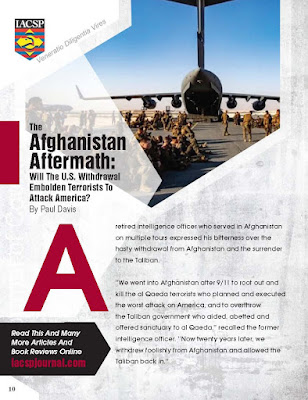
Afghanistan Aftermath: Will The U.S. Withdrawal Embolden Terrorists To Attack America?


Counterterrorism magazine published my piece on the aftermath of the hasty withdrawal from Afghanistan.


You can read the piece via the above and below pages or the below text: 


The Afghanistan Aftermath: Will The U.S. Withdrawal Embolden Terrorists To Attack America?


By Paul Davis

A retired intelligence officer who served in Afghanistan on multiple tours expressed his bitterness over the hasty withdrawal from Afghanistan and the surrender to the Taliban.

“We went into Afghanistan after 9/11 to root out and kill the al Qaeda terrorists who planned and executed the worst attack on America, and to overthrow the Taliban government who aided, abetted and offered sanctuary to al Qaeda,” recalled the former intelligence officer. “Now twenty years later, we withdrew foolishly from Afghanistan and allowed the Taliban back in.”

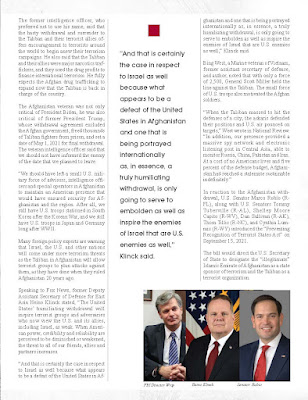
The former intelligence officer, who preferred not to use his name, said that the hasty withdrawal and surrender to the Taliban and their terrorist allies offers encouragement to terrorists around the world to begin anew their terrorism campaigns. He also said that the Taliban and their allies were major narcotics traffickers, and they used the drug profits to finance international terrorism. He fully expects the Afghan drug trafficking to expand now that the Taliban is back in charge of the country.

The Afghanistan veteran was not only critical of President Biden, he was also critical of former President Trump, whose withdrawal agreement excluded the Afghan government, freed thousands of Taliban fighters from prison, and set a date of May 1, 2021 for final withdrawal. The veteran intelligence officer said that we should not have informed the enemy of the date that we planned to leave.

“We should have left a small U.S. military force of advisors, intelligence officers and special operators in Afghanistan to maintain an American presence that would have ensured security for Afghanistan and the region. After all, we still have U.S. troops stationed in South Korea after the Korean War, and we still have U.S. troops in Japan and Germany long after WWII.

Many foreign policy experts are warning that Israel, the U.S. and other nations will come under more terrorism threats as the Taliban in Afghanistan will allow terrorist groups to plan attacks against them, as they have done when they ruled Afghanistan 20 years ago.

Speaking to Fox News, former Deputy Assistant Secretary of Defense for East Asia Heino Klinck stated, “The United States’ humiliating withdrawal will inspire terrorist groups and adversaries who now view the U.S. and its allies, including Israel, as weak. When American power, credibility and reliability are perceived to be diminished or weakened, the threat to all of our friends, allies and partners increases.

“And that is certainly the case in respect to Israel as well because what appears to be a defeat of the United States in Afghanistan and one that is being portrayed internationally as, in essence, a truly humiliating withdrawal, is only going to serve to embolden as well as inspire the enemies of Israel that are U.S. enemies as well,” Klinck said.

Bing West, a Marine veteran of Vietnam, former assistant secretary of defense, and author, noted that with only a force of 2,500, General Scott Miller held the line against the Taliban. The small force of U.S. troops also motivated the Afghan soldiers.

“When the Taliban massed to hit the defenses of a city, the askaris defended their positions and U.S. air pounced on targets,” West wrote in National Review. “In addition, our presence provided a massive spy network and electronic listening post in Central Asia, able to monitor Russia, China, Pakistan and Iran. At a cost of no Americans lives and five percent of the defense budget, Afghanistan had reached a stalemate sustainable indefinitely.”

In reaction to the Afghanistan withdrawal, U.S. Senator Marco Rubio (R-FL), along with U.S. Senators Tommy Tuberville (R-AL), Shelley Moore Capito (R-WV), Dan Sullivan (R-AK), Thom Tillis (R-NC), and Cynthia Lummis (R-WY) introduced the “Preventing Recognition of Terrorist States Act” on September 15, 2021.

The bill would direct the U.S. Secretary of State to designate the “illegitimate” Islamic Emirate of Afghanistan as a state sponsor of terrorism and the Taliban as a terrorist organization.
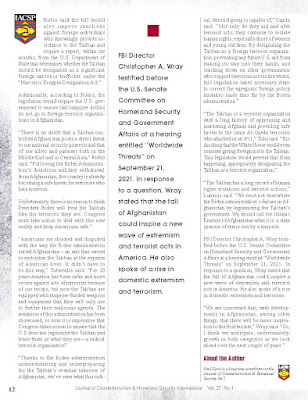
Rubio said the bill would also impose sanctions against foreign individuals who knowingly provide assistance to the Taliban and require a report, within six months, from the U.S. Department of State that determines whether the Taliban should be designated as a significant foreign narcotics trafficker under the “Narcotics Kingpin Designation Act.”

Additionally, according to Rubio, the legislation would require the U.S. government to ensure that taxpayer dollars do not go to foreign terrorist organizations in Afghanistan.

“There is no doubt that a Taliban-controlled Afghanistan poses a direct threat to our national security interests and that of our allies and partners both in the Middle East and in Central Asia,” Rubio said. “Following the Biden Administration’s disastrous military withdrawal from Afghanistan, the country is already becoming a safe haven for terrorists who hate America.

Unfortunately, there is no reason to think President Biden will treat the Taliban like the terrorists they are. Congress must take action to deal with this new reality and keep Americans safe.”

“Americans are shocked and disgusted with the way the Biden administration exited Afghanistan – an exit that served to embolden the Taliban at the expense of American lives. It didn’t have to be this way,” Tuberville said. “For 20 years America has been safer and more secure against acts of terrorism because of our troops, but now the Taliban are equipped with taxpayer-funded weapons and equipment that they will only use to further their malicious agenda. The weakness of this administration has been showcased, so now it is imperative that Congress takes action to ensure that the U.S does not legitimize the Taliban and treats them as what they are – a radical terrorist organization”.

“Thanks to the Biden administration underestimating and underpreparing for the Taliban’s eventual takeover of Afghanistan, we’ve seen what this radical, terrorist group is capable of,” Capito said. “Not only do they aid and abet terrorist acts, they continue to violate human rights, especially those of women and young children. By designating the Taliban as a foreign terrorist organization, preventing any future U.S. aid from making its way into their hands, and cracking down on other governments who support terrorism across the world, this legislation takes necessary steps to correct the egregious foreign policy mistakes made thus far by the Biden administration.”

“The Taliban is a terrorist organization with a long history of oppressing and murdering Afghans and providing safe haven to the same Al-Qaeda terrorists who attacked us on 9/11,” Tillis said. “It is shocking that the White House would even consider giving foreign aid to the Taliban. This legislation would prevent that from happening, appropriately designating the Taliban as a terrorist organization.”

“The Taliban has a long record of human rights violations and terrorist actions,” Lummis said. “We must not exacerbate the Biden administration’s failure in Afghanistan by legitimizing the Taliban’s government. We should call the Islamic Emirate of Afghanistan what it is: a state sponsor of terror run by a terrorist.

FBI Director Christopher A, Wray testified before the U.S. Senate Committee on Homeland Security and Government Affairs at a hearing entitled “Worldwide Threats” on September 21, 2021. In response to a question, Wray stated that the fall of Afghanistan could inspire a new wave of extremism and terrorist acts in America. He also spoke of a rise in domestic extremism and terrorism.

“We are concerned that, with developments in Afghanistan, among other things, that there will be more inspiration to the first bucket,” Wray said. “So, I think we anticipate, unfortunately, growth in both categories as we look ahead over the next couple of years.”

About the Author

Paul Davis is a long-time contributor to the Journal of Counterterrorism & Homeland Security Int’l. 

'Daughter Of The Morning Star': My Washington Times On Crime Column On Craig Johnson's New Longmire Crime Novel

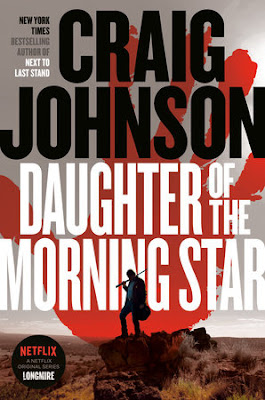
 The Washington Times published my On Crime column on Craig Johnson’s Daughter of the Morning Star. 

Although the series “Longmire" ended on Netflix, fans of the modern Western Sheriff Walt Longmire can still read Craig Johnson’s popular crime series of novels where Longmire is still on the job as the sheriff of a fictional Wyoming county. 


I reached out to Craig Johnson and asked what inspired him to write his latest crime novel, “Daughter of the Morning Star.”


“I was doing a library event up in Hardin on the Crow Reservation a few years back when I looked up and noticed a missing persons poster on the community bulletin board. It was a simple computer copy with the face of a young woman, bright-eyed and smiling and now… Gone,” Mr.Johnson replied. “The words were desperate, and pleading and a reward was posted. 


Her face was faded, and the paper wrinkled and yellowed with age — a fervent and unanswered prayer that fluttered against the bulletin board like a turning page every time the door of the library opened and closed.  I can’t think of anything worse than losing a loved one—I mean, having them turn up missing and then never knowing what happened to them. I’ve spoken with people to whom this has happened, and the thing I have heard repeatedly is that the worst part is the not knowing — the lack of closure, having no idea if they are alive or dead or if they suffered or are still suffering.”


Mr. Johnson went on to say that he wanted to write a novel about the plight of murdered and missing indigenous women, so he had to come up with the idea that would take Walt Longmire somewhere he’d never been before, like a bus full of teenaged girl basketball players.


A young star basketball player, Jaya Long, was receiving death threats. The tribal police chief invites Sheriff Longmire to the Cheyenne Reservation, hoping that his involvement would bring additional attention to the case. Longmire discovers that Jaya Long’s older sister Jeanie had also been receiving threats, and she has been missing for more than a year.

You can read the rest of the column via the below link:


https://www.washingtontimes.com/news/2021/nov/4/book-review-daughter-of-the-morning-star/


Thursday, November 4, 2021

Arsenic Widows, Kidnappers, Bank Robbers And Mass Murders: My Philadelphia Weekly Crime Beat Column On Early True Crime In Philadelphia

Philadelphia Weekly published my Crime Beat column on early true crime in Philadelphia.

You can read the column via the below link or pages:

Kidnappers, robbers and murderers - Philadelphia Weekly


You can click on the above and below to enlarge. 


Tuesday, November 2, 2021

My Threatcon Column: Yet Another U.S. Navy Bribery Scandal

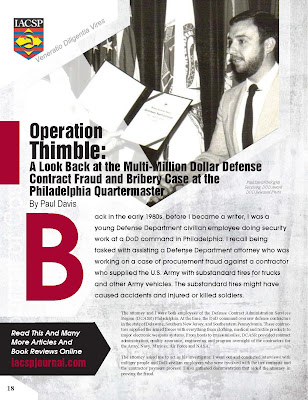
In the last issue of The Journal, I offered a look back at the multimillion-dollar bribery and fraud case that occurred in the late 1980s at the Defense Personnel Support Center in Philadelphia, known locally as the “Quartermaster.” 

Defense contractors who manufactured Navy peacoats and other military clothing bribed Department of Defense civilian employees to ensure the companies received major clothing contracts and expedited processing that led to the contractors receiving enormous government checks. The federal investigation was called “Operation Thimble.” 

At the time, I was a young Defense Department civilian employee doing security work at the Quartermaster, so I knew and worked with some of the people that were caught up in the scandal. 

For the Journal piece, I interviewed Joesph L. Ford, the former lead FBI investigator and Linda Dale Hoffa, the assistant U.S. attorney who prosecuted case. Both Ford and Hoffa have long since retired from federal service. 

A year after Operation Thimble, an even bigger bribery case rocked the Defense Department and the Navy. The investigation was called “IllWind.” 

According to the FBI, some Defense Department employees had taken bribes from businesses in exchange for inside information on procurement bids that helped some of the nation’s largest military contractors win lucrative weapons systems deals. 

More than 60 contractors, consultants, and government officials were ultimately prosecuted—including a high-ranking Pentagon assistant secretary and a deputy assistant secretary of the Navy. As a monetary measure of the significance of the crimes, the case resulted in a total of $622 million worth of fines, recoveries, restitutions, and forfeitures.

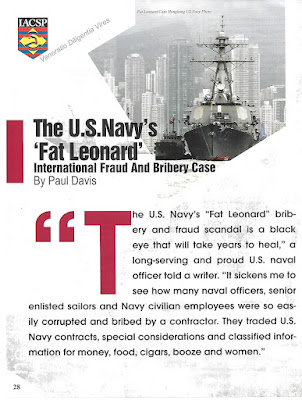
The Navy was again rocked more recently with another massive bribery case. I covered the “Fat Leonard” case in the Journal in 2017. 

In 2015, Leonard Glenn Francis, a 350-pound Malaysian known as Fat Leonard, pled guilty to bribery and fraud charges and admitted to presiding over a decade-long conspiracy involving what the Justice Department called “scores of U.S. Navy officials, tens of millions of dollars in fraud and millions of dollars in bribes and gifts – from cash, prostitutes and luxury travel to Cuban cigars, Kobe beef and Spanish suckling pigs.” 

The Navy officers and others provided Francis with information about the upcoming port visits of naval ships, which is classified, as well as confidential contracting information and information about law enforcement investigations of Leonard’s company.    

More than 27 active duty and retired Navy officers, civilian officials and others pled guilty when faced with the overwhelming evidence from the investigation. More indictments are forthcoming. 

So even while the Fat Leonard investigation is ongoing, the Navy is facing yet another bribery scandal. 

On October 18th, the Justice Department announced that Frank S. Rafaraci, the CEO of Multinational Logistics Services (MLS), a large ship husbanding company that has received over $1 billion in U.S. Navy contracts since 2010, appeared in federal court to face a criminal charge for his alleged participation in a bribery scheme. 

“According to the affidavit in support of a criminal complaint filed in September, Frank S. Rafaraci, 68, a U.S. citizen who resides abroad, has been the CEO of MLS since at least 2005,” the Justice Department stated. “MLS is a defense contractor that provides ship husbanding services, such as refueling and stocking provisions, to U.S. Navy ships at ports worldwide. From approximately 2010 to the present, the U.S. Navy, other U.S. Department of Defense (DoD) components, and U.S. government civilian agencies awarded husbanding services contracts to MLS worth approximately $1.3 billion.” 

The affidavit alleges that, beginning in 2011, Rafaraci was involved in a wide-ranging scheme to bribe U.S. Navy officials, defraud the U.S. Navy using falsely inflated invoices, and launder the proceeds of the scheme through shell companies Rafaraci had set up in the United Arab Emirates, all in an effort to benefit MLS. 

“Frank Rafaraci allegedly defrauded the Navy, bribed a Navy official, and laundered money through foreign bank accounts for years,” said Assistant Attorney General Kenneth A. Polite Jr. of the Justice Department’s Criminal Division. “The Criminal Division remains committed to combating fraud and corruption in defense contracting around the world. 

Eric Maddox, the Special Agent in Charge of the Naval Criminal Investigative Service (NCIS) Economic Crimes Field Office, added, “Rafaraci’s alleged long-running criminal scheme to defraud the Federal government through bribery, falsified invoices, and money laundering cheated the U.S. taxpayer and wasted tremendously valuable resources. NCIS and our law enforcement partners remain steadfast in our commitment to root out bribery and corruption that threaten to diminish the operational readiness and warfighter superiority of the Navy and Marine Corps.” 

As Linda Dale Hoffa, the Quartermaster prosecutor, told me, “Defense Department corruption can permeate an entire system and put at risk the lives of military personnel. Corruption costs taxpayers. It costs everybody.”   

Paul Davis is a longtime contributor to the Journal of Counterterrrorism & Homeland Security Int’l. 

You can also read my Counterterrorism magazine pieces on the Quartermaster and Fat Leonard Navy bribery and fraud cases via the below links:

Paul Davis On Crime: A Look Back At The Multi-Million Dollar Defense Contract Fraud and Bribery Case At The Philadelphia Quartermaster

Paul Davis On Crime: My Piece On The 'Fat Leonard' U.S. Navy Bribery And Fraud Case 

Hillary Clinton Dresses up As President For Halloween: Three From The Bee

 Gotta love the Bee.

Below are three satirical pieces from the Babylon Bee:

 Hillary Clinton Dresses Up As President For Halloween

 CHAPPAQUA, NY—According to sources, former First Lady and skilled assassin Hillary Clinton is joining the Halloween festivities this year by dressing up as a real live president. 

"I really wanted to show little girls everywhere that if you believe in yourself and kill a lot of people, you can be president of the United States someday," she said, "...just like I was. I was the rightful president. I WAS THE RIGHTFUL PRESIDENT!" She then screamed and threw an open bottle of wine against the wall and made her servants pick it up.

Hillary will be wearing a realistic president costume and sitting behind a handmade replica of the resolute desk to complete the look.

"This is where I sign my executive orders to bail out banks and drone strike brown people in the Middle East," she said proudly as she signed imaginary papers on her desk. "You may address me as Madam President. Happy Halloween!"

Sources say that Bill Clinton will also be dressing up for Halloween, as someone who's not married to Hillary Clinton.  

Supply Chain Crisis Solved As Each Migrant Coming Into Country Will Be

Asked To Help Carry A Shipping Container

 DEL RIO, TX—Secretary of Transportation Pete Buttigieg announced that the supply chain crisis wreaking havoc on the nation’s economy has been resolved, and praised Biden’s brilliance and ingenuity in proposing the solution: Ask each migrant coming into the country to help carry a shipping container.

“Big, big shiny boats are flocking to the shores of Mexico,” said the cabinet member. “And all the choo-choo trains and beep-beep vroom-vrooms can't handle all the containers! Oh no! So let's just have the thousands and thousands of migrants carry them in! It’s a solution that can only be attributed to Biden’s progressive policies.”

One immigrant praised the opportunity to have a job before even entering the United States illegally. “It’s unbelievable that only a few weeks ago the White House sent my family a personal invitation, map, GPS, and detailed instructions on how to cross the border illegally, and here I am now, using my skills to carry shipping containers and boost the American economy for a modest $450,000 salary. Gracias Señor!”

Border Patrol agents trying to stop the illegal immigrants from bringing the vital shipments into the country were arrested and sent to Guantanamo Bay.

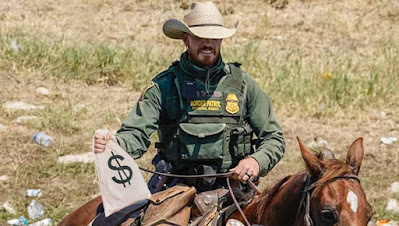
Mounted Border Patrol Ordered To Replace 'Whips' With Bags Of Money

 DEL RIO, TX—After weeks of being placed on leave, Texas border patrol agents are finally returning to the border on their horses. This time, however, they will be carrying giant sacks of money instead of their leather reins.

"This is our way of showing who we are as Americans," said the newly appointed Border Patrol Chief Zamby Fiddlepoot. "Our agents have all been given 320 hours of anti-racist and sensitivity training. We also chemically castrated them. They will just hand out hugs and money now." 

The newly trained agents will patrol the border day and night, giving $450,000 to every illegal crosser they meet.

"Howdy, pardners!" said one officer to a small group of 3,200 migrants approaching him. "Please allow me to apologize for oppressing you with my cisgender colonial whiteness! Please take this money as a token of our apology and come on in!"

Unfortunately for the migrants, experts predict $450,000 will not be enough to fill a tank with gas in a few weeks due to inflation. 

You can read more humor pieces via the below link: 

The Babylon Bee | Fake News You Can Trust 

Monday, November 1, 2021

A Sailor On Sunset Strip

I’m pleased that military people are treated with proper respect these days, with strangers often greeting military people and veterans with the phrase, “Thank you for your service.” 

It was certainly not this way when I was in the U.S. Navy in the early 1970s. 

In those days supporters and opponents of the Vietnam War were evenly split in America, but the anti-war crowd made themselves more visibly and vocally known.  

One often heard of anti-war people spitting on returning servicemen (had anyone spit on me, I would have punched their lights out). Anti-war protestors were also known to confront service members and ask them how they could murder women and babies. 

Marines had a great response: “You don’t lead them as much.”

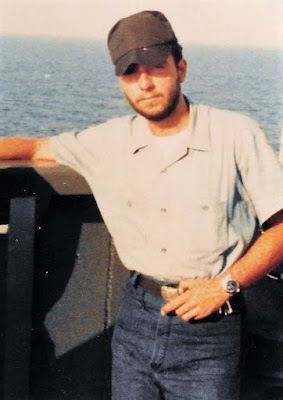
I enlisted in the U.S. Navy in 1970 during this national turmoil. I was 17. 

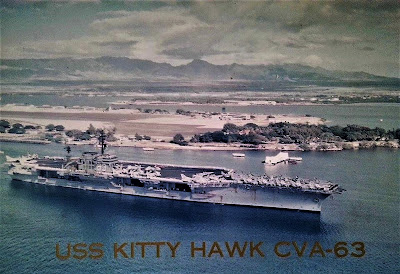
After Boot Camp I received orders to report to the aircraft carrier USS Kitty Hawk. I reported aboard the carrier in Bremerton, Washington where she was undergoing a major overhaul. 

Once the overhaul was complete, we sailed down to San Diego, California and began sea trials and air operations in preparation of our tour of duty on “Yankee Station” off the coast of North Vietnam. 

I turned 18 in San Diego in June of 1970. 

The Kitty Hawk went to sea from Monday to Friday to perform the sea trials and flight ops, and returned to San Diego on the weekends. With three-section duty, I had two out of three weekends off. I spent that precious time in downtown San Diego, in nearby Tijuana, Mexico, and in Los Angeles. 

I was fond of LA and liked the vibrant city’s nightlife, and I visited there on many of my free weekends. 

I also liked to go to West Hollywood and hit the “happening” clubs on the mile and half of Sunset Boulevard that was known famously as the “Sunset Strip.” 

The Strip was home to trendy restaurants, sleazy bars and hip nightclubs. The Strip was a girl watchers’ delight and walking the Strip at night was like being part of a wild parade. Someone called the Strip a “cultural carnival.” 

I also liked the great rock music played at the clubs there – this was a bit before punk rock and new wave set in - and I liked dancing with the young, pretty girls. Growing up in South Philly, I had gone to teenage dances every weekend, so I knew that hitting the dance floor on the Sunset Strip was a good way to meet girls. 

There were other servicemen at the clubs, as well as hippies, college students, tourists, music and movie people, and everything in between. 

Like other servicemen, I wore my "civies" (civilian clothes) to the clubs, but, unfortunately, like the other servicemen with regulation short hair, I stood out a bit from the guys who sported the longer hairstyles of the day. It appeared that the prettiest and most desirable girls shied away from military guys.

I recall one Friday night when I met an exceptionally pretty girl, a college student, who spent some time with me on the crowded dance floor. We took a break and I bought her a drink at the bar. 

She was a bit inebriated, giddy and cheerful. Then she looked at me closely. 

“Why do you have short hair? Are in you in the military?” 

I knew that my being in the Navy would be a “turn off” for her, so I thought fast. 

“No, but I don’t want to talk about it,” I replied sheepishly. 

“Why not?” 

“My hair is cut short because I just got out of San Quentin prison.” 

Her interest and imagination ignited, and she leaned into me and whispered, “Why were you in prison?” 

“I robbed a bank.” 

She nodded her head slowly, as if to say she understood. She then smiled, kissed me, and we returned to the dance floor. 

She was fine with me being with a bank robber and ex-con, but she would have surely bolted had I told her I was a sailor. 

Go figure.  

Thankfully, the girls in the Philippines, Japan, Hong Kong and other ports in Southeast Asia we later visited had no such prejudice against sailors. 

Note: You can read my other sea stories, vignettes, short stories, and humor pieces about the Navy via the below link:

 Paul Davis On Crime: Sea Stories: Vignettes, Short Stories And Humor Pieces About My Time In The U.S. Navy