Showing posts with label Claudette Roulo. Show all posts
Saturday, March 14, 2015
Cyber Domain Presents Profound Challenges, Says Defense Secretary Carter At The U.S. Cyber Command
Claudette Roulo at the DoD News offers the below report:
WASHINGTON, March 13, 2015 - Defense Secretary Ash Carter gave his first domestic troop talk as secretary to the cyber warriors assigned to U.S. Cyber Command at Fort Meade, Maryland, today.
The mission of Cybercom is vital to the economic and physical security of not just the nation, but to Americans in their individual lives, Carter said.
"With all that's going on in the world, from Iraq to Ukraine, to the Asia-Pacific, the domain that you protect -- cyberspace -- is presenting us with some of the most profound challenges, both from a security perspective and from an economic perspective," he told the troops.
National leaders at every level are "seized with the need to get on top of this problem," the defense secretary said.
Building Bridges to Society
The Defense Department must be open to sources of good people and new technology to better position itself to defend the nation in cyberspace, he said.
"And that means we need to build bridges to society. Bridges that aren't as necessary in other fields of warfare that don't have a civilian or a commercial counterpart to the extent that this field does," Carter said.
Transparency is a difficult goal in cyber defense, the secretary acknowledged, but added that the department must always be open to new ideas and people.
"We can't always tell them what we are doing," the defense secretary said, "but we need to be open enough with our government so that it knows what it's doing."
The department must also be open to the ideas of new generations, he said.
"We need people who grew up with technology that was not available when I was growing up, and therefore have a sixth sense about it which I can never have," Carter said.
Nontraditional Warriors
The development of the cyber workforce can be a model for DoD, he told the troops.
"The freshness of approach, the constant effort to stay up [and] reinvent, that your field demands is actually something we can use everywhere in the department," the defense secretary said.
The cyber skill set and professional orientation doesn't have a good analog in the traditional armed services, Carter said.
"For the institutions that you join, be they military services or field agencies or new commands, they are trying to figure out how to welcome this new breed of warrior to their ranks," he said.
"We have to figure out how to get it to fit in, so that you all have a full opportunity to bring to bear on your careers the expertise that you gained here and that sense of mission that you felt here," the defense secretary said.
Challenges always accompany doing something new and exciting, Carter said, adding that he is determined to create a place where cyber warriors fit. "We'll find the path together," he said.
The relationship between Cybercom and the National Security Agency is also a work in progress, Carter said.
"My view is that we're doing the right thing in having the leadership of those two organizations in the same place," he said. "And one way of thinking about that is that we just don't have enough good people like you to spread around, and we need to cluster our hits."
Ensuring that cyber troops have the training, equipment and resources they need is a high priority for the department, he said.
Sequester 'Terrible, Stupid'
"If you read about sequester, which is a terrible, stupid thing that we are doing to ourselves -- I have nothing good to say about it," Carter said, referring to the across-the board government spending cuts the Budget Control Act of 2011 is set to impose in October. "But I think that even in the era of sequester, we understand that this mission area is one we cannot afford not to keep investing in."
The cyber mission force represents American ideals in cyberspace, he said. Keeping cyberspace open and free for everyone is its central focus, the defense secretary said.
"We're the ones who stand with those who create and innovate against those who would steal and destroy. That's the kind of country we are, and that's the kind of cyber force we are," he said.
"We're going to execute our mission while being as transparent as possible, because that's also who we are," Carter said.
"And that's why I wanted my remarks to you to be public," he told the troops. "That's an unusual thing for you, and I know that some of you can't be seen on television because of the nature of your work. And [that] it's rare that media come into the premises of this organization, but I wanted not only you to know how important we know what you do is for the country, but everyone else to hear that as well."
Tuesday, September 2, 2014
Somali Airstrike Targeted al-Shabab Leader, Camp, Pentagon Spokesman Says
Claudette Roulo at the DoD News offers the below piece:
WASHINGTON, Sept. 2, 2014 - Manned and unmanned aircraft operated by U.S. special operations forces participated in an airstrike yesterday in Somalia that destroyed an al-Shabab encampment and a vehicle located at that camp, Pentagon Press Secretary Navy Rear Adm. John Kirby (seen in the above DoD photo) said today.
Kirby said the operation was a direct strike against the al-Shabab network, and specifically, the group's leader, Ahmed Abdi al-Muhammad, also known Ahmed Godane. The operation was carried out after actionable intelligence was obtained that suggested that Godane was present at the camp, located south of the Somali capital of Mogadishu, the press secretary said.
It's too early to know whether Godane was killed as a result of the airstrikes, Kirby said, adding that if he were, it would be a "very significant blow to their network, to their organization and, we believe, to their ability to continue to conduct terrorist attacks."
The aircraft fired several Hellfire missiles and laser-guided munitions, he said, noting that the Defense Department is still assessing the results of the operation. "We certainly believe that we hit what we were aiming at," the press secretary said. "And based on intelligence that, as I said, we believe was actionable -- in other words, strong enough -- we took this strike."
No U.S. forces were present on the ground, either before or after the attack, he noted. Al-Shabab is a jihadist group based in Somalia. It has claimed responsibility for last year's attack on the Westgate Mall in Nairobi, Kenya, which resulted in more than 70 deaths and 200 injured. The group is also believed to be responsible for many bombings, including suicide attacks in Mogadishu and in central and northern Somalia, the admiral said.
These attacks typically target officials and perceived allies of the current federal government of Somalia and the former transitional federal government of Somalia, Kirby said.
Al-Shabab has occupied most of southern Somalia since 2006, he said. It has claimed responsibility for the deaths of numerous government officials, aid workers, peace activists and journalists and was named as a foreign terrorist organization by the State Department in 2008.
"They've also continued to plan plots targeting Westerners, including U.S. personnel in East Africa," the press secretary said. "In recent months, al-Shabab claimed responsibility for a suicide bombing in Djibouti that killed a Turkish national and wounded several Western soldiers, as well as a car bomb at the Mogadishu Airport that targeted and killed members of the United Nations convoy."
The operation is an example of the commitment of the U.S. government and its allies and partners to the people and government of Somalia "to detect, deter, disrupt and defeat violent extremists who threaten progress in the region, as well as threaten to conduct terrorist attacks against innocent people around the world," Kirby said.
The United States will continue to use all of the tools at its disposal, he said -- including finance, diplomacy, intelligence and military force -- to dismantle al-Shabab and other terrorist groups that threaten U.S. interests and those of U.S. allies and partners.
Monday, August 18, 2014
Security of Mosul Dam Critical to Iraq's Infrastructure
Claudette Roulo at the DoD News offers the below piece:
WASHINGTON, Aug. 18, 2014 - President Barack Obama has announced that Iraqi forces, aided by on-going U.S airstrikes, have recaptured Mosul Dam from ISIL terrorists.
U.S. military officials said American aircraft had conducted a total of 68 targeted airstrikes since Aug. 8, the majority directed at setting the conditions for Iraqi security forces to retake the dam.
"These strikes were conducted under authority to support Iraqi security forces and Kurdish defense forces as they work together to combat ISIL, as well as to protect critical infrastructure, U.S. personnel and facilities, and support humanitarian efforts," a release from U.S. Central Command said.
The attacks are aimed at preventing ISIL forces from receiving reinforcements, Pentagon Spokesman Army Col. Steve Warren said, as well as reducing their defenses. This "will allow [Iraqi security forces] to conduct maneuvers around the dam," he explained.
No U.S. military personnel were involved in the ground operations, the colonel said. "We do have U.S military overhead in these aircraft that are conducting airstrikes and of course in our [joint operation centers]," Warren said.
The Mosul Dam captures the flow of the Tigris River, providing flood control, water and electricity to Mosul's 1.7 million residents. First opened in 1986, it is the fourth-largest in the Middle East.
"If the Mosul Dam were to fail, that would lead to a humanitarian disaster," Warren said.
And failure is a real concern, he added.
The dam's location was "chosen for reasons other than geologic or engineering merit," according to a 2007 report by the Army Corps of Engineers.
While the report found that the dam itself was well-constructed, the underlying geology is a cause for "intense concern about the safety of the structure." The dam's bedrock foundation consists of water-soluble rocks, such as gypsum, marl and limestone, and the presence of the dam's reservoir is hastening subsurface dissolution.
The geologic conditions under the dam necessitate "extraordinary engineering measures to maintain the structural integrity and operating capability of the dam," the report said.
A constant program of maintenance is needed to ensure the dam is not undermined, which could unleash a floodwall that would travel southward down the Tigris River valley all the way to Baghdad, nearly 300 miles away.
A letter sent by President Barack Obama to Congress yesterday said the dam's failure would endanger the lives of large numbers of civilians, U.S. personnel and facilities, including the U.S. Embassy in Baghdad, and prevent the Iraqi government from providing critical services to the Iraqi populace.
Note: The above U.S. Army photo of the Mosul Dam was taken by Staff Sgt. Brendan Stephens.
Labels:
Claudette Roulo,
DoD News,
Iraq War,
ISIL,
Kurds,
Mosul Dam,
U.S. airstrikes,
U.S. Central Command
Sunday, July 27, 2014
General Dempsey Explains Danger Posed By Extremist Groups
Claudette Roulo at DoD News offers the below piece:
ASPEN, Colo., July 24, 2014 - It's important to recognize that the various religious extremist groups that threaten the United States do not share the same ideologies, the chairman of the Joint Chiefs of Staff said here today.
"Some of them are opportunistic, some of them seek to establish a sense of political Islam and theocracy under sharia law, and some of them are apocalyptic, actually, meaning they have such a world view that it becomes of a magnitude that makes them, I think, especially dangerous," Army Gen. Martin E. Dempsey told an audience at the Aspen Security Forum.
The group known as Islamic State of Iraq and the Levant seeks a sense of religious legitimacy, he said. Its leaders believe they are the heirs to the Islamic caliphate that Muslims believe began with the prophet Muhammad. "They can only sustain that religious legitimacy if they continue to succeed," Dempsey said. "So this is not a group that can go halfway. It has to keep moving toward its ultimate end-of-days, apocalyptic narrative or it will lose support, because it loses religious legitimacy."
ISIS must be contained, then disrupted and, ultimately, defeated, the chairman said. "What makes it very hard is that ultimate defeat has to come from within the Sunni population," he said. Their defeat can be enabled and assisted by the United States, Dempsey said, but their end will come about only when moderate Sunnis of the region, and the world, reject them. The group is very dangerous, he said. "They will employ whatever tactics they have to employ," the chairman added, noting that they have succeeded through infiltration and misinformation and by preying upon a "youth bulge" and disenfranchised populations in parts of the world that aren't led by inclusive governments. "And then they just pop up one day, and you have to deal with them," Dempsey said. "
And you deal with them by either allowing them their way or suffering the consequences." The nation must take a long view in dealing with ISIL in particular, but also in dealing with many similar organizations that are filling voids where governments are absent or failing, the chairman said. "This isn't about us. ... This very much has to have the support of the government in Baghdad," he explained, adding that it remains to be seen whether the nation has a credible partner in the re-formed Iraqi government.
ISIL isn't a unified force in Iraq, Dempsey said, but rather is a syndicate of several disenfranchised Sunni groups willing to work with ISIL "because they're winning." "When you are disenfranchised and believing that the government in Baghdad will never be inclusive and never allow you to be part of the government, you'll back a winner until that winner is contained," the chairman said.
The collapse of the Iraqi military is representative of this disenfranchisement, he said. They were overcome because their soldiers concluded that their future did not lie with the government in Baghdad, Dempsey said. "Look, why do any of us in uniform stand and fight?" he asked. "You know, it's not just because were wear the uniform. We stand and fight because we believe in what we stand and fight for. ... If we were ever placed in a position where you didn't believe what you were fighting for, you know, you wouldn't see the kind of military you have in the United States today."
The problem of ISIL isn't isolated to Iraq, he said. The border between Iraq and Syria has ceased to exist, Dempsey explained. In addition, Turkey and the Kurds in northern Iraq are uniquely positioned to pressure ISIL, he noted. "It has to be a partnership, a coalition, and we have to build partners who can reject it from inside out," the chairman said. "
The immediate task is to determine whether Iraq has a political future, because if Iraq has a political future, then we will work through Iraq, among others, to deal with the ISIL threat," Dempsey said. "If Iraq does not have a political future as an inclusive unity government, then we're going to have to find other partners."
Tuesday, June 3, 2014
Changes Coming to Intelligence Communities, Undersecretary of Defense For Intelligence Says
Claudette Roulo at the American Forces Press Service offers the below link:
Speaking at a Center for Strategic and International Studies forum, Vickers
said the nation faces an assortment of national security challenges, including
several permutations of al-Qaida and its affiliates, homegrown violent
extremists, unrest in the Middle East and North Africa, Russian revanchism,
cyber threats and the proliferation of weapons of mass destruction.
"But the three biggest threats are al-Qaida in the Arabian Peninsula --
centered in Yemen -- and the growing al-Qaida threat in Syria and al-Qaida's
affiliates, ... who are spread elsewhere and who are taking advantage of what we
call metastasization ... across the Middle East and North Africa. ... And so
this really remains job one for the intelligence community and our special
operations forces," he told the audience.
The Syrian civil war is a particularly vexing national security challenge,
Vickers said.
"It's a horrific civil war, with 150,000 dead," he said. "It's a humanitarian
crisis of mind-boggling proportions, with some 9 million internally displaced
[persons] or refugees who have fled the country. ... And, of course, it's giving
rise to a significant terrorism threat."
The most concerning aspect of Russia's taking of the Crimean Peninsula and involvement in Ukrainian politics is the destabilizing effect these actions are having on the region, Vickers said. "While Russian forces have pulled back their troops from the border region, they have not ceased their support for pro-Russian separatists in eastern Ukraine, and that threat remains to the government of Ukraine and its territory," he explained.
Cyber threats range from the theft of intellectual property to destructive attacks, the undersecretary said. "Over the past couple of years, we've had destructive attacks against South Korea, against Saudi Arabia, and denial-of-service attacks against the U.S. financial sector," he said, adding that the probability is high that there will be more destructive attacks in the future.
These challenges are broad and enduring, Vickers said. "Taken together, these are highly asymmetric challenges," he said, and solving them will require a series of "offset" strategies -- oblique approaches designed to address a specific aspect of each challenge.
"Also critical to dealing with this set of enduring challenges is the continued economic and technical leadership of the United States, which ... is a national security imperative," he said.
Intelligence is the first line of defense in national security, Vickers said. It informs national security policy, enables intelligence-driven precision operations, provides commanders and the commander in chief with options, and it prevents strategic surprise.
"Intelligence is a significant source of advantage for the United States. ... It's an advantage that's very important to us, but it's also one that has to be used aggressively, but also prudently, to make sure we're helping our leaders solve problems and not adding to their problems," Vickers said.
The United States is making a number of investments to sustain its intelligence advantage well into the future, the undersecretary told the audience.
"There are big changes ahead in the way we use our overhead space architecture -- some of the biggest changes that we've seen in several decades," he said. "It will be possible ... to have persistence we've never had before."
Through the Defense Clandestine Service, the Defense Department will strengthen its human intelligence and cryptanalytic capabilities, the undersecretary said.
The Predator and Reaper unmanned aerial vehicles have become the "signature weapon" of counterterrorism operations over the past decade, Vickers said.
"It has enabled the most precise counterterrorism campaign in the history of warfare, and it is our most effective instrument," he added. "We are very healthy in this area, but we are looking to make advancements in some advanced sensors as well as extending the range of our second-generation platform considerably."
The Defense Department is making significant progress as it seeks to develop a cyber force and its associated support structures, the undersecretary said. "The key to making that cyber force effective ... has really been our partnerships with industry, ... particularly in the area of information sharing," he said.
Separately, the sharing of information within and between agencies has vastly improved in the years since 9/11, Vickers said. "Our intelligence agencies work much closer together," he added. "It's hard to find a case where a single intelligence agency has been responsible for a significant intelligence breakthrough or operation."
Vickers said he and Director of National Intelligence James Clapper have made it their top priority to ensure that the national and defense intelligence apparatuses are integrated and transparent to one another.
In addition, the national security strategy depends on enabling partners, he said. "To make the national security apparatus effective across the interagency -- both domestic and foreign -- also requires a high degree of intelligence sharing," he added.
In that vein, Vickers said, DOD and the intelligence community are modernizing their information technology systems to strike a balance between the need to protect information while also distributing it.
Tuesday, April 8, 2014
U.S. Navy Team Detects Signals in Search for Missing Aircraft
Claudette Roulo at the American Forces Press Service offers the below piece:
WASHINGTON, April 7, 2014 - U.S. Navy personnel continue their support of the search for missing Malaysia Airlines Flight 370, a Pentagon spokesman said today.
The United States has two P-8 Orion aircraft searching in the Indian Ocean, Army Col. Steve Warren said.
Navy aircraft supporting the search have flown 24 missions, with 220 hours of flight time covering 336,000 square nautical miles, according to a U.S. 7th Fleet news release.
"Additionally, we have two pieces of highly sophisticated underwater detection equipment [engaged in the search] -- the towed pinger locator and the Bluefin-21 [sidescan sonar]," Warren said.
Both underwater devices are operating from the Australian defense vessel Ocean Shield, the news release said.
The team operating the towed pinger locator detected signals yesterday that are consistent with sounds that would come from a black box, the release said. The signals were detected on at least three separate occasions for extended periods of time and at several different depths. The locator also detected two signals at the same frequency, but in different locations, which would be consistent with signals transmitted by both a flight data recorder and cockpit voice recorder, the release noted.
The team is working to reacquire the signal and plans to use the Bluefin-21 to create a picture of any potential wreckage.
The search is a round-the-clock operation, and is currently focused on an area about 950 nautical miles northwest of Perth, Australia.
Determining the location and position of search assets is "a very collaborative effort between Americans, the Australians, the Malaysians and others," Warren said. But, he added, "the Australians right now do have the lead."
Note: In the above U.S. Navy photo taken by Petty Officer 1st Class Peter D. Blair the Bluefin-21 Artemis autonomous underwater vehicle is hoisted back aboard the Royal Australian Navy Defense Vessel Ocean Shield after successful buyancy testing.
Thursday, March 20, 2014
U.S. Navy Personnel Remain Aboard as Seized Tanker Returns to Libya
Claudette Roulo at the American Forces Press Service offers the below piece:
WASHINGTON, Mar. 19, 2014 - Twenty-five Navy personnel remain aboard the oil tanker Morning Glory after a team of Navy SEALs boarded and took control of the ship March 17, Army Col. Steve Warren, a Pentagon spokesman, said today.
U.S. forces took control of the tanker in international waters at the request of the governments of Libya and Cyprus following its seizure earlier this month by three armed Libyans.
"The Morning Glory is carrying a cargo of oil owned by the Libyan government National Oil Company. The ship and its cargo were illicitly obtained from the Libyan port of As-Sidra," Navy Rear Adm. John Kirby, the Pentagon press secretary, said in a statement released yesterday.
The U.S. sailors aboard the tanker are supervising the transit and performing security, navigation and communications tasks, Warren said today, and the SEALs have left the ship.
"The USS Stout is escorting the Morning Glory towards Libya. The three Libyans who had taken control of the Morning Glory remain now under U.S. control aboard the Morning Glory," the colonel said.
The 21-person civilian crew, consisting of six Pakistanis, six Indians, three Sri Lankans, two Syrians, two Sudanese and two Eritreans, also remain aboard the ship, he said.
The ship is underway to an as-yet undetermined spot in international waters near Libya to await a final port decision, Warren said, noting that discussions have begun on turning the three Libyans over to the Libyan government.
Note: In the above U.S. Navy photo by Petty Officer 1st Class Christopher B. Stolz, the Arleigh Burke-class guided missile destroyer USS Stout is escorting the Libyan oil tanker Morning Glory.
Wednesday, March 19, 2014
U.S. Navy Continues Search for Missing Malaysian Airliner
Cladette Roulo at the American Forces Press Service offers the below piece:
WASHINGTON, Mar. 19, 2014 - U.S. Navy aircraft and personnel remain engaged in the search effort for missing Malaysia Airlines Flight 370, which disappeared March 8 after taking off from Kuala Lumpur, Malaysia, en route to Beijing, a Defense Department spokesman said today.
A P-8 Poseidon aircraft previously dedicated to search efforts in the Bay of Bengal has relocated to Perth, Australia, to join the southern search area, Army Col. Steve Warren told reporters.
"It is conducting a search in coordination with the Australians, 1,500 nautical miles west of Perth," he said.
The P-8 can stay over its assigned search area for nine hours, Warren noted. "It is a vast area, ... but the P-8 can search a tremendous amount of space," he added.
Australia is directing the search in the southern Indian Ocean, Warren said.
"We routinely train with the Australians," he said. "They're very close partners to us, and we particularly routinely train in maritime search."
A Navy P-3 Orion continues to search for the lost aircraft in the Bay of Bengal, Warren added.
The Arleigh Burke-class destroyer USS Kidd, which previously was taking part in search efforts off the coast of Malaysia, has left the search and moved on to other operations in the South China Sea, the colonel said.
Note: In the above U.S. Navy photo taken by Petty Officer 2nd Class Eric A. Pastor, sailors attached to Patrol Squadron 16 conduct search and rescue operations for Malaysia Airlines Flight 370 while aboard a P-8A Poseidon over the Indian Ocean, March 16, 2014.
Tuesday, February 4, 2014
U.S. Faces Many Threats, Intelligence Chief Says
Claudette Roulo at the American Forces Press Service offers the below piece:
WASHINGTON, Feb. 4, 2014 - Never in his more than 50 years of intelligence experience has the nation been beset by more crises and threats from around the world than it now faces, Director of National Intelligence James R. Clapper (seen above in his official photo) said today during a House hearing on worldwide threats.
The long list of global threats includes terrorism, sectarian violence and radical extremism, Clapper said.
"And there are many other crises and threats around the globe," he added, "to include the spillover of the Syria conflict into neighboring Lebanon and Iraq, the destabilizing flood of refugees in Jordan, Turkey and Lebanon now about 2.5 million people, essentially one of the largest humanitarian disasters in a decade."
Adding to the list of threats, Clapper said, are the implications of the drawdown in Afghanistan, the deteriorating internal security posture in Iraq, the growth of foreign cyber capabilities, the proliferation of weapons of mass destruction, aggressive nation-state intelligence efforts against the United States, an assertive Russia, a competitive China, a dangerous and unpredictable North Korea, a challenging Iran, the lingering ethnic divisions in the Balkans, and perpetual conflict and extremism throughout Africa.
"I could go on with this litany, but suffice to say that we live in a complex, dangerous world," he said.
The intelligence community also is threatened by the fallout from leaks by former contract employee Edward Snowden, Clapper said. Though he didn't want to dwell on the debate about Snowden's motives, he added, he did want to address the damage caused by his disclosures.
"As a consequence, in my view, this nation is less safe and its people less secure," he said. "What Snowden has stolen and exposed has gone way, way beyond his professed concerns with so-called domestic surveillance programs. As a result, we've lost critical foreign intelligence collections sources, including some shared with us by valued partners."
The leaks have provided terrorists and other adversaries insight into U.S. intelligence sources, methods and tradecraft, Clapper said. "And the insights that they are gaining are making our jobs much, much harder," he added.
"The stark consequences of this perfect storm are plainly evident," he said. "The intelligence community is going to have less capacity to protect our nation and its allies than we've had."
But if it's necessary to operate with reduced capabilities to restore the faith and confidence of the American people and their elected representatives, Clapper said, "then we in the intelligence community will work as hard as we can to meet the expectations before us."
The major lesson for the intelligence community from the revelations by Snowden and other leakers is that the community must lean in the direction of transparency wherever and whenever it can, he said. "With greater transparency about these intelligence programs, the American people may be more likely to accept them," Clapper noted.
President Barack Obama described the way forward for the intelligence community in a speech Jan. 14, and a new presidential directive, Clapper said. The major characteristic of this new direction is transparency, he said.
Clapper and Attorney General Eric H. Holder were ordered to conduct further declassification, to develop special protections under Section 702 of the Foreign Intelligence Surveillance Act governing collection of non-U.S. persons overseas, to modify how telephone metadata is collected under Section 215 of the PATRIOT Act, and to ensure more oversight of sensitive collection activities, he said.
"Through all of this, we must, and we will, sustain our professional tradecraft and integrity. We must continue to protect our sources and methods so that we can accomplish what we've always been chartered to do; to protect the lives of American citizens here and abroad to a myriad of threats," Clapper said.
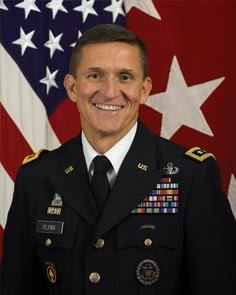
Clapper was joined at the hearing by Army Lt. Gen. Michael T. Flynn, Defense Intelligence Agency director, and Matthew G. Olsen, National Counterterrorism Center director.
Monday, November 25, 2013
Changing World Challenges U.S. Intelligence Community
Claudette Roulo at the American Forces Press Service offers the below piece:
WASHINGTON, Nov. 21, 2013 - In the past, intelligence personnel wouldn't be found participating in open forums, the director of the Defense Intelligence Agency said yesterday at a Brookings Institution discussion on defense intelligence.
"I think that's a sign of the times for the kinds of things that we are involved in, particularly ... [in] this open world," Army Lt. Gen. Michael T. Flynn said. "There's so much transparency going on between the intelligence community and all others, and there has to be. There has to be more of it."
The immense volume of open source information has increased commanders' intelligence needs and changed what sources they use, he said. Ten or 15 years ago, intelligence briefings were primarily composed of what is traditionally thought of as intelligence -- human intelligence, signals intelligence, imagery intelligence -- with a little bit of open source information thrown in.
"Today, it's almost 180 degrees flipped," Flynn said. "The open world -- and the knowledge that exists and is available to all of us at the push of a button -- [is] really smart. This is some really smart analysis that's out there that's being written by people that are on the ground, seeing it for how it is."
Whether that information is posted on a blog or on Twitter, he said, "We cannot sit idle ... and not pay attention to that."
Freely accessible information is just one of the two driving factors behind today's intelligence imperatives, Flynn said.
The international fiscal situation is forcing intelligence agencies to evaluate their priorities, including how they collaborate and how they invest in current capabilities versus the next generation of ideas and capabilities, he said.
Four "mega-trends" influence these factors: economic, resources, information and population, the general said. "For the most part ... these are trends that we can judge pretty accurately," he noted.
Of these four mega-trends, the rapid changes over the past 100 years in information and population trends are having the most impact, Flynn said.
Those changes were "stunning," the general said, and the world hasn't yet come to grips with many of them despite already being nearly 15 years into the 21st century.
Flynn said that about half of DIA personnel are working on the "edge" of the enterprise -- in combatant commands and forward environments -- and for him, the question is how to leverage those resources. "How do we make the edge the center?" he asked.
It's important to understand what is happening at the edge, he said, and to make it the place where the best, most relevant and most timely knowledge can be gained. "Then you bring it back to help shape the conversations that are happening [in Washington, D.C.]," Flynn added.
The general said he expects that the nation's need for special operations forces, cyber capabilities and intelligence will only increase in the coming years.
Special operations forces will not only continue their counterterrorism mission, but will become increasingly involved in foreign internal defense operations and building the capacity of partner nations, he said.
In some defense communities there's still a belief that cyber is a function of intelligence, or that intelligence and cyber are the same, but that isn't at all the case, Flynn said.
"Cyber is a capability that allows us to understand an operational environment far better," he said. "It allows us to see each other. It allows us to communicate. It allows us to defend. It allows us to exploit. It allows so many other things."
And whenever possible, Flynn said, the United States' cyber capabilities should be used to help partner nations.
"I think there's a tendency to think [cyber] is all about war fighting or some negative," he said, "and we have to look at it as how it can be turned into a positive."
For the intelligence community to succeed, it must be agile and integrated with other agencies and partners, Flynn said, and it must have a firm grasp of the operational environment.
That includes developing an understanding of social issues, he said.
"Some of the regions that are out there in the world are facing extraordinary challenges, and we have to have a much deeper operational understanding of that. That means understanding the culture, understanding just the humanity that's out there," the general said.
"I think the last key to success is about technology," he said, "but it's not to lose sight of the human being in the loop."
If intelligence's role is to provide the kind of information leaders need to be able to make better decisions, the intelligence community must not let itself be pulled along by technology, Flynn said.
Friday, October 25, 2013
Defense Secretary Says New Protections Are Needed For Unclassified Data
Claudette Roulo at the American Forces Press Service offers the below piece:
WASHINGTON, Oct. 24, 2013 - Defense Secretary Chuck Hagel recently directed that DOD organizations take additional steps to ensure unclassified controlled technical information is protected from cyber intrusions.
"Stolen data provides potential adversaries extraordinary insight into the United States' defense and industrial capabilities and allows them to save time and expense in developing similar capabilities," Hagel said in a memo dated Oct. 10.
"Protection of this data is a high priority for the department and is critical to preserving the intellectual property and competitive capabilities of our national industrial base and the technological superiority of our fielded military systems," he added.
As the world has become increasingly dependent on electronic data, traditional physical security concepts are no longer valid, said Jennifer Elzea, a Defense Department spokesperson.
"The opportunity to gain access to sensitive unclassified information is simply too unconstrained, and we must rethink how we safeguard our technical information," she said.
Unclassified controlled technical data losses have become a major problem for the nation and its industrial base, Elzea said. And the problem is getting worse. Data and intellectual property concerning defense systems requirements, concepts of operations, technologies, designs, engineering, systems production and component manufacturing are all being targeted, she said. While the information is unclassified, its loss still represents a significant threat to national security.
"The department must be sure that unclassified controlled technical information is protected from network intrusion and that any consequences associated with loss of this information are assessed and minimized," Elzea said.
To that end, the secretary directed that the offices of the undersecretaries of defense for acquisition, technology and logistics, policy, intelligence, and the DOD chief information officer work together to develop any necessary changes to policy, guidance and rulemaking activities to improve the protection of unclassified controlled technical information that resides on or passes through defense contractor systems or networks.
DOD also has proposed an amendment to its acquisition and contracting regulations, Elzea said. The amendment will add language to defense contracts requiring contractors to incorporate established security standards on their networks, and to report cyber-intrusions that result in the loss of unclassified controlled technical information.
The change is part of the effort to balance the cost of increased protection with the ability to conduct business operations at an unclassified level, she noted. The department must be able to safely operate at that level.
Other actions directed in the memo include the establishment of a joint analysis cell to assess losses of technical information. The cell, to be led by the undersecretary of defense for acquisition, technology and logistics, will determine the consequences of those losses and develop necessary responses.
In addition, Hagel directed the military departments to identify critical acquisition and technology programs that require additional protection. This process will include a review of the classification guidance for those programs.
Finally, the DOD CIO, the National Security Agency and the Defense Information Systems Agency will continue to identify the technical standards needed to protect unclassified information in the Joint Information Environment.
"The Department of Defense is committed to protecting our unclassified controlled technical information against the threat of cyber intrusions that target the department and our industrial base," the defense secretary said.
"These actions will ensure that the department provides a cohesive, comprehensive and cost-effective approach to protect priority investments and future defense capabilities while maintaining efficient business operations with our industrial partners," he added.
Wednesday, October 16, 2013
Former U.S. Army Captain William D. Swensen Inducted Into Pentagon Hall Of Heroes
Claudette Roulo at the American Forces Press Service offers the below piece:
WASHINGTON, Oct. 16, 2013 - Defense Secretary Chuck Hagel, Army Secretary John M. McHugh and Army Chief of Staff Gen. Raymond T. Odierno inducted former Army Capt. William D. Swenson into the Pentagon's Hall of Heroes today during a ceremony at the Pentagon.
President Barack Obama presented Swenson with the Medal of Honor at the White House yesterday. He was nominated for his actions while serving as an embedded trainer for the 1st Zone Afghan National Border Police. Swenson is the first Army officer to receive the Medal of Honor since the Vietnam War and the sixth living recipient from the war in Afghanistan.
Hagel said he could not improve on what has been said about Swenson over the past few days, but "one particular point that President Obama made yesterday was that at a time in our country when we need more unifying dimensions and dynamics to remind us who we are ... the Will Swenson story does that."
While taking part in an operation that included U.S. Army, U.S. Marine Corps, Afghan National Army and Afghan National Border Police elements, Swenson repeatedly risked his life to rescue his comrades -- Afghan and American -- during an enemy ambush in the Ganjgal valley.
This is a time of mixed emotions, McHugh said. "A time when we pay tribute to uncommon valor, but at the same time we mourn and remember the horrible loss of comrades and friends."
As dawn broke on Sept. 8, 2009, the combined element departed their vehicles and made their way up the valley on foot toward Ganjgal village, the site of a planned leader engagement mission. The column consisted of 106 personnel: 60 Afghan soldiers; 14 U.S. Marine Corps embedded training team mentors; 30 Afghan border police officers; and Swenson and Army Sgt. 1st Class Kenneth Westbrook, both advisors to the border police. The dismounted patrol was made necessary by the terrain and by reports of improvised explosive devices along the road.
Perched high in the mountains of eastern Afghanistan's Kunar Province, Ganjgal village lies near the head of a U-shaped valley lined with loose rocks and boulders washed down from the steep, terraced slopes. A narrow, ungraded road -- not wide enough for heavy military vehicles -- snakes through the valley, which ends at the border with Pakistan.
The operation that morning, dubbed Buri Booza II, was being conducted at the behest of village leaders, who had visited the local forward operating base, FOB Joyce, a few days earlier and invited the Afghan and coalition forces there to come assess repairs needed on the Ganjgal mosque.
Intelligence reports indicated that the operation was unlikely to encounter a large or heavily-armed force. However, patrols entering Ganjgal valley were regularly engaged by small arms fire and rocket-propelled grenades, usually from small groups taking advantage of the high ground, and the combined force was prepared for that prospect.
Instead, they walked into a three-sided ambush by at least 60 enemy armed with RPGs, mortars, PKM machine guns and AK-47s.
As sunlight crept its way into the valley, the patrol broke into three elements. Swenson, Westbrook and their Afghan Border Patrol counterparts walked up the center of the wash at the bottom of the valley with two small elements from the embedded training team leading the way, while the remaining Marines and their Afghan army counterparts took up support positions to the north and south of the column.
Hidden in trenches and buildings and positioned on the slopes above the village, the Taliban fighters opened fire as the Marines and Afghan soldiers at the head of the column crested a rise in the wash about 100 meters from the village. The steep terrain made it difficult for the patrol elements to maintain visual and audio contact as they sought cover, but Swenson was able to call for artillery to disrupt the enemy's attack.
Despite the incoming artillery fire, the insurgents were able to gain the initiative due to a combination of the complicated terrain and proximity to the village. After about an hour of fighting, they had drawn to within 50 meters of Swenson's men. Unable to re-establish contact with the patrol's lead elements, with wounded troops accumulating, Swenson coordinated for combat aviation and helicopter support to evacuate the wounded.
Learning that Westbrook had been shot, Swenson and Marine Corps 1st Lt. Ademola D. Fabayo and 1st Sgt. Christopher Garza -- also seriously wounded -- exposed themselves to enemy fire by maneuvering through open areas to Westbrook's position and began administering first aid.
After more than an hour and a half of fighting, two OH-58D Kiowa Scout helicopters arrived and began engaging the enemy under the direction of Swenson. The helicopters provided the distraction Swenson, Fabayo, Garza and Jonathan Landay, a reporter embedded with the Marines, needed to carry Westbrook to an evacuation point. Westbrook later died of his injuries.
Swenson and Fabayo returned to the battlefield twice again in an unarmored Afghan border police vehicle to evacuate the wounded. Unable to establish contact with the lead element of three Marines, a Navy corpsman and their Afghan army counterparts, Swenson worked with the air support pilot in an effort to locate the missing men. An the same time, Marine Staff Sgt. Juan Rodriguez-Chavez and Marine Cpl. Dakota Meyer were engaging in a similar effort to recover wounded troops.
After two trips up the valley, Swenson and Fabayo's vehicle became too damaged to return to the kill zone a third time, but enemy fire was making it impossible for a combat search and rescue helicopter to land. So, Swenson returned to where the patrol had left their vehicles and brought back four armored vehicles, stopping to pick up Meyer on the way back to the battlefield.
The convoy succeeded in extracting several more wounded Afghan troops, but was unable to find the missing lead element -- even after a dismounted search. After several hours of searching, the fallen men were finally located from the air, and their position was marked with smoke.
With the help of air support, Swenson, Fabayo, Rodriguez-Chavez, Meyer and several Afghan soldiers once again battled their way through enemy fire toward the now-marked position. They found their comrades at the bottom of a deep trench that had been impossible to see during their earlier ground searches. The rescue team recovered the bodies of their fallen comrades and returned to the evacuation point. Swenson went immediately afterward to verify with the Afghan forces that there were no remaining missing personnel.
Five Americans and nine Afghans died as a result of the fighting. Rodriguez-Chavez and Fabayo received the Navy Cross for their actions. Meyer also received the Medal of Honor in 2011 for his role in the rescue effort. In addition, a Silver Star and nine Bronze Stars with "V" devices were awarded out of the battle.
Swenson proved his heroism over and over again through his actions that day, Hagel said. And Swenson continued to prove it even after the battle, when "he dared to question the institution that he was faithful to and loyal to. Mistakes were made in his case. Now, that's courage, and that's integrity and that's character."
Swenson's biggest contribution to the nation will most likely come later, as he serves as a role model for generations to come, the defense secretary said.
"That is our biggest, most significant responsibility -- to improve upon the inheritance that we were each given. ... make it better, inspire, uplift our people, our families, our countries and the world," the secretary said.
Note: You can read a profile of Captain Swenson via the below link:
http://www.army.mil/medalofhonor/swenson/profile.html
Friday, November 16, 2012
Admiral McRaven Says No Evidence Pakistan Knew Bin Laden's Location
Claudette Roulo at the American Forces Press Service offers the below piece on Admiral Willaim H. McRaven at the Hero Summit.
WASHINGTON, Nov. 15, 2012 - The commander of U.S. Special Operations Command said yesterday that a post-raid assessment concluded there is no evidence that the Pakistani government knew the whereabouts of Osama bin Laden.
Senior leaders, he said, believed informing Pakistan about the raid in advance would have put the mission at risk. McRaven said he doesn't believe the Pakistani government knew bin Laden's whereabouts. "We have no intelligence that indicates the Pakistanis knew he was there," he added.
McRaven, interviewed on stage by PBS' Charlie Rose, said there was never a moment he doubted the raid would succeed. "We hand-picked the guys," he said. "They were the best of the best, all across the board. They had extensive combat experience, and consequently ... I was very confident."
Though bin Laden is dead, nonstate actors still present a threat, the admiral said.
"We've done a terrific job of taking care of the core of al- Qaida," McRaven said. But, he added, "there's no such thing as a local problem anymore. ... Everything in the world is connected." This interconnectedness means the future of special operations lies in partnerships with other nations, he added.
"We understand ... to minimize the rise of violent extremism, you have to create the conditions on the ground where people have good jobs, where there is the rule of law, where there is stability [and] where there is good governance," he said. "We think, from a military standpoint, we can certainly help with the security that will be required to help begin to build some of that stability.
"The raids get all the media attention," he continued, "but the reality of the matter is the bulk of what we do is building partner capacity and working with host nations. I think that's the future of special operations."
The admiral said he recently returned from Afghanistan, where partnership building is ongoing, and he feels the relationship is the best he's ever seen it. The relationship between Afghans and their local, regional and national governments is taking serious root, he said.
Afghanistan will be a better version of itself in 2014, McRaven said, noting that the Afghan army is one of the most respected institutions in the country.
"It's an entirely different paradigm for the people of Afghanistan, but I'm convinced we're on the right path," he said.
Note: The above DoD photo by Claudette Roulo show Navy Admiral McRaven on the right and PBS' Charlie Rose on the left.
Wednesday, September 12, 2012
Outrage: Terrorists Murder U.S. Ambassador To Libya And Three Other Americans
By Claudette Roulo
American Forces Press Service
WASHINGTON, Sept. 12, 2012 - The attack in Benghazi, Libya, that resulted in the deaths of four Americans should "shock the conscience of people of all faiths around the world," Secretary of State Hillary Rodham Clinton said here today.
U.S. Ambassador to Libya J. Christopher Stevens and Sean Smith, a Foreign Service information officer and Air Force veteran, were killed in the attack. The State Department is withholding the identities of the other Americans, pending next-of-kin notification.
"All over the world every day, America's diplomats and development experts risk their lives in the service of our country and our values because they believe that the United States must be a force for peace and progress in the world," Clinton said. "Alongside our men and women in uniform, they represent the best traditions of a bold and generous nation."
Stevens risked his life to stop former Libyan dictator Moammar Gadhafi and then gave his life trying to help in building a better Libya, Clinton said.
"The world needs more Chris Stephenses," she added.
Although this happened in a country the United States helped to liberate and in a city it helped to save from destruction, Clinton said Americans must remain "clear-eyed, even in our grief."
"This was an attack by a small and savage group, not the people or government of Libya," she added. Libyans stood and fought to protect Americans during the attack, and Libyans carried Stevens' body to the hospital, Clinton noted.
The United States will not waver in its mission in Libya, the secretary pledged.
"The mission that drew Chris and Sean and their colleagues to Libya is both noble and necessary," she said. "A free and stable Libya is still in America's interest and security, and we will not turn our back on that."
Clinton said the United States is working closely with Libyan authorities to bring those responsible for the attacks to justice.
"Some have sought to justify this vicious behavior, along with the protests that took place at our embassy in Cairo yesterday, as a response to inflammatory material posted on the Internet," Clinton said, referring to a video that is purported to blaspheme Islam.
"Let me be clear, there is no justification for this," she said. "Violence like this is no way to honor religion or faith. And as long as there are those who would take innocent life in the name of God, the world will never know a true and lasting peace."
Clinton noted that the attack took place as Americans observed the anniversary of the 2001 terrorist attacks on the United States.
"It's an anniversary that means a great deal to all Americans," she said. "Every year on that day, we are reminded that our work is not yet finished -- that the job of putting an end to violent extremism and building a safe and stable world continues."
Friday, July 27, 2012
U.S. Cyber Command Chief Says U.S. Unprepared For Serious Cyber Attacks
By Claudette Roulo
American Forces Press Service
ASPEN, Colo., July 26, 2012 - The United States is not adequately prepared for a serious cyber attack, the commander of U.S. Cyber Command told the audience at the Aspen Institute's annual security forum today.
Army Gen. Keith Alexander, who also serves as the director of the National Security Agency and the chief of the Central Security Service, said that, in terms of preparation for a cyber attack on a critical part of its network infrastructure, the U.S. is at a three on a scale of one to ten.
The problem of defending the nation from a cyber attack is complicated, Alexander said. It's not just a question of preparing the Department of Defense or federal networks. Private industry also has to be defended.
"Industry has a variety of capabilities," Alexander said. While networks serving the financial community are well-defended, others sectors need help.
Key to developing a strong cyber security infrastructure is educating its users, Alexander said.
"We have a great program, it's jointly run by [the National Security Agency] and [the Department of Homeland Security] working with over 100 different colleges and universities to set up an information assurance/cyber security portfolio," he said.
Ensuring people who didn't grow up in the Internet age are security-aware is one of the major challenges facing those who secure the network, Alexander said.
The number of exploits of mobile technology has almost doubled over the past year, he said, and many people don't realize that phones are tied into the same digital network infrastructure as computers.
Alexander defined exploits as the means that a hacker uses to penetrate a system, including mobile phones or tablets, to potentially steal files and credentials or jump to another computer.
"The attack surfaces for adversaries to get on the internet now include all those mobile devices," Alexander said. And mobile security lags behind that of cyber security for landline devices like desktop computers.
Alexander said the Department of Defense, in concert with agencies like the Department of Homeland Security and the Federal Bureau of Investigation, works together with industry to secure network devices.
"If we identify a problem, we jointly give that back to industry and say 'Here's a problem we found,'" Alexander said.
Using the nuclear model, or concentrating solely on major nation-states, to analyze the cyber threat is wrong, he said. Several nations are capable of serious cyber attacks, he explained, but anyone who finds vulnerabilities in the network infrastructure could cause tremendous problems.
Industry and government must work as a team to combat these threats, Alexander said.
"There are great folks in industry who have some great insights," he said. "That's the only way that we can prevent those several states from mounting a real attack on this nation's cyber."
In addition, deterrence theory worked for nuclear weapons in part because the decision time was much slower than it is for cyber threats.
"A piece of information can circumnavigate the globe in about 133-134 milliseconds," he said. "Your decision space in cyber [is] half that60 seconds."
"My concern is...you've seen disruptions like in Estonia in 2007, in Georgia, Latvia, Lithuania, Azerbaijan, Kyrgyzstan, you could go on," he said. "We've seen them here in the United States... What I'm concerned about is the shift to destructive [attacks]. Those are the things that will hurt our nation."
Disruptive attacks, like distributed denial-of-service attacks, are aimed at interrupting the flow communication or finance, but aren't designed to cause long-term damage.
In contrast, destructive attacks are designed to destroy parts of the network infrastructure, like routers or servers, which would have to be replaced in order to resume normal operations, Alexander said. In some cases this could take weeks or months.
Congress is considering bills that would give the Department of Homeland Security a greater role in setting performance requirements for network industries. Alexander said this legislation is important to assist in setting network infrastructure standards.
Both parties have something to bring to the table, he said. Industry knows things that government doesn't, and government knows things that industry doesn't.
"If we were to be completely candid here, the reality is that industry is getting hacked [and] government is getting hacked," he said. "What we need to do is come together and form best practices."
Government-civil partnerships open up the possibility that the U.S. can accomplish things in cyber space that no other nation has the capability to accomplish, Alexander said.
"When we put together this ability for our nation to work as a team in cyber space, what that allows us to do now is do things that other countries aren't capable of doing in defending the nation," Alexander said.
Because attributing the source of a cyber attack is difficult, the focus is currently on defense rather than offense, Alexander said.
"Today, the offense clearly has the advantage," he said. "Get cyber legislation in there, bring industry and government together, and now we have the capability to say 'You don't want to attack us. We can stop it and there are other things that we can do to really make this hurt.'"
"The key is having a defensible capability that can survive that first onslaught," Alexander said.
Defense Department Officials Describe Threats To U.S., Steps To Counter Them
By Claudette Roulo
American Forces Press Service
ASPEN, Colo., July 26, 2012 - Internal and external threats to the United States are legion, and the Defense Department is partnering with industry and the international community to defend against them, senior defense officials said today.
Paul N. Stockton (seen in the above photo), assistant secretary for Homeland Defense and Americas' Security, and Michael A. Sheehan, assistant secretary for Special Operations and Low-Intensity Conflict, described the natural and manmade threats that threaten the United States during a panel discussion at the Aspen Institute's annual security forum.
The officials were joined by retired Navy Adm. Eric Olson,former commander of U.S. Special Operations Command, and moderator Eric Schmitt, a senior writer for the New York Times.
Stockton and Sheehan said that much work remains to be done to keep the U.S. safe from both terrorism and natural disasters.
"There is a problem I discussed last year that is still keeping me up at night, and that is...the risk of a long-term, large-scale outage of the electric power grid," Stockton said.
Such an outage could result from either a natural disaster, such as a geomagnetic disturbance or major earthquake, or from a targeted attack, he said.
Stockton said a major earthquake in the New Madrid Seismic Zone, which touches on five Midwestern states, "could bring down the electric grid for weeks and months."
Internal attacks, like the attempted bombing of Times Square in 2009, demonstrate that there is much to be concerned about in the nexus between domestic and foreign threats, Sheehan said.
"Our adversaries, state and non-state, are not stupid. They're clever and adaptive," Stockton said. "Rather than attacking us on the pointy end of the spear...there is a risk that they'll adopt a profoundly asymmetric strategy, reach around and attack us here at home [in] the critical infrastructure that is not owned by the Department of Defense."
Despite this, the U.S. and its international partners have made a lot of progress in their fight against al-Qaida, its various affiliates, and groups like al-Shabaab in Somalia, Sheehan said, with enormous success coming in regions like Afghanistan and Pakistan. In other regions the fight is just beginning to show progress.
"We have begun to turn the tide of al-Qaida in Yemen," Sheehan said. "That partnership is showing results on the ground. Yemen is starting to regain territory that they lost to al-Qaida, but we still have a long way to go."
Sheehan added that al-Qaida in Yemen, along with the al-Qaida threat in the Federally Administered Tribal Areas of Pakistan, remain the preeminent threat for strategic attacks against the U.S.
The Department of Defense is continually developing partnerships, both with the international community and with U.S. industries, to counter these threats, the officials said.
"We're taking care of business inside the Department of Defense...that is not enough," Stockton said. Industry needs have strong plans to ensure the continuity of operations in the event of an emergency. There also need to be voluntary, innovative partnerships between industry and the government, Stockton said.
Partnerships with industry do more than just protect business interests. They also protect the Department of Defense's ability to execute its mission, Stockton said.
"The Department of Defense depends on U.S. facilities and infrastructure in order to be able to operate abroad," he said. "To make those operations function, we depend on the electric grid and all of the other critical infrastructure that needs electrons to function."
The United States needs to take an all-hazards approach to dealing with potential threats, Stockton said, because prevention of certain events is just not possible.
"There are all kinds of threat vectors out there in addition to cyber," Stockton said. "There's only so much that can be done on the prevention side. We should do everything we can, but building resilience is also critical component of that effort."
Subscribe to:
Posts (Atom)