Philadelphia Weekly published my Crime Beat column on early organized crime in Philadelphia.
You can read the column via the below link or the above and below pages:
Bootleggers, burglars and a beauty - Philadelphia Weekly
News and commentary on organized crime, street crime, white collar crime, cyber crime, sex crime, crime fiction, crime prevention, espionage and terrorism.
Philadelphia Weekly published my Crime Beat column on early organized crime in Philadelphia.
You can read the column via the below link or the above and below pages:
Bootleggers, burglars and a beauty - Philadelphia Weekly
As I’ve noted here before, after serving two years on the aircraft carrier USS Kitty Hawk in 1970-1971 during the Vietnam War, I was separated from the Navy.
I went on to
study journalism at Penn State, but I dropped out due to a lack of money. I took a job as a DOD civilian at the Defense Personnel Support Center in South
Philadelphia, but as I was bored and did not see an immediate future as a
writer, I re-upped and returned to the Navy in 1974.
Serving on the
USS Kitty Hawk two years prior, I had some unique experiences. The aircraft
carrier sailed to Southeast Asia for a WESTPAC cruise and served on “Yankee
Station” in the Gulf of Tonkin off the coast of North Vietnam during the final
years of the Vietnam War.
We worked long and hard hours while on Yankee Station as our aircraft flew combat air sorties, taking the war to the Communist North. Air combat operations were fast-paced and precarious as the carrier launched and recovered aircraft around the clock.
I had an admin job in the radio communications division, and I
served on a Damage Control Team. The teams were called out to fight fires and
quell other emergencies. With vast amounts of
jet fuel, bombs, missiles and rockets on board, an accident or a fire on a
carrier can be a truly deadly affair, which we saw happen on the USS Forrestal
and other carriers during the war.
The long Yankee Station line periods were broken up by memorable port of calls to Hong Kong, Sasebo, Japan, and frequent visits to Subic Bay in the Philippines. No one who encountered the bizarre times in the wide-open city of Olongapo will ever forget it.
I certainly have not.
After re-enlisting, I reported to the Norfolk, Virginia naval base to await my orders. I hoped to receive orders to another carrier that would cruise the Mediterranean, or “Med,” but I received orders to the USS Saugus (YTB-780), a Navy harbor tugboat attached to Submarine Squadron 14 (SUPRON 14) at the U.S. nuclear submarine base at Holy Loch, Scotland.
I went from serving on one of the largest warships in the U.S. Navy to one of the smallest boats.
I reported
aboard the tugboat in January of 1974. I regretted immediately my decision to return
to the Navy – what the hell was I thinking? I went from a boring but easy job
in a comfortable government office to doing hard physical work aboard a Navy
tugboat while enduring the wet and cold Scottish winter.
But looking back
after all these years, I achieved what I had set out to do, which was to have
some interesting travel experiences and a bit of adventure.
During the Cold War years, Submarine Squadron 14, called "Site One," consisted of the USS Canopus, a 644-foot-long ship called a submarine tender, a floating dry dock that could accommodate submarines, and a large barge with a super crane. All were anchored in the middle of the loch.
Submarines reported to Site One from the
sea before and after their patrols and tied up to the anchored submarine
tender. The submarines received supplies, maintenance and repairs at
the floating Navy base. The base also had several small boats that tied up to
the barge.
Two of the boats were 100-foot harbor
tugboats, which were the workhorses of the bustling naval base.
The crew consisted of a chief petty
officer and twelve other enlisted sailors.
The
USS Saugus and the USS Natick (YTB 760)
towed ships, oil barges, submarines and other craft in, out, and
around the site. The tugboats also put out fires and broke up oil slicks. Most
days during those two years I was a cold and wet sailor working on the deck of
the tugboat at the floating submarine base.
The work was
hard, physical and dangerous, but we were proud of our small boat and line-handling
skills. Working with the rugged and independent crew on the tugboat felt
like I was serving in McHale's Navy, one of my favorite
TV shows from my youth.
I worked on
deck, stood helm watches while at sea, stood security watches in port, and
during my second year onboard I was the boat's supply petty
officer.
The Saugus,
along with the USS Natick, were often sent to sea to rendezvous with submarines
for medivacs, classified missions and transfers
of the Commodore and his staff. We would throw over a short brow to
the submarine and the Commodore and his staff walked precariously across the
brow from the pitching, rolling and bobbing tugboat to the submarine. Once
aboard, the submarine submerged.
Under the sea was calm, but it was
certainly not calm on the surface. The tugboat then served as a target for the
submarine’s torpedoes. In the exercises, the unarmed torpedoes were aimed to
pass near us.
After the torpedo passed us, we had to
go and retrieve them, which was like someone shooting a gun at you and you then had the further indignity of picking up the shells for the shooter.
Retrieving the torpedoes was not an easy
task in winter, as both the tug and the tip of the torpedo bobbed up and down
in the rough sea at different intervals. We went to the tug’s fantail and
attempted to bring in the torpedo with a thick wire lasso. It often took several
attempts before we lassoed the long torpedo.
Once the wire took hold, we used our hydraulic capstan to twirl the line up and in,
bringing the torpedo out of the sea into the air, where it swung mightily from
the rocking of the boat and the strong winds. We threw another line on the back
of the torpedo and with some difficulty, we brought the torpedo to rest on the
fantail.
I recall in the summer of 1975 we were ordered to sail to Loch Fyne to pick up a floating torpedo that was spotted by local fishermen. Normally, the fishermen haul in the American torpedo, which had a message on it that read “If found, call U.S. Navy and claim award.” For some reason, the fishermen were not able to retrace this torpedo, but they called the U.S. Navy.
A squadron officer ordered our chief to assemble his crew and head out to Loch Fyne and bring in the torpedo. The chief, whom I nicknamed “Chief Cool,” as he rarely spoke and had a deadpan face much like the silent film comedian Buster Keaton, was not happy with being called out on an early Saturday morning, as he was hung over and thought the mission was a bullshit one.
I had the weekend duty with another
deckhand and an engineman, so I was onboard, but the chief called the rest of
the crew in.
When everyone reported aboard, the chief
told us to get out to Loch Fyne and cruise around, and if we saw the torpedo,
haul it in. But don’t look too hard, he added. With that, the chief retired to
his cabin and went to sleep.
It was a beautiful sunny and warm day as
we entered Loch Fyne. The sea was calm and clear and there was a soft breeze.
Loch Fyne, which means “Loch of the Vine” in Scottish Gaelic, is off the Firth of Clyde and located on the west coast of Argyll, Scotland.
Loch Fyne was teaming with wild life on that summer day. As we cruised along slowly, we saw dolphins, porpoises and various fish in the water. Flocks of seagulls and other birds formed an air force that flew overhead.
We also saw a huge number of large dorsal
fins protruding from the water. The dorsal fins belonged to basking sharks, a
huge, fierce-looking creature that resembles a great white shark.
The basking shark (Cetorhinus maximus) is the world’s second largest shark, but despite its size and looks, the shark is quite docile and passive and eats plankton rather than people. The small-brained creatures are called basking sharks due to their swimming slowly and feeding near the surface, which makes them appear to be “basking” in the sun.
The average basking shark weighs more than ten thousand pounds and grows to about twenty-six feet long.
As we cruised among the many dorsal
fins, we were all out on deck snapping photos of the huge sharks. Most of us
would later show the photos and neglect to mention that the sharks were harmless.
I don’t know who first had the idea, but
someone at the helm in the pilothouse decided to ram one of the sharks. As we were cruising
slowly, and the tug’s bow was swathed in rubber, the shark was not harmed. Everyone
laughed as the shark dashed away from the tug, and we went on to bump several of the sharks in
the loch.
After a bit, most of the crew left the
pilothouse, leaving me and a seaman whose name I don’t recall. The seaman decided to turn the tug towards another fin in the loch. I felt the bump as the tug shook from
the encounter.
“Oh, shit!” I heard the seaman say.
I looked towards the seaman at the helm
and beyond him out of the pilothouses’ starboard window. I saw 50-feet of white underbelly
as a huge creature breached the sea just off the tug.
I grabbed the tug’s big wheel and swung
it to port sharply. The boat seemed to lift from the water with the maneuver
just as a huge wave enveloped the pilothouse as the creature crashed back into
the sea.
The seaman stood there in shock. He
managed finally to say, “I didn’t know a shark could jump that high out of the water.”
“That wasn’t a shark, you fucking
idiot,” I said. “You rammed an orca – a killer whale.”
I knew that an orca could punch a hole in the hull and sink us, so I was happy to see the killer whale swim away from us.
We failed to find the torpedo.
As I noted above, I went back into the Navy seeking more travel experiences and a bit of adventure.
While serving in Scotland for two years,
I had some unique adventures in Holy Loch and out in the Irish Sea. And during
my time off, I traveled all over the United Kingdom and visited Italy, Spain
and France.
I also spent a day at Loch Fyne among basking sharks and a killer whale.
Note: You read my other sea stories, vignettes, humor pieces and short stories via the below link:
On this Veterans Day I'm thinking about my late brother Ed Davis (seen in the above photo), who served as a soldier in South Vietnam in 1968-1969.
I'm also a veteran, having served on the aircraft carrier USS Kitty Hawk during the Vietnam War in 1970-1971.
I also served on a U.S. Navy harbor tugboat, the USS Saugus, at the U.S. nuclear submarine base at Holy Loch, Scotland in 1974-1975.
I salute all who served in the armed forces.
In 1998 the Beatles' producer George Martin produced an album of covers of some of the Beatles songs he originally produced.
The U.S. Justice Department released the below information:
The Justice Department announced recent actions taken against two foreign nationals charged with deploying Sodinokibi/REvil ransomware to attack businesses and government entities in the United States.
An indictment unsealed today charges Yaroslav Vasinskyi, 22, a Ukrainian national, with conducting ransomware attacks against multiple victims, including the July 2021 attack against Kaseya, a multi-national information technology software company.
The department also announced today the seizure of $6.1 million in funds traceable to alleged ransom payments received by Yevgeniy Polyanin, 28, a Russian national, who is also charged with conducting Sodinokibi/REvil ransomware attacks against multiple victims, including businesses and government entities in Texas on or about Aug. 16, 2019.
According to the indictments, Vasinskyi and Polyanin accessed the internal computer networks of several victim companies and deployed Sodinokibi/REvil ransomware to encrypt the data on the computers of victim companies.
“Cybercrime is a serious threat to our country: to our personal safety, to the health of our economy, and to our national security,” said Attorney General Garland. “Our message today is clear. The United States, together with our allies, will do everything in our power to identify the perpetrators of ransomware attacks, to bring them to justice, and to recover the funds they have stolen from their victims.”
“Our message to ransomware criminals is clear: If you target victims here, we will target you,” said Deputy Attorney General Monaco. “The Sodinokibi/REvil ransomware group attacks companies and critical infrastructures around the world, and today’s announcements showed how we will fight back. In another success for the department’s recently launched Ransomware and Digital Extortion Task Force, criminals now know we will take away your profits, your ability to travel, and – ultimately – your freedom. Together with our partners at home and abroad, the Department will continue to dismantle ransomware groups and disrupt the cybercriminal ecosystem that allows ransomware to exist and to threaten all of us.”
“The arrest of Yaroslav Vasinskyi, the charges against Yevgeniy Polyanin and seizure of $6.1 million of his assets, and the arrests of two other Sodinokibi/REvil actors in Romania are the culmination of close collaboration with our international, U.S. government and especially our private sector partners,” said FBI Director Christopher Wray. “The FBI has worked creatively and relentlessly to counter the criminal hackers behind Sodinokibi/REvil. Ransomware groups like them pose a serious, unacceptable threat to our safety and our economic well-being. We will continue to broadly target their actors and facilitators, their infrastructure, and their money, wherever in the world those might be.”
“Ransomware can cripple a business in a matter of minutes. These two defendants deployed some of the internet’s most virulent code, authored by REvil, to hijack victim computers,” said Acting U.S. Attorney Chad E. Meacham for the Northern District of Texas. “In a matter of months, the Justice Department identified the perpetrators, effected an arrest, and seized a significant sum of money. The Department will delve into the darkest corners of the internet and the furthest reaches of the globe to track down cyber criminals.”
According to court documents, Vasinskyi was allegedly responsible for the July 2 ransomware attack against Kaseya. In the alleged attack against Kaseya, Vasinskyi caused the deployment of malicious Sodinokibi/REvil code throughout a Kaseya product that caused the Kaseya production functionality to deploy REvil ransomware to “endpoints” on Kaseya customer networks. After the remote access to Kaseya endpoints was established, the ransomware was executed on those computers, which resulted in the encryption of data on computers of organizations around the world that used Kaseya software.
Through the deployment of Sodinokibi/REvil ransomware, the defendants allegedly left electronic notes in the form of a text file on the victims’ computers. The notes included a web address leading to an open-source privacy network known as Tor, as well as the link to a publicly accessible website address the victims could visit to recover their files. Upon visiting either website, victims were given a ransom demand and provided a virtual currency address to use to pay the ransom. If a victim paid the ransom amount, the defendants provided the decryption key, and the victims then were able to access their files. If a victim did not pay the ransom, the defendants typically posted the victims’ stolen data or claimed they sold the stolen data to third parties, and victims were unable to access their files.
Vasinskyi and Polyanin are charged in separate indictments with conspiracy to commit fraud and related activity in connection with computers, substantive counts of damage to protected computers, and conspiracy to commit money laundering. If convicted of all counts, each faces a maximum penalty of 115 and 145 years in prison, respectively.
The $6.1 million seized from Polyanin is alleged to be traceable to ransomware attacks and money laundering committed by Polyanin through his use of Sodinokibi/REvil ransomware. The seizure warrant was issued out of the Northern District of Texas. Polyanin is believed to be abroad.
On Oct. 8, Vasinskyi was taken into custody in Poland where he remains held by authorities pending proceedings in connection with his requested extradition to the United States, pursuant to the extradition treaty between the United States and the Republic of Poland. In parallel with the arrest, interviews and searches were carried out in multiple countries, and would not have been possible without the rapid response of the National Police of Ukraine and the Prosecutor General’s Office of Ukraine.
The FBI’s Dallas and Jackson Field Offices are leading the investigation. Substantial assistance was provided by the Justice Department’s Office of International Affairs and the National Security Division’s Counterintelligence and Export Control Section.
Assistant U.S. Attorney Tiffany H. Eggers of the U.S. Attorney’s Office for the Northern District of Texas and Senior Counsel Byron M. Jones from the Justice Department’s Computer Crime and Intellectual Property Section are prosecuting the case.
The U.S. Attorney’s Office for the Northern District of Texas, the FBI’s Dallas and Jackson Field Offices, and the Criminal Division’s Computer Crime and Intellectual Property Section conducted the operation in close cooperation with Europol and Eurojust, who were an integral part of coordination. Investigators and prosecutors from several jurisdictions, including: Romania's National Police and the Directorate for Investigating Organised Crime and Terrorism; Canada’s Royal Canadian Mounted Police; France’s Court of Paris and BL2C (anti-cybercrime unit police); Dutch National Police; Poland’s National Prosecutor’s Office, Border Guard, Internal Security Agency, and Ministry of Justice; and the governments of Norway and Australia provided valuable assistance.
The U.S. Department of the Treasury Financial Crimes Enforcement Network (FinCEN), Department of Homeland Security's Cybersecurity and Infrastructure Security Agency (CISA), Germany’s Public Prosecutor’s Office Stuttgart and State Office of Criminal Investigation of Baden-Wuerttemberg; Switzerland’s Public Prosecutor’s Office II of the Canton of Zürich and Cantonal Police Zürich; United Kingdom’s National Crime Agency; U.S. Secret Service; Texas Department of Information Resources; BitDefender; McAfee; and Microsoft also provided significant assistance.
This case is part of the Department of Justice’s Ransomware and Digital Extortion Task Force, which was created to combat the growing number of ransomware and digital extortion attacks. As part of the task force, the Criminal Division, working with the U.S. Attorneys’ Offices, prioritizes the disruption, investigation, and prosecution of ransomware and digital extortion activity by tracking and dismantling the development and deployment of malware, identifying the cybercriminals responsible, and holding those individuals accountable for their crimes. The department, through the task force, also strategically targets the ransomware criminal ecosystem as a whole and collaborates with domestic and foreign government agencies as well as private sector partners to combat this significant criminal threat.
For more information about the Ransomware and Digital Extortion Task Force, read the Deputy Attorney General’s recent guidance memo on related investigations and cases. For more resources on ransomware prevention and response, visit StopRansomware.gov.
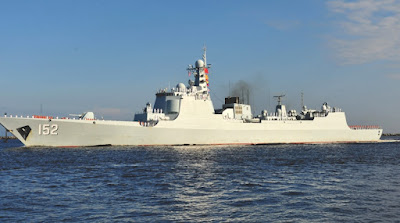
China’s navy is now the world’s largest maritime military force and will deploy 460 warships by the end of the decade, according to the Pentagon ‘s latest annual report on Chinese military power.
The current warship arsenal for the People’s Liberation Army Navy (PLAN) includes 355 naval platforms, including major surface ships, submarines, aircraft carriers, amphibious warships and mine warfare craft.
By contrast, the U.S. Navy currently has 296 warships, but that arsenal includes 11 aircraft carriers capable of projecting power at long distances. Other Navy ships include 115 cruisers and destroyers, 68 submarines, 31 amphibious warfare ships and 59 small surface combatants and combat logistics ships.
U.S. analysts say the PLAN, financed by China‘s growing economic might, is building new warships at a rapid pace, mainly guided-missile cruisers and destroyers and corvettes, while its submarine force continues to expand.
“These assets will significantly upgrade the PLAN‘s air defense, anti-ship, and anti-submarine capabilities and will be critical as the PLAN expands its operations beyond the range of the PLA’s shore-based air defense systems,” the Pentagon report, made public last week, states. “By the end of 2019, the PLAN had commissioned its 30th Jiangkai II class guided-missile frigate (FFG), completing the production run while it finalizes a follow-on class with additional units under construction.”
You can read
the rest of the piece via the below link:
https://www.washingtontimes.com/news/2021/nov/8/chinas-navy-now-worlds-largest-460-warships-2030-p/
You can also
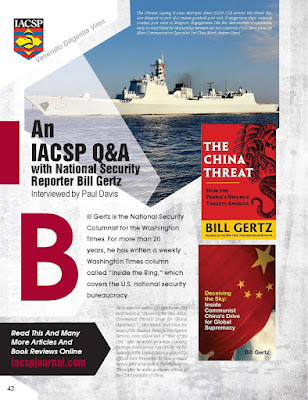
read my Counterterrorism magazine Q&A with Bill Gertz via the below link:
Note: The above U.S. Navy photo is of the Chinese Luyang II-class destroyer Jinan (DDG 152).
The U.S. Justice Department released the below information:
A federal jury convicted Yanjun Xu, a Chinese national and Deputy Division Director of the Sixth Bureau of the Jiangsu Province Ministry of State Security, of conspiring to and attempting to commit economic espionage and theft of trade secrets. The defendant is the first Chinese intelligence officer to be extradited to the United States to stand trial.
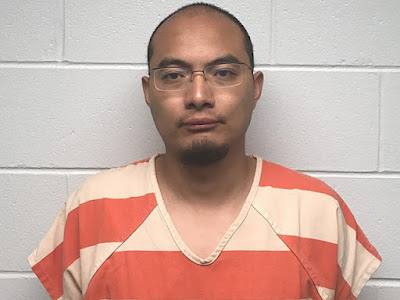
“This conviction of a card-carrying intelligence officer for economic espionage underscores that trade secret theft is integral to the PRC government’s plans to modernize its industries,” said Assistant Attorney General Matthew G. Olsen of the Justice Department’s National Security Division. “But this conviction also serves notice that the United States will not sit by as China, or any other nation-state, attempts to steal instead of researching and developing key technology. Instead, and with the support of our allies, we will continue to investigate, prosecute, and hold accountable those who try to take the fruits of American ingenuity illegally.”
“The jury, by its guilty verdict here today, held Xu accountable for his classic spy techniques,” said Acting U.S. Attorney Vipal J. Patel for the Southern District of Ohio. “Xu conspired to commit economic espionage on behalf of the Chinese government, and he tried to steal the valuable innovation and trade secrets of industry-leading American aviation technology companies. This office will continue to seek to protect American innovation and hold accountable those who attempt to steal our nation’s science and technology, regardless of status or affiliation, whether civilian, military or spy.”
“This was state-sponsored economic espionage by the PRC designed to steal American technology and put Americans out of work,” said Assistant Director Alan E. Kohler Jr. of the FBI’s Counterintelligence Division. “For those who doubt the real goals of the PRC, this should be a wakeup call; they are stealing American technology to benefit their economy and military. The FBI is partnering with over 50 U.S. Government agencies to share information and investigative resources to stop the PRC’s illegal activities.”
According to court documents and evidence presented at trial, beginning in at least December 2013, Xu used multiple aliases to target specific companies in the United States and abroad that are recognized as leaders in the field of aviation. He identified experts who worked for the companies and recruited them to travel to China, often initially under the guise that they were traveling to give a presentation at a university. Xu and others paid the experts stipends on top of covering travel costs. According to today’s conviction, Xu attempted to steal technology related to GE Aviation’s exclusive composite aircraft engine fan – which no other company in the world has been able to duplicate – to benefit the Chinese state.
In March 2017, a GE Aviation
employee in Cincinnati, Ohio, was solicited to give a report at a university in
China. The employee traveled to China two months later to present at the
university and was introduced to Xu. Xu and others paid the employee’s travel
expenses and a stipend.
In January 2018, Xu requested “system specification, design process” information from the employee and – with the cooperation of the company, who was working with the FBI – the employee emailed a two-page document from the company that included a label that warned about the disclosure of proprietary information.
In February 2018, Xu began discussing with the employee the possibility of meeting in Europe during one of the employee’s business trips and asked the employee to send a copy of the file directory for his company-issued computer.
Xu traveled to Belgium on April 1, 2018, to meet with the employee and was arrested at that time.
Xu was convicted of two counts
of conspiring and attempting to commit economic espionage, which carries a
maximum statutory penalty of 15 years in prison for each count and a fine of up
to $5 million. Xu was also convicted of conspiracy to commit trade secret theft
and two counts of attempted theft of trade secrets, which carries a maximum
statutory sentence of 10 years in prison for each count and a $250,000 fine. A
federal district court judge will determine any sentence after considering the
U.S. Sentencing Guidelines and other statutory factors.
The FBI investigated the case.
Assistant Deputy Criminal Chief Timothy S. Mangan and Deputy Criminal Chief Emily Glatfelter for the Southern District of Ohio and Trial Attorney Matthew J. McKenzie of the National Security Division’s Counterintelligence and Export Control Section are prosecuting the case.
The Criminal Division’s Office of International Affairs secured Xu’s extradition to the United States, with valuable assistance provided by the government of Belgium and the Belgian Federal Police.
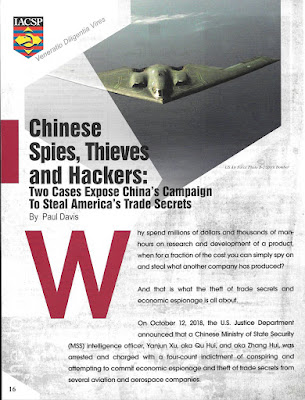
You can also read my Counterterrorism magazine piece that covered the Xu case and more via the below link: