Showing posts with label Casino Royale. Show all posts

Tuesday, August 12, 2025

On This Day In History Ian Fleming, Former WWII British Naval Intelligence Officer, Journalist And Author Of The James Bond Thrillers, Died

On this date in 1964 Ian Fleming, former WWII naval intelligence officer, journalist and author of the James Bond thrillers, died. He was 56.

I became an Ian Fleming aficionado when I was a pre-teen in the early 1960s after watching the late, great Scot actor Sean Connery portray Ian Fleming’s iconic character James Bond in the first two Bond films, Dr. No and From Russia With Love.

Watching the two great cinematic thrillers led me to join a book club and receive the introductory offer of a 9-volume set of Ian Fleming’s novels, which were the first nine books in my now quite extensive library. 

Reading the first two Fleming novels, I was pleased to discover that the novels were darker and more complicated that the films.  

A short time later, I heard on the radio in my father's car that Ian Fleming had died.   

A house on a beach

AI-generated content may be incorrect.

Years later, in the early 1980s, I was thrilled to spend a week with my wife at Fleming's villa Goldeneye in Jamaica, where he wrote all of the James Bond thrillers.   

A screenshot of a website

AI-generated content may be incorrect.

A person holding an object

AI-generated content may be incorrect.

As History.com notes, Ian Fleming led an interesting, if all too short, life: 

On August 12, 1964, the British author and journalist Ian Fleming, creator of James Bond, the world’s most famous fictional spy, dies of a heart attack at age 56 in Kent, England. 

Fleming’s series of novels about the debonair Agent 007, based in part on their dashing author’s real-life experiences, spawned one of the most lucrative film franchises in history. Ian Lancaster Fleming was born into a well-to-do family in London on May 29, 1908. As an adult, he worked as a foreign correspondent, a stockbroker and a personal assistant to Britain’s director of naval intelligence during World War II–experiences that would all provide fodder for his Bond novels. 

You can read the rest of the piece via the below link:

James Bond creator Ian Fleming dies - HISTORY 

A person in a uniform standing in front of a sign

AI-generated content may be incorrect.

You can also read my Counterterrorism magazine piece on Ian Fleming's war and two of my Crime Beat columns on Ian Fleming via the below links:

Paul Davis On Crime: My Piece On The 30 Assault Unit, The British WWII Commando Group Created By Ian Fleming, The Creator Of James Bond

Paul Davis On Crime: My Crime Beat Column: A Look Back At Ian Fleming's Iconic James Bond Character

Paul Davis On Crime: My Crime Beat Column: The Ian Fleming and James Bond Phenomenon

A book cover of a casino royale

AI-generated content may be incorrect.

A broken glass and a watch

AI-generated content may be incorrect.

A book cover with an object and text

AI-generated content may be incorrect.

A poster of a person holding a flute

AI-generated content may be incorrect.

A book cover with an object and pictures

AI-generated content may be incorrect.

A book cover with a person sitting on a car

AI-generated content may be incorrect.

A book cover with a bag and a picture of a person

AI-generated content may be incorrect.


Thursday, April 13, 2023

Happy 70th Birthday, Mr. Bond: On This Day In History 'Casino Royale,' Ian Fleming's First James Bond Thriller, Was Published

On this date in 1953 Casino Royale, Ian Fleming's first James Bond thriller, was published.

Fleming, a British journalist and WWII naval intelligence officer, wrote the gripping thriller while on holiday at his Jamaican villa, Goldeneye. Raymond Chandler, a friend and fellow thriller writer, believed that Casino Royale was Fleming's best novel.  

Ian Fleming would go on to write more Bond novels and short stories and millions of copies of his books have been sold around the world. 

The film series based on Fleming's Bond novels, which began with Dr No in 1963, is one of the most successful film series in cinematic history.

Scottish actor Sean Connery appeared as James Bond in the early Bond films in the 1960s. Daniel Craig appeared as James Bond in the 2006 film Casino Royale.  

Ian Fleming died in 1964 at the age of 56. 

You can read my Crime Beat columns on Ian Fleming and James Bond via the below links: 

http://www.pauldavisoncrime.com/2013/11/my-crime-beat-column-happy-anniversary.html  

http://www.pauldavisoncrime.com/2010/06/casino-royale-revisited-film-that.html 

Friday, August 12, 2022

On This Day In History Ian Fleming, The Creator Of James Bond, Died

On this day in 1964, Ian Fleming, the author of Casino Royale, From Russia With Love, Goldfinger, and other classic thrillers that featured his iconic character James Bond, died. He was 56.


You can read my Counterterrorism magazine piece on Ian Fleming's WWII service as a naval intelligence officer via the below link:


And you can read two of my Crime Beat columns on Ian Fleming via the below links:


Wednesday, November 13, 2019

'Extraordinary' Letters Between Ian Fleming And Wife To Be Sold


Mark Brown at the Guardian offers a piece on the sale of the late, great thriller writer Ian Fleming's letters to his late wife Ann.

An extraordinary stash of letters that shine a light on the tangled relationship between the James Bond creator Ian Fleming and his wife, Ann, from their intense and secret affair to the bitter end of their marriage, are to appear at auction.

Sotheby’s is selling more than 160 letters between the couple, written over 20 years. Gabriel Heaton, a specialist in books and manuscripts at the auction house, said the letters in their scope and scale provided what “must surely be an unmatchable record of the life of the author as his fortunes changed”.
They also provide insight into the rise of Bond. Heaton said it was no coincidence that Fleming wrote his first Bond novel, Casino Royale, in the year of his marriage.
… Heaton said the letters were packed with stories of high society, travel, love of nature and gossip.

“They are quite something, it has been a real treat,” he said. “They are an extraordinary read because Ian Fleming is pretty much incapable of writing a dull sentence.” 
You can read the rest of the piece via the below link:

https://www.theguardian.com/books/2019/nov/11/extraordinary-letters-between-ian-fleming-and-wife-to-be-sold 

Saturday, September 15, 2018

Shaken: Drinking With James Bond And Ian Fleming


The website jamesbondlifestyle.com looks at Shaken, the new book on Ian Fleming’s iconic character James Bond and his drinking pleasures.

Shaken explores James Bond creator Ian Fleming’s writings on the pleasures of drinking, the stories behind the Bond phenomenon and drinks inspired by 007 and his creator.

From the first Ian Fleming James Bond novel Casino Royale (1953) in which agent 007 invents the now famous Vesper Martini, to the immortal lines, ‘shaken and not stirred’, which first appeared in print in Diamonds Are Forever (1956) strong, carefully crafted cocktails are at the glamorous heart of every Bond story. Shaken explores James Bond creator Ian Fleming’s writings on the pleasures of drinking, the stories behind the Bond phenomenon and drinks inspired by 007 and his creator.

You can read the rest of the piece via the below link:


You can also go to www.ianfleming.com to read about the book. 

Friday, April 27, 2018

How To Drink Like Ernest Hemingway, Ian Fleming, And Other Literary Greats


Philip Greene, author of To Have and Have Another: A Hemingway Cocktail Companion, offers a piece at the Daily Beast on Ernest Hemingway and Ian Fleming, two writers who drank and wrote about Campari and other drinks.  

 European watering holes have been seducing writers for decades. A long afternoon spent writing (or supposedly writing) at a sidewalk café, usually accompanied by an apéritif, has a certain allure and draw. Ernest Hemingway wrote of his “good café” and extolled the virtues of “a clean, well-lighted place.” Malcolm Cowley pined for those days on the café terrace, “with a good long drink and nothing to do but drink it.”

And often, from the research I’ve done for my books, those writers enjoyed the bitter apéritif Campari and, naturally, included it in their novels, memoirs and poems.

The liqueur was invented by Gaspare Campari in the 1860s at the Bass Bar in Turin, Italy, where he worked as a maitre licoriste, or master bartender. Campari is a secret blend of natural ingredients, mostly herbs, spices, bark, fruits and fruit peels. Its distinctive carmine hue originally derived from dye extracted from the cochineal, a beetle-like insect native to Latin America.

… Coincidentally, it was in Milan where Ernest Hemingway discovered Campari, just two years after Lawrence released Twilight. At age 18, Hemingway served in the International Red Cross Ambulance Corps, and was severely wounded during an Austrian mortar attack on the Italian lines near Venice. Evacuated to a hospital in Milan, he spent the summer and fall of 1918 recovering from 227 shrapnel and bullet wounds to his legs. Friends would bring him wine and spirits to help him deal with his pain (and boredom). As he recalled in his memoir A Moveable Feast, one of these friends was an “old man with beautiful manners and a great name who came to the hospital in Italy and brought me a bottle of Marsala or Campari and behaved perfectly, and then one day I would have to tell the nurse never to let that man into the room again.” When he later recounted this tale to Gertrude Stein, she brusquely replied, “those people are sick and cannot help themselves and you should pity them.” Hmmm, but the old guy did have good taste in booze, no?


…Another famous novelist and imbiber, Ian Fleming, was also a Campari fan. In fact, the first drink ever enjoyed by his signature character, James Bond, who is, of course, known for ordering a Vesper and his “shaken, not stirred” Martini, was actually the Americano. It makes an appearance in Fleming’s first Bond novel, Casino Royale, published in 1953:

“Bond ordered an Americano and examined the sprinkling of overdressed customers, mostly from Paris he guessed, who sat talking with focus and vivacity, creating that theatrically clubbable atmosphere of l’heure de l’apéritif. The men were drinking inexhaustible quarter-bottles of Champagne, the women Dry Martinis.”

Speaking of Paris, Fleming reveals his disdain for the City of Light’s cocktail scene in his 1960 short story “From a View to a Kill.”

“James Bond had his first drink of the evening at Fouquet’s. It was not a solid drink. One cannot drink seriously in French cafés…No, in cafés you have to drink the least offensive of the musical comedy drinks that go with them, and Bond always had the same thing—an Americano—Bitter Campari, Cinzano, a large slice of lemon peel and soda. For the soda he always specified Perrier, for in his opinion expensive soda water was the cheapest way to improve a poor drink.”

You can read the rest of the piece via the below link:


Friday, April 13, 2018

On This Day In History 'Casino Royale,' Ian Fleming's First James Bond Thriller, Was Published


On this date in 1953 Casino Royale, Ian Fleming's first James Bond thriller, was published.


Fleming, a British journalist and former naval intelligence officer, wrote the gripping thriller while on holiday at his Jamaican villa, Goldeneye. Raymond Chandler, a friend and fellow thriller writer, believed that Casino Royale was Fleming's best novel.  

You can read about Casino Royale via the below link:


Ian Fleming would go on to write more Bond novels and short stories and millions of copies of his books have been sold around the world. The film series based on Fleming's Bond novels, which began with Dr No in 1963, is one of the most successful film series in cinematic history. 

Ian Fleming died in 1964 at the age of 56. 


You can also read my Crime Beat columns on Ian Fleming and James Bond via the below links:


Tuesday, January 6, 2015

Rush Is Right: James Bond Is White - Here's A Big Reason Why


Joe Concha at mediaite.com weighs in on the black James Bond controversy, highlighted by conservative radio commentator Rush Limbaugh's comments that Bond was white and should only be played by white actors.

Give Rush Limbaugh credit: the guy certainly knows how to stir a debate over topics few would touch for politically correct reasons.

The latest controversy stirred up by the 63-year-old radio icon (and regardless of your opinion on Rush’s politics, the “icon” label has absolutely been earned, given his huge audience and decades of success in the business) surrounds the prospect of Idris Elba–a black British actor–playing James Bond on the big screen.

And as you may have heard, Limbaugh is staunchly against the idea, stating, “That’s NOT who James Bond is, and I know it’s racist to probably even point this out: We had 50 years of white Bonds because Bond is white. Bond was never black. Ian Fleming never created a black Brit to play James Bond. The character was always white. He was always Scottish.”

The argument against Rush is that a fictional character can be whomever since he isn’t based on an actual person. That said, it’s not Limbaugh’s opinion that matters here, nor Sony’s, regardless of holding rights to the franchise. Instead, the only person who has a say in who exactly Bond is… is one Ian Fleming, who created 007 in his mind back in 1952 when writing the first of many books on the spy character starting with the timeless Casino Royale.

So just how did Fleming–who passed away back in 1964–imagine Bond looked like? To find the answer, one has to go back to 1958, when the author agreed to allow London’s Daily Express to create a Bond comic strip, but only under the condition that all published material must be approved by him and him only. Once an agreement was finalized, Fleming hired an artist to draw a portrait of how he envisioned Bond would look like:


You can read the rest of the piece via the below link:

http://www.mediaite.com/online/rush-is-right-james-bond-is-white-heres-a-very-big-reason-why/

You can also read my Crime Beat column on a black James Bond via the below link:

http://www.pauldavisoncrime.com/2014/12/my-crime-beat-column-black-james-bond.html

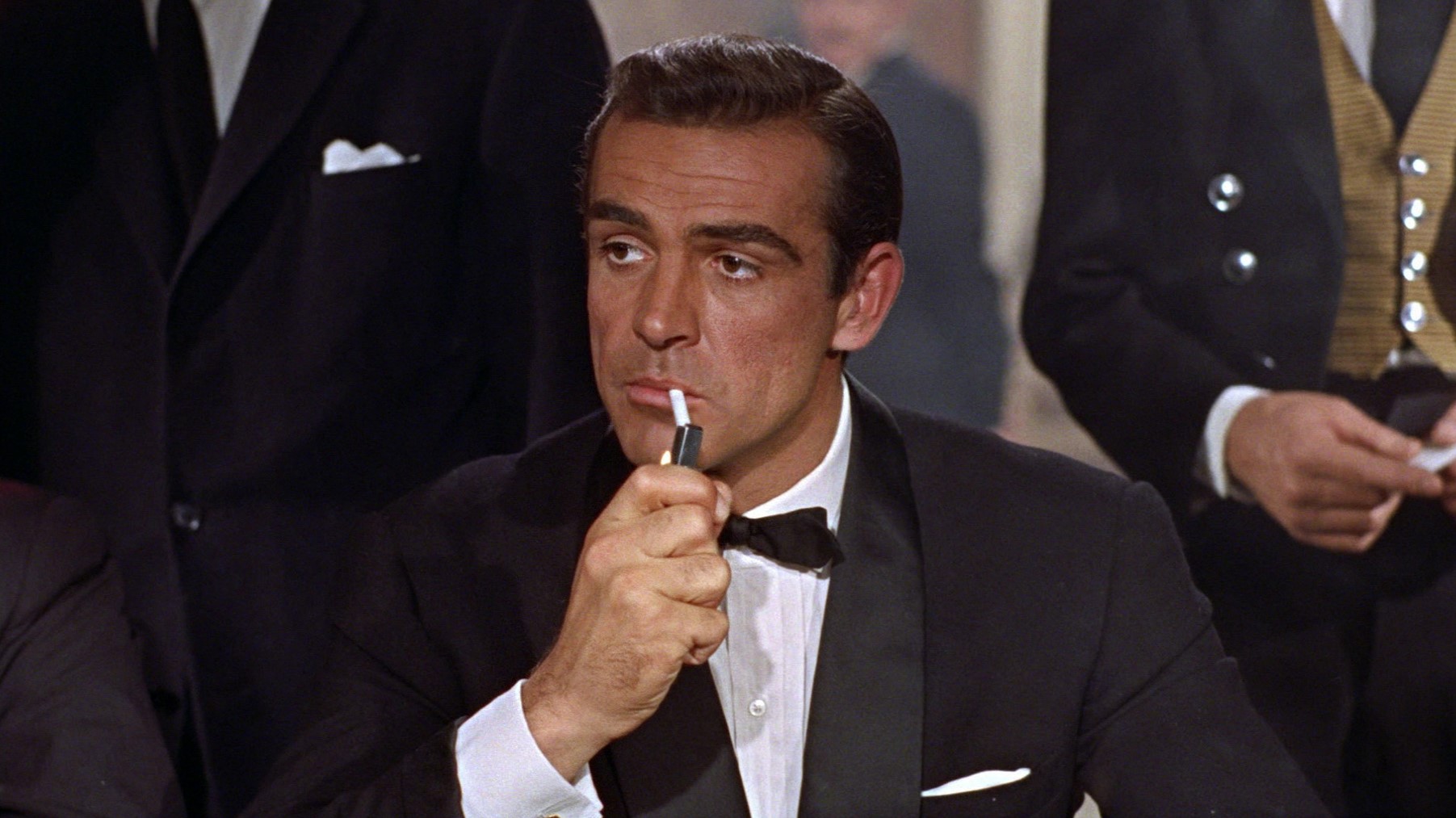
Note: The top photo show Sean Connery - the actor Joe Concha correctly calls the "Gold Standard" for portraying James Bond - as he first appears as Bond in the first Bond film Dr No. 

Tuesday, December 9, 2014

The First James Bond Car In The Ian Fleming Thrillers Was A Bentley


Jordon Golson at wired.com offers a piece on James Bond's first car, the Bentley.

James Bond is almost synonymous with Aston Martin, and his newest ride, the Aston Martin DB10, is a gorgeous one-off created specifically for the forthcoming movie Spectre. It calls to mind the glorious DB5 from Goldfinger, a car that is almost as iconic as 007 himself.

But before James Bond was the dashing and debonair secret agent on the silver screen, he was the tormented and brooding assassin of Ian Fleming’s novels. And in those books, he drove a Bentley.

In Fleming’s first 007 novel, Casino Royale, published in 1953, Bond tooled around in a 1931 4.5 Litre Blower Bentley. It wasn’t so sleek or sexy as the Astons that Bond would come to be known for, but it was among the finest cars of its day and just the thing for getting around in all due haste with style.

Bond was, in Casino Royale, something of a car nut and his beloved Bentley was “his only personal hobby.” He bought it in 1933 and kept it in storage while serving in World War II. “Bond drove it hard and well and with an almost sensual pleasure.” 

You can read the rest of the piece via the below link:

http://www.wired.com/2014/12/first-bond-car-actually-monster-bentley/

Note: James Bond (Sean Connery) stands before his Bentley in the above photo from Never Say Never.

Thursday, October 3, 2013

The Real Reason Ian Fleming Wrote 'Casino Royale,' The First James Bond Thriller


Andrew Lycett, the author of good biograhy of Ian Fleming, offers a piece on huffingtonpost.com on why Fleming wrote the first James Bond thriller.

Ian Fleming's mind was a jumble of conflicting thoughts and emotions when he sat down to his first draft of Casino Royale in Jamaica in February 1952.

He liked to joke that he finally got round to writing his first James Bond novel because he needed something to take his mind off his impending marriage to Ann, the striking dark-haired aristocratic woman with whom he had an on-off affair for over a decade, and who had recently divorced her second husband, Lord Rothermere, owner of the powerful Daily Mail newspaper.

But this was a typical Fleming flim-flam. He had been talking for several years about his desire to write the 'spy novel to end all spy novels'. But his attention had simply drifted in other directions.

After hostilities ended, he had been recruited as Foreign Manager of another London-based newspaper, the Sunday Times, a job that required him to build up a network of foreign correspondents, not so different from the agents with whom he liaised when he was the influential war-time Personal Assistant to the Director of Naval Intelligence, Admiral John Godfrey.

In that earlier job, he had been Godfrey's gate-keeper in Room 39 of the Admiralty. He dealt directly with MI6 and the other secret services on behalf of his boss. He saw agents going to and returning from the field. He played a major role in liaising on intelligence matters with President Roosevelt's special enjoy, Colonel "Wild" Bill Donovan, whom he visited in Washington in the summer of 1941 and helped draw up guidelines for the combined US intelligence agency which would later become the Office of Strategic Services (OSS) and then the Central Intelligence Agency (CIA). One of his memos detailing the ideal American agent seems in retrospect to anticipate the qualities of James Bond. Donovan later presented him with a .38 Colt Police Positive revolver inscribed "For Special Services."

Fleming was essentially a bureaucrat during the war. But, being an imaginative man (he had written poetry in his youth), he could not help thinking about a more active role as a secret agent.

Before James Bond could make his first appearance at Royale Les Eaux in Casino Royale, however, Fleming had to get his own life in order. 

You can read the rest of the piece via the below link:

http://www.huffingtonpost.com/andrew-lycett/ian-fleming-book_b_4024547.html


You can also read my column on Ian Fleming and James Bond via the below link:

http://www.pauldavisoncrime.com/2010/06/casino-royale-revisited-film-that.html

Thursday, September 26, 2013

Bond Is Back, In William Boyd's New Novel 'Solo'


ABC News offers a piece on the William Boyd's new continuation novel featuring Ian Fleming's iconic character, James Bond.

William Boyd has left James Bond stirred, if not shaken.

The British writer has taken on the fictional spy in "Solo," a new 007 novel that balances fidelity to Ian Fleming's iconic character with subtle changes.
 
Bond fans will find much they recognize, along with some surprises — one of which is that in Boyd's mind, James Bond looks like Daniel Day-Lewis.
 
Boyd says Fleming once described the spy as "looking like the American singer-songwriter Hoagy Carmichael. Daniel Day-Lewis looks like Hoagy Carmichael."
 
"Solo" is set in 1969, and takes the suave British spy from London's plush Dorchester Hotel to a war-ravaged West African country and on to Washington on a perilous lone mission.
 
Boyd steers Bond away from his big-screen action-hero image and back toward the complex and conflicted character of Fleming's novels.
 
"Even though he's this handsome superspy, when you read the books you realize that he's haunted," Boyd told The Associated Press on Wednesday.
 
"He's not a cartoon character. Fleming gave him all his traits, his tastes, his likes and dislikes — and his complexes. Bond has a dark side. He's troubled sometimes. He weeps quite easily. And he makes mistakes. That's what's so interesting about him."  
 
You can read the rest of the piece via the below link:
 
 
Note: I agree that a younger Daniel Day-Lewis fits Ian Fleming's description of the Bond character, certainly far better than Daniel Craig, but at 54, he is perhaps a bit too old to slap on the Walther PPK.

Still, he is a great actor and I'd like to see him portray Bond.
 
Also, Vesper Lynd in the novel Casino Royale tells Rene Mathis that Bond resembles Hoagy Carmichael, and he tells Bond. Bond later looks in the mirror and mutters to himself, "Not much Hoagy Carmichael there."  

Sunday, April 14, 2013

Early Draft Of 'Casino Royale' Reveals Cover Name For Ian Fleming's James Bond Character


Although Ian Fleming had James Bond use operational cover names in some of the novels - Mark Hazard in The Man With the Golden Gun, for example - Liam O'Brien at the British newspaper the Independent reports that in an early draft of Fleming's first Bond novel, Casino Royale, Bond had a cover name.

James Bond creator Ian Fleming originally wanted to call his hero James Secretan when on secret missions, an early draft of Casino Royale has revealed.

Perhaps sensing that “Secretan… James Secretan” didn’t have quite the same ring as the iconic introduction, “Bond… James Bond”, he disposed of the idea before the first Bond novel’s publication in 1953.

An extract from the 1952 draft version is to be made public to coincide with the book’s 60th anniversary this weekend.

In the manuscript, a CIA man introduces himself to 007 at the Hotel Splendide casino by saying: “My name’s Felix Leiter. Glad to meet you.” Bond replies: “Mine’s Secretan. James Secretan.” The word “Secretan” is scrawled out in blue ink, with “Bond” written in its place.

The author’s niece, Kate Grimond, told The Sunday Times of Fleming’s potential reasons for dropping the idea.

“Ian must have realised it would cause confusion if he had Bond known as Bond to his friends and the security services in London, but as Secretan for his cover name to strangers or people he didn’t want to know he was a spy.”   

You can read the rest of the story via the below link:

http://www.independent.co.uk/news/uk/home-news/the-names-secretan-james-secretan-early-draft-of-casino-royale-reveals-what-ian-fleming-wanted-to-call-his-super-spy-8572375.html 

Tuesday, March 26, 2013

The Birth Of Bond: The 60th Anniversary of Ian Fleming's 'Casino Royale' To Be Celebrated At University Of Illinois


The University of Illinois  plans to celebrate the 60th anniversary of the publication of Ian Fleming's first James Bond thriller, Casino Royale.

CHAMPAIGN, Ill. — “The scent and smoke and sweat of a casino are nauseating at three in the morning.” That’s the opening line of “Casino Royale,” the novel that introduced secret agent James Bond to the world, launching a franchise of books and blockbuster movies that continues to this day. April 13 marks the 60th anniversary of the publication of “Casino Royale,” and the University of Illinois will recognize the event with a collaborative celebration hosted by the Rare Book and Manuscript Library, the Spurlock Museum, and the Sousa Archives and Center for American Music.

Titled “The Birth of Bond: Ian Fleming’s ‘Casino Royale’ at 60,” the event will feature a collection of first editions, manuscripts and Fleming ephemera at the Rare Book and Manuscript Library; a film festival and display of Bond movie costumes and props at the Spurlock Museum; a collection of audio recordings, photographs and sheet music (including the original 2006 “Casino Royale” score) at the Sousa Archives; and a performance of music from the Bond movies and books by the U. of I. Concert Jazz Band.

You can read the rest of the piece via the below link:

http://news.illinois.edu/news/13/0325james_bond60.html

Friday, April 13, 2012

James Bond: Never Say Die

 
Ron Charles at the Washington Post interviewed William Boyd, the Scottish author will pen the next James Bond continuation novel.

Boyd, whose sexy World War I thriller “Waiting for Sunrise” will be published next week, expects to bring out his Bond novel in 2013 — 60 years after “Casino Royale.”

Boyd said: "I think the first thing to do is to separate the Bond movies from the Bond novels. The “literary” Bond is a far more intriguing and nuanced character than the cinematic version. He is more troubled and flawed, and because he’s in a novel — and not in some cartoonesque action-movie — he seems far more human."

You can read the rest of the piece via the below link:

http://www.washingtonpost.com/blogs/arts-post/post/james-bond-never-say-die/2012/04/13/gIQAijuFFT_blog.html

Wednesday, March 2, 2011

Discovering The Lost Script Of Casino Royale, Written By The "Shakespeare of Hollywood," Ben Hecht

In the 1960s James Bond was King at the box office and Sean Connery WAS James Bond, according to the movie advertisements.

In 1966 a film producer who held the film rights to a single Ian Fleming novel, Casino Royale, attempted to buck the powerful Bond film producers by making a rival Bond film.

Rather than compete with Connery and the Bond series, the producer ended up making a broad awful comedy (although there are some funny bits) rather than a thriller.

But before he made the comedy, the producer hired "the Shakespeare of Hollywood," Ben Hecht (seen in the below photo), author of The Front Page, to write a screenplay that closely followed Ian Fleming's dark thriller.

I happen to be reading a collection of Hecht's columns, 1001 Afternoons in Chicago this week, when I came across a story in the British newspaper The Telegraph that reveals that Hecht's Casino Royale script drafts have been discovered.

You can read the newspaper story via the below link:
*

Thursday, June 17, 2010

My Crime Beat Column: The Ian Fleming and James Bond Phenomenon


The below column originally appeared in The Orchard Press Online Mystery Magazine in 2006.

A British Royal Navy Commander visited Jamaica in 1944 for a conference on the threat of Nazi U-boats in the Caribbean. He fell in love with the island.

Commander Ian Fleming was a slim and athletic 6'2", with black hair and blue eyes. Many of his women friends described him as having cruel good looks, his broken nose adding a touch of ruggedness.

Fleming returned to Jamaica after the war and purchased an old donkey race track in Oracabessa on the North Coast. His built his villa – called Goldeneye - on a bluff overlooking a private beach and the Caribbean. He would spend every January and February there until his death in 1964.

To get over the shock of getting married at the age of 44, he often said, he sat down at his typewriter at Goldeneye in 1952 and wrote his first novel Casino Royale. The novel, published in 1953, introduced the world to a debonair and deadly British secret agent named Bond, James Bond.

Casino Royale, the 21st installment in the world’s most successful film series featuring Fleming’s Bond, opened on November 17th. The thriller features a new actor in the role of Bond, Daniel Craig.

“It has been a long time ambition for us to film the first book in the series, Casino Royale, which defined the complex character of James Bond,” said the producers, Michael G. Wilson and Barbara Broccoli. “Daniel is a superb actor who has all the qualities needed to bring a contemporary edge to the role. Casino Royale will have all of the action, suspense and espionage that our audiences have come to expect from us, but nevertheless takes the franchise in a new and exciting direction.”

The film was directed by Martin Campbell, who also directed Pierce Brosnan’s first outing as Bond in GoldenEye in 1995. Casino Royale was filmed in the Czech Republic, the Bahamas, Italy and the United Kingdom.

The film has opened to rave reviews and box office success and the film has fueled a renewed interest and respect for Ian Fleming, who died in 1964 at the age of 56.

Since first viewing Dr No in a South Philadelphia movie theater in 1963 when I was eleven years old, I’ve been a serious Bond fan. I went on to read the Fleming novels as a pre-teen and teenager and I was amazed that they were darker, more complex, and far more intriguing than the films. I’ve been a Fleming aficionado ever since.

Born on May 28th 1908 and educated at Eton and Sandhurst , Fleming worked as a journalist at Reuters prior to WWII, reporting from London , Berlin and Moscow. He was a special correspondent for The Times of London in Moscow in 1939 and entered British Naval Intelligence later that year.

He served as the assistant to the Director of Naval Intelligence. After the war, he became The Sunday Times' foreign manager. His experience as a naval intelligence officer and a journalist enabled him to write knowledgeably about espionage, crime and terrorism.

The character of James Bond found in the novels was based in part on the WWII commandos, secret agents and intelligence officers Fleming met during his service. He conceived of Bond as merely a cipher, a blunt instrument for Her Majesty’s Secret Service. But Fleming said he also infused Bond with his own personal quirks and characteristics.

The Bond character in the films had become exaggerated to the point of self-parody, so I was pleased that the producers were returning to the first novel as source material and made Casino Royale as a true thriller.

The choice of actor to portray this back-to-basics Bond set off a heated debate in work places, bars, cafes and on the Internet. The selection of the blond and not particularly handsome Craig enraged many fans that preferred Brosnan, the previous actor to portray Bond in four films. But for many of the older fans, like me, there is only one actor who is the ideal Bond - Sean Connery.

Beginning in 1962 with Dr No, the Bond films attracted a world-wide audience that loved the suave, yet rugged Connery as Bond. From Russia With Love and Goldfinger followed and the James Bond craze ignited, creating imitators in film, TV, novels, advertisements and launching a huge business in merchandising and collectibles. To date, the Bond film series has earned more than $4 billion, according to the-numbers.com.

Prior to the release of the new film, I set out to talk to a number of other Fleming aficionados about the film, the new actor and the cultural influence of Ian Fleming and his blunt instrument, James Bond.

“Bond had a tremendous influence on film, television, style and the political spectrum,” said Steven Watt, an English Professor at Indiana University and the author of Ian Fleming and James Bond: The Cultural Politics of 007.

“Fleming was way ahead of his time when he invented SPECTRE, a mobile, multi-national group, headed by a mad genius, mostly made up of cells of hardened criminals, loyal to no nation, only to each other, and that one of their principle objectives is to produce terror. They would be a lot more difficult to beat than a clunky Soviet machine – and he was right!”

“Who else in the 1960s was talking about nuclear blackmail and chemical and biological warfare?” Watt added.

Watt noted that there was much to be learned from Fleming in terms of the evolution of the enemies of the West and on the level of sexuality, ethnicity, global politics, and popular culture.

Watt was one of the organizers of a conference on Ian Fleming at Indiana University in 2003. The University’s Lilly Rare Library purchased Ian Fleming’s entire library in the 1970s, including his papers, the literature he owned, naval and military histories and unpublished and little-known works.

“For people interested in Fleming, the Lilly Library has become a depository of great interest,” Watt said. “Fleming was an extremely literate man, a collector of high modernist work. I think he was an excellent writer. He was a great craftsman and his prose style, though be it fairly direct and simple, is interesting. And certainly he was writing from a pretty intense knowledge of some exotic cities.”

“I think he holds up pretty well in the context of Dashiell Hammett and Raymond Chandler,” Watt said.

Watt explained that the English Department and the Lilly Library sponsored the conference, which attracted academics, historians, scholars and writers. Watt explained that one group took the position that if you don’t know anything about Britain during the Cold War, you don’t know anything about Fleming and the audience for whom he wrote these novels, and there was a second group, a series of younger scholars, who said they were not interested in the novels, they were only interested in the way the characters evolved on film.

Watt, a scholar of Anglo-Irish culture, whose major interests are 19th and 20th Century Irish culture, has published books on James Joyce and Sean O’Casey and a book on Samuel Beckett. He also considers himself a scholar on Fleming and he teaches a course on Cold War culture that includes Fleming in the 1950s and 60s.

Watt said that as the Connery era grew, the films became less and less reliant on the novels and by the time Connery came back for Diamonds Are Forever and Roger Moore assumed the role, they left the novels behind. Watt said he was glad the producers were returning to the novels as a source for the newest film. 

“The novel Casino Royale is extremely interesting, extraordinarily sinister and very dark,” Watt said. “Casino Royale has never been given its proper due. As the first Bond novel and one of the darker Bond novels, it never received anything resembling an adequate film treatment.”

“I think Craig will turn out to be an excellent choice. Terrorism is a huge, serious, important issue - much more important than 25 years ago when Roger Moore was cavorting around – and the James Bond of today has to be a tough guy, a serious guy.”


He saw Dr No and From Russia With Love on their original theatrical release in the United Kingdom , but Graham Rye said it wasn’t until he saw Goldfinger in 1964 that he was inspired to read the Fleming novels. He was so hooked, he said, that his interest in Bond has been his career for more than 25 years.

“I think the success of both the books and the films are down to both appearing at just the right time in a historical sense,” said Rye , who is the editor and publisher of 007 MAGAZINE OnLine (http://www.007magazine.co.uk/) and the author of The James Bond Girls.

“In 1953 when Jonathan Cape published Fleming’s first Bond novel Casino Royale, Great Britain was still going through post-war doldrums; it was a very grey time,” Rye explained. “Fleming’s books achieved just the right strength cocktail of exotic sex, violence and adventure to lift the reader out of the harsh realities of everyday life and into the pages with his hero secret agent James Bond.”

Rye went on to say that after all the kitchen-sink/social dramas and neo-realism of British cinema of the Forties and Fifties, film producers Cubby Broccoli and Harry Saltzman came together at exactly the right time to form a partnership in cinema that remains unequaled to this day.

“Their partnership developed a series of films that have brought untold happiness to billions of people around the world, and still do, and wealth to many of the creative participants in the most enduring film franchise of all time,” Rye said. “I think the world has a lot to be thankful for from Messrs Fleming, Broccoli and Saltzman. Not to mention a certain Scottish knight – Sean Connery!”

 “There has only ever really been one actor for me who was and will forever remain James Bond – Sean Connery,” Rye said. “Other actors have put in some good performances as Bond, but the gap between them and Sean as Bond is the Grand Canyon.”

Rye said that George Lazenby could have grown into a Bond who would have given Connery competition, judging by his first and only outing in 1969’s On Her Majesty's Secret Service. Rye believes the film is the best overall depiction of Fleming’s Bond in the film series, due mostly the film’s director Peter Hunt, and it’s his favorite Bond film and book.

“Roger Moore could never take playing Bond seriously, which was fine by me because I could never take Roger Moore playing Bond seriously, and for the following seven films over the next 12 years I’m afraid my interest in the Bond film series reached an all-time low,” Rye said.

Rye said that Timothy Dalton’s fresh new approach to the Bond role in 1987’s The Living Daylights won him and the series many new fans in a debut that Rye felt was as exciting as it was impressive. Unfortunately, Rye said this all fell apart in his second Bond picture, 1989’s Licence To Kill. Rye explained that the six-year delay between Bond pictures caused by legal wrangles between EON Productions and the financing studio MGM, made it clear that EON should search for a new Bond actor for their 17th film.

Pierce Brosnan, who ironically lost out to Dalton in the role for The Living Daylights, took over as Bond in the 1995 GoldenEye. Rye said the film made significantly more than its predecessor, but was far less impressive.

“Brosnan became christened MGM’s ‘Billion Dollar Bond’ in all the trade ads, before eventually being unceremoniously dumped by the producers after the huge financial success, but almost universal panning, of 2002’s Die Another Day,” Rye said.

Rye believes that Daniel Craig will make an excellent Bond. Noting that the world has changed almost beyond recognition in his lifetime, and since Dr. No in 1962, the 44-year life cycle of the series of films has reflected the changing world in which they are made, so it seems sensible to Rye to “reboot” the character for the 21st century-style of film making.

“While not all of this new turn of affairs is to my own personal taste, Bond is bigger than anyone and will no doubt continue to live on beyond many lifetimes,” Rye said. “I certainly hope so because it has given me a great deal of fun and excitement and I’d like to think kids of the future will have the same chance to see and enjoy this wonderful series of films and read Ian Fleming’s novels.”

I agree with Rye, but differ on his assessment of License To Kill, which I very much liked. I liked that the film took material from Fleming's novels, such as the bait warehouse scene in Florida. I especially liked Robert Davi as the drug kingpin villain. And I also liked Dalton's portrayal of Bond. In my view, he offers the second best Bond portrayal in the series, with Connery, of course, being the best.

Now a new generation will be reading the Fleming novels in part due to the new film and in part to the re-issue of the novels by Penguin Press’s Modern Classics.

“Ian Fleming has shaped British sensibilities now for over half a century and by almost any standard the Bond novels have to be viewed as modern classics,” said Simon Winder, the publishing director of Penguin Press and the author of The Man Who Saved Britain: A Personal Journey into the Disturbing World of James Bond, a humorous look at the Bond phenomenon.

“At a time when many of his contemporaries from the 1950s have dropped from view, Ian Fleming's invention, thanks to the overwhelming success of the films, continues to resonate in a world fantastically different from the one in which Bond was invented.”

Winder ran Penguin Modern Classics and was involved in buying the rights for Penguin to publish the Bond novels. He said it struck him as both provocative and correct to put the Fleming novels in the series.

“Fleming is one of the three great 1950s visionaries in British literature--together with Arthur C. Clarke and J R R Tolkien - all despised at the time as 'genre' writers, but who have between them had an incalculable effect on world literature, while their notionally more serious contemporaries have almost faded from sight,” Winder said.

Winder said he wrote his book on Fleming and Bond as he was trying to make sense of his own experience – that of a fan in the early 1970s, who at age ten, first watched Live and Let Die.

“I thought it was the pinnacle of sophistication, only to realize as an adult that it was rubbish,” Winder said. “The book takes this point to go back over Ian Fleming's life, the books and the early films to pick apart, in a jokey way, what made them tick.”

“Bond sprung into being in the 1950s because Britain was in a sort of horrible free-fall - the empire falling to bits, the economy in tatters, no real friends, and run by a gang of weird gentlemen with no real vision of how to get out of the mess.”

Bond was invented by Fleming, Winder explained, to reassure the British that while the day-to-day reality was a humiliating fiasco, in secret they were still saving the world. This struck him as an amusing, though admittedly not entirely original, perception and the book plays with this idea through Fleming's life, through the books and the films.

Winder said that he would like to see the producers remake Live and Let Die, Diamonds Are Forever, and the other poor Bond films, with the second try being more faithful to the Fleming novels in the way Casino Royale has promised to be. I agree.

“Daniel Craig seems to be really good - he was terrifically nasty in Munich and has a sort of fish-eyed menace which certainly gives him the potential,” Winder said.

I was initially displeased with the choice of Craig, thinking that Clive Owen was the only young actor to fit Fleming’s physical description and who could deliver a Bond comparable to Connery’s Bond. Having now seen the film, I still think Owen would have been the better choice, but I was pleased with Craig’s portrayal and the film.

Although I would have preferred the film to be a period piece set in Bond’s true time – the 1950s and early 60s – and I truly miss John Barry’s music, the producers did a fine job of updating the plot from the threat of post-WWII communism to the threat of modern terrorism. The film is fast-paced, gripping and intelligent. The introduction of Bond, pre-00 status, was very clever, as was the ending of the film, which made one anxious for the next film.

The producers believe that Craig has the right stuff to play Bond truer to Fleming’s character and have enough faith in him that even before the film’s release, they announced that he will reprise the role in the 22nd Bond film, which will released on May 2, 2008, the year of the centenary of Fleming’s birth.

Ian Fleming Publications Ltd, which is run by Fleming’s family, has commissioned a well-known author to write a new James Bond novel, marking the centenary. The author will be kept a secret until the publication.

“There will be a broad range of events and publications designed to celebrate the life of this literary legend and to examine his legacy,” Corinne Turner of Ian Fleming Publications said. “The program includes a major exhibition featuring never-before-seen material and events will reflect Fleming’s passions and experiences in the worlds of art, literature, journalism, sport, motoring and travel.”

“The Ian Fleming Centenary presents an exciting opportunity to celebrate an extraordinary life,” Turner said. “The Bond novels are, however, just one aspect of a fascinating life that combined the flamboyant elements of 007 with a unique creativity. Fleming was not only a novelist, but also a journalist, sportsman, naval commander, traveler, intelligence officer and bon-viveur.”