Showing posts with label spy thriller. Show all posts

Friday, November 14, 2025

My Washington Examiner Review of Jack Carr's 'Cry Havoc'

The Washington Examiner ran my review of Jack Carr’s thriller Cry Havoc today.

You can read the review via the pages below or the below text:


Cry Havoc By Jack Carr, Atria, 560 pp., $29.99 

In Jack Carr’s outstanding series of thrillers featuring the fictional former Navy SEAL and intelligence operative James Reese, there are several mentions of and passages about James Reese’s father, Tom Reese, a CIA officer and former Navy SEAL who served in Vietnam.

The latest entry, Cry Havoc, puts Reese front and center in action that takes place in South Vietnam and Laos during 1968. Jack Carr (seen in the above photo) writes about the tumultuous year 1968, in which Bobby Kennedy and Martin Luthor King were assassinated, and the U.S. was racked with violent anti-war demonstrations and race riots. 1968 was also the bloodiest year in the Vietnam War.

Jack Carr, a former Navy SEAL who rose from an enlisted sniper to a SEAL Lieutenant Commander serving in Iraq, retired in 2016 after serving 20 years. His thrillers describe combat and firearms with accuracy and verve. Carr’s well-researched novel opens with the taking of the USS Pueblo by the North Koreans in international waters on January 23, 1968. Despite the spy ship’s crew’s inability to destroy their highly classified electronic equipment and limited armament needed to protect the ship and crew, the Pueblo was ordered to sea. North Korean ships fired on the Pueblo, killing one sailor and capturing the whole thing, taking 83 American sailors prisoner in the bargain. President Johnson, bogged down by the Vietnam War, chose not to respond militarily to this blatant act of piracy and the theft of America’s state-of-the-art spy equipment.    

Carr then shifts the action to South Vietnam, where Navy SEAL Gunners Mate 1st Class Thomas Reese is teamed with a Green Beret named Frank Queen at a forward operating base. Serving as part of a shadowy special operations unit, Reese and Quinn capture a North Vietnamese intelligence officer with a satchel of intelligence documents. The pair of special operators are then ordered to escort the prisoner to Saigon, where the North Vietnamese officer will be interrogated by the South Vietnamese. The special operators and their prisoner are attacked on the streets of Saigon, leading Reese and Quinn to become involved in intelligence operations in Viet Nam’s capital. 

Reese and Quinn are in Saigon on January 30, 1968, when the Viet Cong and the North Vietnamese launch their Tet offensive, which surprised the South Vietnamese and the Americans. The two special operators engage in a fierce firefight with Viet Cong sappers on a hotel rooftop as Viet Cong sappers attack the U.S. Embassy in Saigon, and South Vietnamese and American forces battle the Communists across the country. 

As Carr notes in the novel, although the 1968 Communist Tet offensive was a shock to the Americans and the South Vietnamese, the Communists were quickly beaten back and severely crushed, effectively destroying the Viet Cong as a fighting force for the rest of the war. Yet Tet was portrayed by most of the American and world news media as a Communist victory and an example of why American forces should exit the war. Even the North Vietnamese and their Soviet and Chinese benefactors were shocked at the ensuing psychological victory for the North Vietnamese. 

The action shifts again as Reese and Quinn illegally enter neutral Laos, where the North Vietnamese, also based in Laos illegally, are operating supply lines called “the Ho Chi Minh Trail.” After a deadly battle, Reese escapes back to South Vietnam, where he informs his officers that he believes a spy gave up their operation, which explains why so many American operators were missing in Laos. 

Cry Havoc is a war novel as well as a spy thriller. The action flows from realistic combat in the jungles of South Vietnam and Laos to the Kremlin, where Soviet GRU military intelligence officers execute a plan to transport American POWs from North Vietnam to the Soviet Union for interrogation. The GRU officers also discuss the Pueblo’s intelligence haul and the American Navy spy John Walker, who provided the Soviets with the keys to the communication equipment. 

Back in Saigon, the Viet Cong and North Vietnamese spies and American intelligence officers live, operate and compete. A Communist spy ring in Saigon handles an anti-war American official, who provides valuable classified information while routinely being seduced and drugged by an attractive Vietnamese woman spy. Also in the picture is a Soviet GRU intelligence officer, a master at seduction and recruitment of Western spies, who is in Hanoi planning the transfer of American POWs to Moscow. He is aided by a brutal, homicidal GRU Spetsnaz special operator, who will later confront Reese.  

In addition to fine fictional characters, Jack Carr also offers cameos of actual legendary historical intelligence figures in Vietnam, from U.S. Air Force General Edward Landsdale to Pham Xuan An, a South Vietnamese who trained under Lansdale and went on to become a TIME magazine correspondent. An was a friend and advisor to many of the American correspondents covering the Vietnam War in Saigon, only to later be uncovered as a North Vietnamese spy. 

Cry Havoc is a seamless blend of historical fact and fine fiction. The novel offers combat action, romance, espionage, exotic intrigue, and unforgettable characters.

And it’s a reminder that 1968 was a tumultuous year abroad, not just at home. 

Paul Davis, a Navy veteran who served on an aircraft carrier during the Vietnam War, covers crime, espionage and terrorism.

Friday, March 7, 2025

My Washington times On Crime Column On 'The Seventh Floor,' A Suspenseful CIA Thriller

The Washington Times ran my On Crime column on former CIA analyst David McCloskey’s spy thriller, The Seventh Floor. 

You can read the column via the link below or the text below:


BOOK REVIEW: 'The Seventh Floor' - Washington Times


David McCloskey (seen in the photo above), a former CIA analyst, has previously written two fine spy thrillers, “Damascus Station” and “Moscow X,” which I covered here.


Mr. McCloskey’s third spy thriller, “The Seventh Floor,” is as gripping and suspenseful as his two earlier novels.


I reached out to Mr. McCloskey and asked him how he would describe “The Seventh Floor.”


“The Seventh Floor” is a story very close to my heart,” Mr. McCloskey replied. “At its center is Artemis Aphrodite Procter, who, making her return from my previous novel, “Moscow X,” is run out of the service after a series of operations gone wrong.

She eventually makes her way back in a very unofficial capacity to investigate the existence of a mole operating at Langley. She is joined by her good friend — and Damascus Station collaborator — Sam Joseph, a reunion that I feel gives this story some incredible spark. Procter and Sam’s mole hunt quickly leads them to the bleak reality that they must investigate some of Procter’s dearest friends and most cherished enemies. These suspects are denizens of the CIA’s famed Seventh Floor — the Langley executive suites, where the leadership of the organization rules the roost. The book, more than any of my other work, is an exploration of the current nature and culture of the present-day CIA. It is also a story about friendship in a faithless business and to what extent we really know our friends.”


How would you describe your CIA characters Artemis Aphrodite Proctor and Sam Joseph?


“Artemis Aphrodite Procter is a mildly deranged CIA case officer with a foul mouth, zero patience, a deeply ingrained code of honor and personal loyalty, and a bit of a drinking problem. In this novel, she is wrestling with what she owes CIA, having given it her career (and, arguably, her life), before being cast aside. Must she remain loyal to a place that does not love her back? What’s clear, though, is her unwavering loyalty to her friends. She has many in this novel (and quite a few enemies, too), but first among equals is her old friend from Damascus, Sam Joseph, a stellar case officer whose career fell off the rails after he made a terrible mistake. Sam is a Minnesota boy, a talented reader of people and assessor of risk who’s also, perhaps like Procter, impulsive and prone to thinking with parts of his body that are not his brain.”


Is your thriller based on your experience, actual events, and/or real CIA and Russian intelligence officers? 


“Absolutely nothing in the novel is based on my personal experience, except, perhaps, the sights and smells and sounds inside CIA headquarters at Langley.


That said, I did base much of the novel, albeit loosely, on actual events. First, the book is a modern mole hunt, so it was critical to understand how a counterespionage investigation really functions. The novel is, I hope, to some extent an “intelligence procedural” in which the reader is brought into the inner workings of the CIA and the espionage business, and so I invested heavily in researching how such investigations have functioned in the past and how they work today.


There are many good memoirs of historical mole hunts (and the psychology of those who commit treason, think Philby, Ames or Hanssen). I was able to tap an exceptional network of former colleagues who are willing to speak to me about such things. Second, another absolutely essential bit was to get CIA and Langley right, everything from the cultural moment down to the tradecraft and the furniture on the actual “Seventh Floor.”


I’ve, of course, visited the Seventh Floor many times for meetings and briefings, but now, as a novelist, I am drawn to details that I quite frankly had ignored when I was in the building. For example: How are the offices decorated? What food is served? I was fortunate to be able to go back into Langley once during my research process to refresh my memory on all of this. I also spent hours on the phone with colleagues who helped me piece it all together.”


As a former CIA analyst, do you believe there is a “mole” in the senior ranks of the CIA? 


“I sure hope not. And I actually do think it’s quite unlikely that there’s a spy working for a foreign intelligence service in the uppermost reaches of the CIA, though, of course, I can’t be sure. At least in the U.S., history would suggest that while it’s very likely that foreign services are running agents inside the U.S. intelligence community, those assets or agents are very likely to be mid- to lower-level officers, analysts or employees. I think it’s a safe assumption that, at some level, all intelligence services are penetrated by the opposition.”


• Paul Davis’ “On Crime” column covers true crime, crime fiction and thrillers.

• • •

David McCloskey

The Seventh Floor

WW Norton, $29.99, 400 pages


Friday, November 24, 2023

On This Day In History Conservative Author, Newspaper Columnist, TV Host And Magazine Editor William F. Buckley Was Born

On this day in 1925 conservative newspaper columnist, magazine editor, TV talk show host and author William F. Buckley was born. 

He died in 2008 at the age of 82. 

I began reading William F. Buckley's books, newspaper columns and his magazine National Review when I was 12 years old. I also began watching his TV show Firing Line at that time.  

As he was for so many others, William F. Buckley was a huge influence in my life.   

I’m thankful that I was able to review favorably two of his books for the Philadelphia Inquirer. One was a political book on President Reagan, and the other was his last spy thriller.  

He died before my review of his The Reagan I Knew appeared in the Inquirer, but as he was alive and still an avid reader when my review of Last Call for Blackford Oakes appeared in the Inquirer, I hope he read and enjoyed my review.

William F. Buckley may have passed, but his influence lives on. 

You can read my two reviews of his books below:


Note: You can click on the above to enlarge.

Saturday, January 29, 2022

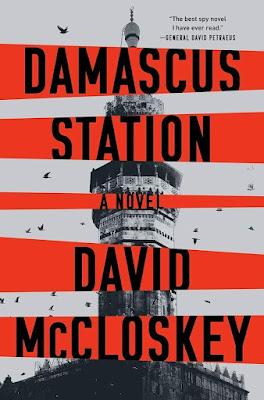
My Washington Times On Crime Column On 'Damascus Station,' A Realistic Spy Thriller About CIA Operations In The Tumultuous Middle East

 The Washington Times published my On Crime column on Damascus Station, a realistic spy thriller written by David McCloskey (seen in the bottom photo), a former CIA officer. 

Former CIA Directors Gen. David Petraeus and Leon Panetta, as well as Washington Times columnist and former CIA Chief of Middle East Operations, Daniel N. Hoffman, have all praised David McCloskey’s spy thriller “Damascus Station” for being a realistic portrayal of CIA overseas operations.


I reached out to Mr. McCloskey and asked him if presenting a realistic portrayal of the CIA was one of his reasons for writing the spy novel.


“The novel certainly aims for authenticity. This isn’t a shoot ’em up spy story. I wanted a real CIA case officer as the protagonist and, within reason, I wanted this to be a bit of a CIA ‘procedural,’ to bring to life the real world of intelligence, from its operations to its bureaucracy,” Mr. McCloskey replied. “I was struck while at the Agency at just how dramatic and intriguing the real-world business of intelligence could be, particularly the development and recruitment of human assets. The actual business of spying, it turned out, made a solid foundation for a spy novel. In it I found fertile ground for exploring the full gamut of human emotion and experience, and, of course, the opportunity to inject action and intrigue to make the plot propulsive.”


“That said, there are several spots in the book where I did ultimately sacrifice authenticity either to protect sensitive Agency tradecraft or where I thought it might weaken the storytelling,” he continued. “For example, there is a sequence in which CIA bomb techs test their work on cadavers. I had help creating my fictional bombs from a couple EOD techs, and when they read this part they said, ‘this is totally insane, the U.S. government would never do this.’ I said, I get it, but this is too fun, too cinematic to cut. I left it in.” 


You can read the rest of the column via the below link or the below page:


https://www.washingtontimes.com/news/2022/jan/27/boor-review-damascus-station-a-novel/


Monday, March 1, 2021

A Story Of Kidnapping, Spousal Resentment And Betrayal: My Washington Times Review Of 'The Power Couple'

 The Washington Times published my review of Alex Berenson’s The Power Couple. 

“Marriage is a mirror,” Alex Berenson writes in the prologue of his novel, “The Power Couple.”


“Your spouse, the first person you see when you open your eyes. The last person you touch as you slip into bed. The person who knows you better than anyone else. Who shares your public joys and private sorrows. Who beds you and you alone. Who makes children with you and builds those children into adults.


“How it’s meant to be, anyway. The deal you made. Both of you. Call your spouse your best friend, if you must. Your partner. Really your spouse is your reflection. That face, always there.

Monday, May 6, 2019

Warner Archive Blu-Ray Release: James Garner's Wartime Spy Thriller '36 Hours'


I saw 36 Hours in a movie theater when I was a kid back in 1964 and I watched the movie on TV a few years ago. The World War II espionage film, starring James Garner, is an interesting, suspenseful and very clever wartime spy thriller. 

Doug Oswald at Cinemaretro.com offers a review of the film, which Warner Archive has just released on Blu-Ray. 

James Garner is an American Army intelligence officer who is one of the men behind the planning of D-Day when he’s kidnapped by the Germans in neutral Portugal just days prior to the invasion of Normandy in “36 Hours,” released on Blu-ray as part of the Warner Archive Collection. Major Jefferson Pike (Garner) is sent on a routine intelligence gathering mission to Lisbon, but it turns out to be a ruse by the Germans to kidnap Pike in order to get him to reveal the invasion plans. They drug him and transport him to Germany where Pike wakes up six years later in a U.S. Army hospital suffering from amnesia. It’s 15 May 1950 and the war has been over for several years, but Pike can’t remember anything after his night in Lisbon.

In reality, it’s still a few days before D-Day and the Germans have created an elaborate deception in order to convince Pike he’s receiving treatment at a military hospital in American occupied Germany. The Allied invasion was victorious, and the war is over. Pike’s doctor, Major Walter Gerber (Rod Taylor), is in reality a German psychiatrist who developed the elaborate plan in order to gather the invasion plan date and location for Nazi Germany. A base camp filled with fake Americans and German nationals are roaming the grounds to set Pike at ease and disorient him at the same time, but also to convince him he is indeed located at an American military hospital in Germany. The Germans have gone to elaborate steps to make the trap work by dying the edges of his hair gray and putting drops in his eyes to trick him into believing he needs prescription glasses in order for Pike to accept he has aged six years. There are fake newspapers in his room, pictures of his parents, American books and a fake radio station plays American “oldies” from the 1930s and early 40s. He also learns he’s married to Anna Hedler (Eva Marie Saint), his nurse for all these years and a Jewish concentration camp survivor. Gerber has 36 hours to complete his plan, but he is under extreme pressure from Gestapo agent Werner Peters (Otto Shack) to use torture in order to retrieve the information in Pike’s head.

You can read the rest of the review via the below link:

Thursday, April 4, 2019

My Washington Times Review Of 'The Moroccan Girl'


The Washington Times published my review of Charles Cumming’s The Moroccan Girl.

In Frederick Forsyth’s memoir, “The Outsider: My Life in Intrigue,” the author of the classic thriller, “The Day of the Jackal,” tells how he came to perform various functions for the British Secret Intelligence Service (SIS), also known as MI6.

He was working as a journalist in Africa when an SIS officer asked him for information about the war in Biafra. While working as a journalist and later a thriller writer, he continued to assist the SIS on numerous occasions, and the SIS returned the favor by providing Mr. Forsyth with information for his thrillers.

In a piece written at St. Martin’s Press, Charles Cumming explains how he was influenced by Frederick Forsyth’s SIS connection when he came to write his latest spy thriller, “The Moroccan Girl.”

“In my new novel, ‘The Moroccan Girl,’ a successful writer of spy thrillers becomes an agent for MI6. Kit Carradine is in his mid-30s. He lives alone in London, forever putting off the moment when he has to sit at his desk and write the required 1000 words per day which will allow him to meet the deadline on his latest book. Restless and easily distracted, Carradine is struggling to come to terms with what he calls the ‘Groundhog Day routine’ of the writer’s life. In short, he’s a bit bored,” Mr. Cumming writes.

Mr. Cumming has Kit Carradine run into a man named Robert Mantis in London who identifies himself as a British intelligence officer. Mantis asks Carradine to become a support agent for the Service and perform a couple of jobs while he is attending a book festival in Marrakech. Carradine, intrigued by the chance of becoming a bona fide spy, agrees.

“Could such a thing happen in real life? Does MI6 use writers in this capacity — or can I be accused of writing a 350-page wish-fulfilment fantasy?” Mr. Cumming writes. “The answer is: of course! MI6 has a well-documented history of recruiting novelists to its cause.”

You can read the rest of the review via the below link:

https://www.washingtontimes.com/news/2019/apr/4/book-review-the-moroccan-girl-by-charles-cumming/

Friday, December 14, 2018

My Washington Times Review Of The James Bond Continuation Novel, 'Forever And A Day'


The Washington Times ran my review of Anthony Horowtiz’s James Bond continuation novel, Forever and a Day.

I’m not fond of continuation novels, as some writers, like Raymond Chandler, Ian Fleming and Sir Arthur Conan Doyle, have a unique style that truly can’t be imitated. But I understand that the authors' iconic characters, Philip Marlowe, James Bond and Sherlock Holmes, are so popular that their many loyal readers want to read more about them, just as they enjoy watching the characters portrayed on TV and on film.

Anthony Horowitz, the author of 40 novels, including two Sherlock Holmes continuation novels, and the creator of the TV series “Foyle’s War,” which I liked very much, is the latest writer to offer a James Bond continuation novel, following Kingsley Amis, John Pearson, John Gardner, Raymond Benson, William Boyd and Sebastian Faulks.

The late Kingsley Amis, author of “Lucky Jim,” wrote the James Bond continuation novel “Colonel Sun” in 1968. Mr. Amis was an admirer of Ian Fleming and he wrote of the “Fleming Effect,” which he called the fusion of a vivid imagination with an air of authority that swiftly carries the reader along on fantastic stories that Ian Fleming himself called “improbable but not impossible.”

I don’t believe Mr. Horowitz captured the Fleming Effect, but he comes close.

I was weaned on Ian Fleming as a preteen and teenager. I devoured his novels about the British secret agent with the license to kill. I loved Mr. Fleming’s description of exotic places, people and products. I also loved his unforgettable characters, such as villains like Goldfinger and Blofeld, women like Domino and Honeychile, and James Bond’s friends, like Felix Leiter and Darko Kerim. James Bond fought the good fight against Soviet killers, international criminals and malicious madmen. Ian Fleming’s novels are far darker and much more complicated than the films and I’ve reread the thrillers a good number of times over the years.

… Mr. Horowitz penned an earlier James Bond continuation novel called “Trigger Mortis.” Like that novel, “Forever and a Day” was commissioned by the Ian Fleming estate and contains original material from the late Mr. Fleming. Utilizing his ideas and unpublished story notes is a good idea and a good hook.

A portion of “Forever and a Day” is based on an outline Ian Fleming wrote for an American TV series that never came to be. I wish that he had expanded more on the outline, but most of the novel is an original story crafted by Mr. Horowitz.

In this novel, which takes place in the 1950s in a prequel to Ian Fleming’s “Casino Royale,” 007 is killed right off. No, not James Bond. The man killed is the holder of the 007 code name that James Bond takes on as he is ordered to investigate the murder of the previous 007 in Marseille, France. 

You can read the rest of the review via the below link:

Sunday, August 12, 2018

On This Day In History Thriller Writer Ian Fleming, Creator Of James Bond, Died


On August 12th in 1964, I was a 12-year-old sitting in the back seat of my father's car when I heard on the car radio that Ian Fleming had died. I was thunderstruck.

In the months prior to that sad announcement I had been reading through Ian Fleming's James Bond thrillers. Having loved the first two Bond films, Dr. No and From Russia With Love, starring Sean Connery as James Bond, I began reading the novels. I was pleased to discover that the books were darker and more complicated than the films and I've been an Ian Fleming aficionado ever since. 

Below is Ian Fleming's obituary, which appeared in the Philadelphia Inquirer: 


You can read my Crime Beat columns on the late, great thriller writer via the below links: 


You can also read my Counterterrorism magazine about Ian Fleming's WWII experience and his creation of the intelligence commando group, 30 Assault Unit, via the below link:


And you can learn more about Ian Fleming and his fascinating life as a naval intelligence officer, journalist and author by reading the below biographies of the late writer:


Sunday, March 25, 2018

My Washington Times Review Of 'The Quantum Spy'


The Washington Times ran my review of David Ignatius’ The Quantum Spy.

Although my knowledge of computers is somewhat limited, I was able to follow the computer science backdrop to “The Quantum Spy,” as author David Ignatius did a fine job of explaining the basic technology involved in quantum computing and why it is vital that the United States builds a quantum computer before China, America’s adversary, builds one.

Quantum computing, Mr. Ignatius‘ fictional CIA director explains, is a paradigm shift. It’s like Galileo and Newton. It will change everything. “A Quantum computer would simultaneously explore every answer to a problem, creating a tool of immense, almost infinite computational power,” Mr. Ignatius writes.

The novel opens with John Vandal, the CIA Deputy Director for Operations, paying a visit to Jason Schmidt, an electronics engineer who operated QED, a small, privately-owned computer company in Seattle, Washington. The CIA official was responding to a letter the engineer wrote to his cousin, a CIA officer, that stated he had made a breakthrough in building a quantum computer.

 “I’ve solved the puzzle,” the engineer wrote.

“You understand what a big deal this is, Mr. Schmidt? We’re spending billions on quantum research. This is a race. The White House pounds on me every week wanting to know where the Chinese are, and we say relax: It’ll be ten years before anyone builds a machine, probably twenty, and we’re way ahead,” John Vandal said. “And now you say bang, you’ve done it.”

The CIA official explained that the issue was no much that the breakthrough, but rather that someone wanted to steal it. He was referring to what he called a “bell-ringer” in the letter, which was the engineer informing his cousin that he received an offer by a company to buy control of QED. The company, John Vandal told the engineer, was Chinese.

You can read the rest of the review via the below link:


You can also read my interview with David Ignatius (seen in the above photo) via the below link:

Saturday, March 24, 2018

The Quantum Spy: My Q&A With Spy Novelist And Washington Post Columnist David Ignatius


Counterterrorism magazine published my Q&A with David Ignatius, the Washington Post columnist and author of the thriller The Quantum Spy.

You can read the interview below:


  Note: My review of David Ignatius’s The Quantum Spy will soon appear in the Washington Times. 

Friday, March 9, 2018

The Kremlin's Candidate


Veteran journalist and author Joseph C. Goulden offers a good review of Jason Matthews’ The Kremlin’s Candidate for the Washington Times.

An ever-present nightmare for an intelligence agency is the prospect of an enemy officer winnowing his or her way into a position where he or she can endanger operations.

High-level traitors are not unknown in the trade. Consider the British officer Kim Philby who spied for the Soviets while working in counterintelligence for his country’s Secret Intelligence Service.

Author Jason Matthews posits an even more audacious penetration in his delightfully-readable novel in which Russia has positioned a candidate for the position of director of Central Intelligence.

Mr. Matthews writes with the insider-authenticity of an officer who served for 33 years in the CIA’s Operations Directorate, specializing in denied-area assignments.

“The Kremlin’s Candidate” is the third book in his Red Sparrow series, with carry-over characters, but nonetheless a stand-alone work. It reinforces Mr. Matthews‘ dominance as a writer of intelligence fiction.

You can read the rest of the review via the below link:

Wednesday, January 24, 2018

My Washington Times Review of 'The Last Man In Tehran'


The Washington Times published my review of Mark Hemshaw’s The Last Man in Tehran.

 Mark Henshaw, the author of the “The Last Man in Tehran” and the three previous spy thrillers in his “Red Cell” series, is a veteran CIA analyst who served in the CIA’s Red Cell Unit.

As Mr. Henshaw wrote in his debut novel, “Red Cell,” the unit is an alternative analysis unit set up by then-CIA Director George Tenet on Sept. 13, 2001 to ensure that the CIA didn’t suffer another surprise like the Sept. 11 attack. The Red Cell’s job is to play devil’s advocate and think out of the box. The unit was to discover possibilities that other analysts might overlook or dismiss.

“The Last Man in Tehran” opens on Nov. 4, 1979 outside of the American Embassy, where the embassy employees have been taken prisoner by students in support of the Iranian Islamic revolution. Sitting on a bench in Honarmandan Park is an Israeli Mossad officer named Gavi Ronen. The Israeli intelligence officer was meeting his counterpart in SAVAK, the ousted Shaw’s secret police. The two intelligence officers lament the current events and say their goodbyes.

Kyra Stryker, a case officer brought in from the cold due to a fiasco in Venezuela and assigned to the Red Cell unit in the first novel, has been recently promoted to be chief of the Red Cell unit. In her first days as the Red Cell chief a radioactive “dirty bomb” is detonated in the Port of Haifa in Israel.

Suspecting the Iranians, the Mossad counterattack with a campaign of sabotage and assassinations. The CIA then discovers that someone in the CIA is helping the Israelis wage the covert war. The FBI is brought in to find the CIA mole and Kyra Stryker is assigned to work with the FBI.

... According to the publisher, the dirty bomb attack on Haifa was based on a fictional event which occurred in a war game that Mr. Henshaw organized and ran for the CIA. All of the historical events referenced in the novel are true and the descriptions of CIA headquarters and other locations are accurate. This realism adds to the suspense and believability of the story.

“The Last Man in Tehran” is a suspenseful and action-packed novel that spy thriller fans will enjoy.

You can read the rest of the review via the below link:


 You can also read my Counterterrorism magazine interview with CIA analyst and author Mark Henshaw (seen in the above photo) about spies in fact and fiction via the below link:

Saturday, January 6, 2018

David Ignatius' 'The Quantum Spy' Is About Quantum Computing, The Chinese/American Technology Race And Espionage


I interviewed Washington Post columnist and best-selling spy novelist David Ignatius (seen in the above photo) yesterday morning. 

We discussed his latest thriller, The Quantum Spy, and quantum computing, espionage and the technology race between China and America.

My Q&A with David Ignatius will appear in the upcoming Journal of Counterterrorism & Homeland Security International, a quarterly magazine for government, law enforcement and military people worldwide. 

I’ll post the piece here when it comes out. (I’m also reviewing The Quantum Spy for the Washington Times).  


In addition to covering quantum computing, The Quantum Spy also takes the reader into the headquarters of Communist China’s Ministry of State Security (MSS), an adversarial intelligence agency mush less known than the Russian SVR and the old Soviet KGB. 

His realistic, well-researched and well-written novel is informative, suspenseful and entertaining.      

Below is a description of the novel from www.davidignatius.com:  

From the best-selling author of The Director and Body of Lies comes a thrilling tale of global espionage, state-of-the-art technology, and unthinkable betrayal.

The Quantum Spy is a hyper-fast quantum computer is the digital equivalent of a nuclear bomb; whoever possesses one will be able to shred any encryption and break any code in existence. The winner of the race to build the world’s first quantum machine will attain global dominance for generations to come. The question is, who will cross the finish line first: the U.S. or China?

In this gripping cyber thriller, the United States’ top-secret quantum research labs are compromised by a suspected Chinese informant, inciting a mole hunt of history-altering proportions. CIA officer Harris Chang leads the charge, pursuing his target from the towering cityscape of Singapore to the lush hills of the Pacific Northwest, the mountains of Mexico, and beyond. The investigation is obsessive, destructive, and—above all—uncertain. Do the leaks expose real secrets, or are they false trails meant to deceive the Chinese? The answer forces Chang to question everything he thought he knew about loyalty, morality, and the primacy of truth.

Grounded in the real-world technological arms race, The Quantum Spy presents a sophisticated game of cat and mouse cloaked in an exhilarating and visionary thriller.

You can also read David Ignatius’ review of John le Carre’s spy novel, A Legacy of Spies, in the Atlantic via the below link:


And you can read my Washington Times review of A Legacy of Spies via the below link:

Thursday, October 19, 2017