Showing posts with label The Philadelphia Daily News. Show all posts

Sunday, June 4, 2023

All That Chazz: My Q&A With Chazz Palminteri

I’ve been watching the very talented and interesting actor, writer and filmmaker Chazz Palminteri on his youtube.com podcasts.  

I interviewed Chazz Palminteri for the Philadelphia Inquirer back in 2016. My Q&A with him also appeared in the Inquirer’s sister newspaper, the Philadelphia Daily News.

After interviewing Chazz Palminteri, I took in his one man show A Bronx Tale, where he portrays 18 roles, at the Golden Nugget in Atlantic City. 

After the amazing show, I was invited backstage to speak with him and pose for photographs, along with my wife and my friends Mark and Donna Tartaglia. 

Even after his grueling performance, Chazz Palminteri was engaging and gracious. 

You can read the Q&A via the below link or below:

Q&A: Chazz Palminteri and 'A Bronx Tale' come to Golden Nugget (inquirer.com)

Note: You can click on the above and below to enlarge.


You can also watch Chazz Palminteri's podcasts via the below link: 

Monday, April 6, 2020

Welcome To Hell, Stinky: ‘Unicorn Killer’ Ira Einhorn, 79, Dies In Pa. Prison


Back in 2002, the Philadelphia Daily News offered a mocking headline, Bon Voyage, Stinky, which eluded to convicted murderer Ira Einhorn being sentenced to prison, and to the fact that the "Hippie Guru" did in fact often smell bad, as he had questionable personal hygiene.

Julie Shaw at the Philadelphia Inquirer reports on the death of Einhorn, who died in prison.

Ira Einhorn, 79, the convicted murderer known as the “Unicorn Killer,” died of natural causes early Friday in state prison, authorities said. His death was not related to the coronavirus, according to Susan McNaughton, a state Department of Corrections spokesperson.

Einhorn was housed at State Correctional Institution Laurel Highlands in Somerset County. A prison nurse pronounced him dead at 4:23 a.m., McNaughton said. She declined to elaborate or say if he had been sick.

Einhorn was found guilty of fatally bludgeoning his girlfriend, Helen “Holly” Maddux, 30, in 1977 and stuffing her body into a trunk that he kept in his Powelton apartment for 18 months. In 1981, just before his trial, he fled to Europe, and he remained on the lam for two decades. He was extradited from France in 2001, and a Philadelphia jury convicted him of first-degree murder in 2002 in Maddux’s slaying. He was sentenced to life in prison.

Einhorn, a hippie guru in the 1960s and ’70s, reportedly called himself “Unicorn” because that is the English translation of his last name from German. The media dubbed him the “Unicorn Killer.”

You can read the rest of the piece via the below link: 


You can also read my Crime Beat column, Peace, Love and Homicide: A Look Back at the Unicorn Killer in Philadelphia, via the below link: 


Saturday, May 27, 2017

A Look Back At The Inquirer Building


William K. Marimow, the former editor of the Philadelphia Inquirer and now the Philadelphia Media Network editor-at-large, offers a look back at the old Inquirer Building, which is scheduled to become the new headquarters for the Philadelphia Police Department.

When the news broke Wednesday that the former home of the Inquirer, Daily News, and Philly.com would become headquarters for the Philadelphia Police Department, it transported me back to that grand white tower that still dominates the corner of Broad and Callowhill Streets. To many of us who worked there in the three newsrooms, the business offices, and, at one time, the mail room, the pressroom, and on the loading docks, it also was known as the “Tower of Truth.”

When I first entered the building one warm afternoon in June 1972, what I discovered was that a beautiful building on the outside was antiquated on the inside. Four uniformed operators ran the elevators; a little shop in the lobby sold cigarettes, cigars, candy, and magazines. On the fifth floor, home of the Inquirer newsroom, there were dull gray desks clustered tightly together and, in the background, the rhythmic tapping of typewriters and the clacking of news-wire machines amid the haze of cigarette smoke.

Despite a long-term, gradual decline in circulation, the newspaper industry in the summer of 1972 — thanks to highly lucrative advertising revenues from department stores and classified ads for employment, cars, and real estate — was profitable and robust. Outside on Broad Street, one of the city’s tallest police officers stood at the intersection of Broad and Vine — this was before the Vine Street Expressway was submerged below street level — and directed an unending stream of traffic. On the southwest corner, a newspaper vendor hawked the Inquirer and Daily News, cackling to passersby emerging from the subway, “Whaddaya read! Whaddaya read!”

… I worked in that cramped, grungy, collegial newsroom for 19 years, and I savored the experience. I then spent two more years working in the publisher’s office on the 12th floor, which had once served as the office of Walter Annenberg, the former ambassador to England and the owner of the Inquirer and Daily News. Our newsroom was transformed in the fall of 1972 when Gene Roberts, the national editor of the New York Times, arrived to take the helm. A laconic man who spoke with a North Carolina drawl when he spoke – Roberts often intimidated staffers with his prolonged periods of silence – he came to Philadelphia with a wealth of journalistic experience that gave him immediate credibility. He had covered agriculture in rural North Carolina, the maritime beat in Norfolk, labor in Detroit, and the civil rights movement and the Vietnam War at the New York Times. He recognized excellence in his staff — reporters, editors, and photographers alike — and he gave them the latitude and the support to pursue their dreams.

Those dreams often were the seedlings that produced great stories — journalism that would make a profound difference in the lives and work of the Inquirer’s readers, their community, and the nation.

You can read the rest of the piece via the below link:


Note: Although I don’t always agree with the Philadelphia Inquirer and Daily News’ somewhat liberal worldview, I’m proud to have been a contributor to the two newspapers since 1996. My last piece, a Q&A with actor, writer and producer Chazz Palminteri, ran in both newspapers.   

You can read an earlier post on the Inquirer Building via the below link:

Wednesday, May 24, 2017

A Tale Of Two Buildings: The Philadelphia Police Department Is Moving From The 'Roundhouse' To The Old Inquirer Building


In the news today is the plan to move Philadelphia Police Headquarters from the "Roundhouse" (seen in the above photo) to the building that once housed the the Philadelphia Inquirer and Daily News (seen in the below photo).

I have a personal attachment to both buildings.


I've been a been a contributor to the Inquirer and the Daily News since 1997 and I often visited the Inquirer Building at 400 N. Broad Street. I recall when the two newspapers were powerhouses and a mainstay of Philadelphia life. The tall, white building that housed the two newspapers was an iconic and instantly recognized symbol of Philadelphia journalism.

The downsized newspapers and Philly.com moved from the Inquirer Building in 2011 and sold the building as an economic move. The Inquirer, Daily News and Philly.com then took up residence at the offices of the old Strawbridge & Clothier department store at 8th and Market Street.

As a writer I was also a frequent visitor to the Philadelphia Administration Building (called the Roundhouse) at 750 Race Street. Over the years I visited the Roundhouse and interviewed several commissioners, deputy commissioners, inspectors, homicide detectives, and many other police officers.

The Roundhouse, so named because of the building's curved structure (some say it looks like a pair of handcuffs from the sky), is an old, cramped and beat up place. The cops need and deserve a better headquarters, although I'll miss visiting the old building after the proposed 2020 move. (I'm not sure the police who work there every day feel quite the same way).

The Inquirer Building is also old and a bit rundown, but I suppose it is a step up from the Roundhouse.

The small irony of the move is the Inquirer and Daily News had and have something of an adversarial relationship with the Philadelphia Police. So the cops moving into the old Inquirer Building is perhaps akin to allied military forces moving into German military headquarters in Berlin at the end of WWII.

You can read Jake Adelman's Philadelphia Inquirer piece on the move via the below link:

http://www.philly.com/philly/news/pennsylvania/philadelphia/philly-police-department-hq-to-move-into-former-inquirer-daily-news-building-on-n-broad-20170524.html

And you can read Philadelphia Daily News columnist Stu Bykofsky's take on the move via the below link:

http://www.philly.com/philly/columnists/stu_bykofsky/Cops-should-enjoy-being-in-the-Tower-of-Truth.html

Wednesday, May 17, 2017

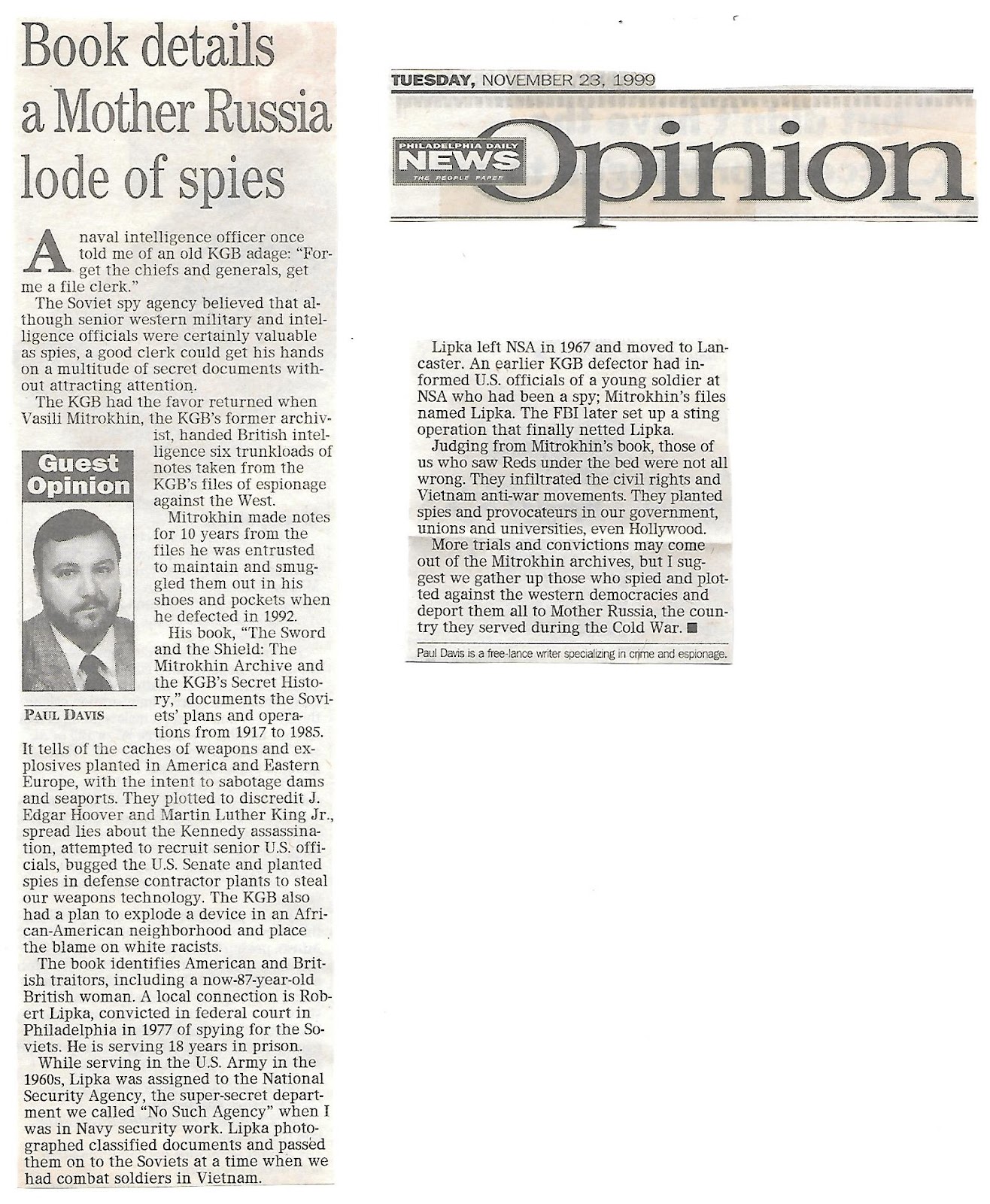
A Look Back At 'The Sword And the Shield: The Mitrokhin Archive And The KGB's Secret History'


One of the best books on Cold War espionage and the Soviet Union's KGB was Vasili Mitrokhin and Christopher Andrew's The Sword and the Shield: The Mitrokhin Archive and the Secret History of the KGB.

I wrote a piece for the Philadelphia Daily News in 1999 on the book. You can read my piece below:


Note: You can click on the above to enlarge.

Tuesday, October 4, 2016

My Philadelphia Inquirer Q&A With Chazz Palminteri


My Q&A with Chazz Palminteri appeared in the Philadelphia Inquirer today.

The interview appeared in the Philadelphia Daily News as well.

You can read the Q&A online and watch a brief video from the film version of A Bronx Tale via the below link:

http://www.philly.com/philly/entertainment/20161004_Q_A__Chazz_Palminteri_and__A_Bronx_Tale__come_to_Golden_Nugget.html

Or you can read the below:

Note: You can click on the above to enlarge.

Tuesday, May 24, 2016

Apologize For Hiroshima? Hell, No!


My late father was an Underwater Demolition Team (UDT) frogman during World War II. The UDT combat swimmers cleared the way for the U.S. Marines to take the Pacific islands back from the Imperial Japanese.

I recall him telling me about an intelligence briefing where the UDT men were advised that the losses they would sustain during the planned invasion of mainland Japan would be catastrophic.

The deaths of millions of U.S. military men, as well as Japanese military men and Japanese civilians, was avoided due to the dropping of atomic bombs on the cities of Hiroshima and Nagasaki.

It took the devastation of this weapon to finally force the proud Japanese to surrender unconditionally.      

I believe it would be a disgrace if President Obama apologizes for the U.S. dropping of an atomic bomb on Hiroshima when he visits the city.

It would be an insult to the men who died during the war, which Imperial Japan began with their sneak attack on Pearl Harbor.

It would also be an insult to the men who survived the war, like my father.  

Stu Bykofsky, a columnist for the Philadelphia Daily News offers his take on the presidential visit to Hiroshima.

THESE ARE THE remarks I would like to hear from President Obama when he visits Hiroshima on Friday:
We gather in this place draped in death and sorrow to respectfully remember those who perished here almost 70 years ago.
Speaking for the United States, we have regrets.
We regret that, 75 years ago this December, Japan killed more than 2,400 Americans in an unprovoked attack against the United States in Hawaii. That's my home.
I regret that the United States was pushed into a war we did not seek and for which we were militarily unprepared.
We believed, correctly, that it was a war between our freedom and your tyranny and butchery.
You can read the rest of the column via the below link:

http://www.philly.com/philly/columnists/stu_bykofsky/20160524_Byko__Apologize_for_Hiroshima__Hell__no_.html

Tuesday, February 23, 2016

A Look Back At The NRA Convention In Philly


I wrote a piece for the Philadelphia Daily News when the National Rifle Association visited Philadelphia in 1998.

You can read the piece below:


Note: You can click on the above to enlarge.

Monday, February 22, 2016

A look Back At The Sword And The Shield Of The Dreaded KGB


I wrote a piece for the Philadelphia Daily News about The Sword and the Shield: The Mitrokhin Archive and the Secret History of the KGB in 1999.  

You can read the piece below:


Note: You can click on the above to enlarge.

Tuesday, January 12, 2016

Dumbest Criminal of 2016 (So Far): Kidnapper Nabbed At Meeting He Scheduled With Victim


Stephanie Farr at the Philadelphia Daily News offers a piece on a candidate for the dumbest criminal of 2016.

JUST DAYS into 2016, one Delaware County teen already has made his bid for the stupidest criminal of the year, by showing up for a follow-up meeting he'd scheduled with an elderly woman he had kidnapped and robbed the day before, according to police.
Nether Providence Police Chief David Splain said the suspect, 17-year-old Jason Donte Hayes, was surprised when he was met in a shopping center parking lot by police instead of the victim.
"We were the last ones he was waiting to see. He was waiting for a little old woman," Splain said. "If he can survive the remaining 340-some days of the year, he will definitely win the dumbest criminal of the year on Dec. 31."
You can read the rest of the piece via the below link:

Sunday, September 13, 2015

Perhaps We Should Equip Philadelphia Police Cars With Porta Potties As Well As Cameras: Philly Cop's Starbucks Restroom Rant Goes Viral


William Bender at the Philadelphia Daily News offers a piece on a justifiably outraged Philly Sgt who was denied the use of a Starbuck's restroom in an embarrassing episode.   

Starbucks is drawing some Internet outrage after a Philadelphia police sergeant went on Facebook and lashed out against a "young blonde liberal" who he said wouldn't let him use the restroom last week at the coffee chain's 1301 Chestnut Street location.

The sergeant is not named in the original post, which was posted Friday on Starbucks' Facebook page by fellow Philadelphia Police Officer Joe Leighthardt. It has since been shared more than 11,500 times. Leighthardt said he knows the sergeant.

The unnamed sergeant said he was in full uniform and that the employee would not give him the key code to the bathroom because he was not a paying customer.

"As I walked out with my hand up and while she continued loudly to tell me about the bathroom down the street, I was even more astonished that the many customers and other employees said nothing and seemed indifferent," the sergeant wrote. "This is the world cops live in anymore. It's hip for this generation to berate and totally disrespect cops in front of the public and praise cop killers as the heroes of they're (sic) time."

Leighthardt wrote that employees of that Starbucks call police "several times a week for things as simple as someone sitting on the bench outside their property."

You can read the rest of the piece via the below link:

http://www.philly.com/philly/blogs/dncrime/Philly-cops-.html

Note: On several of the ride-alongs I've done with Philly cops, the officers stopped at Starbuck's for coffee. I believe Starbuck's will lose a good chunk of business if cops and their supporters boycott them. Personally, I prefer Dunkin Donuts' coffee to Starbuck's.

Monday, June 22, 2015

Anthony Fulwood, Philadelphia Police Officer, Bodyguard for Frank Rizzo, Lynne Abraham and Ron Castille, Dies At 72


John F. Morrison at the Philadelphia Daily News offers a fine obituary of former Philadelphia Police Officer Anthony Fulwood, bodyguard to Philadelphia Mayor Frank Rizzo.

TONY FULWOOD had tears in his eyes when he walked into Frank Rizzo's hospital room and saw the mayor in the bed with a broken leg.

Tony felt responsible for the injury, even though it was an accident and even though he was doing his job of protecting the mayor when an explosion rocked the Arco refinery in a nine-alarm fire in 1976, and he fell on Rizzo to protect him from the blast.

"I hope you're not upset with me," Tony blubbered. "I wish I was in that bed instead of you."

"You know, Tony," Rizzo said. "So do I."

Despite the levity, Rizzo hadn't the slightest inclination to blame his bodyguard for the injury. Theirs was a father-son relationship built on mutual respect and love.

Anthony Fulwood, a police officer who served as bodyguard for Rizzo through his terms as police commissioner and mayor, then did the same for Lynne Abraham for 17 years when she was district attorney, then for Ronald Castille, former Pennsylvania chief justice, for several years, died Wednesday of blood cancer. He was 72 and lived in Wynnefield.

You can read the rest of the piece via the below link:

http://www.philly.com/philly/obituaries/20150622_Anthony_Fulwood__72__bodyguard_for_Frank_Rizzo__Lynne_Abraham_and_Ron_Castille_.html

You can also read Tony Fulwood's obituary in the Philadelphia Inquirer via the below link:

http://www.philly.com/philly/news/20150622_Anthony_Fulwood__72__a_bodyguard_for_politicians.html

Note: Over the years I saw Tony Fulwood standing near Frank Rizzo and Lyn Abraham at public events. He was a big, impressive man. My friend Mark Tartaglia, a retired Philadelphia detective, introduced me to him some years ago. Tony Fulwood was a well-respected and well-liked police officer and man. 

Sunday, March 29, 2015

Assistant U.S. Attorney In Philadelphia: "Human Trafficking Is The Fastest Growing Crime In The Country"


Lara Witt at the Phildelphia Daily News offers a piece on the growing crime of human trafficking.

"Slavery is not an obsolete relic of the past, it is a global industry that generates $32 billion in profits through forced labor and the bodies of tens of millions of human beings each year."

This is what Ivan Cole, who sits on the board of the Life After Trauma Organization, told an audience yesterday during a conference hosted by the nonprofit at Temple University to raise awareness of the pervasiveness of human trafficking. LATO helps women recover from the trauma of human trafficking.

"The main reason why traffickers engage in this crime is because it is extremely lucrative," said Assistant U.S. Attorney Michelle Morgan, during a panel discussion that included six experts on the issue.

According to data from the U.S. State Department, it is estimated that 800,000 people are traded across international borders per year.

You can read the rest of the piece via the below link:

http://www.philly.com/philly/news/20150329_Assistant_U_S__Attorney___quot_Human_trafficking_is_the_fastest_growing_crime_in_the_country.html
 

Friday, November 21, 2014

Fired Philadelphia Narcotics Cop Covered In Pulitzer Price-Winning Newspaper Series 'Tainted Justice' And True Crime Book 'Busted' Gets His Job Back


David Gambacorta at the Philadelphia Daily News offers a piece on the reinstatement of a Philly cop who was fired.

In a decision that Police Commissioner Charles H. Ramsey called "disappointing," an arbitrator on Wednesday moved to reinstate fired Philadelphia narcotics cop Jeffrey Cujdik.

Ramsey booted Cujdik from the force in May, following a long-running Internal Affairs investigation into allegations that the veteran cop lied on search warrants and had an inappropriate relationship with an informant - and then lied about both to investigators. The allegations were first unearthed in the 2009 Daily News series "Tainted Justice."

The series, based on interviews with dozens of victims, detailed incidents of misconduct among a group of undercover narcotics officers, including phony search-warrant applications, the looting of bodegas and even sexual assault.

The city has paid out at least $1.7 million to settle 33 lawsuits filed by bodega owners and two women who said they'd been assaulted by a member of Cujdik's squad.

Federal and local probes of the officers were triggered by the Pulitzer Prize-winning series.

Ramsey said Thursday that the arbitration hearing centered on whether he had just cause to fire Cudjik.

You can read the rest of the piece via the below link:

http://www.philly.com/philly/news/20141120_Tainted_cop_gets_his_job_back.html

You can also read my interview with the Daily News reporters who wrote the newspaper series and the book Busted via the below link:

http://www.pauldavisoncrime.com/2014/05/my-crime-beat-column-my-q-with-wendy.html

Tuesday, August 26, 2014

Newspaper Vs. Newspaper: Philadelphia Daily News Reporter Wendy Ruderman Answers Her Philadelphia Inquirer Critics


JimRomenesko.com, a journalism web site I visit every day, offers links to Philadelphia Daily News reporter Wendy Ruderman (seen on the left in the above photo) as she answers her Philadelphia Inquirer critics via Facebook, as well as other related pieces.

You can read the Romenesko piece via the below link:

http://jimromenesko.com/2014/08/25/wendy-ruderman-speaks-out-about-philadelphia-inquirers-piece-on-busted/ 

You can also read the Philadelphia Inquirer piece via the below link:

http://www.pauldavisoncrime.com/2014/08/tainted-justice-why-accused.html

And you can read my interview with Wendy Ruderman and Barbara Laker via the below link:

http://www.pauldavisoncrime.com/2014/05/my-crime-beat-column-my-q-with-wendy.html

Friday, August 22, 2014

Tainted Justice: Why An Accused Philadelphia Police Officer Is Still On The Force


Mike Newall and Aubrey Whelen at the Philadelphia Inquirer offer a piece on why a Philly cop remains on the force after being accused of several crimes that were covered in a Philadelphia Daily News series and subsequent true crime book called Busted.

The woman in the emergency room at Frankford Hospital told the detective that the police officer who sexually assaulted her was named Tom. After the attack, she said, the officer scrawled his cellphone number on a torn piece of paper and handed it to her.

Through personnel records, police traced the number to a 10-year veteran of the force, Thomas Tolstoy. Within hours of the alleged assault on Oct. 16, 2008, the officer was pulled off the street.
Three women who did not know one another would eventually accuse Tolstoy of assaulting them under strikingly similar circumstances. Of the three cases, only the one involving the woman from Frankford Hospital led to a full-blown inquiry.

The allegations were investigated by the Philadelphia Police Department's Internal Affairs bureau, the FBI launched an exhaustive inquiry, and the U.S. Attorney's Office convened a grand jury, yet no criminal charges were filed. When news broke this year that there would be no prosecution after years of investigation, many expressed outrage.

The city has paid $227,500 to settle lawsuits brought against the officer by two women who accused him of groping their breasts. But unless city prosecutors determine that there is sufficient evidence to file charges against Tolstoy in the Frankford woman's case - the only one in which the statute of limitations has not expired - he soon could be cleared to return to street work.

An Inquirer review of an extensive investigative file - along with detailed interviews of people directly involved in or familiar with the case - reveals how Tolstoy emerged from a joint local and federal investigation unscathed.

The documents show that in seven interviews with investigators, the then-24-year-old woman, from Frankford, never wavered on the central tenet of her story: that she had been sexually assaulted, and that an officer was responsible.

But the woman's case presented a challenge from the start. DNA evidence did not match Tolstoy, according to the documents. The woman was fearful of police, initially lied about her name and criminal history, and at one point changed certain details of the assault - all of which could be used to undermine criminal prosecution of her assailant.

The documents also show that actions the victim ascribed to two Philadelphia Daily News reporters who wrote about her assault further undermined the criminal case by damaging her credibility and complicating a federal investigation.

The woman told investigators that the reporters - whose account of the assault and other police abuses would go on to win a Pulitzer Prize in 2010 - provided her with gifts, paid her bills, offered her money to hire a lawyer, and told her that she could collect a financial windfall if she talked to them and not to law enforcement officials, according to the documents.

You can read the rest of the piece via the below link:

http://www.philly.com/philly/hp/news_update/272249261.html

I reviewed Busted for the Washington Times and I interviewed the Daily News reporters.

You can read my interview with the reporters via the below link:

http://www.pauldavisoncrime.com/2014/05/my-crime-beat-column-my-q-with-wendy.html 

Monday, June 9, 2014

"Busted" Is A Philadelphia Classic


Joel Mathis at phillymag.com offers his take on Busted, the true crime book written by two Philadelphia Daily News reporters about their Pulitzer Prize-winning newspaper series on police corruption.

Over the weekend, I finally got around to reading Busted: A Tale of Corruption and Betrayal in the City of Brotherly Love, the March book by the Daily News Pulitzer-winning team of Wendy Ruderman and Barbara Laker. What a great book.

It’s an easy, breezy read — Philly Mag’s review called it a “captivating story” — but that’s not to say it’s insubstantial. Indeed, the narrative of how the two reported their “Tainted Justice” series of articles on police corruption for the paper deserves to take its place among the great works that have come to define Philadelphia in the popular mind — everything from Rocky to A Prayer for the City.

Three reasons you should read this book if you love Philadelphia:
 
• It’s gritty: In pursuit of their story, Laker and Ruderman chat up pimps, stroll brazenly into drug houses, and basically make themselves at home in some of the hardest-hit, dirtiest parts of the city, spending time among criminals, immigrants and the rest of the city’s dispossessed in order to get at the truth of a rogue drug unit. It’s a great example of the hard work and rewards that can go into shoe-leather journalism during an era in which many reporters can be hard-pressed to do much more than make a phone call from their desks. (Or home office.)     

You can read the rest of the piece via the below link:

http://www.phillymag.com/news/2014/06/09/busted-ruderman-laker-philadelphia-classic/?utm_source=iContact&utm_medium=email&utm_campaign=EDIT:%20News&utm_content=Midday+News+6%2F9%2F14

Note: I reviewed Busted for the Washington Times and I interviewed Wendy Ruderman and Barbara Laker. You can read my review and the interview via the below links:

http://www.pauldavisoncrime.com/2014/05/my-washington-times-review-of-busted.html

http://www.pauldavisoncrime.com/2014/05/my-crime-beat-column-my-q-with-wendy.html

Friday, May 16, 2014

"God's Pocket": Talents Wasted In Stylized South Philly Tale


I recall when Philadelphia Daily News columnist Pete Dexter visited a neighborhood in South Philly in 1978 to follow up on a story. This was a tough neighborhood and Dexter brought along professional fighter Tex Cobb. (I briefly met Tex Cobb. He was a funny, tough guy with a lot of heart).

Dexter received a severe beating from the neighborhood guys. Cobb received a broken arm. Dexter got a novel called God's Pocket out of the incident. 

Now there is a film based on the novel.

Tirdad Derakhshani at the Philadelphia Inquirer offers a review of the film.

It's hard to think of any compelling reasons to see God's Pocket, a messy, shallow, muddled morass of a Philadelphia crime story set in 1978 - except perhaps to check out its lovingly shot portraits of South Philly's wonderfully gritty streets, its familiar storefronts, and its parade of identical rowhouses.

But actor John Slattery's directoral debut disappoints even here: It was shot for the most part in Yonkers, N.Y. 

Slattery told an interviewer at Sundance in January that South Philly today looks far too nice to work as the film's setting.

Hmph. (But thanks for the compliment).

You can read the rest of the review via the below link:

http://www.philly.com/philly/entertainment/20140516__God_s_Pocket___Talents_wasted_in_stylized_South_Philly_tale.html

Gary Thompson at the Philadelphia Daily News also reviewed the film:

God's Pocket is adapted from the book of the same name by former Daily News columnist Pete Dexter, and arrives 30 years after the events that inspired the story.

Which involved Dexter getting beaten half to death by a group of folks who didn't care for one of his columns - an incident inscribed in newspaper lore, in the legend of Dexter, in the city's own reputation for fight-town toughness.

Randall "Tex' Cobb, who accompanied Dexter on that night, and himself sustained a broken arm, later remarked that in Philadelphia "even the drunks punch in combination."

You can read the rest of the review via the below link:

http://www.philly.com/philly/entertainment/movies/20140516__God_s_Pocket___Dexter_book_finally_hits_screen.html

You can also watch the film's trailer via the below link:

https://www.youtube.com/watch?v=KxwwQEkbllI

Thursday, May 15, 2014

My Crime Beat Column: Busted - My Q & A With Wendy Ruderman & Barbara Laker, Pulitzer Prize-Winning Reporters And Authors Of "Busted"


In my Washington Times review of Busted: A Tale of Corruption and Betrayal in the City of Brotherly Love, I noted that the story began in 2008, when a visibly frightened drug addict named Benny Martinez walked into the offices of the Philadelphia Daily News and spoke to Wendy Ruderman and Barbara Laker, two of the gritty tabloid newspaper’s investigative reporters.

Martinez, a confidential informant for a Philadelphia police officer named Jeff Cujdik, told the reporters that either the cops or the drug dealers he had informed on were going to kill him.

This meeting led the reporters to uncover allegations that a rogue narcotics unit systematically looted bodega stores during raids and three women claimed to be sexually molested during the raids.

These allegations were presented in the reporters’ Daily News series, Tainted Justice, which won the 2010 Pulitzer Prize for Investigative Reporting, and later in their book.

Benny Martinez seems to me to be Philly’s answer to Goodfellas Henry Hill, so I contacted the reporters and asked them why they took his word over the word of a Philadelphia police officer. I offered their response in my Washington Times piece.

“Benny gave us examples of fabricated search warrants,” said Barbara Laker. “He could pinpoint certain houses or certain jobs that were based on lies. We checked out everything that Benny said in addition to the documentation from Landlord-Tenant Court. I think that if the story didn’t move to the bodegas and the women with Thomas Tolstoy, there wouldn’t have been any book, any Pulitzer, any series. It would have stopped and been a simple story mostly about a cop and questions about his working relationship with an informant.”
“In the book, we describe how we found 22 merchants from all corners of the city, speaking all different languages, independently telling us the same story that these officers came in with guns drawn, smacked the video-surveillance cameras, and cut wires,” Ms. Laker said. “They all told us that the cops took thousands of dollars from the stores. They ate sandwiches there, guzzled drinks, and they took things like batteries, cellphones and lottery money. And they all independently told us the exact same story. For the women, we knocked on door after door where Tolstoy had been present during the raids. I would bet my children’s lives on the fact that they are telling the truth. Two of the three complained that very night and the third woman, the one we call ‘Naomi,’ she went to the hospital, and they did a rape kit. She could not name the officer. She didn’t know it was Tolstoy, but Internal Affairs knew it was him, because they pulled him off the street that very night.”

“This is not an anti-cop book,” Ms. Ruderman. “It is not even necessarily about police corruption. The book takes you behind the scenes of an investigation done by a newspaper against the backdrop of the failing newspaper industry. Barbara and I don’t come off as angels in the book, and Jeff doesn’t come off all bad in the book. It is a story about characters, and it is a story about Philadelphia and we tried to be as fair as we could about who we are and how we got the story. We could not have written the book or the series without really good police officers helping us, and I’m grateful to them. I think that good police officers represent the lion’s share of the officers on the street. They want to get rid the few bad apples, too.”
My interview with the two reporters took place a short time before the FBI, after a five year investigation, announced that no criminal charges would be filed against the officers. Philadelphia Police Commissioner Charles H. Ramsey later said the officers would still face internal charges.

Earlier this week, Commissioner Ramsey announced that Jeffrey Cujdik will be fired and three other officers face 30-day suspensions. And there is also an ongoing criminal investigation by the Philadelphia District Attorney’s Office into the sexual-abuse allegations against Thomas Tolstoy.

Below is my interview with Wendy Ruderman and Barbara Laker:


DAVIS: Congratulations on your Pulitzer Prize and the book. I thought the book was interesting; especially that it was about Philly, where I grew up and where I live today. Why did you write the book?

RUDERMAN: When we first won the Pulitzer Prize, Hollywood types started looking into the series that won and we started getting phone calls from people who wanted the story for nothing. We really wanted to have some ownership of the story. If anything was going to be expanded upon the series we wanted to be the ones with literary control of it and to make it our own. We don’t know anything about Hollywood, but it seemed like all these people came out of the woodwork. No, this is our story to tell.
DAVIS: I’ve interviewed Joseph Wambaugh a couple of times. He’s a great writer who served as an LAPD detective sergeant before he became a best-selling novelist. I recall he said something like he spent 14 years dealing with crooks, criminals and lowlifes, but they were nothing compared to the Hollywood people he later met.

I should go on record as being pro-cop, although I certainly don’t support crooked cops. I grew up in South Philly, the hub of organized crime and gambling in the Philadelphia area, and I’ve covered the police for a good number of years. I’ve also interviewed Robert Leuci, of Prince of the City fame, and Frank Serpico. It seems to me that crooked cops are in the minority - a few rotten apples. So why did you believe Benny Martinez’s story?
LAKER: One reason was Jeff Cujdik was renting a home to Benny and we had documentation on that and that was against police protocol. I was able to go to Landlord Tenant Court and see Benny and Jeff interact. Benny was almost comically saying, “Look, I’ve been your informant for years and we took down all these drug dealers. Why are you doing this to me, man?” Jeff told me he was there as a landlord and not as Jeff the cop. So that was one reason.       

RUDERMAN: I don’t think we could have or would have written the first story had we not had Landlord Tenant Court paperwork and had we not been at the proceeding.   
LAKER: One other reason was Benny gave us examples of homes that Jeff said he bought drugs from when he said he hadn’t. That it was a lie, a fabricated search warrant. So he could pinpoint certain houses or certain jobs that were based on lies. So what Wendy and I went to those homes and talked to the drug dealers or the drug dealers’ relatives and we believe they were honest with us. They admitted they were heroin or cocaine dealers, but they didn’t sell that particular brand of heroin. They sold the heroin with the skull face, not the smiley face, or as it was called, “Homicide,” not whatever the other name was. So we did try to check out everything that Benny said in addition to the whole documentation from Landlord Tenant Court. Jeff was indeed renting a home to Benny. Benny worked for Jeff for seven years. That’s almost unheard of, because informants get found out pretty quick and they run out of people to set up. There wasn’t really a way for Benny to continue doing what he was doing unless they were sort of fudging it, because seven years was a record and just not very believable that you could work as an informant for seven years and have no one in the neighborhood figure it out.           

RUDERMAN: But honestly, I consider myself to be pro-cop. My neighborhood is all police officers. I love living next to police officers, and I don’t think myself or Barbara are anti-cop at all.
DAVIS: Renting the house to an informant is not a crime.

RUDERMAN: It is certainly against police department protocol.
DAVIS: I know of cops who have close relationships with their informants, sometimes too close, and there are a lot of infractions. Robert Leuci admitted that he gave his informants drugs.      

LAKER: We believe that Jeff was renting the house to Benny to help him.     
DAVIS: How would you describe Benny Martinez? He seems to me to be a weasely Henry Hill type. 

RUDERMAN: I’d describe him the same way. I think he is an opportunist, kind of a parasite, a drug addict. I don’t think he is portrayed in the book as anything but a shyster.   
LAKER: I think that he has the personality of an addict. He is an addict. One of the reasons he worked for Jeff for so long and was so very upset when Jeff wanted to boot him out of the house was because he knew that working with Jeff was his ticket to getting more drugs. People are complicated. They are gray. They are not all good, they are not all bad. It took us a while to see all the different layers to Benny. He is a manipulator, like a lot of addicts are. He could manipulate his family, he could manipulate Jeff and some would say he could manipulate us. But I think that in the book we describe part of his motivation as he was a drug addict who didn’t that supply cut off.      

RUDERMAN: And he was perhaps angry at Jeff for that reason and not about getting kicked out of the house and having nowhere to go, but mostly about his drug supply being cut off. That was coming to an end.    

DAVIS: How were you both assigned to investigate the allegations of police abuse by the Philadelphia Daily News? And in this age of shrinking resources, how much freedom and support did your receive from your editors and publisher? 
LAKER: We were given a lot of freedom at the newspaper, partly because there are so few people here. There are some people who do two or three daily stories and there are other people like Wendy and myself who are given more freedom to do the kind of stories we want to do. The investigative stories we do are not assigned. They are things we decide to chase or a tip one of us gets, or from doing another story we think well maybe this is something we should look into. They are not assigned; they are something that we decide are worth looking into. We have a lot of support from our editor, Gar Joseph, and the top editor, Michael Days, to do that. We’re lucky.     
          
RUDERMAN: If we didn’t get a call from this attorney making the allegations about the mom and pop stores, the bodegas, it would have not gone any further because there would have been nothing to further look into.       

DAVIS: It would have been only a single story rather than a series, right?
RUDERMAN: Yes. We had no agenda. It unfolded in to what we call in the business a “rolling investigation,” where you think you’re done and something else comes up, and then you think you’re done and something else comes up. 

DAVIS: I interviewed crime novelist Michael Connelly, a former Los Angeles Times reporter, and he wrote a novel that noted that with the Internet often breaking the news overnight, a daily newspaper simply becomes The Daily Afterthought. I thought that was kind of clever. But the one thing newspapers can do, and do very well, is investigating reporting. The newspapers have the talent, reporters like yourselves, and the resources to do long, important, investigative series.      
RUDERMAN: Definitely, you’re correct. It is so hard to write breaking news and then you realize the next day that by the time the newspaper gets delivered everybody has already heard about it. The trick for us to do is to try to find something fresh and new that nobody else has. That’s what readers should come to expect from papers, I think.

DAVIS: You sought out these bodega owners, rather than the owners coming forward to you, am I right?
LAKER: Yes, they didn’t complain to anyone after it happened, because they come from countries where the police sometimes do this. They thought that this was the price of doing business in the City of Philadelphia. When we first got word from one attorney who represented one merchant who said this had happened, we thought from going through all the other search warrants for prior stories that we remembered that this particular squad had raided an inordinate number of stores and bodegas across the city. Where other narcotics squads had only done one a year or maybe zero a year, this squad had done 30 or 40 in a six month period.

DAVIS: Raiding stores for drug paraphernalia seems like a waste of manpower.
RUDERMAN: These are elite squads, they are higher than strike force squads, and they are supposed to go after the big-time dealers on the street. They don’t do the street-level sales like the strike force, so it was kind of puzzling. Why were they zeroing on these misdemeanors cases? And Internal Affairs knew that Tolstoy was a problem. They investigated him themselves previously for the very same thing. I think that investigative reporters, obviously, have a lower bar when it comes to evidence than law enforcement. But certainly there was enough evidence to write the story and in fact Internal Affairs became re-interested in the cases after we started writing about it. They wanted to take a second look. But they knew they had a problem with him, because if you get three similar complaints a red flag goes up.              

DAVIS: How do you respond to the FBI and the Philadelphia Police Department’s complaint that your newspaper series hurt rather than aided the investigation of these police officers?
LAKER: The FBI task force was set up right after our initial stories, so Wendy and I uncovered the bodegas and the women. They didn’t know about it. I don’t know if our work hampered their investigations, and when it got to the women, we had a source in Internal Affairs who helped us because they couldn’t find one of the women and they wanted our help because they thought we would have a better chance of finding her and convincing her to talk to Internal Affairs.

DAVIS: But in your book you write that an FBI agent told you their investigation was down the toilet because of you guys.
LAKER: Yes, an FBI agent did say that because they were hoping to “wire-up” a police officer to get the evidence they needed. But frankly, we broke the story; it wasn’t the other way around. It was not the Five Squad case, where they were already investigating and then reporters came along and reported on their investigation. We wrote the initial story and they announced the task force. After you announce a task force and have a press conference, how the hell do you think you’re going to wire someone up? They said we ruined your opportunity to wire someone up by doing what we do. We’re newspaper reporters; we don’t have the same goal. I respect Commissioner Ramsey and what he told us was, “Look, I may want you to hold off on a story, but basically you’ve got have your job to do and I’ve got my job to do.” He respects that and I respect him for saying it that way.               

DAVIS: What would you say were the positive and the negative outcomes from your newspaper series?
LAKER: I’d say that one of the positives was it exposed something that was going on in the city that should be stopped, like that narcotics squad shouldn’t be raiding the bodegas and a police officer shouldn’t be able to sexually assault women during raids and get away with it.

DAVIS: And be better supervised, I would think.
LAKER: We had a story about the supervisors and their role in it. If there is a negative, I would say that there is a huge divide in this city between some people in bad neighborhoods and the police and there is a distrust there, and so maybe because we did expose some wrongdoing and corruption within the police department, in some case it may have given fodder for people in the community to say, “See, all cops are bad.” That’s not what we’re saying at all, but I think there could be a danger in people jumping to that conclusion.

DAVIS: It has been nearly five years since your series. Why do you think the FBI has not charged or cleared the officers?
RUDERMAN: We heard through the grapevine and from people who are on the inside that with the bodega owners the problem was they didn’t keep very good financial records. There was this old Korean woman who didn’t go to a bank and stuffed her money under the bed. 

They didn’t have great receipts or record-keeping, so that was problematic. Also, none of the cops were rolling on one another and saying who took what.


DAVIS: And I don’t think Benny Martinez would make a good witness at a trial.
RUDERMAN: Benny would make a terrible witness, we knew that. Benny was a problem when it came to the part about the search warrant. But with the shop owners the FBI thought they needed something higher to bring the case. They needed more than just 22 people saying the exact same thing. And the fact of the matter was these shop owners were selling these baggies and it is illegal if you know or should have known they were being used for drugs. As for Tolstoy, Seth Williams, the Philadelphia District Attorney, is responsible for bringing charges against Tolstoy, because it is not a federal crime. But he is not doing anything for whatever are his reasons.
DAVIS: I’m kind of surprised that the politicians who represent the alleged victims have not stepped in and placed pressure on the prosecutors and the FBI. Have you talked to any of them?
RUDERMAN: I think the problem is that these victims are very much not within the power structure. They are off the grid and they don’t have clout and they don’t really have somebody who would make a big uproar over it. The people we reported on are much disenfranchised to begin with.
DAVIS: Are they illegal aliens?
LAKER: No, they are all legal in the United States, every single store owner we talked to. They also had no criminal records. The three women and every single store owner we used in the series had no criminal record, whatsoever.
DAVIS: The narcotics officer you call “Ray” in the book is sort of your “Deep Throat.” Can you tell us about him without exposing his identity?
RUDERMAN: I can tell you that I met Ray years earlier covering a court case and I gave him my card. We kind of kept in touch, mostly about positive stories about big drug busts that narcotics officers were doing across the city. That was how our relationship began. He felt that public affairs could do a better job at promoting the good work the narcotics officers were doing. So if a huge drug bust was going down he would let me know after it went down and see if we wanted to write about. Simply because he felt that officers doing this kind of dangerous work didn’t get the kind of attention they deserved. He was a source of mine for years before the series. Ray thought these guys were cutting corners and doing things that weren’t right and he could see it from his squad. He had no ax to grind. He was one of the nicest people I’ve met and he was just a good cop. But he wasn’t going to blow the whistle because he didn’t want to be seen as a rat. He didn’t want to turn on his brother and sister in blue, but one way you can get rid of corruption is to slip things to a newspaper and that’s exactly what he did.                   
DAVIS: Were you worried about your personal safety when you visited some of Philadelphia’s meanest neighborhoods, especially after Barbara was assaulted.   
LAKER: We really weren’t up until Tiffany hit me. We’ve been out on the street a lot covering different stories. For the most part if you talk to people and tell them who you are and show them respect and just want to hear what they have to say, they are not going to do anything to you. There were a couple of times where we were worried that we’d get caught in the crossfire, but not as a target.      
DAVIS: I have to give you two credit for being brave and determined to get the story. Why did you include so much information about your personal lives in the book? 
LAKER: We thought that we wanted to write the book in the first person to make it more intimate and personal. And we thought it was only fair that since we were going to develop characters like lawyers, drug dealers, cops, the bodega owners, the women victims and editors here at the paper, that we include our lives and our own baggage too.           
DAVIS: For those who have not read the book yet, can you give us a brief overview of your lives and careers?
LAKER: I graduated from the University of Missouri in 1979 and I worked at the Clearwater Sun then the Atlanta Journal Constitution, the Dallas Times Herald, the Seattle Post Intelligencer and I’ve been at the Philadelphia Daily News since 1993. I love being a reporter. I think there is no better job in the world. I’m divorced and I have two great adult children who are awesome.
RUDERMAN: I’ve been a newspaper reporter since 1991 and I came up the traditional way where you go from little papers to little bit bigger papers and I worked my way up in newspapers at a time when newspapers were thriving. I love my job a lot. Being a journalist takes a toll on your family, as you never know when you are going to be called to work or you have to work late.
DAVIS: It is a consuming job.
RUDERMAN: I could never compare myself to a police officer and the work they do, but there are things that you think about that keep you up at night. Or to follow the story where it takes you is not a nine to five kind of thing. Long and short, I’m also divorced recently
DAVIS: Wendy, you left Philadelphia for the New York Times. For a journalist, that might be considered the top of the line, but then you returned to the Philadelphia Daily News. Can you tell us why?
RUDERMAN: Quite simply, I was at the New York Times and I really enjoyed it and it was a lot of work. It was high profile, high pressure job, and I planned on staying but things fell apart in my marriage and I kind of realized that I had to take a step back in my career and reevaluate what was important to me. My family and friends are from the Philadelphia area. I felt like it was so hard to get to the New York Times and then my personal life was a mess, so I decided to do what was best for me and my kids. It was a hard decision, but I don’t regret it.
DAVIS: I’ve interviewed a lot of New York cops. From your experience, what’s the difference between Philly cops and New York cops?
RUDERMAN: I don’t think I was there long enough. I was there for a year and being bureau chief, I worked in police headquarters and I mostly dealt with Ray Kelly and the top people. But I went out on a couple of ride-alongs and I thought the New York cops were outstanding. I feel the same way about Philly cops.                           
DAVIS: Do you think that newspaper reporters have an adversarial relationship with the police and if so, is that a good thing?
LAKER: I don’t think we have an adversarial relationship with police.
RUDERMAN: We have an adversarial relationship with dirty cops.
DAVIS: Good answer.  
LAKER: Yes, with dirty cops, but with the rest of the police force I don’t think we do at all. I talk to Commissioner Ramsey a lot and we could not have done this book without people like Ray and lots of other cops like him. Good cops who wanted to help expose corruption. If there were a reporter here in the newsroom that was making up stories and people in every story he or she wrote, I would not want to be associated with that person and I would want that person fired because it taints the whole industry. Good cops out there want to expose corruption for the very same reason. It taints them and it taints the police department and then it erodes the trust that police officers need to do their job in the community. If people in the community don’t trust cops, they are less apt to help them.
RUDERMAN: But that said, I do think that there is tension between reporters and police officers and the hierarchy. But I think that is good, because a smart police force is one who knows how to bring the media into the tent. One of my favorite stories I ever done in my entire career was on a group of officers in New York City whose sole job it was to talk people out of committing suicide. We scaled the Brooklyn Bridge and I got to know these officers who literally saved people’s lives. It was great press for the New York police Department to have this story in the New York Times. It was a heart-rending, wonderful story and I think that police departments who don’t tout what they do best are doing a disservice to the community. I think there is an unnecessary wall between the police force and the press and I just think that wall sometimes needs to come down for the benefit of the community.
DAVIS: Have you received any movie offers?
RUDERMAN: No, not yet.
DAVIS: If you could cast yourself, who would you want to portray you in a film?
RUDERMAN: I’m very tiny, so people say Holly Hunter would be good for me, but I think she’s too old.
DAVIS: What are you guys working on now?
RUDERMAN: We are doing a series about social security fraud, people who game the system. In Philadelphia there are people who take advantage of the elderly and people with intellectual disabilities and take their SSI payments from them and mistreat them. In the worst cases, they hold them hostage. We’ve gotten some great help from the detectives in the units who deal with these special victims, so it is rewarding to kind of work together and not against one another.
LAKER: The series is called Perfect Prey and we have done two big take-outs on it.
DAVIS: I have to check that it out. Thank you for taking the time to talk to me and good luck with the book.  
Note: Wendy Ruderman appears on the left in the above photo and Barbara Laker appears on the right. 

You can read my Washington Times review of Busted via the below link:

http://www.pauldavisoncrime.com/2014/05/my-washington-times-review-of-busted.html