Showing posts with label Stu Bykofsky. Show all posts

Sunday, May 15, 2022

My Crime Beat Column: My Q&A With Veteran Newspaper Columnist And Author Stu Bykofsky

For a time, I was proud to have my Crime Beat column appear in Philadelphia Weekly alongside the contributions of veteran newspaper columnist Stu Bykofsky.  

Previous to this, I was also a proud contributor for 19 years to the Philadelphia Inquirer, where Stu Bykofsky’s popular column ran for many years. 

So when I read that Stu Bykofsky had written a novel about newspapers, reporters, crime and politics, called Press Card, I purchased the novel online, and I read and thoroughly enjoyed it. 
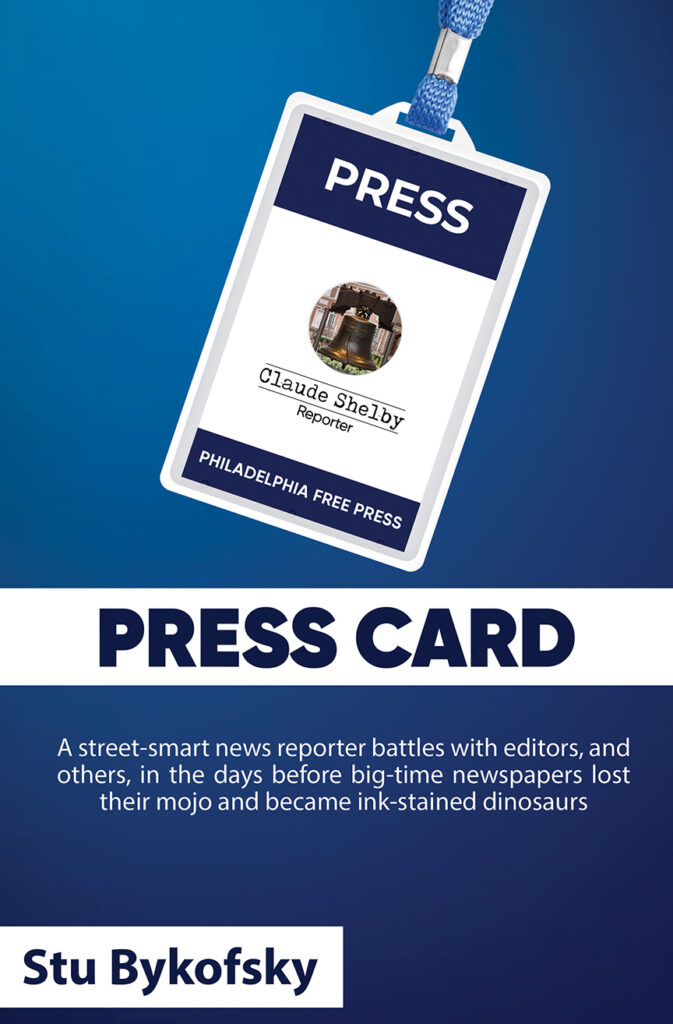
Stu Bykofsky described Press Card on his website, STU BYKOFSKY - Reality determines my political positions, not vice versa : 

Did you ever have a bad boss? Sure, you have.

Did you ever do anything about him (or her)?

Probably not.

Claude Shelby does.

He’s a straight-talking, wisecracking, street-savvy reporter who doesn’t like his bosses -- and they don’t like him.

That conflict provides the framework for Press Card, which is funny, sad, poetic, obscene, sexy, and knowing.

Following his demotion for cutting corners to get a political story, Shelby struggles with his bosses, and with what his job sometimes requires him to do. 

When he’s at his lowest point and floating aimlessly, he stumbles into clues that could lead him to the biggest story of his life -- finding fugitive Black revolutionary Sister Sojourner.

He chases the leads he digs out all the way to St. Lucia in the Caribbean, where he receives help from an unexpected source in a skintight dress.

In this picaresque novel, Claude Shelby interacts with memorable characters: a rags-to-riches millionaire, a close friend who regrets quitting journalism for the big bucks of P.R., the Philadelphia artist who designs neon tube clothing accessories that double as dildos, and a predatory female reporter.

Press Card takes readers inside the Fourth Estate and reveals how some newspapers make decisions. It unmasks power plays between union and management, and reporters’ tricks.

It is fiction based on fact.

Press Card crackles like a police radio and rolls as fast as the presses that print the fictional Philadelphia Free Press.

I reached out to Stu Bykofsky and asked him about Press Card. 

Davis: Why did you write Press Card? 

Bykofsky: Two reasons. 1- A personal challenge to myself to see if I could write something that long. “Cats Are Supermodels” was a decade earlier, nonfiction, and about 20% as long as “Press Card.” 2- Wanted revenge on some editors.  

Davis: How would you describe the novel? 

Bykofsky: I call it “faction” -- fact wrapped in fiction. It pulls back the curtains on how print really works, in a fast-paced, humorous manner.  

Davis: Is Claude Shelby in any way autobiographical? 

Bykofsky: Claude Shelby is not Stu Bykofsky, but some of Stu Bykofsky is in Claude Shelby. Claude is somewhat anti-union; Stu is very pro-union. Shelby chews gum, Stu never had, and Stu was never a political reporter. 

Davis: Is the Philadelphia Free Press based on the Daily News or the Inquirer? 

Bykofsky: The Free Press is a tabloid, like the News, and, honestly, the novel is a roman a clef, using the News as a template. You know the adage -- write what you know.

Davis: Are the other characters, especially the editors, based on real people? 

Bykofsky: Some yes, some no. Some are complete inventions; other characters are borrowed from people I know. When inventing a character, I picture someone I know. It helps with the physical descriptions and helps me keep them separate. 

Davis: Did you cover any of the stories that Shelby covered in the novel? 

Bykofsky: I was working the desk the night a tanker exploded in the Delaware. That’s the chapter called Fire on the Water. I actually had a lead on Patty Hearst, through a friend, but the trail went cold fast. As to the suicide of a TV anchor, that was loosely based on Bud Dwyer, but I did not cover that. I was a TV critic for five years and will say the TV reporter Howard Scott was based on WPVI’s Marc Howard.  

Davis: Why do newspapers cover crime stories so prominently? 

Bykofsky: They don’t anymore -- and that is intentional. The “Woke” element in newsrooms have decided coverage of crime is racist. If you give it a moment's thought, you can imagine why.  

Davis: What made you want to go into newspaper journalism?  

Bykofsky: I started by joining the college newspaper at Brooklyn College (night school), because I didn’t like fraternities and it was one club that had girls, where everyone drank and cursed and smoked. It turned out writing was a gift -- I could do it easily and I figured it would be a good career. Not a lot of money, but a lot of fun. My intuition was correct. And the editor of its college paper got me my first professional job at The World-Telegram & The Sun in NYC in 1959. I retired 60 years later. 

Davis: Was anyone in particular a major influence? 

Bykofsky: The aforementioned college editor, Gordon Lattey -- still a friend. Got me the job at the Telegram, and later got me a freelance job with a travel magazine he edited, which opened the door to world travel -- with someone else paying the bill. I have been everywhere from Antigua to Yugoslavia, something that would have been completely impossible for someone like me who grew up in the projects. 

Davis: How are newspapers today different today from the 1970s, the era portrayed in Press Card

Bykofsky: I hate to generalize, but they seem to be run by people guided more by their politics than by news values. 

Davis: What do you see for the future of newspapers? 

Bykofsky: In print -- none, and that is really sad. I see them each becoming silos, catering to the perceived biases of their readers. I can’t be specific because I signed a NDA (Non-Disclosure Agreement) with the Inquirer, which I am suing for defamation. 

Davis: Do you have a favorite book, novel or play about newspapers? 

Bykofsky: Citizen Hearst, although only indirectly about newspapers. And The Front Page, of course, for sheer fun. 

Davis: Do you have a favorite film or TV series about newspapers? 

Bykofsky: There was an OLD series, maybe the ‘50s, called The Big Story, something like that, that was sort of a documentary recreation. I also strongly like Absence of Malice, although it is slightly off-kilter about libel law. But Paul Newman and Sally Field -- what’s not to like? 

Davis: How would you describe your career as a newspaperman and columnist?  

Bykofsky: Pleasure. The bad days were few, and I got to travel the world, and rub elbows with celebrities and politicians. (I don’t really like celebrities, but they make good fodder for story telling). Unfortunately, I now have forgotten most of the stories. Importantly, at stages in my career I was able to help people who needed it, and kick the asses of politicians, who also needed it. 

Davis: Do you plan to write another novel? 

Bykofsky: The first one took almost 40 years. I am 80. And I write a very active blog, so there’s no time. 

Davis: Good luck with the novel.

Note: You can read Stu Bykofsky's bio via the below link:

Stu Bykofsky | Columnist & Author | About (presscardthebook.com)

And you can purchase Press Card via the below link:  

  Www.PressCardTheBook.com


Tuesday, July 20, 2021

‘A Laughing Jury Never Convicts': Charles Peruto Wants To Bring His Unique Style To The Philly D.A.’s Office


Stu Bykofsky offers a good piece on Chuck Peruto, a well-known lawyer and Republican candidate for Philadelphia District Attorney at Philadelphia Weekly.

The man who wants to be your district attorney is willing to take a break from his 42-year career as one of Philadelphia’s best known and most successful defense attorneys.

His father, A. Charles Peruto, was a Philadelphia legal legend up until his death in 2013, a defense attorney famed for using folksy warmth to seduce juries into seeing things his way. Chuck’s tactic is to entertain. “A laughing jury never convicts,” he says seriously. In court, he is The Entertainer.

In one memorable case, he defended a county detective charged with beating his girlfriend, who happened to be a judge.

She claimed he had beaten her, but instead of calling 911, she first called a police captain friend of hers who rushed over to her apartment, to stage the scene, Peruto told the jury.

The judge then called 911, claimed to be in death throes and slipped unconscious to the floor at the conclusion of the call.

Peruto acted out her testimony, winding up on the floor, in mock unconsciousness, splitting his pants. The jury roared with laughter – and did not convict.

Behind closed doors, many of his colleagues say that Peruto is a hot dog, a term he would relish.

You can read the rest of the piece via the below link:

‘A laughing jury never convicts’ - Philadelphia Weekly

You can also read my Philadelphia Weekly Crime Beat columns on Chuck Peruto via the below links:

Paul Davis On Crime: 'I'm Going To Kick Krasner's Ass': My Philadelphia Weekly 'Crime Beat' Column On Chuck Peruto's Run For Philadelphia District Attorney

Paul Davis On Crime: Peruto Means Business: Part Two Of My Philadelphia Weekly 'Crime Beat' Column On Chuck Peruto's Run For Philly DA 

Wednesday, March 17, 2021

Stu Bykofsky Covers Ralph Cipriano: Attacking Hypocrisy: “This Is What I Do”

Stu Bykofsky, a former Philadelphia Inquirer columnist-turned blogger, offers a profile of Ralph Cipriano, a former Philadelphia Inquirer reporter-turned blogger, at stubykofsky.com  

If you are a profligate prelate, a prosecuting-shirking D.A., or an editor with loose lips, the last person you want on your case is Ralph Cipriano, an old-fashioned ball buster.  

The 67-year-old lapsed liberal and unlapsed Catholic has more scalps on his belt than an Apache war party. 

I know that Native American imagery will awake the woke. 

Ralph doesn’t care, and I don’t care. 

Disdain for ubiquitous Political Correctness is one thing we have in common. 

He was the first Philadelphia Inquirer reporter to sue the paper for libel, in 1998. 

In his footsteps, I am suing the paper for defamation, but my attorney, Mark Schwartz, says I am not free to comment on the suit. 

In Ralph’s case, an editor of the paper said Ralph’s reporting was “untrustworthy.” That could be a career-killer, and, it was untrue. 

In brief, the controversy’s roots were planted when Inquirer City Editor Robert Rosenthal recruited Ralph, a self-described “fallen Catholic,” to become the paper’s religion writer.

Ralph had arrived four years earlier from the Los Angeles Times, where he covered local government and exposed police brutality. Ralph was one of the breed of newspaper vagabonds, moving from one paper to the next.  

His first job at a daily was with the Meriden Record-Journal, not far from his hometown of Waterbury, Conn. He then did a couple of years at the Albany Times-Union, before heading to L.A. 

… Ralph was hired in 2004 by Jim Beasley, who had sued Ralph’s employer, to help write his autobiography, which became a biography after his death. Ralph also covered trials for a legal-oriented website called TheBeasleyFirm.com. “They were paying me, it was great,” says Ralph. 

Then a second website was launched — BigTrial.net.  

Over time, Beasley bailed, but Ralph kept it. 

BigTrial.net is avidly read by cops, lawyers, and some journalists. His top number of hits was 94,000, typical might be around 50,000. 

Like StuBykofsky.com, there is no advertising, no charge to readers. He says it’s an expensive hobby. (His other hobby, which he jokes is “downwardly mobile,” is wine-making, an ethnic throwback to his Italian grandfather. His mother is Lebanese.)  

So why run BigTrial.net? 

He thought about bagging the website a couple of times, he told me as we sat at the table in his airy, modern kitchen.  

Then Larry Krasner was elected D.A. 

The reporter who had gone after brutal cops in L.A., suddenly turned into the city’s most ferocious critic of the man nicknamed “Let ‘Em Loose Larry,” the former anti-cop defense attorney who is George Soros’ fair-haired boy in Philadelphia. 

Why did he go after Krasner? 

Because no one else did, notably the Inquirer, he says. 

You can read the rest of the piece via the below link: 

https://stubykofsky.com/attacking-hypocrisy-this-is-what-i-do/

You can also read my Philadelphia Weekly Crime Beat column on Ralph Cipriano via the below pages and link:

 Paul Davis On Crime: Philly's Wreak-It Ralph: My Philadelphia Weekly 'Crime Beat' Column On Ralph Cipriano's Journalistic Assault On The Mayor, DA, Police Commissioner And The Philadelphia Inquirer 

Friday, March 12, 2021

Stu Bykofsky: 'Thumbsucking' Philadelphia Mayor 'Are' Making A Statement

 Stu Bykofsky takes a shot at the progressive Philadelphia mayor. 

Mayor Kenney is losing it. 

A sad announcement mourning a life lost was turned into progressive parody by the mayor’s office.

Here’s the first paragraph with my edits: 

“Once again our city has been rocked by senseless gun violence. Tonight, we tragically lost a 15-year-old who had their entire life ahead of them. I extend my deepest condolences to their family during this unimaginable time. The lives of at least two other teenage victims will also never be the same, as they now have to recover from gunshot wounds that ravaged their young bodies, and face the long-term impacts of experiencing this trauma.” 

In reality, the dead victim was a 15-year-old boy who had his  entire life in front of him. And he, not them, of him,  had a family, which mourns. 

Now — a small percentage of you may be thinking, well, maybe they were nonbinary and thought of himself as they. 

In that case, did Kenney have their families’ permission to out their son offspring?

Naw, you know what? It’s just our thumbsucking mayor taking gender neutering to ridiculous lengths. 

You can read the rest of the piece via the below link:

https://stubykofsky.com/the-mayor-are-making-a-statement/ 

Monday, January 25, 2021

Stu Bykofsky: "Sour-Faced" Gov. Kenney? Sen. Kenney?

I interviewed Philadelphia Mayor Jim Kenney some years ago when he was a city councilman and I was a columnist for a South Philly weekly newspaper. I agree with former Philadelphia Daily News columnist Stu Bykofsky - he was a different man then. 

Stu Bykofsky offers his take on the “sour-faced” Philly mayor on his website:    

This is the kind of person he is. 

When running for reelection in 2019, Mayor Jim Kenney refused to debate Republican candidate Billy Ciangalini, basically sticking his thumb in the eye of critics who said he owed the concept of democracy a little show. In a city that hasn’t elected a Republican mayor in more than 70 years, he wasn’t in much danger from Ciangalini, who ran a barely there campaign. Kenney showed his contempt for political process. 

Please, God, spare me from this job. 

And now rumors circulate that he may be interested in running for governor or U.S. Senate. I wonder a) why, and b) how can he possibly win? 

I think Kenney ran for a second term because he didn’t have anything better to do. He ran for mayor in the first place on an impulse, when someone else dropped out, and, like a dog chasing a car, didn’t know what to do when he caught it. 

I don’t think highly of him as a politician now — I was a big fan when he was a Councilman concerned with quality of life issues. I also don’t think much of him as a man — having turned his back on his wife, Maureen, his mentor, former State Sen. Vince Fumo, even members of the Jokers Mummers club, where he spent a couple of happy decades before he went to progressive reeducation camp, and learned his former friends were low-life racists. 

He’s become a different man today, and seemingly not happy with what he has become. 

Don’t take my word for it. Listen to fellow progressive Larry Platt, editor of the Public Citizen:

“Even before a once-in-a-lifetime plague and a racial conflagration rocked our city, Philadelphia had the dubious distinction of having America’s most sour-faced mayor,” Platt wrote. 

You can read the rest of the post via the below link:

https://stubykofsky.com/gov-kenney-sen-kenney/ 

Wednesday, January 6, 2021

Stu Bykofsky: The Truth Behind Reporters’ Sources

Former Philadelphia Inquirer and Daily News columnist Stu Bykofsky explains journalism news sources in a post on stubykofsky.com. 

One thing the Main Stream Media rightfully gets criticized for is the use of anonymous sources. If you want a better understanding of journalism, here’s an explanation of sourcing. 

Sources are those who provide information to reporters for news stories. If you think about it, most news stories are built on platforms of information provided by sources. 

Reporters may initiate stories, but they are dependent on sources to provide data, detail, and fact. 

Sources are frequently the government — information shared by everything from the Census, to the Department of Revenue, to State, Defense, HUD, Education, and so on. 

In addition to the government, reporters receive information from think tanks, industry groups, political organizations, universities, scholars, scientists, unions, various experts, and so on. It’s a long list. 

None of this information should be accepted without question, but it often is. In most cases, organizations like those I mentioned, or their executives or spokespeople, are willing to be quoted by name.  

Why use these sources? Because reporters are trained to get information from authority, which makes sense (although authority sometimes has reason to shade the truth).  

A source willing to be quoted by name, and thereby willing to face any argument or challenge, is more believable than one that refuses to be identified.  

Back in the ‘50s, most people were willing to be quoted by name, and not just because the media was more highly regarded then. Times were different, simpler. 

Starting in the ‘60s, I believe things began to change as a direct result of a loss of trust in government and other institutions.  

… Here’s what these terms generally mean.  

On the record means the information can be directly quoted, and the name and title of the person providing it can be used. 

Off the record means the information can’t be used, it is only for the edification of the person hearing it. Some people — including some journalists — confuse it with 

Not for attribution, which means the information can be used, but the person providing it can’t be named. You see this all the time when you read, “A high government official says that….” or “A Department of Revenue spokesman said…”

… On background provides information on a situation for the journalist, who uses the background details to help him or her construct a deeper story in his or her own words. 

… Journalism is an occupation where practitioners will happily cast out the bad apples.

Real journalists hate “fake news” even more than you do.  

You can read the rest of the piece via the below link:  

https://stubykofsky.com/the-truth-behind-reporters-sources/ 

Wednesday, March 27, 2019

From Highway Patrol Cop To Crime Beat Reporter, Thomas J. Gibbons Was An Ace


I first met Thomas J. Gibbons Jr briefly at a crime conference some years ago. He was covering the conference for the Philadelphia Inquirer and I was covering the event for a South Philadelphia weekly newspaper. I saw him again later a couple of times after I became a contributor to the Philadelphia Inquirer. 

He was, as Stu Bykofsky (seen in the bottom photo) describes him in his Philadelphia Inquirer and Daily News column, unfailingly friendly. 

Stu Bykofsky offers a good column on the late Thomas J. Gibbons Jr, (seen in the above and middle photo), who went from a Philadelphia Highway Patrol Officer to a crime reporter..

Duty first.

A ceremony scheduled for Tuesday at which a gleaming, loaded Harley-Davidson was to be presented to the Philadelphia Highway Patrol was postponed when the elite unit was reassigned to escort the funeral procession for firefighter Michael Bernstein, who died last Wednesday while on duty.

The motorcycle was to have been presented in memory of Thomas J. Gibbons Jr., who served four years in Highway Patrol until he was critically wounded in a 1970 ambush.

Physically unable to return to active duty, in 1972 Tommy went to the Evening Bulletin as a police reporter. The Inquirer lured him away in November 1981, two months before the Bulletin folded.

By the time Tommy retired in 2005, he was one of the most popular journalists in the city, loved by colleagues and competitors alike. He was unfailingly friendly to everyone, and dressed better than anyone.

He enjoyed his career as a reporter, but nothing meant more to him than his years in the Highway Patrol, says his widow, Carol. They had been married 47 years when Tommy died of brain cancer a year ago. 

You can read the rest of the column via the below link:

https://www.philly.com/opinion/stu-bykofsky-tommy-gibbons-police-highway-patrol-maureen-rush-sylvester-johnson-inquirer-temple-university-20190326.html


You can also read Thomas Gibbons Philadelphia Inquirer obituary via the below link:

https://www.philly.com/philly/obituaries/thomas-j-gibbons-jr-73-elite-highway-patrolman-and-later-a-crime-reporter-for-the-inquirer-20180316.html 


Wednesday, May 24, 2017

A Tale Of Two Buildings: The Philadelphia Police Department Is Moving From The 'Roundhouse' To The Old Inquirer Building


In the news today is the plan to move Philadelphia Police Headquarters from the "Roundhouse" (seen in the above photo) to the building that once housed the the Philadelphia Inquirer and Daily News (seen in the below photo).

I have a personal attachment to both buildings.


I've been a been a contributor to the Inquirer and the Daily News since 1997 and I often visited the Inquirer Building at 400 N. Broad Street. I recall when the two newspapers were powerhouses and a mainstay of Philadelphia life. The tall, white building that housed the two newspapers was an iconic and instantly recognized symbol of Philadelphia journalism.

The downsized newspapers and Philly.com moved from the Inquirer Building in 2011 and sold the building as an economic move. The Inquirer, Daily News and Philly.com then took up residence at the offices of the old Strawbridge & Clothier department store at 8th and Market Street.

As a writer I was also a frequent visitor to the Philadelphia Administration Building (called the Roundhouse) at 750 Race Street. Over the years I visited the Roundhouse and interviewed several commissioners, deputy commissioners, inspectors, homicide detectives, and many other police officers.

The Roundhouse, so named because of the building's curved structure (some say it looks like a pair of handcuffs from the sky), is an old, cramped and beat up place. The cops need and deserve a better headquarters, although I'll miss visiting the old building after the proposed 2020 move. (I'm not sure the police who work there every day feel quite the same way).

The Inquirer Building is also old and a bit rundown, but I suppose it is a step up from the Roundhouse.

The small irony of the move is the Inquirer and Daily News had and have something of an adversarial relationship with the Philadelphia Police. So the cops moving into the old Inquirer Building is perhaps akin to allied military forces moving into German military headquarters in Berlin at the end of WWII.

You can read Jake Adelman's Philadelphia Inquirer piece on the move via the below link:

http://www.philly.com/philly/news/pennsylvania/philadelphia/philly-police-department-hq-to-move-into-former-inquirer-daily-news-building-on-n-broad-20170524.html

And you can read Philadelphia Daily News columnist Stu Bykofsky's take on the move via the below link:

http://www.philly.com/philly/columnists/stu_bykofsky/Cops-should-enjoy-being-in-the-Tower-of-Truth.html

Tuesday, May 24, 2016

Apologize For Hiroshima? Hell, No!


My late father was an Underwater Demolition Team (UDT) frogman during World War II. The UDT combat swimmers cleared the way for the U.S. Marines to take the Pacific islands back from the Imperial Japanese.

I recall him telling me about an intelligence briefing where the UDT men were advised that the losses they would sustain during the planned invasion of mainland Japan would be catastrophic.

The deaths of millions of U.S. military men, as well as Japanese military men and Japanese civilians, was avoided due to the dropping of atomic bombs on the cities of Hiroshima and Nagasaki.

It took the devastation of this weapon to finally force the proud Japanese to surrender unconditionally.      

I believe it would be a disgrace if President Obama apologizes for the U.S. dropping of an atomic bomb on Hiroshima when he visits the city.

It would be an insult to the men who died during the war, which Imperial Japan began with their sneak attack on Pearl Harbor.

It would also be an insult to the men who survived the war, like my father.  

Stu Bykofsky, a columnist for the Philadelphia Daily News offers his take on the presidential visit to Hiroshima.

THESE ARE THE remarks I would like to hear from President Obama when he visits Hiroshima on Friday:
We gather in this place draped in death and sorrow to respectfully remember those who perished here almost 70 years ago.
Speaking for the United States, we have regrets.
We regret that, 75 years ago this December, Japan killed more than 2,400 Americans in an unprovoked attack against the United States in Hawaii. That's my home.
I regret that the United States was pushed into a war we did not seek and for which we were militarily unprepared.
We believed, correctly, that it was a war between our freedom and your tyranny and butchery.
You can read the rest of the column via the below link:

http://www.philly.com/philly/columnists/stu_bykofsky/20160524_Byko__Apologize_for_Hiroshima__Hell__no_.html